O’Neill’s Death1616 CE
In 1616, Ireland remained shaped by the settlement following the Nine Years’ War despite the absence of nationwide warfare. Hugh O’Neill’s death in Rome on 20 July marked the passing of a figure in resistance and exile. A new royal governor and confrontation in Waterford illuminated continuing disputes over government, religion and civic authority. Ireland’s political life connected Dublin with Rome, London, Spain and Scotland, rather than operating within isolated borders. Conquest had altered the institutions through which allegiance and land were contested without settling those questions. The year demonstrates the persistence of uncertainty within an increasingly organised royal kingdom.
Dateline
In 1616 Ireland was not at war, yet it was still being remade by the settlement that followed the Nine Years’ War. The disappearance of one old leader, the arrival of a new royal governor, and a civic confrontation in Waterford make the year unusually revealing. They show an Ireland governed from Dublin in the name of James I, but connected also to Rome, London, Spain, the Scottish west coast and the English border counties. They show, too, that conquest had not made questions of land, religion or political allegiance disappear. It had changed the institutions through which those questions were fought.
A Death Securely Dated
The clearest Irish event of the year occurred far from Ireland. On 20 July 1616 Hugh O’Neill, second earl of Tyrone and the most formidable Irish lord of the previous generation, died in Rome. The date is firmly recorded in the Annals of the Four Masters. For contemporaries in the Irish Catholic world, his death marked the end of a life that had moved between accommodation with the crown, regional lordship, open rebellion and exile. For the Dublin administration, it removed a figure whose name still carried immense political weight, even though he had been absent from Ireland since the Flight of the Earls in 1607.
O’Neill had been the central leader of the resistance to English rule in the Nine Years’ War. After surrendering to the crown in 1603, he retained his title and much of his standing for a time, but his departure from Rathmullan with Ruaidhrí O’Donnell, earl of Tyrconnell, helped to create the political and legal circumstances in which the crown claimed vast Ulster estates. By 1616 those claims had already been translated into the Plantation of Ulster. O’Neill’s death did not cause that transformation, and it should not be presented as the instant end of Gaelic political life. It did, however, remove the exiled lord most capable of personifying a recovered Tyrone.
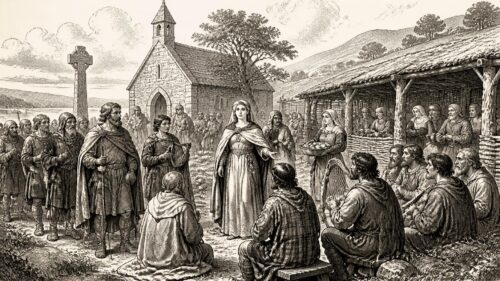
The setting of his burial carried its own meaning. He was interred at San Pietro in Montorio on Rome’s Janiculum, where members of the O’Donnell and O’Neill exile communities were also commemorated. Spanish diplomatic money met the funeral costs, but surviving evidence suggests that the occasion was kept politically restrained: Madrid did not want a display that might damage relations with James I. The modesty of the grave’s original inscription is therefore as significant as the place itself. Rome preserved an Irish Catholic community in exile, but it was no longer an obvious launching place for a renewed war in Ireland.
The Annals of the Four Masters, compiled later in the seventeenth century, gave O’Neill a magnificent Gaelic memorial. They praised his learning, lordship, martial capacity and defence of religion and patrimony, while regretting that he lay far from the ancestral burial place at Armagh. That testimony is not a neutral governmental record, nor does it supply a complete picture of his career. It does, however, preserve the political memory through which many Irish readers understood his death: not as the fading of an obscure refugee, but as the passing of “the O’Neill”.
A New Deputy at St Patrick’s
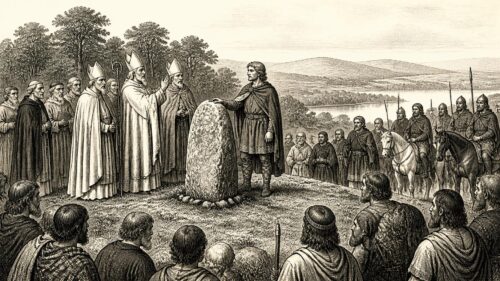
Power in Ireland was also visibly transferred in 1616. Arthur Chichester, lord deputy since 1605, had been removed from the deputyship in late 1615, though he remained an important figure and was soon made lord treasurer of Ireland. On 2 July 1616 Sir Oliver St John was appointed lord deputy. The succession was more than a change of personnel. Chichester’s long administration had overseen the post-war settlement, the Ulster Plantation and the contentious parliament of 1613–15. St John arrived amid changing court patronage, with the rising George Villiers among those connected to his advancement.
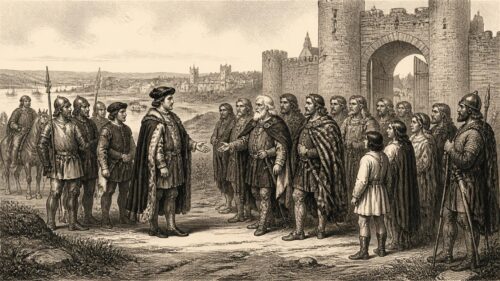
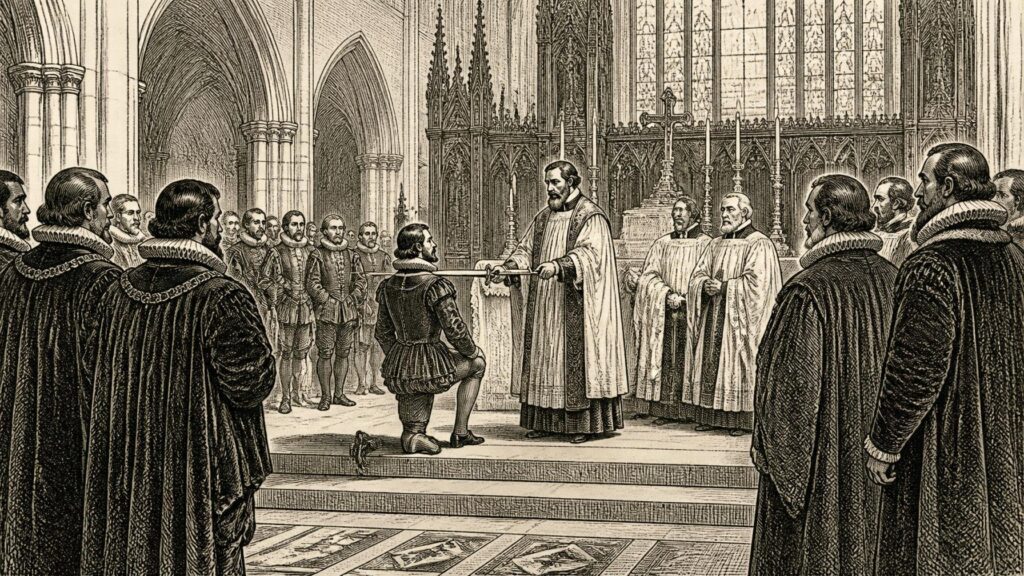
The ceremony was precisely recorded. St John landed at Skerries on 26 August. On Friday 30 August, after a sermon by James Ussher at St Patrick’s Cathedral in Dublin, he presented his letters patent, took the oath of supremacy and the oath of office, and received the king’s sword from the Lords Justices. Chichester, now lord treasurer, was among the councillors present. The service made the constitutional point unmistakable: the deputy governed as the monarch’s representative, under a Protestant ecclesiastical settlement, with civil authority symbolised by the sword.
It would be misleading to load all the later features of St John’s administration into the last months of 1616. The harsher policies for recusants and later plantation projects were not completed events of that year. Nevertheless, his appointment mattered immediately because it placed a man associated with revenue reform, land administration and a more assertive view of conformity at the head of government. The state’s principal difficulties were not hidden: finance, local office-holding, land title and the refusal of many Catholic elites to accept the religious tests required by the crown.
Waterford’s Civic Deadlock
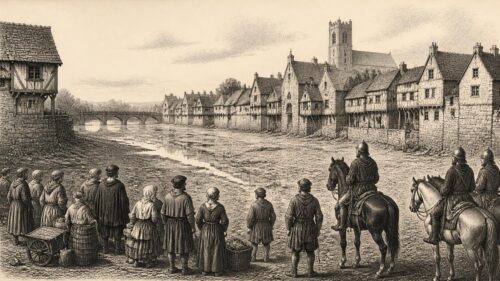
Waterford gives the year its most detailed local story. The city was an important Atlantic port with a politically confident corporation. Its crisis concerned an apparently procedural requirement with far-reaching consequences: the Oath of Supremacy, by which office-holders acknowledged the king’s supremacy in ecclesiastical matters. To refuse it was to be treated by government as a recusant; to take it could be understood by Catholics as a betrayal of religious obligation. This was not merely a private matter of conscience. It determined whether a town could appoint a mayor, sheriffs and officers capable of administering justice.
On 23 April 1616, a gaol delivery was held with the acting mayor and sheriffs assisted by Richard Wadding, temporarily acting as recorder. The unusual arrangement pointed to the difficulties created by the lack of a regular recorder after the previous year’s death of Sir Nicholas Walshe. On 27 May the aldermen elected Alexander Cuffe as mayor. When the lord chancellor, Archbishop Roger Jones, tendered the oath on 8 July, Cuffe refused to acknowledge James’s ecclesiastical supremacy and was deposed. John Browne, elected in his place, and the newly chosen sheriffs, William Lincoln and Paul Sherlock, likewise refused and were removed.
The impasse continued. John Joy, an elderly Scottish-born candidate, was rejected as an alien. Sir Richard Aylward, a committed Protestant selected in October, was refused on grounds of age and infirmity. In December the corporation elected Maurice Power of Adamstown, whom the authorities also rejected. The sequence was not a simple tale of a united city against an outside state: individual candidates, civic factions and legal technicalities all mattered. Yet the larger collision is plain. Waterford’s governing class repeatedly put forward men who would not, or could not, satisfy the religious requirement; the Dublin government repeatedly withheld recognition.
Everyday consequences followed from this constitutional stalemate. A corporate town needed accepted magistrates for courts, prisons, markets, municipal finance and dealings with crown officials. Later accounts stressed that the shortage of magistrates endangered the regular administration of criminal justice. Waterford’s case also warned other towns that royal government could turn the legal machinery of charters, offices and oaths into instruments of religious pressure. St John would identify the resistance of municipal elites as a central problem in Irish government before the year was out.
An Unfinished Ulster
Elsewhere, the most consequential change was not a single 1616 proclamation but the continued making of plantation society in Ulster. The formal scheme of 1610 had divided confiscated land in Armagh, Cavan, Donegal, Fermanagh, Londonderry and Tyrone among English and Scottish undertakers, military servitors, the London companies in Londonderry, and a category of “deserving” Irish grantees. Its intended landscape included demarcated estates, fortified houses or bawns, new tenants, market centres and Protestant institutions.
By 1616 this was a lived but incomplete transformation. Roads, buildings, leases and new neighbourhoods altered some districts, while older Irish communities remained numerous and indispensable to the local economy. The very need for official inspections demonstrates that implementation was uneven. Sir Josias Bodley’s survey of 1613 had found reason for concern over progress; Nicholas Pynnar’s more detailed survey belongs to 1618–19 and cannot simply be treated as a snapshot of 1616. It does, however, confirm that the plantation was still a developing project, measured estate by estate in buildings, tenants and cultivation.
The death of Hugh O’Neill sharpened the contrast between this emerging Ulster and the world that had preceded it. His old lordship was no longer governed from Dungannon by an O’Neill earl. Yet neither were the new arrangements secure simply because they had been legally decreed. Landholding, labour, language, worship and local authority remained contested. In 1616 the settlement’s long-term consequences were already visible, but its eventual shape was not settled.
Religion, Memory and Restraint
Religion linked the year’s apparently separate episodes. O’Neill’s Roman burial represented a Catholic exile community sustained within continental Europe. St John’s installation at St Patrick’s placed royal office inside the Church of Ireland’s constitutional order. Waterford showed how the Oath of Supremacy could turn that difference into a practical crisis of civic government. Catholic worship and clerical networks endured widely, while the established church possessed the backing of the state; neither fact meant that religious allegiance mapped neatly onto ethnicity, language or loyalty in every locality.
For that reason, 1616 is best understood neither as an empty interval after war nor as a year of sudden revolution. It was a year of markers. In Rome, an exiled earl was buried with restrained diplomatic ceremony. In Dublin, a deputy received the king’s sword after an Anglican sermon. In Waterford, offices stood vacant or disputed because conscience and royal authority could not be reconciled. Across Ulster, settlement proceeded in uneven, material steps. Together, those developments show a kingdom being consolidated, but not yet reconciled.

Primary Sources
- Annals of the Four Masters: Annal M1616
- Annals of the Four Masters: Irish Text
- O'Neill, Hugh
- St John, Oliver
- Chichester, Arthur
- Calendar of the State Papers Relating to Ireland, 1615–1625
- Calendar of the State Papers Relating to Ireland of the Reign of James I, 1603–1625
- State Papers Ireland 1509–1782: Government Papers on Irish Affairs
- Add MS 4756: Oliver St John, Lord Deputy of Ireland
- San Pietro in Montorio, Burial-Place of the Exiled Irish in Rome, 1608–1623
- The Exilic Burial Place of a Gaelic Irish Community at San Pietro in Montorio, Rome
- Waterford Corporation and Religious Conflict in the Early Seventeenth Century
- Ireland Under the Stuarts and During the Interregnum
- Ulster Plantation: Sources
- Ulster Plantation: Movement of British Settlers
- Ulster Plantation: Plantation Archaeology
- Plantations in Ulster, 1600–41
- The Bible and the Bawn: An Ulster Planter Inventorised
- The Selection of the English Undertakers in the Ulster Plantation, 1609–10
- Protestant Military Humanism in Early Stuart Ireland
- A Chronology of Irish History