

Offerlane’s Crown Inquest1621 CE
In 1621, Ireland remained unsettled despite the absence of war, as Crown policies on land, religion, revenue and loyalty generated grievances. Parliamentary criticism of Deputy Oliver St John, together with the Pale gentry’s petition, prompted investigations leading towards the Commission of 1622. Plantation patents and the Crown inquest asserting title to Upper Ossory, including Offerlane, extended ambitions beyond Ulster. Preparations to inspect the Ulster Plantation exposed doubts about settlement and administration. James Ussher’s advancement to Meath symbolised strengthened Protestant authority amid Catholicism. Galway’s detention of a privateering vessel revealed Atlantic diplomatic entanglements, while reports of starlings reflected contemporary providential anxieties.
Dateline
In 1621 Ireland was not at war, yet it was far from settled. The Nine Years’ War was almost two decades past and the great Ulster Plantation was well under way, but the Jacobean state remained anxious about land, religion, revenue and loyalty. That anxiety sharpened markedly during the year. Decisions made in London and Dublin did not always produce immediate change on the ground, but they exposed the pressures affecting Irish communities: Catholic landowners facing an increasingly intrusive administration; tenants and older local interests confronting plantation schemes; Protestant officials concerned that reform was incomplete; and merchants whose ports were tied into an Atlantic world of commerce and conflict.
The most consequential development was therefore not a battle but a gathering investigation. Complaints about government in Ireland, heard amid the political storms of the English parliament, helped set in motion the review that would become the Irish Commission of 1622. The commission itself belongs to the following year; its origins, however, lie firmly in 1621. Its eventual enquiries into plantations, courts, finance, the established church and administration would offer an unusually detailed view of a kingdom being remade by Crown policy.
A Government Under Scrutiny
James I was king of Ireland as well as England and Scotland, but government was exercised through Dublin Castle. The lord deputy in 1621 was Sir Oliver St John, a hard-driving official whose policies joined the extension of English common law, the reinforcement of Protestant institutions and the enlargement of royal revenue. On 3 January he was created Viscount Grandison of Limerick, an honour that signalled continued royal favour. Yet favour did not protect the Irish administration from criticism.
On 26 April, Sir John Jephson, an Irish privy councillor and Munster planter sitting in the English House of Commons, attacked St John’s administration. He portrayed Ireland as discontented because of accumulated local oppressions and urged an enquiry. His immediate proposal did not prevail, but it connected Irish grievances to wider English fears about corruption, royal patronage and the influence of George Villiers, marquess of Buckingham. Ireland was becoming an issue in a parliamentary confrontation centred elsewhere, an important reminder that the country’s political affairs were inseparable from the politics of the three Stuart kingdoms.
At about the same time, the nobility and gentry of the Pale presented a substantial petition of grievances to the lord deputy. The surviving description of the petition is clearer about its collective authorship than about every individual complaint: it came from the Catholic, Old English landed elite of the region around Dublin. That alone mattered. These were not outsiders to the political system; they were men with estates, local standing and long experience of royal law. Their petition demonstrated that dissatisfaction with the manner of government could be voiced through formal channels, even where confessional distrust limited its effect.
London responded first with paperwork. On 28 May an ad hoc group of Irish officials in England was appointed to consider the complaints. It produced a report on 16 June, after which the privy council issued directions for immediate action. A proposed settlement with Ulster undertakers—colonists who had received land on condition that they build, settle British tenants and provide security—came before the council on 27 July. It was rejected in favour of a wider inspection of plantations and government. On 10 August James issued a warrant clearing St John personally of blame, but the underlying decision remained: Ireland required a searching review. By 21 November the intention to mount a major investigation had been announced in the English parliament.
Offerlane and the Midland Frontier
Land lay at the heart of these concerns. In January, patents were granted for plantation projects in Leitrim, King’s County, Queen’s County and Westmeath. These were not all identical schemes, nor did a patent instantly transform a landscape. They did, however, show that plantation was no longer only an Ulster project. The Crown continued to seek legally defensible titles, reliable rents and loyal landholders in the midlands and west as well as in the north.
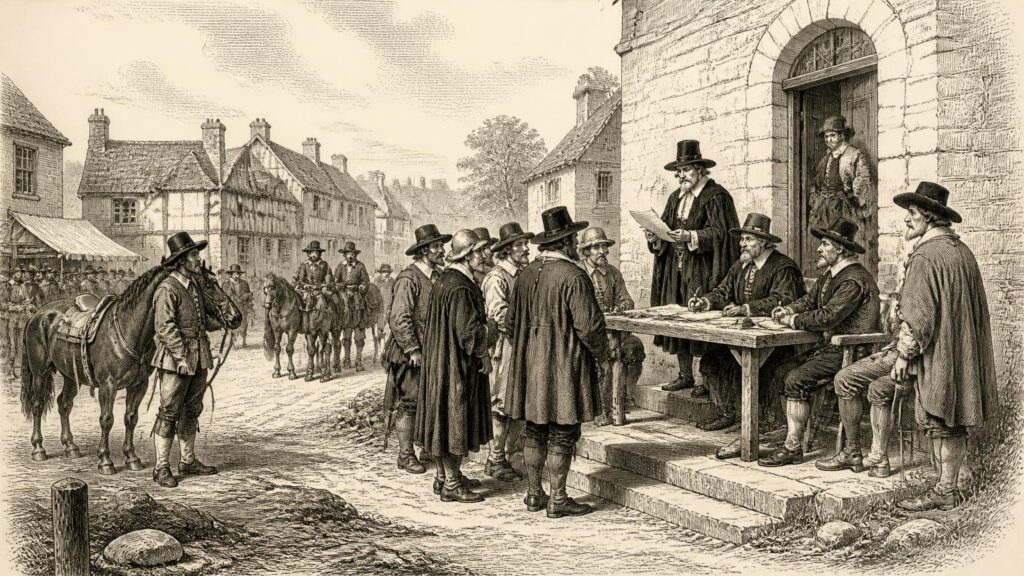
Upper Ossory, in what is now County Laois, illustrates the process. During 1621 an inquisition at Maryborough, now Portlaoise, found for the Crown’s claim to the lordship of Upper Ossory, including Offerlane. The finding drew upon the tangled consequences of the Tudor surrender-and-regrant settlement with the Fitzpatrick lords. In later years this title would facilitate plantation and dispossession, but it is important not to project that later outcome backwards: 1621 was the year of the Crown’s legal assertion, not the completed plantation of the district.
Such inquiries turned ancestry, inheritance and local jurisdiction into instruments of conquest. To officials, they offered a means to regularise title and increase revenue. To families rooted in these places, they threatened security even where they possessed royal grants or had adapted to English law. The process helps explain why arguments over juries, courts and patents carried such force. Land was livelihood, status and political influence; it was also the foundation on which the Crown hoped to construct a more controllable Ireland.
Ulster’s Unfinished Plantation
Ulster remained the largest and most conspicuous plantation experiment. Since 1609, land in Armagh, Cavan, Donegal, Fermanagh, Tyrone and the new county of Londonderry had been allotted among London companies, English and Scottish undertakers, servitors and selected native grantees. Towns, bawns, churches, mills and farms were intended to make the settlement permanent. Yet the 1621 decision to inspect plantations recognised a stubborn truth: promises on paper and conditions in the countryside did not always match.
The full survey was carried out in 1622, so its individual figures and judgements should not be presented as events of 1621. What can responsibly be said is that preparations for it began late in this year, because Whitehall wanted to know whether settlers had built, whether tenants had been planted, whether defensive obligations had been met and whether the new order was producing the expected income. The forthcoming enquiry would examine not merely buildings and acreages, but trade, justice, religious provision and local administration. Plantation was thus both settlement policy and a test of the state’s capacity.
Episcopacy and Confessional Division
Religion was inseparable from that test. On 16 January James nominated the Dublin-born scholar James Ussher to the bishopric of Meath, one of the senior sees of the Church of Ireland. Ussher had a formidable scholarly reputation and strong Protestant convictions. While in England, he preached before the House of Commons on 20 February, urging Protestant unity and condemning toleration of Catholics. He returned to Ireland and was consecrated bishop on 2 December. These firmly dated moments made 1621 a turning point in his career, though his greater political prominence in Ireland still lay ahead.
Ussher’s advancement did not mean that Ireland had become Protestant in practice. The established church possessed bishops, legal privileges and Crown backing, but Catholic belief and worship remained deeply embedded among both Gaelic Irish and Old English populations. The state’s pressure on recusants—those refusing conformity to the established church—was an enduring source of resentment. The contrast between Ussher’s elevation and the Pale petition captures the problem neatly: official Protestant authority was being strengthened, while many of the kingdom’s established families continued to understand both religion and political interest differently.
Galway’s Atlantic Entanglement
Ireland’s western ports reveal another side of the year. In the winter of 1620–21, the French vessel St Andrew, damaged by weather on its return to Normandy after a long Atlantic voyage, entered Galway Bay. Its cargo reportedly included wine, silk, salt, hides and ivory. Andrew Lynch, mayor of Galway, suspected that the ship might be a warship or pirate and detained its crew and goods pending instructions. A sworn inquiry ordered by Grandison began in Galway in early February 1621.
The case soon became an international dispute. Evidence suggested that the ship had authority to prey on Spanish interests, but had also seized goods beyond that remit; Galway merchants alleged that an officer connected with it had earlier robbed a Galway-bound vessel. French and Spanish diplomats became involved, while Galway men found themselves caught between municipal authority, maritime violence and European diplomacy. The episode demonstrates that Ireland’s coastal towns were not remote margins: they were commercial communities exposed to imperial rivalry, wartime privateering and the hazards of oceanic trade.
Birds Above Cork
One final episode belongs more to the history of perception than to high politics. A contemporary printed report claimed that vast flocks of starlings fought over Cork on 12 and 14 October. It described birds falling in such numbers that observers treated the spectacle as extraordinary. Whether the account enlarged a natural flocking event is impossible to establish. What matters historically is that it was printed, circulated and remembered as a prodigy. In a society accustomed to read providential meaning in unusual natural events, birds in conflict could be interpreted as warning, wonder or commentary on human disorder.
Thus 1621 was a year of inquiries, claims and watchfulness. The Crown’s inquest at Offerlane, complaints against Dublin government, plans for a nationwide inspection, Ussher’s consecration and Galway’s maritime investigation all reveal a kingdom in which authority was expanding but remained insecure. Ireland was being measured, petitioned, surveyed and argued over—well before the commission of 1622 arrived to put those strains on the official record.
Primary Sources
- The Irish Commission of 1622: An Investigation of the Irish Administration, 1615–1622, and Its Consequences, 1623–24
- The Irish Commission of 1622: An Investigation of the Irish Administration, 1615–1622, and Its Consequences, 1623–24
- St John, Oliver
- Ussher, James
- Wilmot, Sir Charles
- Loftus, Adam
- The Cambridge History of Ireland: chronology
- Sources | Ulster Historical Foundation
- The Ulster Plantation | Ulster Historical Foundation
- Kindred Lines: Tracing People on the Land in the Tudor and Jacobean Plantations
- Plantations in Ulster, 1600–41
- The Plantation of Ulster
- Sources: National Library of Ireland catalogue, 1621 revenue records and instructions
- The Correspondence of James Ussher, 1600–1656
- Controversy and Religious Identity in Sixteenth-Century Ireland
- The ‘Recusancy Revolt’ of 1603 Revisited, Popular Politics, and Civic Catholicism in Early Modern Ireland
- The Protestant Reformation in Ireland, c. 1590–1641
- Traders or pirates – a 17th-century maritime incident in Galway that sparked an international dispute
- Council Book of Cork and Early Annals
- Starlings, Whales and Herring: Animals as Portents in Early Modern England
- Harvest Crises in Early Seventeenth-Century Ireland