Piltown and Monaghan Friary1462 CE
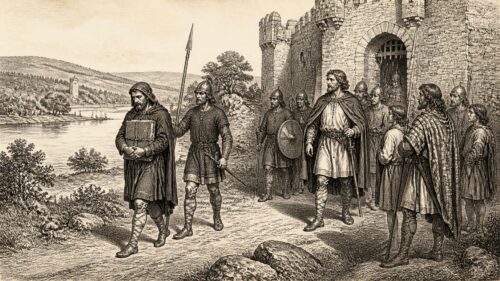
In 1462, Ireland experienced interconnected conflicts, raiding, lordship and institutional development. Butler forces, supported by English followers, contested Desmond control in the south-east; their defeat at Piltown enabled FitzGerald advances, though maritime captures and parliamentary attainder prolonged the struggle. In Ulster, Henry Ó Néill raided Tír Chonaill, devastating districts amid rivalry with Aodh Ruadh Ó Domhnaill, while killings reflected continuing northern instability. Connacht disputes involved ransoms, rents and cattle seizures. Franciscan friars founded a house at Monaghan, and Thomas Cusin taught law in Armagh. These events demonstrate power exercised through warfare, wealth, patronage, fortified places and learning across medieval Ireland.
Dateline
In 1462, the best-documented Irish developments were not the acts of a single government but a series of wars, settlements, raids and religious foundations across several political worlds. In the south-east, the Butler–FitzGerald contest became the Irish episode most clearly connected with the Wars of the Roses. In Ulster, Henry Ó Néill carried a destructive hosting into Tír Chonaill against Aodh Ruadh Ó Domhnaill. In Monaghan, meanwhile, a new Franciscan house was begun, and Armagh hosted a celebrated teacher of law. The contrast is instructive: force, lordship, learning and religious patronage all mattered in the Ireland of this year.
Piltown and the Butler–FitzGerald War
The principal southern event is recorded in Annála Connacht under 1462. Its account needs to be used carefully. It calls one participant the “young Earl of Ormond”, although the succession and the status of the Butler claim were complicated after the execution in England of James Butler, fifth earl of Ormond, in May 1461. His brother John inherited the Irish earldom but was politically vulnerable as a Lancastrian. The annalist’s language reflects the authority that the title still carried in Ireland, rather than settling every legal question surrounding it.
What is firmly placed in 1462 is an armed Butler return to Ireland with a very large body of English followers. The annalist says that war followed between Ormond and Desmond, that a son of the earl of Desmond named Gerald was captured, and that Waterford was taken by the Butler side. These were not merely local skirmishes. Waterford was a strategically valuable walled port, while the arrival of English troops shows how the civil wars of England could reinforce a contest over Irish lordships, towns and revenues.
A battle was then arranged. The same source says that the earl of Ormond did not attend on the appointed day, attributing this to a custom against giving battle on a Monday or after midday. Mac Richard Butler nevertheless advanced to fight, apparently without the earl. He met the FitzGerald force in what the annalist calls a fierce and bloody encounter. The Butlers were routed and Mac Richard was captured. The battle is conventionally known as Piltown, near the Suir in south Kilkenny, although the contemporary annal itself does not provide that place-name.
The figure supplied by Annála Connacht is striking but should not be converted into a modern casualty total. It says that 410 Butler men were counted as buried, in addition to others left unburied and consumed by animals. That establishes a severe defeat and a substantial death toll; it does not prove the numbers engaged, nor validate later tales that local watercourses ran red with blood. The enduring importance of Piltown is clearer: it was the only major Irish battle directly associated with the English Wars of the Roses, but it was also an episode in the much older rivalry of the Butler and FitzGerald lordships.
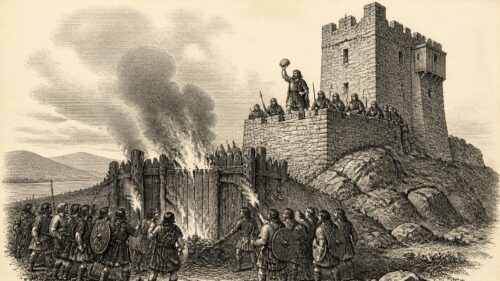
The fighting did not simply end at the field. The annalist states that the FitzGeralds then took Kilkenny and the chief towns of the Butler country, killing inhabitants in the process, while the earl and his English followers held an unnamed fortified town. Such wording may be compressed and partisan, but it conveys the character of late-medieval warfare: control of towns, castles, roads, food stores and dependent populations mattered as much as a single encounter. It also warns against treating “Yorkist” and “Lancastrian” as labels that fully explain Irish politics. Dynastic allegiance overlapped with inheritance, regional power and family feud.
Sea power formed part of the same struggle. Later in the year, a young kinsman of Ormond captured four ships belonging to Desmond’s people, reportedly laden with treasure. The annalist says the prize greatly strengthened the Butler position. Whatever the cargo precisely consisted of, the notice demonstrates that ships moving along the Irish Sea and southern coast carried wealth that could be seized in a private war. Ports such as Waterford were therefore gateways not only for English reinforcements but for trade, communications and plunder. On 15 October 1462, a Dublin parliament attainted John, earl of Ormond, an act later reversed; this was a further sign that victory in England could be used to punish a rival Irish affinity through law as well as arms.
War in Tír Chonaill
At the other end of the island, the Annals of Ulster record a “great war” between Henry Ó Néill and Aodh Ruadh Ó Domhnaill, together with the sons of Art Ó Néill. The conflict belonged to the continuing competition between leading northern kindreds, not to the Butler–FitzGerald dispute. Henry Ó Néill entered Tír Chonaill with a substantial hosting which included Ó Catháin and Thomas junior Mag Uidhir. The named allies matter: they reveal how a lord’s strength rested on negotiated support from other rulers and military households rather than upon a central Irish army.
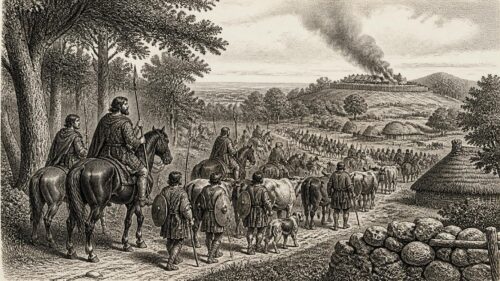
The annal is unusually precise about the raid’s rhythm. Henry spent two nights in Fanad, burning and destroying, and another two nights in Clann Éidhile or Glenelly. This was coercive campaigning aimed at livestock, food, dwellings and the political credibility of Ó Domhnaill’s rule. A hosting that stayed only a few nights could still devastate a district, especially if it destroyed stores and took animals at a critical point in the agricultural year. But the entry does not describe a decisive pitched battle or a final settlement. It records a phase in an unresolved northern struggle.
Violence continued close to Christmas. Brian, son of Philip Mag Uidhir, was killed by Ruaidhri, son of Art Ó Néill, a fortnight before Christmas; Edmund Ruadh Mag Uidhir was slain by the same man on the preceding day. The annalist’s praise of Brian’s prowess and hospitality is not incidental decoration. In Gaelic political culture, a lord’s reputation was measured not only in fighting but in the capacity to feed, reward and protect followers and guests. The death of Gráinne, daughter of Thomas junior Mag Uidhir and wife of Cathal Mac Maghnusa Mag Uidhir, was likewise marked as a loss widely mourned in Ireland. Elite women were integral to the kinship networks through which lordship operated.
Rents, Cattle and Local Power
The same year’s Connacht entries bring the conflict down to a local scale. Feidlim Ó Conchobair encountered Mac Branáin and his kinsmen on the road to Bagna. Feidlim was wounded in the knee with a dart, but Mac Branáin was captured. His ransom was set at eighty marks and at rent for a town that his family had long held free. This is valuable evidence that warfare could end not only in death or expulsion but in a revised fiscal relationship: ransom, rent and acknowledgement of superiority were practical fruits of victory.
Elsewhere, Ruaidhrí Mac Diarmata, Cormac Ballach Mac Donnchada and their allies took what Annála Connacht calls 120 score cows and other livestock at Bél Átha Dúin Imdain. A retaliatory raid followed, with further large numbers of cattle driven away and men killed. The exact totals should be treated as annalistic claims, but cattle were unquestionably mobile wealth: they supplied food, hides, breeding stock and a means of payment, while their seizure damaged an opponent’s capacity to sustain dependants. Such raids were central to the experience of people living between competing lordships.
Friars and Legal Learning
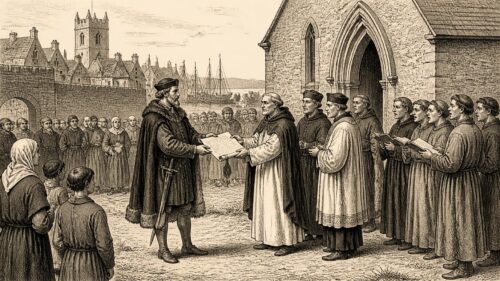
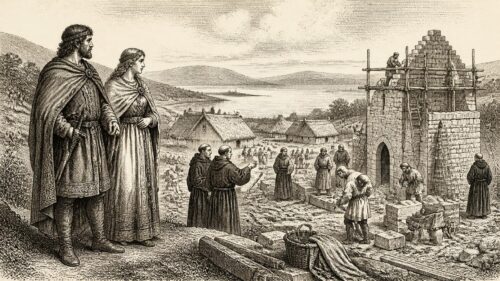
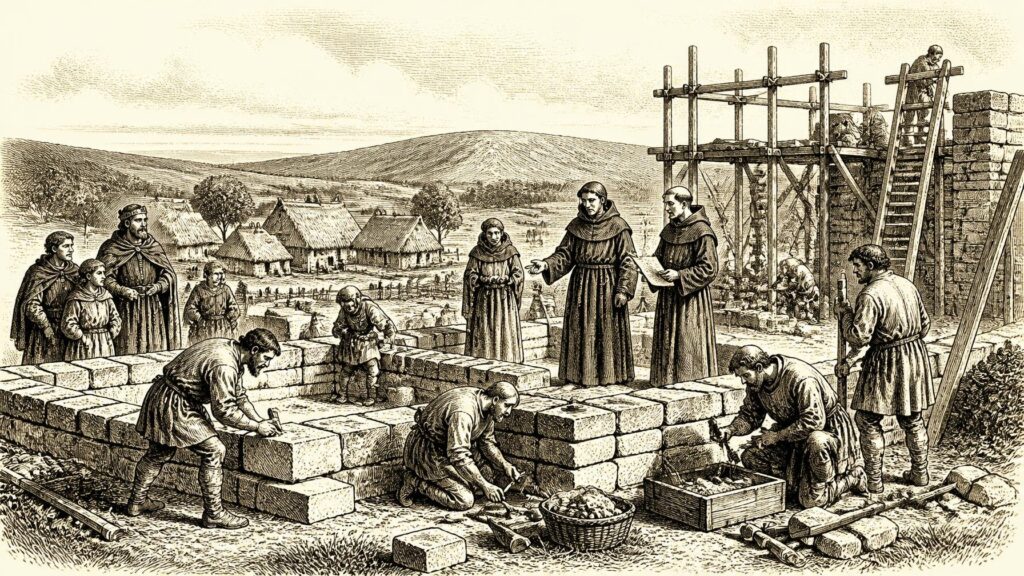
Amid the warfare, two entries point to enduring institutions. The Annals of Ulster, the Annals of Loch Cé and the Annals of the Four Masters agree that a house of Friars Minor was begun at Muineachán, modern Monaghan, while Feidhlimidh Mac Mathghamhna was lord of Oirghialla. This is a securely dated foundation notice, though it does not supply a detailed building history. Its importance lies in the patronage itself: a Franciscan community linked a regional lordship to a religious order with wide Irish and European connections, and helped make Monaghan a more substantial ecclesiastical focus.
Armagh was also a centre of learning in 1462. Thomas Cusin, described as a Master of Law and as the finest such scholar in Ireland in his time, kept a school there. The annal offers no syllabus, so it would be unsafe to reconstruct its daily teaching in detail. Yet the entry demonstrates that advanced legal learning was being publicly recognised in Armagh even during a year of northern warfare. The deaths of the herenagh of Iniskeen on Lough Erne and of the prior of Devenish on Lough Derg further show the continuing administrative life of churches and monasteries around the Erne lake system.
A Cautious Architectural Note
Glenquin Castle in County Limerick is often assigned to 1462 in older topographical writing and local tradition. That precise date cannot be treated as secure. The Office of Public Works more cautiously places the O’Hallinan tower-house in the late fifteenth or early sixteenth century. It is therefore better understood as evidence for the wider age of fortified residences than as a firmly dated event of this particular year. The year 1462 supports a sharper conclusion elsewhere: power was exercised through hostings, fortified places, ports, cattle, rents, religious patronage and schools, in an Ireland connected to England’s dynastic crisis but never reducible to it.
Primary Sources
- Annála Connacht: Annal 1462
- Annála Connacht
- The Annals of Ulster: Year U1462
- The Annals of Ulster
- Annals of the Four Masters: Annal M1462
- Annals of the Four Masters: CELT Project Documentation
- Annals of Loch Cé: Annal LC1462
- Annales Breves Hiberniae
- Butler, James
- Holdings: Inspeximus of an Act Attainting the Earl of Ormonde and Others of the Butler Family, 15 October 1462
- Holdings: Petition to Edward IV of Thomas Butler for Restitution to the Earldom of Ireland
- Monaghan Friary, Co. Monaghan
- County Monaghan Urban Archaeology Survey 1989
- An Introduction to the Architectural Heritage of County Monaghan
- Monaghan County Development Plan: Heritage Chapter
- Glenquin Castle
- Monuments in State Care: County Limerick
- Killeedy, County Limerick
- The Battle of Pilltown
- MS A 13: Annals of the Four Masters
- MS 23 P 6: The Annals of the Four Masters
- English Lordship of Ireland and the Irish Sea World: Re-assessing the Origins of the Kildare Ascendancy, c.1390–c.1513
- James IV, the O’Donnells of Tyrconnell and the Road to Flodden
- The Battle of Piltown, 1462