Oriel Siege1365 CE
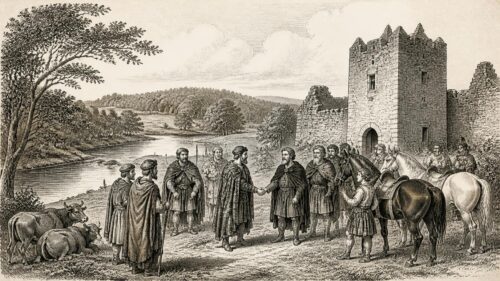
In 1365, Niall Ó Néill, newly king of Tír Eógain, led a coalition into Oriel, besieging Brian Mac Mathghamhna before an unauthorised assault shattered the settlement and killed allies. Dynastic contention also reshaped Connacht, Magh Luirg and East Bréifne, where deaths, accessions, warfare and Cú Chonnacht Ó Raghallaigh’s religious retirement altered lordship. Raids on border communities demonstrated the human cost of rivalry. Ecclesiastical leaders and learned travellers remained active across Irish Sea networks. In the English lordship, Lionel of Antwerp briefly returned England, while Thomond’s rulers submitted diplomatically. The year reveals authority as negotiated through warfare, kinship, religion and accommodation.
Dateline
In 1365, Ireland’s political map was made and remade through local succession struggles, military expeditions, marriage alliances and negotiated submissions. The year is unusually revealing because the surviving annals preserve activity from Ulster and Oriel to Connacht, Bréifne, Thomond and the English lordship. They do not give a complete national chronicle, and most entries lack a day or month. Accordingly, events discussed here are those explicitly placed under 1365 by the sources, while wider circumstances are identified as context rather than treated as happenings securely dated to a particular day.
An O’Neill Host in Oriel
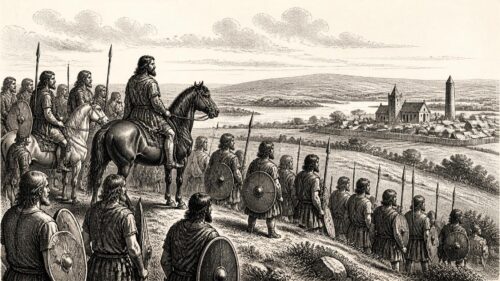
The year’s most substantial recorded campaign occurred in Oriel, the broad lordship centred largely on modern County Monaghan and adjoining districts. The Annals of Ulster report that Niall Ó Néill, king of Tír Eógain, led a great hosting into Oriel against Brian Mac Mathghamhna. The annalist calls Niall a man worthy of the high-kingship of Ireland: this was praise for his standing and military capacity, not proof that he held that title. Niall had come to the kingship of Tír Eógain in 1365, inheriting an expanding northern lordship whose influence had grown after the collapse of the de Burgh earldom of Ulster earlier in the century.
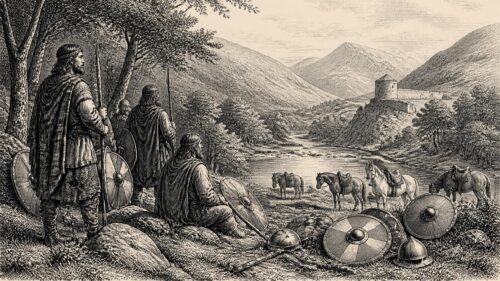
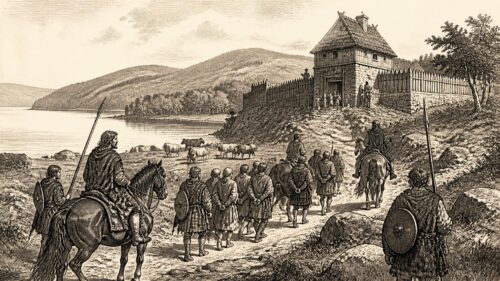
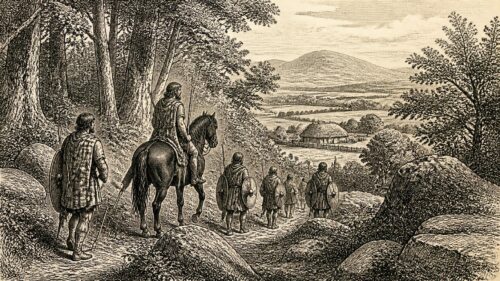
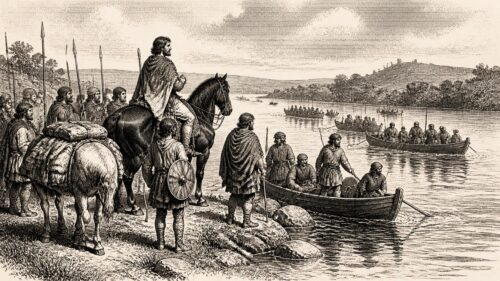
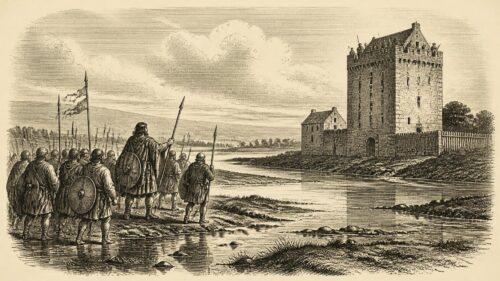
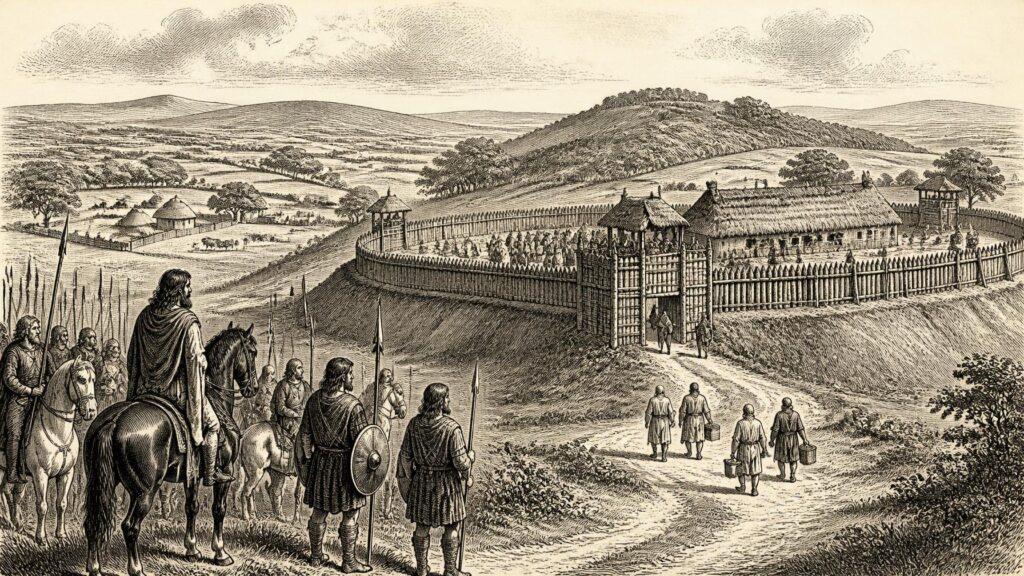
Ó Néill’s force did not merely raid and depart. It established a fortified position in the middle of the territory and laid siege to Brian Mac Mathghamhna. Such a leaguer was a conspicuous assertion of overlordship: it required food, armed followers, camp discipline and control of routes across the surrounding countryside. The annal says that the nobles of the northern ‘Fifth’ rose with Ó Néill, suggesting a coalition rather than a private household expedition. The geography mattered. Oriel stood between Tír Eógain, the English settlements around Louth and Meath, and the lordships of Bréifne; its ruler could not ignore the ambitions of powerful neighbours.
Brian tried negotiation. He offered substantial payments and, more strikingly, half of Oriel to Niall son of Murchadh Mac Mathghamhna, the previous ruler whom Brian had displaced. He also offered compensation connected with the death of a Mac Domhnaill. Ó Néill accepted. Yet the settlement immediately unravelled. Niall Mac Mathghamhna and Alexander Mac Domhnaill, lord of the gallowglasses, attacked Brian without Ó Néill’s leave, each with a battalion. Brian and his muster beat off the assault. Niall, Alexander the younger—constable of the gallowglasses and heir of Clann Domhnaill—and Eóghan Ó Domhnaill were killed, alongside many others.
This was no simple clash between fixed ethnic blocs. Brian Mac Mathghamhna had seized the kingship of Oriel during the year, but his authority was contested within his own dynasty. His political choices also reached into neighbouring families. Annála Connacht says that he formed a spiritual kinship alliance with Somairle Mac Domhnaill, altered a marriage connection with the Ó Raghallaigh of East Bréifne, and then treacherously detained Somairle after inviting him to a wine gathering. The chronicle states that Brian was banished because of this act. The sequence is vivid but its precise order cannot be recovered; it does show how marriage, foster-style kinship, hospitality and captivity could be instruments of high politics.
Succession and Conflict Beyond the Camp
The northern struggle coincided with instability farther west. In Connacht, Áed son of Fedlimid Ó Conchobair, described by the Annals of Ulster as arch-king of Connacht, died. Ruaidhrí son of Toirdelbach Ó Conchobair then took the provincial kingship. The same annal records the death of Ferghal Mac Diarmata, king of Magh Luirg, of Cormac Mac Diarmata junior, and of Tomaltach, tánaiste—or recognised heir—of Magh Luirg; Áed son of Conchobur Mac Diarmata assumed its kingship. It also baldly records that ‘great war’ arose in Connacht between Mac William and Ó Conchobair. The accumulation of deaths and accessions indicates not a quiet transfer of authority but a moment when competing lineages had fresh reason to test one another.
There are limits to certainty. The Annals of the Four Masters, compiled much later, place several related Connacht deaths and successions under 1368 rather than 1365, while independently recording some 1365 events reported by Annála Connacht. That discrepancy warns against imposing a day-by-day narrative which the evidence cannot sustain. What can safely be said is that the Ulster annalist assigned the death of Áed Ó Conchobair, Ruaidhrí’s accession, and the new Connacht war to its 1365 entry.
Local violence was likewise recorded in the Connacht and Bréifne borderlands. Clann Goisdealbh attacked the people of Leyney, where six ‘kings’ sons’ were killed, among them Cormac Ó hEaghra, eligible for the kingship of Leyney. Áed Mac Diarmata raided Muinter Eolais, taking plunder, but the counter-blow killed notable members of his following and captured two Mac Diarmatas. The annalist remembered the encounter as the ‘Defeat of the Young Warriors’. These notices expose the social cost of lordship rivalry: the victims were not only rulers but prospective heirs, mounted retainers, dependent households and communities whose cattle and goods were targets of raiding.
Bréifne, Church and Learning
In East Bréifne, Cú Chonnacht Ó Raghallaigh ‘entered an Order’, renouncing active secular rule; Pilip Ó Raghallaigh was made king in his place. This was a major dynastic transition rather than an incidental personal devotion. Cú Chonnacht had relied on marriage alliances to defend his lordship amid pressure from the Ó Ruaircs, Ó Conchobairs and Oriel. His connection with the Mac Mathghamhna crisis helps explain why the fortunes of Oriel and East Bréifne were so closely entangled in 1365. The decision to retire to religious life did not remove the Ó Raghallaigh from politics, but it transferred formal authority to a brother rather than a son, a choice with consequences for later internal dispute.
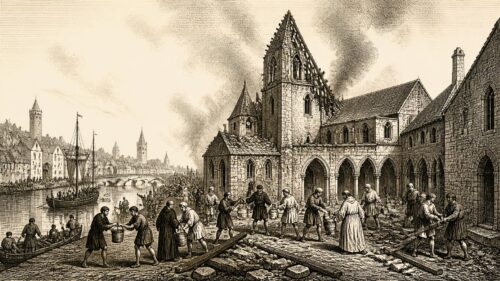
Religion remained embedded in this political world. The Annals of Ulster record the death of the successor of St Moedóc, who was also archdeacon of Bréifne, praising his charity and humanity. Such an office joined local ecclesiastical prestige to a wider diocesan structure. The same annal records the deaths of Cú Uladh Mac Cathmhaoil and his son, described as a young master of learning, while returning from ‘Saxon-land’—England. Their journey is a small but important sign that Irish learned families and churchmen moved across the Irish Sea. Learning, clerical office and travel were part of everyday elite life, even in a year remembered chiefly for camps, raids and deaths.
Lionel’s Brief Absence
In the English-controlled lordship, the annals note that the king of England’s son left Ireland. The prince was Lionel of Antwerp, duke of Clarence, Edward III’s son, earl of Ulster through his wife and royal lieutenant in Ireland. The Dublin annalist, James Grace, similarly says that Lionel returned to England in 1365 and left Sir Thomas de la Dale as deputy. Modern accounts treat this as a short absence within Lionel’s wider Irish lieutenancy rather than his final departure: he was back in Ireland for the Kilkenny parliament of 1366. The caution is important, since an annalistic phrase such as ‘left Ireland’ can describe a temporary withdrawal, not necessarily the end of an office.
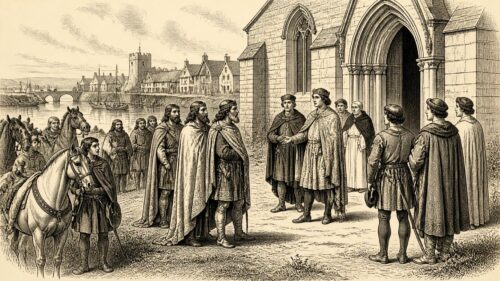
Lionel’s government had been intended to strengthen royal administration and secure the colony’s frontiers, especially in Leinster. It depended on English funding, imported military resources, Anglo-Irish cooperation and also dealings with Irish leaders. The southern dimension of 1365 is visible in the reported joint submission of Mathghamhain Ó Briain of Thomond and his son Brian Sreamach to Lionel during the summer. Submission did not mean that Thomond had been permanently absorbed into the lordship; rather, it was a diplomatic acknowledgement made within a shifting balance of power. It belongs beside, rather than above, the autonomous contests being fought in Oriel, Connacht and Bréifne.
Thus 1365 should not be read merely as a prelude to the better-known Statutes of Kilkenny, enacted the following year and therefore outside this year’s story. Its own record is more varied. A new Ó Néill projected power into Oriel but could not control all who fought in his coalition. Connacht and Magh Luirg changed rulers amid war. Bréifne saw a king enter religion and another succeed. Ecclesiastical office, scholarship and Irish Sea travel continued. Lionel’s short departure showed the fragility of royal administration. Across the island, authority was negotiated in fortified camps, households, churches, marriage alliances and the dangerous spaces between them.
Source References
Hover over a number to see the source. Select it to open the source.

- [1] The Annals of Ulster: Year U1365
- [2] Annála Connacht: Annal 1365
- [3] Annals of the Four Masters: Annals M1364–M1369
- [4] Annales Hiberniae
- [5] Lionel (‘of Antwerp’) | Dictionary of Irish Biography
- [6] O'Neill (Ó Néill), Niall Mór | Dictionary of Irish Biography
- [7] MacMahon (Mac Mathghamhna), Brian Mór | Dictionary of Irish Biography
- [8] O'Reilly (Ó Raghallaigh), Cú Chonnacht | Dictionary of Irish Biography
- [9] O'Brien (Ó Briain), Brian Sreamach | Dictionary of Irish Biography
- [10] O'Donnell (Ó Domhnaill), Conchobhar | Dictionary of Irish Biography
- [11] ‘Hobbes’, ‘Dogs’ and Politics in the Ireland of Lionel of Antwerp, c. 1361–6
- [12] Lordship and Principality: Colonial Policy in Ireland and Aquitaine in the 1360s
- [13] The Viceroyalty of Lionel, Duke of Clarence, in Ireland, 1361–1366
- [14] Lionel of Clarence and the English of Meath
- [15] Annála Connacht: CELT Project Document Details
- [16] Annals of the Four Masters: CELT Project Document Details
- [17] Annals of the Four Masters: Original Irish Text
- [18] The Lords' Right Hand: The Role of the Butler Earls of Ormond in Later Medieval Ireland
- [19] The English Aristocracy at War: From the Welsh Wars of Edward I to the Battle of Bannockburn
- [20] A Task Too Great for One Dynasty? The Mortimer Earls of March, the de Burghs and the Lordship of Ireland
- [21] Annals of the Four Masters: CELT Project Index
Primary Sources
- The Annals of Ulster: Year U1365
- Annála Connacht: Annal 1365
- Annals of the Four Masters: Annals M1364–M1369
- Annales Hiberniae
- Lionel (‘of Antwerp’) | Dictionary of Irish Biography
- O'Neill (Ó Néill), Niall Mór | Dictionary of Irish Biography
- MacMahon (Mac Mathghamhna), Brian Mór | Dictionary of Irish Biography
- O'Reilly (Ó Raghallaigh), Cú Chonnacht | Dictionary of Irish Biography
- O'Brien (Ó Briain), Brian Sreamach | Dictionary of Irish Biography
- O'Donnell (Ó Domhnaill), Conchobhar | Dictionary of Irish Biography
- ‘Hobbes’, ‘Dogs’ and Politics in the Ireland of Lionel of Antwerp, c. 1361–6
- Lordship and Principality: Colonial Policy in Ireland and Aquitaine in the 1360s
- The Viceroyalty of Lionel, Duke of Clarence, in Ireland, 1361–1366
- Lionel of Clarence and the English of Meath
- Annála Connacht: CELT Project Document Details
- Annals of the Four Masters: CELT Project Document Details
- Annals of the Four Masters: Original Irish Text
- The Lords' Right Hand: The Role of the Butler Earls of Ormond in Later Medieval Ireland
- The English Aristocracy at War: From the Welsh Wars of Edward I to the Battle of Bannockburn
- A Task Too Great for One Dynasty? The Mortimer Earls of March, the de Burghs and the Lordship of Ireland
- Annals of the Four Masters: CELT Project Index