

Rathmullan’s Captive Heir1587 CE
In 1587, Hugh Roe O’Donnell, heir to Tír Chonaill, was lured aboard a trading vessel at Rathmullan and imprisoned in Dublin Castle, giving the Tudor government a valuable hostage amid Ulster’s unstable rivalries. Elsewhere, parliament confirmed the Desmond attainder, enabling redistribution and plantation of Munster lands, though implementation remained uneven. In Connacht, the composition system replaced traditional exactions with fixed revenues, provoking resistance and controversy over Sir Richard Bingham’s harsh rule. Wet weather and poor corn heightened rural insecurity. These measures extended Crown authority through captivity, law, land and revenue, but deepened grievances, exposed weak enforcement, and shaped later conflict.
Dateline
A Seizure at Lough Swilly
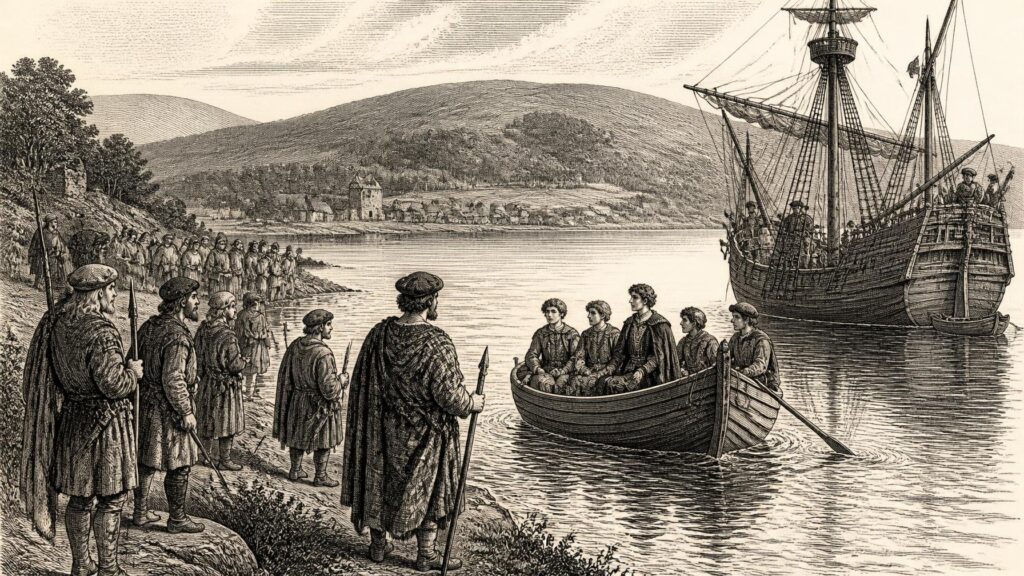
In 1587 the most consequential Irish event was not a battle or a parliament, but the taking of a boy from the shore of Lough Swilly. Hugh Roe O’Donnell, eldest son and heir of Sir Hugh O’Donnell of Tír Chonaill, was seized after being lured aboard a vessel anchored opposite Rathmullan. The episode later acquired the shape of a famous political kidnapping: merchants offered wine and ale, local people came to trade, and Hugh Roe was persuaded to visit the ship. Once aboard, he and his companions were shut below deck, disarmed and carried to Dublin.
The fullest narrative survives in the Annals of the Four Masters, compiled decades later from Irish learned traditions, and it should not be treated as a verbatim contemporary report. Yet its central fact is strongly supported by government evidence. Sir John Perrot, lord deputy, wrote to Elizabeth I on 26 September 1587 that Hugh Roe had been brought to Dublin on the previous day and was secured in the castle. It is therefore responsible to place the abduction in late September, while avoiding a falsely precise date for the moment at Rathmullan itself.
Hugh Roe was still not fifteen. He had been fostered among the Mac Sweeneys of Fanad, a powerful kindred closely tied to the O’Donnells, and Rathmullan was no remote backwater. Its sheltered waters opened on to the north-western seaways linking Donegal, the Hebrides, western Scotland and wider Atlantic trade. The use of a trading ship as a trap exploited that maritime world: wine, ale, bargaining and hospitality were familiar elements of coastal contact, made instruments of state policy.
The youth was then confined in Dublin Castle, the central fortress of royal government in Ireland. His removal was not a routine arrest under a settled legal system. It was the taking of an heir whose person could be used to constrain a lordship. The government had acquired a hostage of exceptional value, while Tír Chonaill lost the young man around whom a future succession might gather.
Ulster’s Unsettled Balance
The seizure made sense within the unstable politics of Ulster. English government had spent years attempting to turn regional lordships into dependable parts of the Tudor state through patents, annual payments, garrisons, sheriffs, courts and hostages. These measures did not replace older forms of authority overnight. Gaelic lordship rested on kinship, military followings, fosterage, negotiated clientship and control of land, cattle and tribute. The two political languages overlapped, but they also collided.
Hugh O’Neill, earl of Tyrone, stood at the centre of that collision. The crown had recognised him as earl in 1585, but his position against the ageing Turlough Luineach O’Neill remained contested. During 1587 Hugh travelled to court and obtained letters patent for the lordship of Tyrone; the grant also embraced territories claimed by O’Cahan and in the Fews. In English legal terms this was a reward and a framework for order. In Ulster it enlarged the earl’s reach and alarmed those whose own standing it threatened.
Perrot had earlier hoped to manage Ulster by balancing its great interests. An agreement negotiated in 1585 between Turlough Luineach and Hugh O’Neill was intended to contain conflict, while Perrot’s accommodation with Sorley Boy MacDonnell aimed to stabilise the north-eastern coast. By 1587, however, the crown’s recognition of Hugh O’Neill had helped create a formidable figure rather than a merely useful client. The removal of Hugh Roe O’Donnell was an attempt to check a related northern power before it became harder to control.
Later writers understandably saw in the capture the beginning of a larger story: Hugh Roe would escape from Dublin Castle, become lord of Tír Chonaill and join Hugh O’Neill in the Nine Years’ War. None of that had yet occurred in 1587. At the time, the immediate outcome was uncertainty. Sir Hugh O’Donnell remained head of his lordship; rival O’Donnell branches, Mac Sweeneys, O’Dohertys, Maguires, O’Neills and Scottish kindreds all retained their own interests. The episode mattered precisely because the future was open, not predetermined.
Government by Land and Law
Elsewhere, 1587 marked a further stage in the crown’s effort to make conquest durable through legal title. The Dublin parliament summoned by Perrot in 1585 was completed in 1587. Its most important result for Munster was the legislation confirming the attainder of Gerald FitzGerald, fifteenth earl of Desmond, and other rebels. Attainder converted rebellion into a legal forfeiture: the dead earl’s extensive estates were vested in the crown, providing the formal basis for their distribution and plantation.
This was not the instant remaking of Munster often implied by later summaries. The Desmond rebellion had ended with the earl’s death in 1583; surveys, claims, legal arguments and competing applications followed. A commission dated 10 February 1587 divided portions of the escheated Desmond lands among English undertakers, while particular grants continued to be made during the year. In April, for example, former monastic land at Kerrycurrihy was treated as plantation land and granted to the courtier John Cooper.
For prospective undertakers, such grants promised rents, status and opportunity. For many established inhabitants, they made possession precarious. A map, a survey and a patent could translate a lordship, a tenancy, woods, fisheries, mills or grazing into Crown property available for reassignment. The plantation project envisaged English settlers, new agricultural communities and defensible centres of authority. In practice, its progress was slow, uneven and dependent on capital, migrants, security and the willingness of local people to remain, work or resist. In 1587 it was a programme in formation, not a finished colonial landscape.
The completion of parliament also revealed the limits of government by statute. Perrot had hoped to advance a broad programme of reform, but Irish parliamentary politics contained powerful Old English interests as well as office-holders and landowners with conflicting expectations. The Desmond attainder passed, but much else proved contentious or incomplete. Dublin’s legislative authority was important; it was not omnipotent beyond the places where officials, soldiers and local allies could enforce its decisions.
Connacht’s Hard Peace
In Connacht, conflict over the ‘composition’ exposed the social cost of reform. The scheme, negotiated from 1585, sought to replace the shifting burdens of military exactions, billeting and traditional dues with fixed payments that would finance government and garrisons. It encouraged the use of English law and narrowed the fiscal authority of local chiefs. Some tenants and smaller landholders could see advantages in limits on arbitrary taking; many lords feared the loss of income, jurisdiction and status.
The policy was inseparable from the reputation of Sir Richard Bingham, the province’s president. His severe campaigns in 1586 had crushed resistance among the Burkes and others, but generated lasting hostility. In 1587 Theobald Dillon, collector of composition revenue and a broker for Connacht interests, brought complaints against Bingham. On 20 February the case was heard before the court of Castle Chamber in Dublin. Bingham was acquitted, while Dillon was reproached for false and malicious accusations.
The verdict did not settle the underlying issue. It demonstrated that arguments over justice, revenue and violence had become arguments within the machinery of the state itself. Bingham’s harshness was criticised even by fellow officials as politically damaging; his relationship with Perrot had deteriorated badly. Later in 1587 he was transferred for service in the Netherlands. For Connacht communities, the change did not erase the new fiscal order, the memory of executions or the pressure to translate local rights into Crown-recognised tenures.
Weather, Food and Ordinary Vulnerability
The annalists recorded that 1587 brought much wet weather and poor corn, though there was an abundant crop of nuts. Such notices are brief and cannot supply a modern national harvest statistic. They do, however, preserve what mattered immediately to rural households: rain, grain and the possibility of making up a shortfall from other seasonal foods. Oats and other cereals were fundamental to diet, rents, hospitality and the provisioning of troops. An unproductive corn harvest could sharpen vulnerability even where it did not produce a documented famine.
The contrast between poor grain and plentiful nuts also suggests the diversity of subsistence. Woods, hedges and uncultivated ground supplied food as well as fuel, timber and cover. In a year when war, taxation, garrison demands and land disputes already disturbed many districts, weather could turn insecurity into a household problem. The evidence does not permit claims of universal hunger in 1587; it does permit the conclusion that the year’s wet season was remembered as economically unwelcome.
A Year of Containment
By the close of 1587, the Tudor administration possessed a captive heir in Dublin Castle, a parliamentary title to vast forfeited lands in Munster, and a developing revenue system in Connacht. These were real gains in reach and paperwork. Yet each carried a warning. The abduction at Rathmullan showed that government feared the political future of Ulster. The Desmond attainder made land a continuing source of grievance and competition. The Connacht dispute showed that reform could divide officials as well as subjects.
Rathmullan’s wine ship was therefore more than an episode of deception. It captured the character of Ireland in 1587: a country connected by sea routes and family alliances, subjected to expanding royal institutions, and still governed in many places through older networks that law and force had not displaced. The Crown had acted to contain danger. In doing so, it helped define the antagonisms that would soon make the island far harder to govern.
Primary Sources
- Annals of the Four Masters
- Calendar of the State Papers Relating to Ireland, 1586–July 1588
- Sir Hugh O'Donnell
- Select Documents XL: An Address to Aodh Ruadh Ó Domhnaill in Captivity, 1590
- The Kidnapping and Imprisonment of Red Hugh
- Flight of the Earls Booklet
- O'Neill, Hugh
- Perrot, Sir John
- Bingham (Byngham), Sir Richard
- Dillon, Theobald
- Fitzwilliam, Sir William
- St Leger, Sir Warham
- O'Donnell, Hugh McHugh Dubh (Aodh Ó Domhnaill)
- The Desmond Survey
- Part 4 of The Desmond Survey
- Division of the Escheated Lands Which Fell to the Crown by the Attainder of the Earl of Desmond
- Statute Law Revision Act 2007
- A Calendar of Manuscript Material Relating to Ireland, 1580–1602
- Chapters Towards a History of Ireland in the Reign of Elizabeth, Part 40
- State Papers Foreign 1509–1782: Government Papers on Foreign Affairs