Lough Laoghaire’s Broken Line1325 CE
In 1325, Domhnall Ó Néill, king of Tír Eógain, died at Loch Laoghaire, and his son Cú Uladh was murdered by rival kinsmen, precipitating a disputed succession eventually favouring Henry Ó Néill of Clandeboye. Intra-dynastic violence also affected Fermanagh and Thomond. Maurice fitz Thomas FitzGerald’s seizure of Bunratty Castle exposed contested Anglo-Irish authority and required intervention by justiciar John Darcy. Meanwhile, an audit at Westminster uncovered forged Irish exchequer accounts associated with Archbishop Alexander Bicknor, leading to confiscation of his temporal property. Together, these events reveal unstable, personal lordship, constrained royal power, and fragile administration across medieval Ireland at once.

Dateline
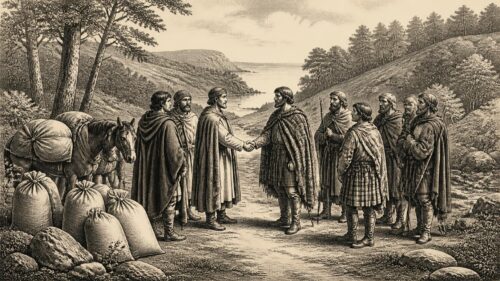
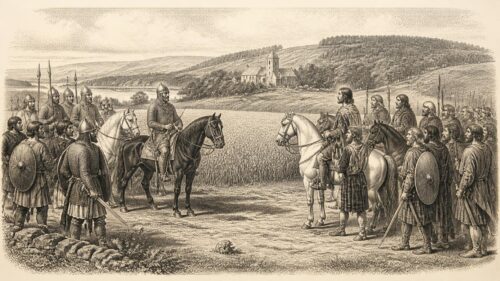
In 1325, the most consequential Irish development securely tied to the calendar year was a succession crisis in Tír Eógain. Domhnall Ó Néill, king of Tyrone, died on a crannóg in Loch Laoghaire, in the Clogher district. Within the same year his son Cú Uladh, described by the Annals of the Four Masters as promising material for the lordship of Tyrone, was killed by the sons of Niall, Domhnall’s brother. The two deaths did not merely remove a ruler and heir. They exposed the precariousness of leadership in the north after a decade of war, famine and the failed Scottish intervention led by Edward Bruce.
A King Dies on the Lake
Domhnall Ó Néill had survived an unusually difficult political career. Son of Brian Ó Néill, who had been killed fighting the Anglo-Normans in 1260, he had spent much of his life struggling to establish and retain authority in Tír Eógain. His position had been contested by rival branches of the Ó Néill family, while the neighbouring Anglo-Irish lordships, the Clandeboye Ó Néills, the MacDonnells and the rulers of Fermanagh and Donegal all mattered to the balance of power. He was also one of the leading Irish associates of Edward Bruce during the Scottish campaign of 1315–18. That venture had briefly offered an alternative political order, but ended in defeat at Faughart and left northern lordships exposed to renewed pressure and internal rivalry.
The location of Domhnall’s death is revealing. A crannóg was an artificial or adapted island dwelling, reached across water and capable of serving as a defended residence, store-place and centre of lordship. Loch Laoghaire was therefore not an incidental backdrop. Its crannóg placed the king within a landscape where authority was exercised through households, retainers, cattle, food supplies, client ties and defensible places rather than through a fixed capital. Yet it would be unsafe to turn this into a romantic image of isolation: a lake residence was embedded in the communications of the Clogher country and in the practical politics of Tyrone.
Domhnall’s death did not deliver an uncontested inheritance. His son Cú Uladh was killed by the sons of Niall Ó Néill, identified in the annal as sons of his father’s brother. This was dynastic violence from within the ruling kindred, not a simple clash between Irish and English. In Gaelic succession, a lordship did not automatically pass from father to eldest son. Adult men of the wider ruling lineage could advance competing claims, and military support, alliances and the ability to protect dependants counted greatly. The killing of Cú Uladh removed a plausible successor at the very moment when the senior ruler had disappeared.
The immediate settlement was not final. Domhnall’s younger son Aodh Reamhar was ultimately to become a major Ó Néill leader, but not at once; Henry Ó Néill of the Clandeboye branch held the kingship after 1325. The year thus marks a fracture rather than a clean accession. It illustrates why medieval Irish politics must not be described as a neat sequence of hereditary reigns. The Ó Néill name conferred prestige, but survival, kinship and force determined which bearer of it could command Tír Eógain.
Violence Beyond Tyrone
The surviving Irish annals also place smaller but meaningful acts of violence in 1325. In Fermanagh, Máel Sechlainn Ó Flannagáin, chief of Tuath Rátha, was killed by the sons of Dermot Ó Flannagáin. This was another intra-kindred killing in a region where lordship was divided among powerful local families and where the Maguires were increasing their influence. Such entries can seem terse, but they point to the human scale of political change. The death of a local chief could alter rights to tribute, cattle, church patronage, land and military followings, while opening opportunities for neighbours and rivals.
In Thomond, the Annals of the Four Masters record a victory by the sons of Toirdelbach Ó Briain over the sons of Brian Ruadh Ó Briain, in which Brian, son of Mahon Ó Briain, and many others were killed. The event belongs to the long-running contest within the Ó Briain dynasty for dominance in the region west of the Shannon and around Limerick. The annal gives no dependable date within the year, nor enough detail to reconstruct the battlefield or the size of the forces. What can safely be said is that dynastic competition in Thomond remained active and lethal in 1325, just as the Ó Néill succession was breaking down in the north.
These conflicts were not isolated from the wider lordship of Ireland. Great households employed mounted men, foot soldiers and local allies; they drew sustenance from agricultural communities and could disrupt cultivation, movement and exchange. But neither should every Gaelic conflict be reduced to resistance against English rule. The political map was made up of overlapping lordships, rival branches of dynasties, church lands, towns, royal liberties and border districts. Alliances could cross language and ancestry, while local disputes often proved more urgent than broad ideological loyalties.
Bunratty and the Limits of Royal Authority
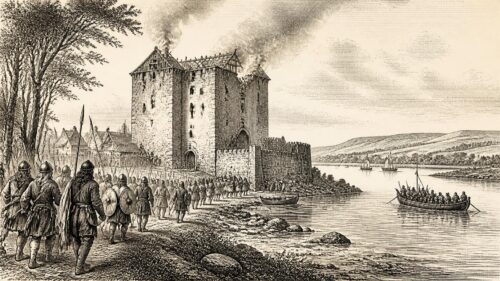
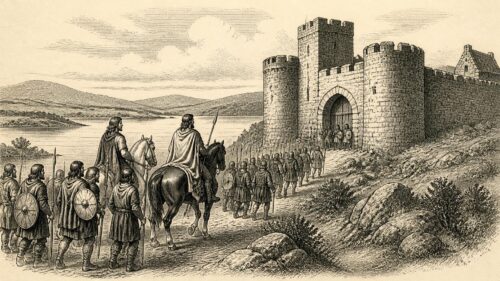
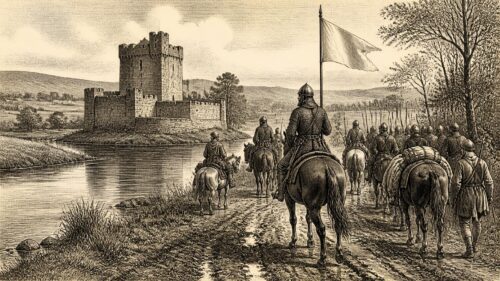
Far to the south-west, Bunratty again demonstrated the instability of lordship in the Shannon estuary. The castle had been a key point in the former de Clare enterprise in Thomond: a fortified centre linked to a manor, a borough, market privileges and an attempted English settlement. That project had been badly damaged after Richard de Clare’s defeat and death at Dysert O’Dea in 1318. In 1325, Maurice fitz Thomas FitzGerald, later earl of Desmond, or men acting for him, forcibly seized Bunratty Castle. The evidence places the seizure in November, though the precise course of occupation and recovery is not fully clear.
The episode mattered because Bunratty was much more than a strong building. Command of it meant influence over the approaches to the Shannon, access to the resources of the former Clare lordship and a claim to intervene in Thomond. Maurice fitz Thomas was one of the greatest magnates in Munster, but the castle was entangled in disputed inheritance and royal interests. His actions also coincided with the beginning of his violent quarrel with Arnold le Poer. The cause of that feud remains obscure, and historians rightly resist pretending that the surviving record supplies a simple explanation.
Sir John Darcy, the king’s justiciar in Ireland, was compelled to intervene. Darcy had arrived in 1324 charged in part with maintaining loyalty to Edward II after the escape of Roger Mortimer, the lord of Trim, from English captivity. At Bunratty, he appears to have arranged a fragile accommodation rather than achieved a decisive settlement. This was characteristic of royal government in much of Ireland: its officers could negotiate, command castles, issue writs and sometimes lead expeditions, but their capacity depended on the co-operation of magnates whose private resources often exceeded those immediately available to the Dublin administration.
An Audit Reaches Dublin
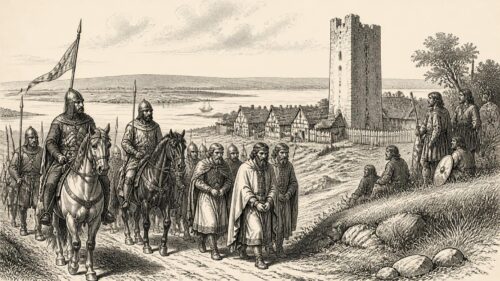
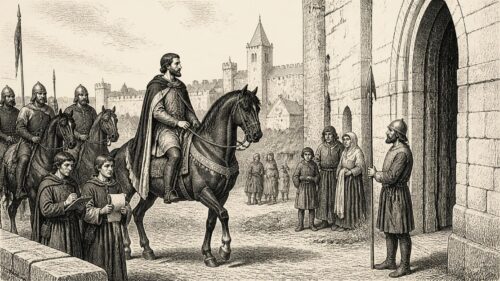
Another firmly dated development of 1325 unfolded at Westminster but directly concerned Ireland’s government. In October, the audit of Irish exchequer accounts exposed falsified material connected with Alexander Bicknor, archbishop of Dublin and former treasurer of Ireland. Bicknor’s accounts covered his earlier term as treasurer, but the discovery came at a politically dangerous moment. He had become associated with Queen Isabella’s circle while Edward II was increasingly dominated by the Despenser regime. Financial inquiry and political hostility became closely intertwined.
The case was serious in both practical and symbolic terms. Investigators found that documents used in the audit had been forged and that substantial sums had not been properly accounted for. On 5 December 1325, the exchequer court ordered punishment against those implicated; Bicknor’s property was taken into the king’s hands, while his episcopal dignity spared him continued imprisonment. The inquiry also engulfed Walter Islip, the later treasurer of Ireland. This was not a marginal clerical scandal. It concerned the machinery that paid officials, maintained castles, recorded debts, handled royal revenues and underpinned the crown’s ability to act in Ireland.
For people living under the English lordship, exchequer administration was felt in rents, fines, customs, royal demands and the costs of war. The scandal did not mean that all Irish government ceased to function, nor does it prove that every shortfall was fraud. Medieval administration was vulnerable to delayed records, travel, changing personnel and the disruption left by the Bruce wars. Nevertheless, the exposure of false accounts showed how fragile the connection could be between orders issued from Westminster, records kept in Dublin and resources actually available on the ground.
Church, Record and Historical Caution
Bicknor’s disgrace also shows the closeness of ecclesiastical and secular authority. As archbishop of Dublin, he stood at the head of the most important Irish diocese within the English lordship; as a former financial officer and royal diplomat, he also moved in the world of government. Church institutions remained centres of worship, burial, hospitality, landholding and record-making, but senior churchmen could be deeply implicated in political conflict. The seizure of Bicknor’s temporal goods was therefore a significant intervention in both public administration and ecclesiastical power.
There is a final caution about dating. Medieval Irish annals are indispensable, but their year-headings do not always correspond precisely with modern calendar years. One sequence in the Annals of Ulster labels a group of events “1325” although comparison with independently dated material shows that it is chronologically displaced; it includes the killing of John de Bermingham, which occurred in 1329. That material cannot responsibly be presented as an event of 1325. This account therefore rests its central narrative on entries and biographical evidence that can be placed securely in 1325, while treating broader conditions as context rather than pretending they happened in this single year.
Viewed together, 1325 was a year of broken lines of authority. At Loch Laoghaire, the death of Domhnall Ó Néill and murder of Cú Uladh ruptured a ruling family’s succession. In Thomond, Ó Briain rivalry continued, while Bunratty exposed the contested edge of Anglo-Irish power. In the financial courts of Westminster, Dublin’s former treasurer was disgraced over forged accounts. None of these developments created a new Ireland overnight. Together, however, they reveal a country in which lordship remained personal, contested and vulnerable—whether on a lake crannóg, at a Shannon castle or in the parchment records of the exchequer.
Primary Sources
- Annals of the Four Masters
- Annals of the Four Masters: CELT Project Index
- The Annals of Ulster, Year U1325
- Annala Uladh: Annals of Ulster Otherwise Annala Senait, Years U1320–U1329
- O'Neill (Ó Néill), Domhnall
- O'Neill (Ó Néill), Aodh Reamhar (Aodh Mór)
- Darcy, Sir John
- FitzGerald, Maurice fitz Thomas
- Bicknor, Alexander
- Revealing the Corrupt Record in 14th-Century Ireland
- Alexander Bicknor – Archbishop and Peculator
- The Case against Alexander Bicknor, Archbishop and Peculator
- English Pipe Roll 19 Edward II: Alexander Bicknor, Walter Islip and Adam Herwynton, Treasurers of Ireland
- John Darcy and the Administration of Ireland
- English Rule in Ireland, c.1272–c.1315
- Maurice Fitz Thomas FitzGerald and the Earldom of Desmond
- Bunratty Archaeological Assessment, Proposed Marine Dump Site, Sod Island
- The Battle of Dysert O’Dea and the Gaelic Resurgence in Thomond
- Mapping and Measuring the Impact of the Bruce Invasion
- Bruce Invasion: Operation Ireland, 1315–1318
- Irish Parliaments in the Reign of Edward II
- History of Parliament in Ireland