Kilmainham’s Offaly Victory1436 CE
In 1436, Ó Conchobhair Fáilghe launched raids against the English lordship, reportedly avenging the captivity of an Ó Domhnaill kinsman. English settlers of Meath, Ó Fearghail allies and the Prior of Kilmainham defeated him, though conflict continued. In Ulster, Niall Ó Néill was killed in a night attack, while Eóghan Ó Néill secured the crannóg of Loch Laoghaire before raiding Tírhugh. Annals also record local deaths and feuds. The deaths of jurist Gilla-Íosa Mac Aodhagáin and historian Geanann Mac Cruitín, alongside a 1436 Dindshenchas manuscript, attest to enduring learned culture amid fragmented, interconnected warfare and lordship across Ireland’s political landscape.

Dateline
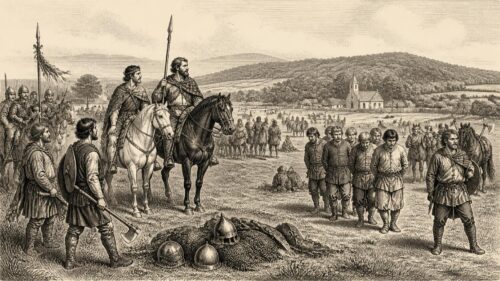
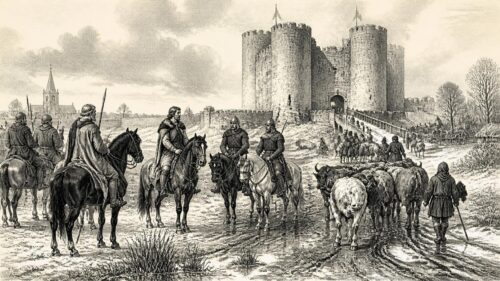
The record for 1436 is unusually revealing because it preserves two sides of a struggle in the Irish midlands. One annal says that Ó Conchobhair Fáilghe waged a great war against the English, burning, plundering and killing in revenge for the imprisonment of an O’Donnell relative by marriage. Another, the Annals of Connacht, reports a decisive counterstroke: the English of Meath, the sons of Ó Fearghail and the Prior of Kilmainham defeated Ó Conchobhair Fáilghe, killing Murchadh Óg Ó Lochlainn and mercenaries from Munster. Neither account supplies a day, battlefield or full sequence of operations. Together, however, they make 1436 a year in which warfare on the lordship’s midland frontier was both intimate and political: prompted by kinship, conducted through raids and answered by a coalition joining colonial settlers, Gaelic allies and a military-religious institution.
A Midland Counterstroke
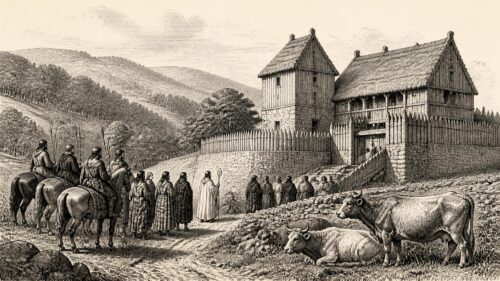
The Ó Conchobhair Fáilghe lordship lay west of the English settlement around Dublin and Meath, across a landscape of woodland, bog, pasture and river crossings. It was precisely the sort of borderland in which royal claims, aristocratic lordship and local Gaelic power met without producing a fixed front line. The Annals of the Four Masters characterise the conflict from the standpoint of Ó Conchobhair Fáilghe: a sustained war against “the English”, undertaken to avenge the confinement of O’Donnell, described as his marriage kinsman. The prisoner was almost certainly connected with the wider crisis created by the capture of Niall Garbh Ó Domhnaill, king of Tír Chonaill, during the preceding years; later annals place Niall’s death in captivity on the Isle of Man in 1439. That identification is a strong contextual reading rather than an explicit statement in the 1436 entry itself.
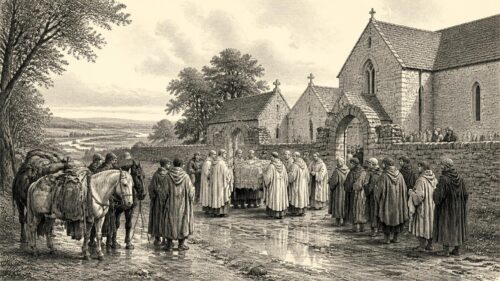
The Connacht annalist supplies the reverse image. It records “a great victory” over Ó Conchobhair Fáilghe by the Galls of Meath, the sons of Ó Fearghail and the Prior of Kilmainham, and names the dead among his followers. The prior headed the Irish house of the Knights Hospitaller, a religious order whose Kilmainham establishment near Dublin possessed land, armed resources and a long political role. This was not therefore a purely secular campaign. A churchman and a military order could be active participants in the defence and extension of the English lordship.
The administrative language around the victory needs care. The annalist calls the Prior of Kilmainham the man who “held the Lieutenancy”. Modern scholarship more cautiously identifies him as acting for James Butler, fourth earl of Ormond, while other evidence places Richard Talbot, archbishop of Dublin, as deputy lieutenant from November 1435 until April 1437. Such overlaps were characteristic of a government in which authority was exercised through lieutenants, deputies, councils and powerful magnates. The essential point is secure: the forces opposing Ó Conchobhair Fáilghe had access to official authority as well as local Meath manpower and Gaelic collaborators.
The victory did not settle the midlands. The Four Masters continued to portray Ó Conchobhair Fáilghe as an active enemy of the English in 1437 and 1438. Indeed, the following year brought an internal dispute between him and his brother Cahir, who made common cause with the English. It would be misleading to turn the 1436 defeat into a final conquest. It was a hard-fought episode in a longer contest over tribute, raiding rights, lordship and the security of settlements bordering Meath and Offaly.
Captivity, Kinship and Power
The claimed motive for the war gives the year a wider Irish dimension. Niall Garbh Ó Domhnaill’s capture had followed campaigning in the north-west and had removed a major ruler from Tír Chonaill. His incarceration was not simply a private misfortune. A captive lord could become a bargaining counter, a cause for revenge, an incentive to allies and an opening for rivals at home. The connection invoked by Ó Conchobhair Fáilghe shows that marriage linked political interests across considerable distances. In fifteenth-century Ireland, a conflict in the central plain could be connected to the fate of a Donegal dynasty.
That connection also demonstrates the limits of treating the island as divided into two sealed communities, “English” and “Irish”. The coalition that beat Ó Conchobhair Fáilghe included the English of Meath and the sons of Ó Fearghail; the lord resisting them could ground his cause in a relationship with an Ó Domhnaill. Alliances were shaped by neighbourhood, family, hostages, payments and immediate advantage. The annals use broad ethnic and political labels, but the action beneath them was often more mixed.
Violence in Tír Eoghain
Ulster was equally unsettled. The Annals of Ulster and the Four Masters place the killing of Niall, son of Eóghan Ó Néill, in 1436. Niall and many of his people were slain in his own house during a night attack by Clann Cinaith of Trough, assisted, according to the Four Masters, by the sons of Henry Ó Néill and the people of Oriel. This was violence within the political world dominated by Eóghan Ó Néill, king of Tír Eoghain, rather than a simple encounter between rival provinces.
A chronological warning is necessary. The Annals of Loch Cé enters Niall’s death under 1435, whereas the Annals of Ulster and Four Masters place it under 1436. The event itself is well attested, but its precise calendar-year assignment is not entirely uniform. It is responsibly included here because two major annalistic traditions explicitly date it to 1436, while the discrepancy reminds us that annal headings are evidence to be compared, not merely copied.
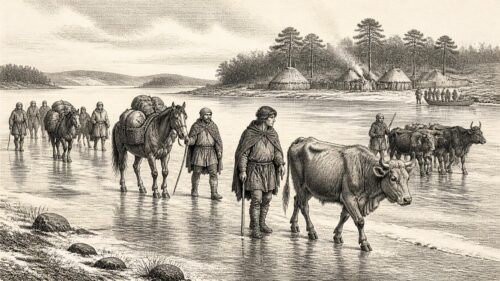
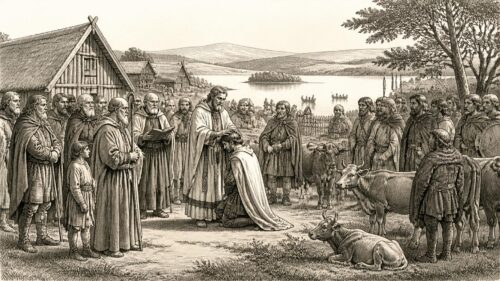
The same northern annals give a clearer sequence for a dispute at the crannóg of Loch Laoghaire, an artificial island stronghold. Sons of Brian Ó Néill held the site. Eóghan Ó Néill and his son Henry surrounded the lough, summoned Thomas Óg Mag Uidhir, king of Fir Manach, and prepared small vessels to approach the crannóg. Before the assault came, the defenders surrendered it and made peace. Eóghan, Henry and Mag Uidhir then raided Tírhugh, in present-day Donegal, taking spoil and causing destruction; John Mac Gille-Martain, Mag Uidhir’s doorkeeper, was killed in the pursuit.
This short account captures the practical geography of lordship. Water was both barrier and refuge. A crannóg could command a lake-bound position, yet its safety depended on food, men, allies and the difficulty of reaching it by boat. Peace did not end coercion: it enabled a combined force to turn outward against Tírhugh. For communities in the path of such expeditions, the annals’ formulae of “spoils”, devastation and killing signify immediate losses of animals, stores and security, even though they do not allow the historian to calculate the human or material cost.
Learning Marked by Loss
Political violence was not the year’s only concern. The Four Masters record the death of Gilla-Íosa Mac Aodhagáin, ollamh in law to Mac Wattin and superintendent of schools of jurisprudence and poetry. They also record the drowning of Geanann Mac Cruitín, described as the intended ollamh of Thomond in history and praised as an exceptionally promising historian. These notices matter because they reveal institutions that rarely appear in administrative records: learned households and schools sustained by aristocratic patronage.
An ollamh was not simply a flattering title for a clever individual. It marked the highest standing in a learned discipline. The Mac Aodhagáin were associated with the transmission of native legal learning as well as literary culture; the Mac Cruitín served the historical and poetic traditions of Thomond. Law, genealogy, history and formal verse were useful forms of knowledge. They could establish pedigrees, articulate rights, preserve precedents, commemorate patrons and make public judgements on reputation. The deaths of two such men cannot demonstrate that learning declined in 1436, but they show the contemporary value attached to its custodians.
A separate manuscript datum offers a modest, firmly dated cultural marker. Trinity College Dublin MS E 4.1 is catalogued to 1436 and preserves material from the Metrical Dindshenchas, the great body of Irish place-lore poetry. The manuscript’s date should not be inflated into a claim about its precise place of copying or patron. It does, nonetheless, sit well beside the annalists’ obituaries: while lords fought for crannógs, lordships and captives, Irish textual culture continued to value the learned preservation of landscape, names and inherited knowledge.
A Year of Connected Local Worlds
Other obituaries underscore the fragmented scale of politics. Conchobhar, son of John Ó Raighilligh and son of the lord of the two Breifnes, died in 1436, praised in Ulster as hospitable and valiant. Murchadh, son of Cormac Mac Donnchadha, heir to the lordship of Tír Eirrill, also died. A raid into Cúil Ua bhFinn involving branches of Mac Donnchadha ended in defeat and the death of seven men, alongside Conchobhar Cam Ó Gadhra. Such entries do not form a national narrative, nor should they be forced into one. They show an Ireland of overlapping lordships, in which inheritance, reputation, hospitality, armed followings and local feuds all remained politically consequential.
For that reason, 1436 is best understood not as a year of one island-wide war, but as a year of connected local worlds. In Offaly, a Gaelic lord’s war of vengeance met an organised counterattack led from the English lordship. In Ulster, a household killing and a struggle for a lake stronghold exposed fractures within the Ó Néill political sphere. In learned families, the deaths of a law teacher and a prospective historian were important enough to be preserved beside campaigns and chieftains. The surviving evidence is brief, partisan and sometimes chronologically uneven. Yet it gives a vivid, responsible picture of how power was made and contested in Ireland: through kinship and captivity, raids and negotiated surrenders, religious institutions and professional learning.
Primary Sources
- Annals of the Four Masters, Volume 4 (English translation)
- The Annals of Ulster, Year U1436
- The Annals of Ulster
- Annals of Loch Cé
- Annála Connacht
- Annála Connacht (Irish text)
- O'Neill (Ó Néill), Eóghan
- Talbot, Richard
- FitzGerald, Gerald fitz Maurice
- FitzGerald, Thomas ‘fitz Maurice’
- The Gaelic Learned Tradition
- The MacEgan Legal Treatise: An Early Modern Irish Law-Text by Giolla Na Noamh Mac Aodhagáin (1309)
- Narratives in Early Irish Law Tracts
- Bardic Poetry and the MacMahons of Oirghialla
- The Metrical Dindshenchas
- MS C iii 3 (The Annals of the Four Masters)
- Royal Irish Academy Manuscript Collection
- Two Irish Brehon Scripts, with Notes on the MacEgan Family
- Registrum de Kilmainham
- Statute Rolls of the Parliament of Ireland, Reign of King Henry the Sixth
- War, Politics and the Irish Lordship in the Fifteenth Century
- Manuscript Contexts of Early Irish Law
- Annals of the Four Masters: Irish History, Kingship and Society in the Early Seventeenth Century