Meelick’s Observant Turn1479 CE
In 1479, Ireland’s diverse political and religious worlds were marked by reform, conflict and administrative adjustment. At Meelick, O’Madden patronage supported a Franciscan Observant renewal, strengthening dynastic commemoration and regional religious links. In Ulster, warfare between Tír Chonaill and Tír Eóghain involved raids, cattle seizures, ransom and hostages, burdening local communities. Obituaries around Lough Erne reveal clergy, artisans and hospitality networks underpinning lordship. In Dublin, Edward IV appointed Gerald FitzGerald, eighth earl of Kildare, deputy lieutenant, acknowledging dependence on local power. Statutes concerning merchants, civic privileges and Gaelic subjects exposed the English lordship’s porous, contested frontiers and commercial regulation alike.

Dateline
For Ireland, 1479 is most clearly illuminated not by a single island-wide crisis but by a cluster of records from very different worlds: a Franciscan house beside the Shannon, a destructive war in Ulster, ecclesiastical deaths around Lough Erne, and the restoration of a young earl to royal office in Dublin. These should not be forced into one story. They reveal instead an island of overlapping jurisdictions, in which Gaelic lordships, Anglo-Irish magnates, towns, religious communities and the English crown all exercised authority in particular places.
The surviving annals attach several developments firmly to this year, though they were compiled or copied after the events they describe and must be read with due care. Their entries are especially rich for the northern and western lordships. Records from the English administration, meanwhile, show a government concerned with office, trade, legal status and the limits of its authority. Together, they make 1479 a revealing year of renewal, rivalry and negotiation.
A Franciscan Renewal at Meelick
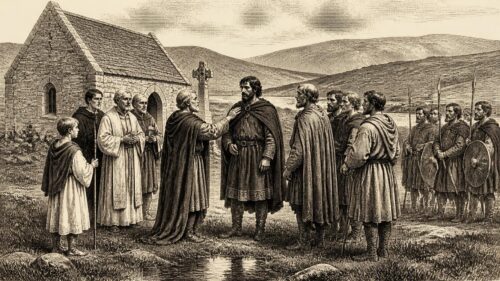
The Annals of the Four Masters place the foundation of a Franciscan monastery at Meelick, on the Shannon in the diocese of Clonfert, in 1479. They add that its O’Madden patron selected his own burial place there. This was a potent act of lordship. A friary provided a setting for worship, preaching, burial, commemoration and hospitality; it also publicly joined a ruling family’s name to an institution with local and wider religious connections.
Yet the word “foundation” needs qualification. Other evidence places papal permission for a Franciscan house at Meelick as early as 1414, while an indulgence for repairs was granted in 1445. Modern Franciscan tradition identifies 1479 as the year in which Meelick became Observant, adopting the reforming current within the order that stressed stricter discipline, poverty and religious observance. It is therefore safer to see the annalistic notice as recording a major renewal, refoundation or formal change in the community’s standing, rather than confidently claiming that every part of the physical friary began from nothing in 1479.
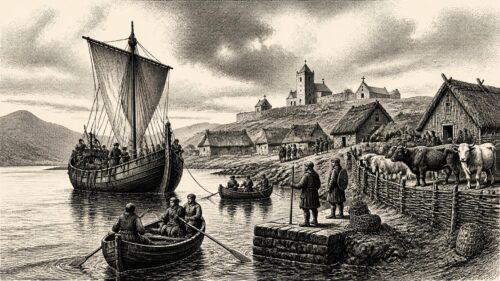
The distinction matters because it makes the event more, not less, significant. The Observant movement was reshaping late medieval Irish religious life. In the fifteenth century, existing friaries as well as new houses adopted reforms that connected them to a wider European drive for a more rigorous Franciscan life. Meelick’s place on the Shannon, within the O’Madden territory of Síol Anmchadha, gave the renewal a strong regional setting. The river was both a boundary and a route, linking settlements, lordships and ecclesiastical centres across the midlands and Connacht.
Patronage did not mean that a lord simply owned a religious house. Friars had their own rule, community and devotional purpose. But the O’Madden connection brought protection, land, resources and burial prestige; in return, the friary could preserve family memory and enhance local standing. In a political landscape where authority depended upon kinship, alliances and reputation, a renewed Franciscan presence was a durable statement of power as well as piety.
War Between Tír Chonaill and Tír Eóghain
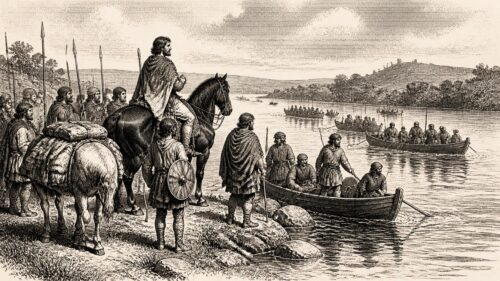
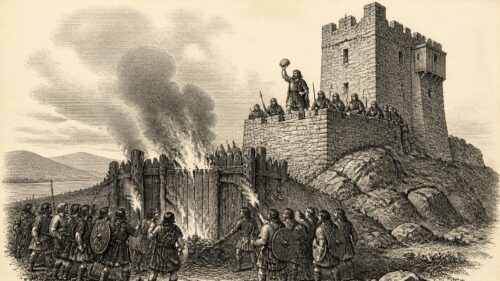
Far to the north, the annals record “great war” between the leading powers of Tír Chonaill and Tír Eóghain. The immediate alignments were complicated. The sons of Art Ó Néill entered Tír Chonaill to make war on Ó Néill, while the lord of Tír Eóghain launched a counter-raid into Tír Chonaill. The account says that substantial preys were taken from the Cenél Conaill and from the sons of Art.
Such wording is important. This was not a simple contest between two neatly unified peoples. The dispute involved the Ó Néill kindred itself, competing claimants and shifting allies, alongside the wider rivalry between the Ó Néill and Ó Domhnaill lordships. Aodh Ruadh Ó Domhnaill, ruler of Tír Chonaill, had already established himself as a formidable northern leader; Henry Ó Néill was the Ó Néill named in the closely related entry on the capture of Brian son of Feidhlimidh. Their competition was embedded in a landscape where control rested on the capacity to protect dependants, gather fighting men and take or defend cattle.
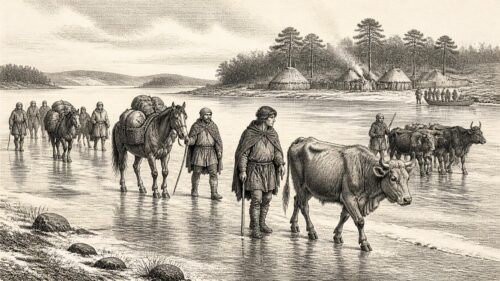
For people in the affected districts, a “prey” was not an incidental spoil. Cattle were central stores of wealth, food, tribute and status. Raiding could strip households of animals, disrupt seasonal work and oblige communities to move stock to safety. It also advertised political weakness. An annalist’s compressed sentence therefore points to much more than a march of armed men: it indicates pressure on farms, herds, labour and local obligations across parts of modern Donegal and Tyrone.
Brian son of Feidhlimidh Ó Néill’s experience captures the unstable politics of the year. Henry Ó Néill captured him, released him only after receiving a large ransom and Brian’s two sons as hostages, and nevertheless saw Brian join Ó Domhnaill in renewed war against Ó Néill. Hostages were not merely prisoners in the modern sense. Their delivery was a recognised guarantee for an agreement, but it also exposed families to grave danger should loyalty fail. Brian’s return to opposition demonstrates that ransom and hostages could impose a temporary settlement without ending a feud.
Church, Craft and Hospitality
The obituaries entered for 1479 offer rare glimpses of the institutions and skills that sustained these lordships. Piaras Ó Flannagáin, who died that year, had been canon chorister at Clogher, parson, prior of the Culdees, sacristan at Devenish and an ecclesiastical official around Lough Erne. The annalist praised his piety, humanity and hospitality. Even allowing for the conventional language of obituary praise, the list of offices shows how clergy could work across churches, collegiate communities, local administration and pastoral life.
Hospitality was a practical virtue as well as a moral one. A churchman, learned household or lord who maintained a guest-house fed travellers, clients, clerics and the poor, while also accumulating honour. Matthew Ó Maolruanaigh, who also died in 1479, is described as Maguire’s master-wright, keeper of a general guest-house and an accomplished goldsmith. His obituary preserves a striking combination: building skill, metalworking and organised hospitality were all valued within the world of Fir Manach.
Matthew’s work should caution against a picture of late medieval Gaelic Ireland as culturally isolated or technically static. A master-wright could be responsible for timber construction and repair; a goldsmith worked in a prestigious craft whose products might include personal ornaments, secular display and ecclesiastical metalwork. His association with the Maguire lordship suggests that skilled artisans were maintained within elite networks, but the description of a general guest-house also indicates a wider social role. Wealth was expected to circulate through giving, feeding and receiving guests.
The year’s deaths also record women within these political and ecclesiastical networks. Aiffric Maguire, wife of Cairpre son of Aodh Ó Néill, died in 1479; Finghuala Maguire, wife of Domnall Ó Breislen, died on 21 February. The annals principally identify them through fathers and husbands, which limits what can be recovered of their own lives. Nonetheless, these notices demonstrate that marriages between important families formed part of the fabric of regional politics. The birth of Edward, son of Cathal Mac Maghnusa junior, on St Patrick’s Day was likewise noteworthy enough to enter the record, perhaps reflecting the standing of a family associated with Fermanagh’s learned tradition.
Kildare and the English Lordship
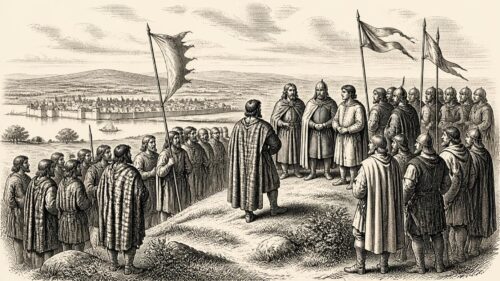
In Dublin and the Pale, 1479 brought a significant change in government. Gerald FitzGerald, eighth earl of Kildare, had succeeded his father in 1478 and had briefly served as temporary governor. Edward IV initially replaced him with the English lord Grey, but Grey’s authority proved ineffective amid resistance from Kildare and his allies on the Irish council. In 1479 the king summoned Kildare to court and appointed him deputy lieutenant, with an annual salary of £600 and directions for the governance of Ireland.
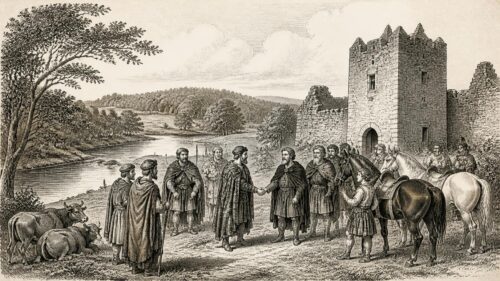
This appointment did not create a government capable of commanding the whole island. Its importance lay precisely in its limits. Kildare’s restoration recognised that royal administration depended heavily on a powerful local magnate who could work through Anglo-Irish and Gaelic relationships. His return marked the beginning of the long Kildare ascendancy, though the scale of that later dominance should not be projected uncritically backwards onto every district in 1479.
Statutory material assigned to the parliamentary session of 1479–80 provides a further, carefully dated window onto the lordship’s concerns. Because the surviving abstracts cover a session straddling two calendar years, individual measures cannot safely be assigned to a particular day in 1479. They nonetheless belong closely to the year’s political setting. They include a charter for a guild of English merchants trading in Ireland, based at the chapel of Mary of Grace near Dublin Bridge; provisions concerning revenue and Dublin civic privileges; and a measure declaring Conn Ó Néill and his children by Eleanor to be English subjects.
Another measure prohibited English merchants from taking goods to markets in Cavan, Granard, Longford or other “Irish country”, or bringing goods back from them. Such legislation shows an official attempt to regulate commerce across the frontier between the English lordship and neighbouring Gaelic territories. It should not be mistaken for proof that exchange ceased. On the contrary, laws restricting traffic usually imply that traffic mattered. The measures reveal both the reach claimed by Dublin’s administration and its anxiety about the economic and legal permeability of its borders.
A Year of Connected Regions
By the close of 1479, Meelick’s religious renewal, the northern war and Kildare’s appointment had not remade Ireland into a single political unit. They instead show several connected regional worlds. Along the Shannon, an O’Madden-backed Franciscan house embodied reform and dynastic memory. In Ulster, raids, ransom and hostages exposed the costs of contested lordship. Around Lough Erne, clerics and craftsmen sustained institutions through learning, labour and hospitality. In Dublin, royal government relied on Kildare while trying to supervise trade, allegiance and law.
The evidence is uneven, and many ordinary lives remain silent within it. But the surviving notices make clear that 1479 was not an empty interval between better-known crises. It was a year in which religious reform acquired a local home, political rivalries reached into households and herds, and the English administration adjusted itself to the realities of power in Ireland.
Primary Sources
- The Annals of Ulster: Year U1479
- Annals of the Four Masters: Annal M1479
- Annála Connacht
- FitzGerald, Gerald (Gearóid Mór)
- O'Donnell (Ó Domhnaill), Aodh Ruadh
- Maguire (Mág Uidhir), Tomás Óg
- Statute Law Revision Act 2007, Schedule 2
- Pre-Union Irish Statutes
- Meelick (Co. Galway)
- Saint Francis's Catholic Church, Friarsland, Meelick, Galway
- County Galway Urban Archaeology Survey: Meelick
- Returning to Core Principles
- Two Nations, One Order: The Franciscans in Medieval Ireland
- A Church ‘in Decline’? The Pre-Reformation Irish Church
- The Parish Fraternities of County Meath in the Late Middle Ages
- Social and Spatial Order in the MacMahon Lordship of Airghialla in the Late Sixteenth Century
- The Struggle for Control of the Irish Mint, 1460-c.1506
- War and Society in Late Medieval Ireland
- Gearóid Mór – The Great Earl of Kildare
- Meelick, County Galway: Schools’ Collection Transcripts