Roscommon Construction1269 CE
In 1269 Robert de Ufford, the English crown’s justiciar, began Roscommon Castle while Áed Ó Conchobair, king of Connacht, was ill, exploiting a temporary weakness to establish a durable royal foothold. The project disrupted local people and intensified Anglo-Irish pressure within Ó Conchobair territory, although it did not signify Connacht’s conquest. Sligo Castle’s rebuilding by Mac Muiris Mac Gerailt similarly demonstrated contested frontier control. Religious life featured Imar Ó Birn’s entry into Roscommon’s Dominican priory and aristocratic patronage. Annals also noted killings, the death of musician Áed Ó Finn, and uncertain reports of an earthquake and weather, requiring cautious chronology.
Dateline
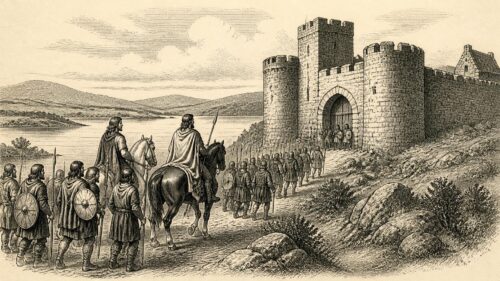
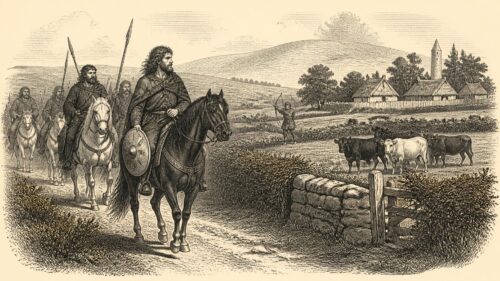
In 1269, the most consequential development securely associated with Ireland was the building of a royal castle at Roscommon. It was an act of state-making in a contested landscape: Robert de Ufford, justiciar of Ireland for the English crown, entered Connacht while Áed Ó Conchobair, king of Connacht, was ill. The Annals of Connacht state plainly that Ufford and the “Galls of Ireland” built the castle because Áed’s sickness prevented resistance. The wording is unusually revealing. A moment of personal vulnerability for a Gaelic king enabled a major encroachment upon the political heartland of his dynasty.
Roscommon was not a remote outpost. It stood within the Ó Conchobair sphere, close to important ecclesiastical foundations and amid the plains and routes of central Connacht. Since the Anglo-Norman arrival, castles had served not merely as refuges in war but as instruments for collecting revenues, housing garrisons, asserting jurisdiction and projecting lordship into disputed territory. The construction begun in 1269 therefore marked a bid to turn military opportunity into a durable royal presence.
A Castle in a King’s Country
Robert de Ufford had arrived in Ireland on the business of the Lord Edward, son of Henry III and lord of Ireland. By 1269 he was acting as justiciar, the crown’s chief governor in the lordship. His task was not simply to administer the settled eastern and southern counties. It was to maintain royal authority among Anglo-Irish magnates and, where possible, extend its reach beyond them. Connacht was an especially difficult arena: the de Burgh lordship claimed extensive rights there, but the Ó Conchobairs remained powerful rulers with their own followers, alliances and political ambitions.
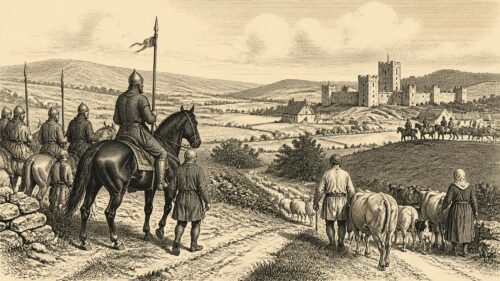
The castle at Roscommon should thus not be imagined as proof that Connacht had been conquered. Rather, it was an attempt to alter the balance of power. The annals’ explanation that Áed Ó Conchobair was incapacitated by illness indicates how contingent the project was. Earlier campaigns had shown that a large force could enter Connacht yet struggle to impose permanent control. A masonry stronghold, once supplied and garrisoned, offered a means of retaining a foothold after an expedition had departed.
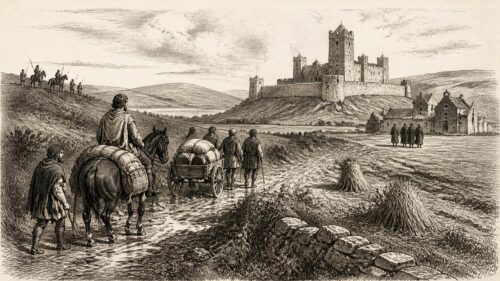
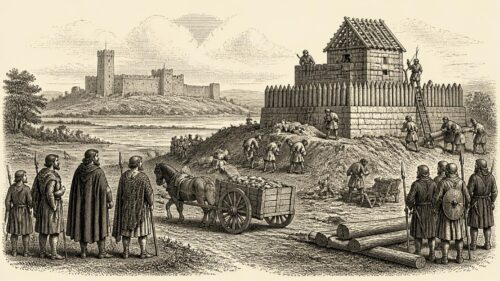
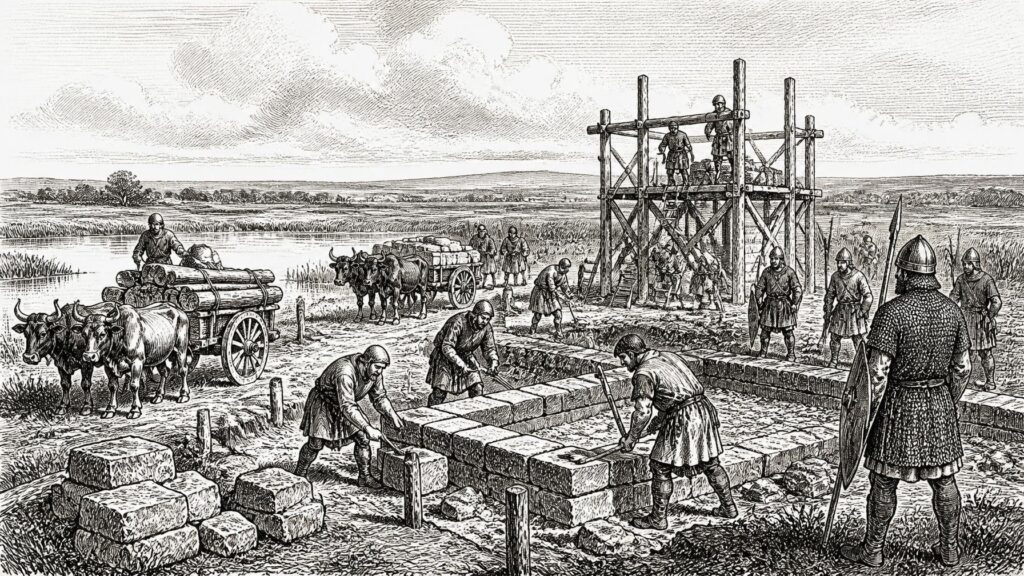
Archaeological and architectural study also cautions against treating 1269 as the completion date of the ruin visible today. Work began then and continued through several phases, while later attacks, captures and rebuilding changed the structure repeatedly. Nevertheless, the initial foundation mattered. The choice of low-lying ground, protected in part by marsh and later by ditches or moats, demonstrates the practical military thinking behind the site. Building required labour, timber, stone, lime, transport, food and security: the castle was an administrative and economic undertaking as well as a military one.
For local people, its arrival was likely to have been immediate and disruptive. The annals say that, while their king was unable to act, the people of Connacht were plundered and oppressed by English forces. Such phrasing is partisan, but it fits the logic of a campaigning army that needed provisions, animals and labour. The new castle concentrated that pressure around Roscommon. It placed a royal and colonial institution within a district where the Ó Conchobairs had deep dynastic, religious and political associations.
Connacht’s Uneasy Balance
Áed Ó Conchobair had succeeded his father Fedlimid as king of Connacht in 1265. His position had been won and maintained amid rival claims within Connacht as well as hostility from Anglo-Irish lords. The years immediately before 1269 had seen raids, negotiated settlements and major fighting. Neither side held an uncomplicated advantage. The Irish annals preserve both the destructive reach of Anglo-Irish expeditions and the ability of Connacht forces to defeat or evade them.
This background explains why Roscommon was worth fortifying. The justiciar’s action was connected to crown government, but it also intersected with the interests of Walter de Burgh, earl of Ulster and lord of Connacht, the greatest Anglo-Irish magnate in the region. De Burgh’s lordship was formidable on paper, yet its exercise depended on alliances, armed followings and castles. The new royal work could assist the wider Anglo-Irish position, while also making the king’s government more visibly present among magnates whose private power often rivalled it.
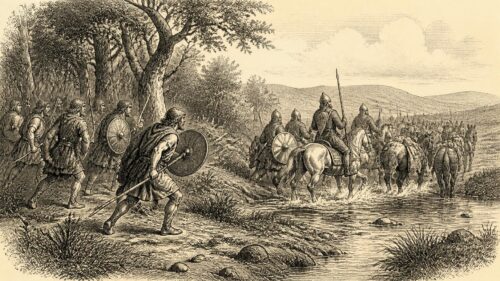
The sources do not permit a precise reconstruction of every negotiation or skirmish of 1269. They do show a political world in which illness, kinship, hostages, cattle, fortifications and control of routes all affected sovereignty. A castle could become a bargaining counter, a base for raids or a target whose loss carried symbolic force. Roscommon’s foundation was therefore not a quiet building project at the edge of events; it was itself a political intervention.
Sligo Rebuilt
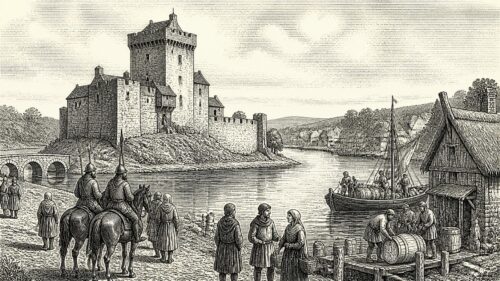
Another Connacht castle appears in the record for 1269. The Annals of Connacht report that Sligo Castle was rebuilt by Mac Muiris Mac Gerailt, a member of the FitzGerald family. Sligo had already demonstrated the instability of frontier fortification. A castle there had been destroyed by Áed Ó Conchobair and his allies in 1265; rebuilding it four years later represented a renewed effort to sustain an Anglo-Irish position in north-west Connacht.
Roscommon and Sligo were different places, but their paired appearance in the year’s annals is significant. One lay in central Connacht near the Ó Conchobair heartland, the other at a strategic settlement in the north-west. Together they reveal a policy of holding territory through fortified nodes rather than through uncontested control of a whole province. They also show that destruction was not necessarily final. Castles were reconstructed because their sites, routes and surrounding lordships remained worth contesting.
Contemporary writers used broad labels such as Galls for settlers and men of Anglo-Norman descent, yet political realities were more complicated than a simple division between two fixed communities. Anglo-Irish lords competed with one another, Gaelic rulers fought among their own kindreds, and alliances could cross cultural lines. The rebuilding at Sligo and foundation at Roscommon should be understood within this shifting frontier, not as a settled boundary between two separate Irelands.
Friars, Patrons and Renunciation
Amid the records of castles and killings, 1269 also offers a striking religious episode. Imar Ó Birn, described as a warrior and trusted officer of Áed Ó Conchobair, left behind children and wealth to enter the Dominican priory at Roscommon. The annalist presents this as a renunciation of the world. His decision gives a rare glimpse of an individual changing vocation within the political society of Connacht.
The setting is important. Roscommon’s Dominican house had been founded in 1253 by Fedlimid Ó Conchobair, Áed’s father. Its presence beside the emerging royal castle illustrates the close, sometimes uncomfortable proximity of Gaelic kingship, reformed religious orders and Anglo-Irish power. Dominican friars preached, heard confession, taught and depended on patrons, but their houses also became places where elite men and women sought burial, commemoration and a religiously meaningful end to secular life.
The death of Christine, daughter of Ó Nechtain and wife of Diarmait Midech Mac Diarmata, was also recorded in 1269. The Annals of Connacht praise her generosity towards the Cistercian order; the later Annals of the Four Masters instead associate her especially with the Grey Friars. The difference should not be smoothed away. It may reflect divergent traditions of patronage or commemoration. What both accounts agree upon is that elite women’s religious giving was worth remembering and that piety, generosity and penitence were public qualities in aristocratic memory.
The Annals of the Four Masters additionally place the death and burial at Mellifont of David Ó Brácáin, bishop of Clogher and formerly a monk there, under 1269. Other reference chronologies put his death around 1267, so this cannot be treated as a firmly dated event of the calendar year. It is nonetheless a useful reminder of the enduring links between episcopal office and the great Cistercian house of Mellifont.
Violence, Music and an Uncertain Weather Record
The annals also record smaller but telling acts of violence. Tadc Ó Conchobair was killed at Elphin by a soldier of his own kinsman and the killer was immediately put to death. Brian, son of Domnall Dub Ó hEgra, was killed by the Galls at Sligo. Domnall Ó Fergail and his son Áed were killed by Gilla na Naem Ó Fergail and the Galls. These notices show that conflict was not confined to formal campaigns. It ran through households, kindreds and local lordships, where political rivalry could become personal killing.
Yet 1269 was not remembered only through war and building. Áed Ó Finn, called a master of music and minstrelsy, died that year. The brief notice confirms the recognised standing of learned performers in Gaelic society. Musicians, poets and other men of learning moved within aristocratic networks of patronage, hospitality and reputation. Their work was central to ceremony and memory, even when the surviving record gives us only a name and an honourable epithet.
A late annal associated with the Kilkenny Franciscan tradition reports an earthquake in Ireland in 1269, but supplies no location, date, damage or corroborating detail. It is responsible to record the notice, not to inflate it into a national disaster. Likewise, the Annals of Inisfallen place dramatic events in Thomond and a destructive wind under their 1269 heading, but modern reference chronology assigns the death of Conchobar Ó Briain to 1268. Medieval annals remain indispensable, but their year headings must be read critically.
The firm centre of 1269 remains Roscommon: a royal castle begun while Connacht’s king was sick, a nearby Dominican house receiving a warrior turned friar, and another castle restored at Sligo. Together, these developments capture an Ireland in which political authority was repeatedly made, challenged and remembered through strongholds, religious institutions and the actions of individuals.
Source References
Hover over a number to see the source. Select it to open the source.
- [1] Annála Connacht: Annal 1269
- [2] Annála Connacht (Irish text)
- [3] Annals of the Four Masters: Annals M1262–M1270
- [4] Annals of the Four Masters (Irish text)
- [5] The Annals of Ulster: Year U1269
- [6] Annals of Ulster (Irish text)
- [7] Annals of Inisfallen
- [8] Annales Breves Hiberniae
- [9] Ufford (Offord), Sir Robert of
- [10] Burgh, Walter de
- [11] Burgh, Richard de
- [12] O'Brien (Ó Briain), Conchobar
- [13] Ó Braccáin, Stiamna (O'Brogan, Stephanus)
- [14] Roscommon Castle
- [15] 2002:1626 – Roscommon Castle, Roscommon
- [16] Anglo-Norman Trail
- [17] Roscommon Abbey
- [18] Irish Historic Towns Atlas: Sligo Text
- [19] History: Old Mellifont Abbey
- [20] Old Mellifont Abbey Monastic Site
- [21] Annales Dominicani de Roscoman
- [22] The Dominicans of Roscommon
Primary Sources
- Annála Connacht: Annal 1269
- Annála Connacht (Irish text)
- Annals of the Four Masters: Annals M1262–M1270
- Annals of the Four Masters (Irish text)
- The Annals of Ulster: Year U1269
- Annals of Ulster (Irish text)
- Annals of Inisfallen
- Annales Breves Hiberniae
- Ufford (Offord), Sir Robert of
- Burgh, Walter de
- Burgh, Richard de
- O'Brien (Ó Briain), Conchobar
- Ó Braccáin, Stiamna (O'Brogan, Stephanus)
- Roscommon Castle
- 2002:1626 – Roscommon Castle, Roscommon
- Anglo-Norman Trail
- Roscommon Abbey
- Irish Historic Towns Atlas: Sligo Text
- History: Old Mellifont Abbey
- Old Mellifont Abbey Monastic Site
- Annales Dominicani de Roscoman
- The Dominicans of Roscommon