Mortimer’s Athlone1381 CE
In 1381, Ireland’s political geography was defined less by a single frontier than by a patchwork of competing lordships, castles, family claims and negotiated loyalties. King Richard II was lord of Ireland, but royal government was strongest in and around the Anglo-Irish towns and lordships of the east and south-east. Beyond them, Gaelic rulers, Gaelicised settler dynasties and Crown officers all exercised power in overlapping ways. The year’s clearest focal point was Athlone: a fortified crossing of the Shannon whose possession mattered not merely to the town, but to the balance between Meath and Connacht.
Dateline
In 1381, Ireland’s political geography was defined less by a single frontier than by a patchwork of competing lordships, castles, family claims and negotiated loyalties. King Richard II was lord of Ireland, but royal government was strongest in and around the Anglo-Irish towns and lordships of the east and south-east. Beyond them, Gaelic rulers, Gaelicised settler dynasties and Crown officers all exercised power in overlapping ways. The year’s clearest focal point was Athlone: a fortified crossing of the Shannon whose possession mattered not merely to the town, but to the balance between Meath and Connacht.
Edmund Mortimer, earl of March and earl of Ulster through his wife Philippa, was serving as the king’s lieutenant in Ireland. He had arrived in 1380 with unusually substantial resources and ambitions. Mortimer was not simply a distant royal official sent to preserve order. His family asserted inherited claims in Ulster and Connacht, territories where effective control had long slipped away from the English administration. His government therefore combined Crown business with an effort to restore Mortimer influence. That ambition made his actions in 1381 politically significant, but also locally disruptive.
A Castle on the Shannon
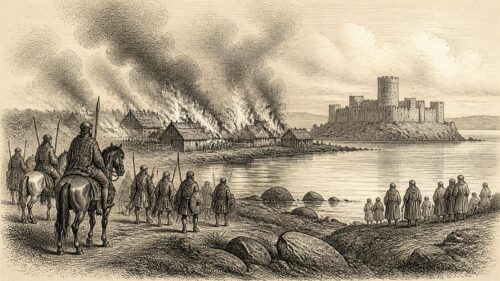
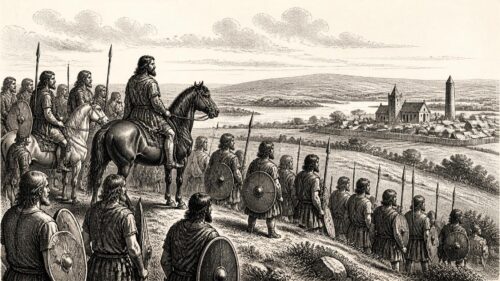
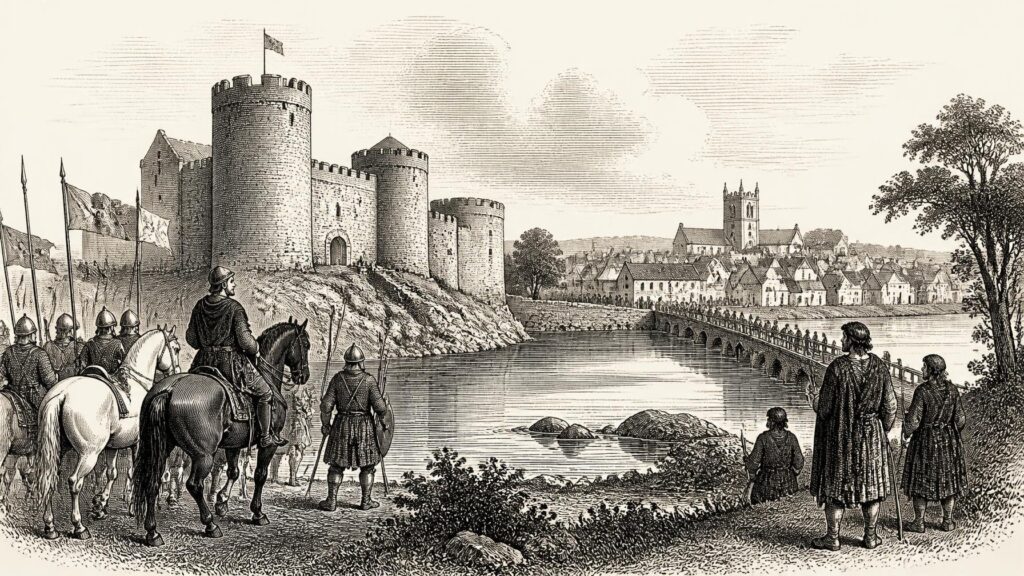
The Irish annals place Mortimer’s seizure of Athlone Castle in this year. The Annals of Ulster state bluntly that “the Mortimer” took the castle and that a son of Richard an tSonnaigh was killed inside it. The Four Masters preserve the same essential event. Athlone had been built to command one of the most important crossings of the Shannon: whoever held its bridge, ford and stronghold could move men, horses, provisions and messages between the English lordship of Meath and the western province of Connacht. It was therefore a strategic prize rather than a remote outpost.
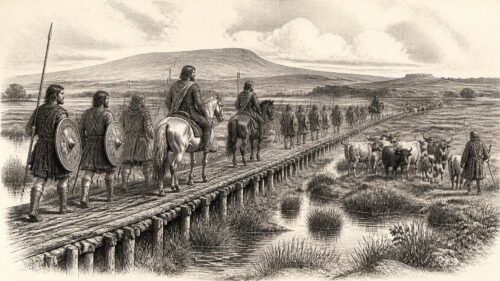
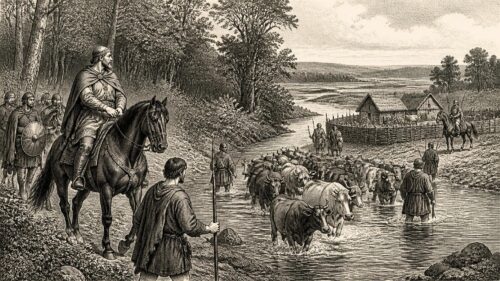
The capture was not the end of the contest. Ruaidrí Ó Conchobair, king of Connacht, came to Athlone, while his sons and other followers crossed into western Meath and carried away substantial prey. Such raids were not random plundering. Cattle, horses, movable goods and captives could sustain a lord’s following, compensate allies and demonstrate that an adversary’s claimed authority was still vulnerable. The Annals of Ulster report that the force was overtaken by “the Foreigners” – their usual term here for settlers or English forces – and defeated. John “the Lagenian”, a son of Ó Conchobair, was killed; Aedh Blind-eye Ó Conchobair was taken prisoner; and William Ó Ceallaigh and many others died.
That sequence reveals the immediate limits of Mortimer’s success. Athlone could be taken, garrisoned and used as a bridgehead, but control of a castle did not automatically secure the countryside beyond it. Connacht’s rulers retained the ability to assemble forces, cross into Meath and contest the frontier through rapid movement and raiding. Conversely, the defeat of Ruaidrí’s men showed that Mortimer’s recovery of the stronghold gave the lordship a more formidable defensive position on the Shannon. The year was not a final conquest of Connacht; it was a sharp, temporary reversal in a longer struggle over access, authority and revenue.
Campaigning and Council
Mortimer’s activity in 1381 was spread across several regions. Modern research places a campaign against the Uí Thuathail, or O’Tooles, in the Wicklow Mountains in April. This was close to the heartland of the English lordship, yet it underlines how insecure communications south of Dublin could be. The O’Tooles’ mountain territory was difficult country for an army dependent on roads, supply and mounted troops. A lieutenant who wished to project royal authority towards Connacht or Munster first had to reckon with enemies and raiders much nearer Dublin.
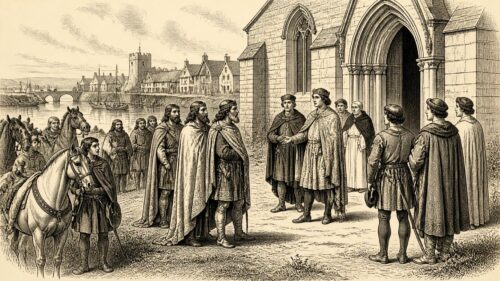
By August, Mortimer’s administration had shifted its attention towards Munster. A later Irish chancery record identifies a council held at Clonmel on 5 August 1381, attended under Mortimer’s authority by his half-brother Thomas Mortimer and Alexander Balscot, bishop of Ossory. This is one of the few pieces of evidence that gives the year a secure administrative date. The council considered an expedition against the Uí Bhriain of Thomond, whose growing pressure in the south concerned the lieutenant. The planned operation did not come to fruition. Still, the Clonmel meeting shows government in practice: magnates, bishops, legal officers and military concerns brought together in a walled town at the meeting-point of Munster and Leinster.
The same record offers a brief glimpse of law amid warfare. It concerns a man described as a brehon and counsellor who had been arrested over a debt owed to Thomas Skirlag, but who was then condemned to death for other harms committed against the king and his lieges. The evidence is too narrow to reconstruct the case or make broad claims about ordinary justice. Yet its language is telling. A brehon – a learned practitioner within Gaelic legal culture – appears in a record of royal administration, while the dispute involved English governmental authority in Munster and Leinster. Legal worlds were not neatly separated; people could move between, or be judged within, overlapping political systems.
Connacht’s Internal Struggles
Conflict was equally fierce within Gaelic dynasties. The Four Masters record that Ruaidrí Ó Conchobair dispossessed the grandsons of Felim Ó Conchobair of Ballintober Castle. Later, Cathal, Ruaidrí’s son, was captured at Bel-an-tachair by Brian Ballach Ó Conchobair while returning from Conmaicne of Dunmore. Brian held him until he obtained terms for his ransom, after which peace was made. Hostage-taking and ransom were established instruments of high politics: they removed a rival temporarily, created leverage and could end in a settlement rather than a killing. These conflicts did not signify political disorder alone; they were also methods through which succession and lordship were decided.
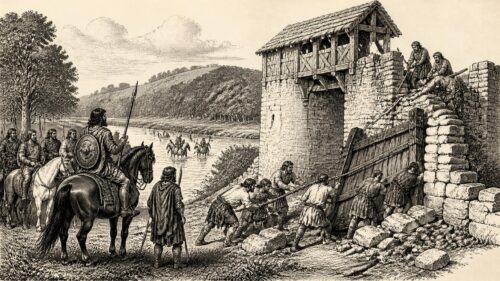
Further north in Connacht, the castle at Ballylahan was broken down by Clann Donnchadha, who carried its gate to Ballymote. The annal does not explain whether this was a ceremonial trophy, a practical reuse of timber and ironwork, or both. What can safely be said is that castles were active political assets: their gates, walls and possession had symbolic as well as military value. Heritage evidence also places the Mac Donnchadha, or MacDonaghs, in possession of Ballymote Castle by 1381. The transfer of such a major fortress in Corann illustrates how thoroughly a structure originally associated with Anglo-Norman power could become embedded in the rivalries of Gaelic and Gaelicised families.
In Uí Maine, covering much of eastern Galway and south Roscommon, the death of William Ó Ceallaigh brought his son Máel Sechlainn to power. Both the Annals of Ulster and the Four Masters record the succession. The latter praises William as a lord who had offered hospitality to the schools of Ireland and given learned visitors what they required. Annalistic praise is formulaic and should not be read as an audited account of an educational system. Nevertheless, it preserves an important reality: learned poets, historians, lawyers, clerics and teachers depended on aristocratic patronage, and a ruler’s reputation rested partly on his ability to feed, reward and protect them. Political succession in 1381 therefore also mattered to the maintenance of scholarship and cultural status.
Violence, Kinship and Piety
Elsewhere, the annals record a succession of smaller but consequential killings. Diarmait Mac Carthaigh, heir to the lordship of Desmond, was killed by the Uí Mathghamhna in what the Annals of Ulster call treachery. Kennedy Mac Brien of Uí Cuanach was killed by the English. Niall Ó Néill led a hosting into Oriel, taking considerable spoils, but Oriel’s people struck his rearguard and recovered part of them; Donnchadh Mac Mathghamhna died in the encounter. These notices show how warfare often worked at local scale: a raid, pursuit, ambush, killing and recovery of livestock could alter the standing of a lineage without producing a set-piece battle.
Family connections also appear repeatedly in the year’s obituaries. The Annals of Ulster name women through both birth and marriage: Dubchablaigh Mac Diarmata, wife of Mag Raghnaill the Red, and Lasairfina Ó Conchobair, wife of Mag Raghnaill the Black. The Four Masters add several more such notices. These entries are reminders that marriages linked ruling houses across regions, creating obligations, channels of negotiation and potential causes of dispute. Women are often visible in the surviving record only at death, but the care with which their kinship is specified reveals their place in the political fabric of lordship.
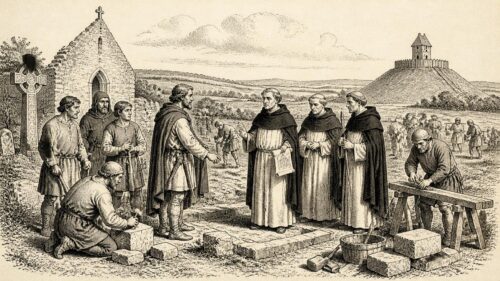
Religion entered the annals in a very different register. The Four Masters state that an image of the Blessed Virgin Mary at Kilmore “spoke after a wonderful manner”. This is evidence for reported belief and devotion, not proof that a statue literally spoke. The location is not securely identified by the annal alone. What the entry does demonstrate is that a miracle associated with a Marian image was considered important enough to preserve in the historical memory of the year. Such reports could encourage pilgrimage, offerings and the reputation of a church, while expressing a society in which sacred images were understood as possible vehicles of divine action.
Mortimer’s Sudden End
Mortimer’s death in Cork at the end of December transformed the year’s meaning. The annals simply record his death. Later evidence and modern biographical scholarship place it at the Dominican friary in Cork on 26 or 27 December, after an illness associated in later accounts with a winter river crossing; the precise day is not equally secure in every source. He was only twenty-nine. His son Roger was still a minor, and the combination of Mortimer authority, private lordship and royal office could not easily be replaced.
For contemporaries, Mortimer’s death did not erase the events of 1381: Athlone remained a contested crossing, Connacht remained politically divided, and Munster had not been brought to heel. But it removed the lieutenant who had supplied a rare concentration of wealth, title and military purpose to the English administration. The year thus closed not with a settlement, but with an abruptly weakened government and a renewed uncertainty over who could sustain the Crown’s ambitions in Ireland.
Source References
Hover over a number to see the source. Select it to open the source.

- [1] The Annals of Ulster, Year U1381
- [2] Annals of the Kingdom of Ireland by the Four Masters, Annal M1381
- [3] Mortimer, Edmund | Dictionary of Irish Biography
- [4] The rise and fall of the Clann Éinrí Aimhréidh Uí Néill: dynastic feuding and geopolitics in the late medieval Irish Sea world
- [5] Close Roll 5 Richard II (1381–1382), Item 167
- [6] Athlone Castle | Heritage Ireland
- [7] Ballymote Castle | Heritage Ireland
- [8] Richard II | Dictionary of Irish Biography
- [9] English Lordship of Ireland and the Irish Sea World: Re-assessing the Origins of the Kildare Ascendancy, c.1390–c.1513
- [10] The Monastic Establishments of Mediaeval Cork
- [11] The Irish Ecclesiastical Record, Volume 7
- [12] Permanent Expressions of Piety: The Secular and the Sacred in Later Medieval Stone Sculpture
- [13] Annals of Loch Cé
- [14] Annala Locha Cé
- [15] Annals of the Four Masters | CELT Project
- [16] The Annals of Ulster | CELT Project
- [17] Richard II | The National Archives
- [18] Codices Hibernenses Eximii II: Book of Ballymote
- [19] Sweteman, Milo | Dictionary of Irish Biography
- [20] Ó Ceallaigh, Muircheartach (Mauricius, Maurice) | Dictionary of Irish Biography
Primary Sources
- The Annals of Ulster, Year U1381
- Annals of the Kingdom of Ireland by the Four Masters, Annal M1381
- Mortimer, Edmund | Dictionary of Irish Biography
- The rise and fall of the Clann Éinrí Aimhréidh Uí Néill: dynastic feuding and geopolitics in the late medieval Irish Sea world
- Close Roll 5 Richard II (1381–1382), Item 167
- Athlone Castle | Heritage Ireland
- Ballymote Castle | Heritage Ireland
- Richard II | Dictionary of Irish Biography
- English Lordship of Ireland and the Irish Sea World: Re-assessing the Origins of the Kildare Ascendancy, c.1390–c.1513
- The Monastic Establishments of Mediaeval Cork
- The Irish Ecclesiastical Record, Volume 7
- Permanent Expressions of Piety: The Secular and the Sacred in Later Medieval Stone Sculpture
- Annals of Loch Cé
- Annala Locha Cé
- Annals of the Four Masters | CELT Project
- The Annals of Ulster | CELT Project
- Richard II | The National Archives
- Codices Hibernenses Eximii II: Book of Ballymote
- Sweteman, Milo | Dictionary of Irish Biography
- Ó Ceallaigh, Muircheartach (Mauricius, Maurice) | Dictionary of Irish Biography