Aghaboe’s Dominican Foundation1382 CE
In 1382, Ireland was divided among royal administration, Anglo-Irish magnates and Gaelic rulers. Ruaidhrí Ó Conchobair, king of Connacht, arrested rival chiefs at an assembly, exposing insecure personal power. Raids in Corcomroe and Desmond destroyed homes, crops and lives, while imprisonment claimed members of the Ó Briain dynasty. Deaths, including that of James Butler, earl of Ormond, altered lordly succession. William Tany resumed the Irish chancellorship, maintaining crown government through the great seal. Finghin Mac Giolla Phádraig founded a Dominican friary at Aghaboe, demonstrating enduring religious patronage. Annals also remembered women, clerics, entertainers and heirs, reflecting regional, interconnected medieval society.
Dateline
In 1382, Ireland’s political map was not governed from one centre. Richard II was lord of Ireland, and royal officials exercised authority through Dublin, castles, courts and the machinery of the Irish chancery. Yet much of the island was ruled in practice by Gaelic kings and lordly lineages, as well as by Anglo-Irish magnates whose estates and affinities were often deeply embedded in local society. The year’s surviving records show this divided world particularly clearly: a Connacht king arrested rival chiefs at his own assembly; raiding parties burned settlements and crops; prisoners died in confinement; a leading Anglo-Irish earl died in Kilkenny; and a Gaelic lord founded a Dominican house at Aghaboe.
Ruaidhrí’s Captive Chiefs
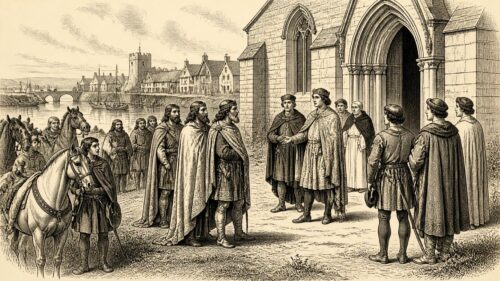
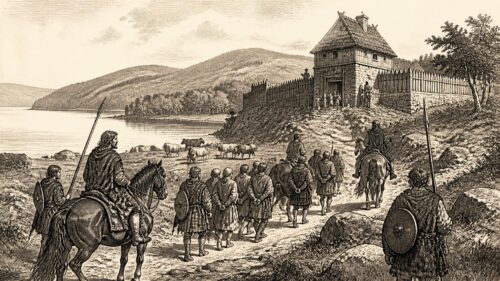
The most revealing political episode recorded for the year occurred in Connacht. Ruaidhrí Ó Conchobair, king of Connacht, had several leading men seized at an assembly which he himself had convened. The Annals of Ulster name Ua hAinlidhe, Ua Birn, Mac Ceithernaigh and Imur Ua hAinlidhe among those imprisoned. The Annals of the Four Masters similarly identify O’Hanly, O’Beirne and Mac Keherny. The annalists explain that Ruaidhrí had received intelligence that these men were making an alliance with the sons of Áed, son of Feidhlimidh Ó Conchobair, against him.
No date or place within 1382 is supplied, and the sources do not permit a fuller reconstruction of the meeting. They do, however, preserve an important fact about power. An assembly was a place where a ruler could gather allies, hear claims, distribute favour and demonstrate precedence; it could also become the setting for decisive coercion. Ruaidhrí’s action was not an impersonal act of government by an established state. It was the forceful intervention of a king seeking to prevent the formation of a rival coalition within the broad Ó Conchobair political world. His position was substantial: he had held Roscommon castle since 1375 and was among the strongest Connacht rulers of his generation. But the arrests themselves indicate that his authority required continual protection against kin-based and regional opposition.
Such tensions mattered beyond Connacht. The political units called kingdoms, lordships and territories were held together by personal relationships: fosterage, marriage, hostage-taking, military service, tribute, hospitality and negotiated submission. A chief’s detention could therefore unsettle not only his immediate followers but the networks linked to him. The surviving annals do not tell us whether Ruaidhrí’s prisoners were released, reconciled or further punished in 1382. It would be unsafe to invent an outcome. What can be said is that the episode captures the insecurity beneath an apparently powerful kingship.
Raids, Corn and Captivity
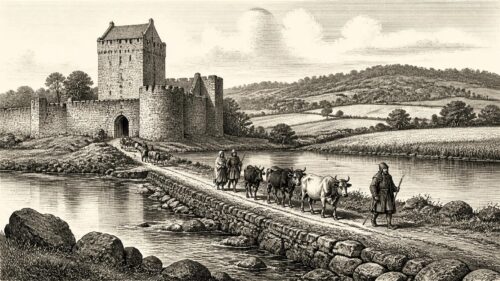
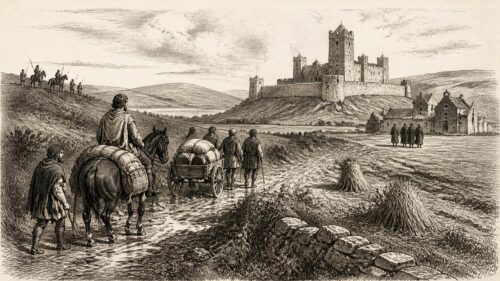
Violence in 1382 was not confined to high politics. The Four Masters record an incursion by Clann Muiris into Corcomroe, followed by the killing of Ó Concannáin when he pursued the raiders’ prey. Conchobhar Óg Mac Diarmata then gathered his kinsmen for a counter-expedition. Warned in advance, Clann Muiris prepared to meet them, yet Mac Diarmata’s party advanced as far as Brees, burned its buildings and corn, killed many people nearby, and returned without loss, according to the annal.
The language is compressed, and the scale of destruction cannot be measured from it. Nevertheless, the reference to corn is especially significant. Raiding was not merely an encounter between armed elites. Burning crops struck at food stores, seed grain, rents and the labour of households whose security depended upon a successful agricultural year. The destruction of houses likewise meant disruption to dependants as well as warriors. Cattle and horses were important movable wealth in Irish warfare, but grain, buildings and cultivated land were also vulnerable targets. For many people, the immediate experience of politics was likely to have been the danger of a passing force, the loss of produce, and the need to rebuild.
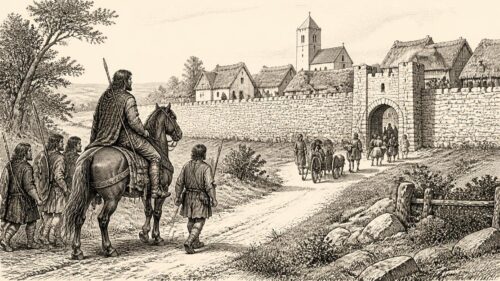
Further south, the same annal reports that Muircheartach Ó Briain led a plundering host into Desmond and “totally devastated” it. That emphatic wording should not be read as a literal survey of every district; annalists commonly used forceful language for successful depredations. Yet it confirms a serious expedition across the old provincial divide between Thomond and Desmond. The entry belongs to a wider pattern in which the competing branches of the Ó Briain kindred, their allies and neighbouring powers contested influence in Munster.
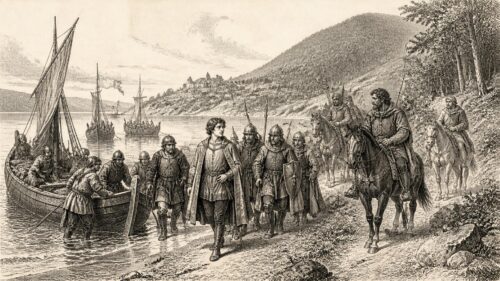
Captivity was another recurring instrument of conflict. Muircheartach, son of Mathghamhain Ó Briain and a son of the king of Thomond, died in prison during 1382; the Annals of Ulster add that his brother Domnall died as well. The Four Masters place Muircheartach’s death in the prison at Trim. Neither source explains the precise circumstances of his imprisonment, and it is important not to supply motives that the evidence does not give. His death nonetheless reveals the reach of confinement across political boundaries. Trim, a major centre of the English lordship in Meath, was a place where a member of a prominent Munster dynasty could be held and die.
Deaths and Changing Lordships
The annals register other losses with immediate political consequences. Diarmait Ó Domnaill, heir to the lordship of Tír Chonaill, died. His death did not end the Ó Domnaill dynasty, but it removed a designated successor in a region where succession was often contested among eligible members of an extended ruling kindred. In Thomond, Toirdelbach and Brian, sons of Diarmait Ó Briain of the line of Brian Ruadh, also died. The accumulation of such deaths mattered because lordship rested on adult male leaders able to command followers, make alliances and defend claims.
On 18 October, James Butler, second earl of Ormond, died at Knocktopher in County Kilkenny. This date is unusually well supported, though later inquisitions created some confusion about the timing; an exchequer record of 23 October already referred to his death. Butler had been a dominant Anglo-Irish magnate and had served as lord justice on several occasions. By his death, he had strengthened the Butler family’s position across south-central Ireland, while the focus of its interests increasingly lay in Kilkenny and the south-east. His succession by his son James, the future third earl, preserved the dynasty, but the disappearance of a seasoned lord altered the balance among the great families of the lordship.
Seal, Chancery and Kilmainham
Government under the English crown also changed hands during the year. William Tany, prior of the Hospitallers in Ireland, returned to the office of lord chancellor. The surviving legal record places his acceptance of the royal patent and oath at Kilkenny in mid-February 1382; he received the great seal shortly afterwards. Tany was not simply a royal clerk. As prior of the Order of St John of Jerusalem, whose Irish headquarters stood at Kilmainham near Dublin, he combined ecclesiastical authority, institutional resources and political experience.
The chancellor’s seal authenticated royal business in Ireland: writs, grants, directions to officials and other instruments through which lordship was expressed on parchment. Its transfer did not mean that the Dublin administration controlled the whole island. It did mean that the crown’s government remained active, organised and dependent upon men who could operate between religious institutions, magnate politics and official administration. Tany’s appointment is a useful reminder that the religious orders were not remote from secular affairs. Their leaders could be landholders, counsellors and office-holders as well as spiritual superiors.
Aghaboe Re-Endowed
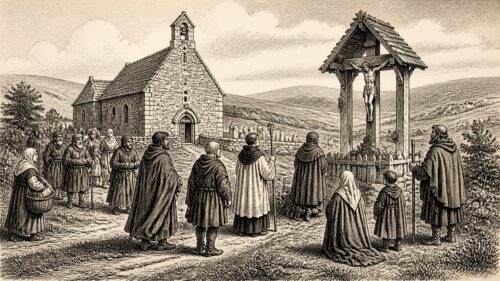
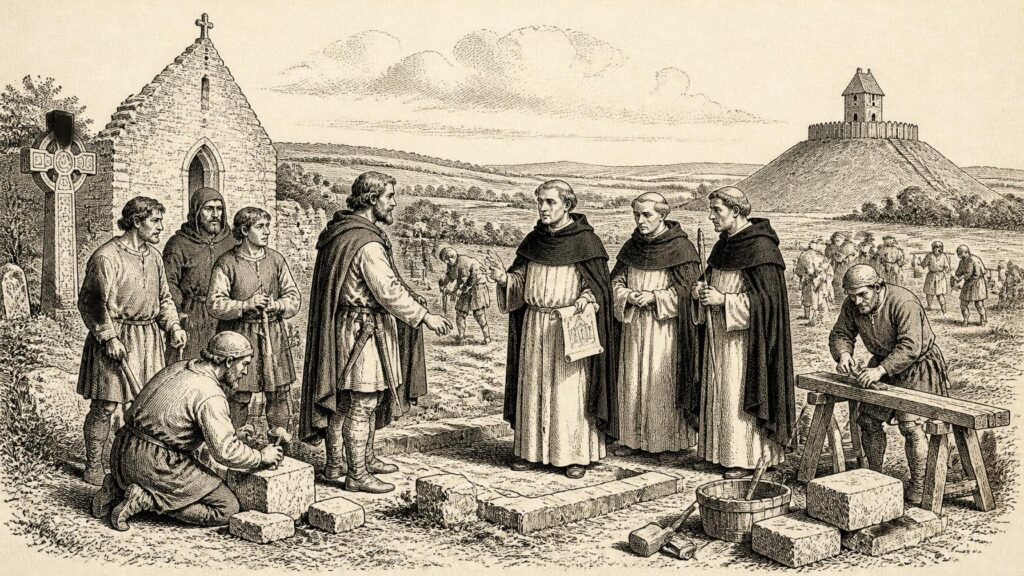
Religion also supplied one of the year’s most constructive developments. At Aghaboe, in present-day County Laois, Finghin Mac Giolla Phádraig, lord of Ossory, founded a Dominican friary in 1382. The foundation stood beside an older ecclesiastical landscape associated with St Canice and an Augustinian priory, while a Norman motte nearby recalled earlier conquest and settlement. Aghaboe therefore brought several layers of Irish history together: an early monastic site, Anglo-Norman fortification, Augustinian religious life and new Dominican patronage under a Gaelic lord.
The foundation should not be imagined as proof of tranquillity. Its significance lies precisely in the fact that religious patronage could flourish amid political fragmentation. A Dominican house offered a permanent institutional presence: a church, cloistered accommodation, worship, preaching and a community connected to a wider international order. Its patron gained spiritual prestige, prayers for himself and his family, and a visible statement of authority in his territory. The surviving ruins, including the friary church’s east window and cloister access, belong to the material afterlife of that decision, though they should not all be assigned to a precise moment in 1382.
Women, Learning and Memory
The year’s notices also preserve glimpses of lives easily obscured by warfare. On 4 September, Áine, daughter of Eachmarcach son of Magnus, died. The Annals of Ulster describe her as a chief entertainer and head of her own people, and identify her as the wife of Máel Sechlainn Ó hEoghain, the archdeacon. The annal adds that her husband had lectured continuously at Oxford for fourteen years. The entry illuminates the reach of Irish learned and clerical networks: an Irish ecclesiastic could spend years teaching at Oxford, while his household remained important enough in Ireland for Áine’s standing to be recorded in detail.
On 7 March, the nun Bean-Midhe, daughter of Mac Maghnusa, also died. The entry is brief, but its inclusion is meaningful. Religious women, entertainers, clerics, heirs and kings all appear in the same annalistic year, showing that medieval Irish historical memory was not confined to battles alone. It recorded the people whose deaths affected households, churches, learned communities and political lineages.
Thus 1382 cannot responsibly be reduced to a single national event. It was a year of regional crises and local decisions. Ruaidhrí Ó Conchobair used an assembly to secure his Connacht kingship; raiding burned homes and crops; confinement and death reshaped dynastic prospects; crown administration renewed its seal; and Finghin Mac Giolla Phádraig invested in a Dominican future at Aghaboe. Together these developments reveal an Ireland in which authority was contested, practical and deeply rooted in particular places.
Primary Sources
- The Annals of Ulster, Year U1382
- Annals of the Four Masters, Annal M1382
- Annals of the Four Masters, Volume 4 English Translation
- Annals of the Four Masters, Volume 4 Irish Text
- Annals of Loch Cé
- Annals of Ulster
- O'Connor (Ó Conchobhair), Ruaidhrí
- Butler, James
- The ‘Calculus of Faction’ and Richard II’s Duchy of Ireland, c.1382–9
- Aghaboe Abbey
- Graveyard, Aghaboe, County Laois
- Aghaboe Abbey
- Ormond Deeds: The Red Book of Ormond
- Annales Hiberniae
- Close Roll 6 Richard II (1382–1383), Item 30
- Chronicle of the Law Officers of Ireland: Lord Chancellors and Keepers of the Great Seal
- O'Connor (Ó Conchobhair), Domhnall
- O'Connor Don (Ó Conchobhair Donn), Toirdhealbhach Óg
- Medieval Irish Dominican Studies
- Aghaboe Abbey
- The Annals of Ulster: Manuscript Witnesses and Edition Information
- The Annals of the Four Masters: Edition Information