Carrickfergus Burning1384 CE
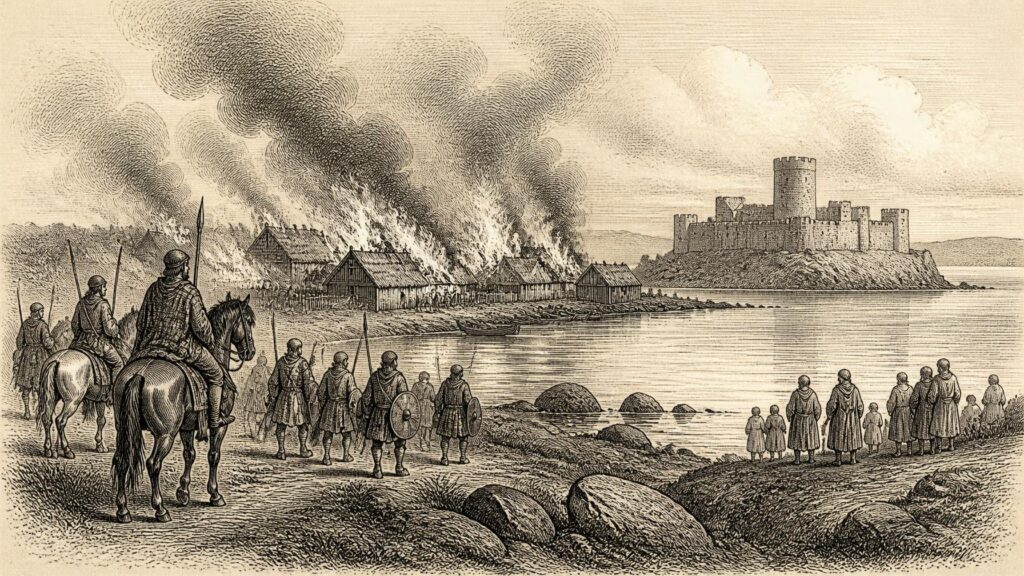
In 1384, Niall Ó Néill burned Carrickfergus, demonstrating Gaelic power against a major crown-held port and castle, though the sources do not show that the fortress fell. In Connacht, Ruaidhrí Ó Conchobair died of plague after a long reign, prompting rival inaugurations and provincial warfare, including attacks on lordly strongholds. Plague and other deaths affected leading families and rulers across Ireland, while feuds caused further killings. Annals also recorded deaths of churchmen and scholars, reflecting enduring learned institutions. Within the lordship, mediation addressed conflict between Ormond and Desmond, and Sir Philip Courtenay appointed Ormond chief governor, illustrating fragmented regional authority.
Dateline
Two sharply different but connected stories dominate the Irish evidence for 1384. In the north-east, Niall Ó Néill burned Carrickfergus on 10 April, an attack which the Annals of Ulster linked to a marked increase in his power over the English of Ulster. In Connacht, the death from plague of Ruaidhrí Ó Conchobair late in the year ended a notably long and relatively stable kingship, only for two rival claimants to be installed in his place. One episode demonstrated the vulnerability of a crown-held coastal town; the other showed how quickly a provincial kingship could become contested when a recognised ruler died.
The surviving annals are not a complete diary of Irish life. They concentrate on rulers, churchmen, learned men, killings and conspicuous political acts. Yet their entries for 1384, reinforced by English administrative material, reveal a country of many political regions: Gaelic lordships, Anglo-Irish liberties, towns and castles connected to the English crown, and ecclesiastical communities whose schools and offices remained important centres of learning.
Fire at Carrickfergus
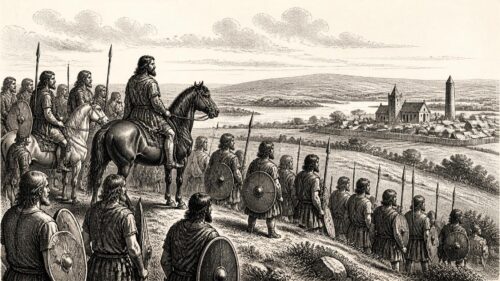
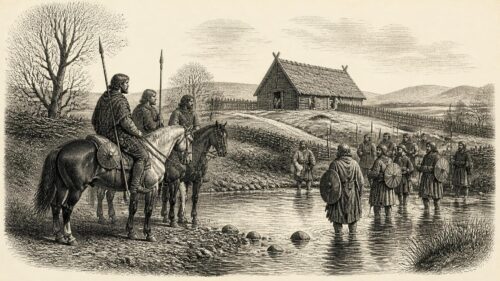
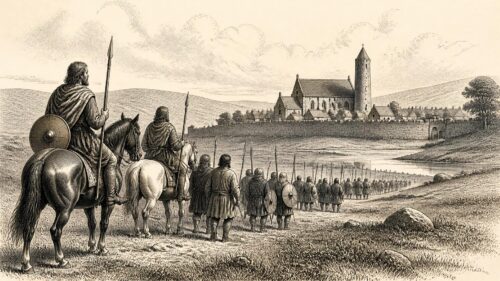
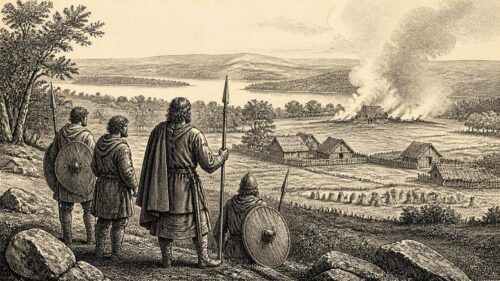
The most securely dated military event of the year occurred on the vigil of Easter, 10 April. The Annals of Ulster state plainly that Carrickfergus was burned by Niall Ó Néill. The Annals of the Four Masters add that he thereby gained great power over the Gall, rendered in English translations as ‘Foreigners’ and, in this late medieval setting, generally denoting the English and Anglo-Irish political interest rather than strangers in a modern ethnic sense.
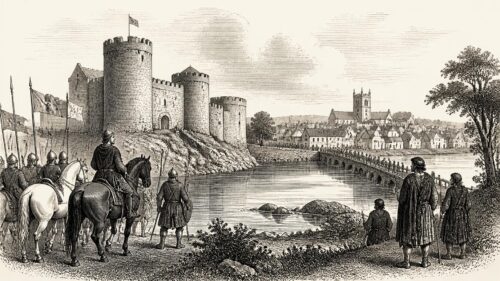
Carrickfergus mattered far beyond its immediate hinterland. Its stone castle and harbour made it a principal royal foothold in Ulster, while the town linked the northern coast to traffic across the Irish Sea. The earldom of Ulster and its castle had effectively become crown possessions after the death of William de Burgh, earl of Ulster, in 1333. For that reason, an assault on its settlement carried both practical and symbolic force. It threatened a market and port beside one of the strongest fortifications in the region.
The evidence requires care. The annals say that Carrickfergus was burned; they do not say that the castle was stormed, surrendered, or permanently taken. The distinction is important. A defended castle could survive while the houses, stores and commercial activity around it suffered badly. Nor do the sources provide a casualty total or a detailed account of the attackers’ route. What can responsibly be said is that the attack displayed Ó Néill’s capacity to strike a royal centre on the coast and that contemporaries judged its political effect substantial.
This was not an isolated sign of northern pressure. Wider scholarship places the raid in a period when the Dublin administration, weakened after the death of Edmund Mortimer in 1381, struggled to check Ó Néill expansion in eastern Ulster and towards the northern edge of Leinster. That broader setting explains why a brief annalistic sentence about fire was remembered as a change in power. It does not justify imagining a single, united Irish campaign: political alliances in Ulster were flexible, local and often temporary. Still, the burning showed that the crown’s surviving strongpoints did not secure the surrounding countryside.
A King Dies in Connacht
At the other end of the island, the decisive turning point came in winter. Annála Connacht records that Ruaidhrí, son of Toirrdelbach Ó Conchobair, died of plague on the night of St Catherine’s feast, 25 November. It credits him with sixteen and a quarter years as full king of Connacht; the Four Masters, compiled later from earlier materials, gives a closely similar reign of sixteen years and three months. Both traditions present his death as the end of a long tenure centred on Cruachan Aí, the royal landscape in what is now north County Roscommon.
The annals’ language is revealing. A poem attributed to Máelín Ó Maolchonaire commemorated Ruaidhrí as a hard-fighting ruler whose years at Cruachan had been peaceful. Such praise should not be read as proof that every district of Connacht was quiet. It does, however, suggest that contemporaries contrasted his reign with the disorder that followed. Kingship was not merely inherited automatically by the nearest son. It depended upon descent, military resources, the backing of leading kindreds and a public act of installation.
That process immediately divided Connacht. Toirrdelbach Ruadh, son of Aed, was installed with the support of Mac Diarmata, Clann Muircheartaigh and the other chiefs of Síol Muireadaigh. A rival, Toirrdelbach Óg, son of Aed son of Toirrdelbach, was installed by Ó Ceallaigh, Clanricarde, Domnall son of Muirchertach Ó Conchobair and Clann Donnchada. These were not merely competing names in a genealogy. Each inauguration represented a coalition capable of collecting followers, cattle and provisions, and of claiming obedience across particular territories.
The immediate result, according to Annála Connacht, was general war throughout the province, with killing, plundering and extensive damage. The Four Masters preserves a concrete episode within that atmosphere: Domnall, son of Muirchertach, led a hosting into Moylurg and burned Mac Diarmata’s fortress. It would be rash to supply details absent from the record or to assign the raid to a particular season. Yet it illustrates the practical burden of disputed lordship. Warfare was commonly directed at settlements, food stores, movable wealth and the prestige of a rival’s residence, rather than being confined to set-piece battles.
Illness, Succession and Local Violence
Ruaidhrí’s plague death was not the only notice of disease in 1384. The annals also record Aed and Feradach Ó Ceallaigh dying of plague within a week, while the Four Masters say that John and David, sons of Mac William Burke, died from it. These entries establish the presence of plague among prominent families that year. They do not, by themselves, measure mortality among the wider population or prove that every region was experiencing the same outbreak. Medieval chroniclers usually noted deaths of importance to their patrons and communities, not systematic totals.
Deaths also reshaped politics in Breifne and the midlands. Philip Ó Raghallaigh, identified by the Annals of Ulster as son of Gilla Ísu Ruaidh and king of Breifne, died. Ualgarg Ó Ruairc, described as eligible for the kingship of Breifne, drowned in Lough Gowna. Muirchertach Ó Conchobair, king of Uí Failghe, died in old age, and Ruaidhrí Ó Maolmhuaidh, king of Fir Chell, also died. No single annal supplies a full map of the successions that followed, so 1384 should not be made to bear claims of wholesale political collapse. Nevertheless, it was a year in which the loss of established figures created opportunities and anxieties across several lordships.
The killing of Diarmait Mac Raghnaill, chief of Muintir Eolais, is especially stark. He was murdered treacherously by sons of Ragnall Mac Raghnaill at the doorway of Richard Mac Raghnaill’s house. This was internal violence within a ruling lineage, not warfare between neatly bounded states. The annalists praised Diarmait’s generosity and valour, reminders that hospitality was a political virtue as well as a social expectation: a successful lord sustained dependants, visitors, clerics and learned households through his resources.
On the western seaboard, a parley between Ó Flaithbheartaigh and Ó Máille ended in violence, with Eógan Ó Máille, Cormac ‘the Round’ Ó Máille and many others killed. The entry gives no trustworthy basis for reconstructing the cause of the quarrel, but its setting is meaningful. The coastal lordships of Iar Connacht and Mayo drew wealth and mobility from fisheries, maritime travel and contacts around the Atlantic seaways. A failed meeting between their leading families could therefore have consequences well beyond the immediate participants.
Learning and Church Office
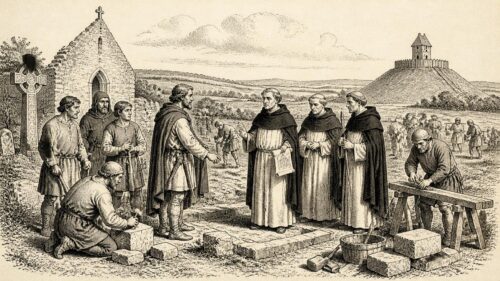
Amid warfare and succession, the annals also register the passing of figures associated with education and ecclesiastical administration. Master John Mac Gilla-Coisgli, herenagh and parson of Airech Brosga, died on 22 June. The Annals of Ulster call him an approved lecturer in both laws, especially canon law. A herenagh held hereditary responsibilities connected with church lands and local religious institutions; John’s description indicates that such office could coexist with advanced legal learning. His death points to the practical importance of canon law in regulating church life, property and clerical affairs.
Two other deaths underline the standing of scholarship in Gaelic society. Uigistín Ó Duibhgeannáin, ollamh-historian of the Conmaicne, died, while Ricard Barrett was remembered as a universal patron of the learned of Ireland. The titles were not decorative. An ollamh was a master in a learned discipline, and patronage enabled poets, historians, lawyers and teachers to work within aristocratic households and church communities. The record of their deaths in a year otherwise marked by raids and plague is evidence that learning remained embedded in political and social life.
Government in the Lordship
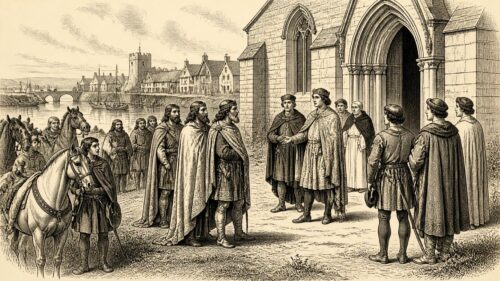
Within the English lordship, 1384 brought an important, if less dramatic, rearrangement of authority. In the autumn, serious discord broke out between James Butler, third earl of Ormond, and Gerald FitzGerald, third earl of Desmond, the foremost magnates in the south. Royal officials sent mediators to restore peace at Clonmel. The settlement was fragile, but it shows that the administration still sought to contain feud through negotiation as well as force.
At the end of November Sir Philip Courtenay, lieutenant of Ireland, strengthened Ormond’s position before departing for England. Courtenay issued him a general pardon on 26 November, nominated him chief governor on 28 November, and Ormond entered office on 30 November. This transfer did not make the Dublin government master of the whole island. Rather, it placed the day-to-day government of the lordship in the hands of a powerful local earl at precisely the moment when Gaelic rulers in Ulster and Connacht were demonstrating their own strength.
Thus 1384 was not a year defined by one national event. It was a year of regional shocks: a burning at Carrickfergus, a contested kingship at Cruachan, lethal feuds in lordly families, and changes in the institutions that sustained both church and government. Together they reveal late medieval Ireland as a politically crowded island, where control was negotiated anew whenever fire, disease or death disrupted an existing balance.
Source References
Hover over a number to see the source. Select it to open the source.

- [1] The Annals of Ulster, Year U1384
- [2] Annála Connacht, Annal 1384
- [3] Annals of the Four Masters, Annal M1384, English translation
- [4] CELT: Annals of the Four Masters
- [5] Annals of the Kingdom of Ireland, Volume IV
- [6] The Annals of Ulster: CELT Project Page
- [7] CELT: Annála Connacht
- [8] O’Neill (Ó Néill), Niall Óg, Dictionary of Irish Biography
- [9] Richard II, Dictionary of Irish Biography
- [10] Richard II and the Wider Gaelic World: A Reassessment
- [11] Richard II and the wider Gaelic world: a reassessment
- [12] The ‘Calculus of Faction’ and Richard II’s Duchy of Ireland, c. 1382–9
- [13] The ‘Calculus of Faction’ and Richard II’s Ireland
- [14] Irish Historic Towns Atlas: Carrickfergus
- [15] Carrickfergus Castle Barracks, Co. Antrim, 2010
- [16] De Courcey’s Castle: The first phase of Anglo-Norman building activity at Carrickfergus Castle, County Antrim
- [17] Calendar of Ormond Deeds, Volume II, 1350–1413
- [18] Letters patent of Richard II granting lands of Knockgraffon, Co. Tipperary to the Earl of Ormonde, 3 February 1384
- [19] Memoranda Roll, 7–8 Richard II, membrane 15, item 1
- [20] Richard II
- [21] Richard II (r. 1377–1399)
- [22] Breifny Antiquarian Society Journal, 1927, Vol. III
- [23] List of Published Texts at CELT
Primary Sources
- The Annals of Ulster, Year U1384
- Annála Connacht, Annal 1384
- Annals of the Four Masters, Annal M1384, English translation
- CELT: Annals of the Four Masters
- Annals of the Kingdom of Ireland, Volume IV
- The Annals of Ulster: CELT Project Page
- CELT: Annála Connacht
- O’Neill (Ó Néill), Niall Óg, Dictionary of Irish Biography
- Richard II, Dictionary of Irish Biography
- Richard II and the Wider Gaelic World: A Reassessment
- Richard II and the wider Gaelic world: a reassessment
- The ‘Calculus of Faction’ and Richard II’s Duchy of Ireland, c. 1382–9
- The ‘Calculus of Faction’ and Richard II’s Ireland
- Irish Historic Towns Atlas: Carrickfergus
- Carrickfergus Castle Barracks, Co. Antrim, 2010
- De Courcey’s Castle: The first phase of Anglo-Norman building activity at Carrickfergus Castle, County Antrim
- Calendar of Ormond Deeds, Volume II, 1350–1413
- Letters patent of Richard II granting lands of Knockgraffon, Co. Tipperary to the Earl of Ormonde, 3 February 1384
- Memoranda Roll, 7–8 Richard II, membrane 15, item 1
- Richard II
- Richard II (r. 1377–1399)
- Breifny Antiquarian Society Journal, 1927, Vol. III
- List of Published Texts at CELT