Askeaton Under Ufford1345 CE
Dateline
In 1345, the sharpest political struggle in the English lordship of Ireland unfolded not at a frontier ford but across the towns, castles and lordships of Munster. Sir Ralph Ufford, justiciar of Ireland and the king’s chief governor, moved against Maurice fitz Thomas FitzGerald, first earl of Desmond. Their quarrel exposed a basic weakness in royal administration: the Crown needed the co-operation of the great Anglo-Irish magnates, yet Ufford sought to discipline them with an unusually forceful assertion of central authority.
The year also brought a violent change of ruler in Connacht, fighting upon Lough Neagh in Ulster, and smaller but revealing notices of local lordship, monastic leadership and learned society. The surviving evidence is uneven. Some events can be placed precisely; others are recorded only under the annal-year 1345. Taken together, they show an island governed through several overlapping political worlds: the king’s government at Dublin, powerful lordships in the English-controlled regions, and Gaelic dynasties whose authority depended on kinship, alliance, military following and the ability to protect dependants.
Callan and Dublin
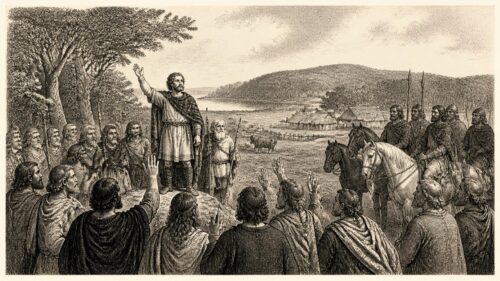
On 22 February, Desmond attempted to convene an assembly at Callan in County Kilkenny. The choice of place was telling. Callan lay within the politically important Butler sphere of south Leinster, rather than in the heart of Desmond’s own lordship. The meeting seems to have been intended to gather fellow magnates in response to Ufford’s government. Ufford forbade it, and the other leading lords did not attend. That failure mattered. It left Desmond without an effective aristocratic coalition when the confrontation with the justiciar intensified.
This was not a simple contest between an ‘English’ administration and an ‘Irish’ earl. Desmond was a great Anglo-Irish lord, descended from the FitzGerald settlers of the thirteenth century, possessing wide lands, affinities and military resources in Munster. Ufford, who had arrived as justiciar in 1343, was himself tied to Irish affairs through his marriage to Maud of Lancaster, widow of William de Burgh, earl of Ulster. The dispute was instead about how Ireland should be governed, who controlled lordship revenues and castles, and whether a royal officer could override the accumulated power of a magnate such as Desmond.
A parliament met at Dublin during 1345, but Desmond did not attend. Contemporary Anglo-Irish annals make that absence the immediate prelude to Ufford’s campaign. Parliament was not merely a ceremonial gathering. It was an arena in which government sought consent, heard grievances and organised the king’s business. Desmond’s non-attendance could therefore be presented as defiance, while his supporters could regard Ufford’s actions as arbitrary encroachment. The language of law, counsel and royal service was central to the conflict, but it was backed by armed men and fortified places.
The King’s Banner in Munster
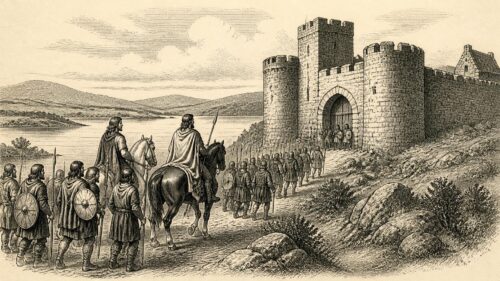
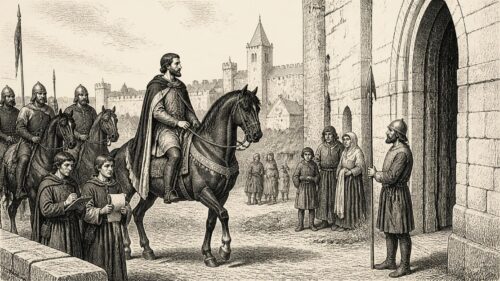
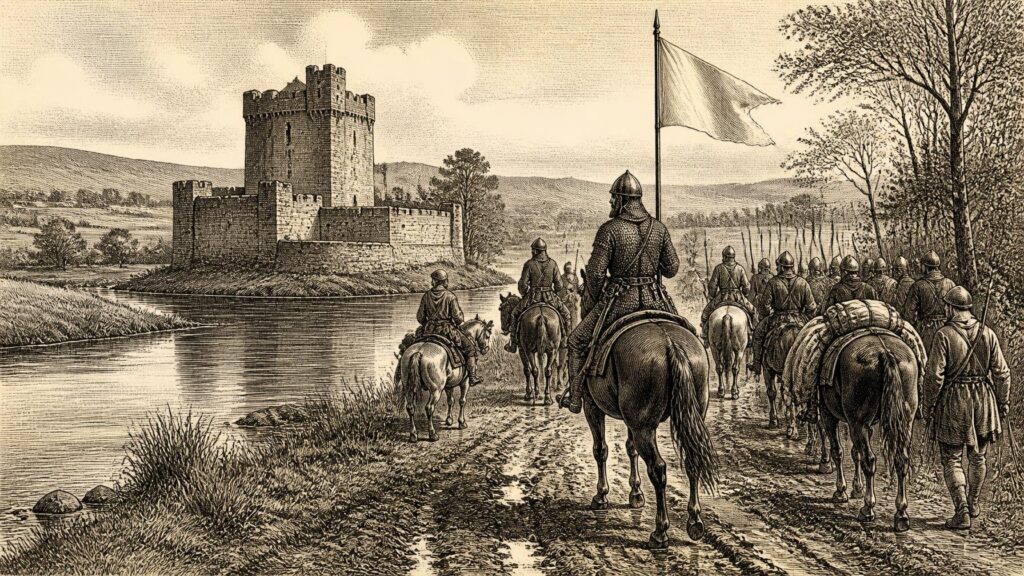
After the feast of St John the Baptist, 24 June, Ufford marched into Munster under the king’s banner. The annalist’s detail is important: the banner declared that this was not a private feud but an operation of royal government. Ufford seized Desmond’s lands and leased them for annual rents to others. Such measures struck at the practical foundations of lordship. A castle was a defensive strongpoint and administrative centre; its surrounding lands produced rents, food, labour services and military support. To take them was to displace not only an earl but also the network of tenants, officers, household servants and local allies dependent upon him.
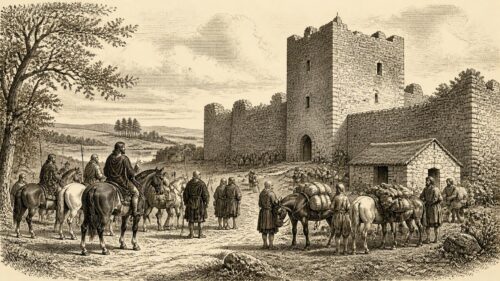
Desmond did not simply yield. The campaign involved raids, resistance and the pursuit of control along routes through Limerick and Kerry. Askeaton, on the River Deel in west Limerick, was one of the important strongholds drawn into the crisis. The castle was taken by Ufford in 1345; later chronological reconstructions place its capture in late September. Its loss was particularly significant because Askeaton stood within a zone from which the earls of Desmond exercised influence towards the Shannon estuary and north Kerry. The seizure showed that the justiciar could penetrate the earl’s regional power base, at least for a time.
Ufford then moved through Kerry towards Uí Chonaill, or Connello, in modern west Limerick. There he took further Desmond castles, including Castleisland. The principal chronicle account says that three of Desmond’s defenders—Eustace Poer, William Graunt and John Cotterell—were captured there and hanged. The episode should not be softened into an administrative adjustment. It was a calculated assertion of authority through exemplary punishment, and it revealed the personal dangers carried by service to a disgraced lord.
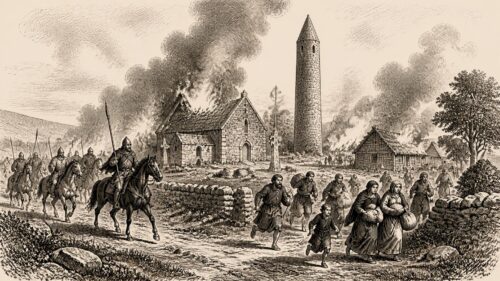
For ordinary inhabitants, the consequences were likely immediate even where the records do not describe every household. Armies needed grain, livestock, horses, carts, lodgings and guides. Castle communities faced changes of garrison and command; tenants could be required to provide food and carriage; merchants and craft workers in nearby settlements had to reckon with disrupted routes and uncertain protection. It would be unsafe to claim a general famine or wholesale destruction in Munster in this particular year, since the evidence does not support that. Yet the seizure and re-leasing of estates plainly made politics inseparable from the local economy.
Kildare Taken
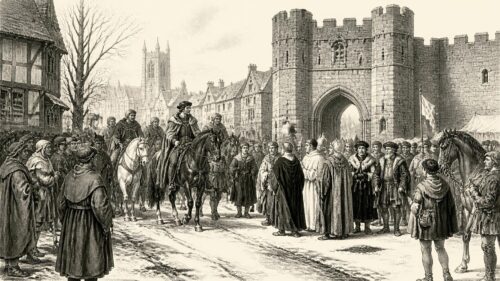
Ufford also turned on Maurice FitzThomas FitzGerald, fourth earl of Kildare. Despite the near-identical names, he was a different man from the earl of Desmond: Kildare’s power lay chiefly in Leinster and Meath rather than Munster. According to the Anglo-Irish annalistic tradition, Ufford wrote two letters to William Burton. One summoned Kildare to bring an army to assist the justiciar; the other instructed Burton to arrest him. Burton persuaded Kildare to come to the Dublin council, apparently with assurances that he could proceed safely. Once there, he was seized and imprisoned.
The arrest was a dramatic warning to magnates who might hesitate to support Ufford. It also reveals the importance of procedure and trust. The council, described by the chronicler as the place of the seizure, was supposed to be a setting for deliberation. Turning it into the scene of an arrest made a powerful political statement, but it could also damage confidence in the justiciar’s promises. Kildare would be released in 1346 after finding numerous sureties. That later outcome suggests that the case against him was politically expedient rather than straightforwardly criminal.
Desmond escaped capture and went into exile or concealment while his lands were occupied. His contest with the Crown did not end in 1345. Ufford’s death on 9 April 1346 transformed the situation, and the earl eventually received more favourable treatment from Edward III. Those later reversals should not obscure the achievement of 1345: Ufford had, for a short period, broken into the territorial machinery of one of Ireland’s greatest lordships and imprisoned another great earl.
Connacht’s Arrow-Shot
Far from the Munster campaign, Connacht suffered a succession crisis of its own. The annals place the death of Toirrdelbach Ó Conchobair, king of Connacht for twenty-one years, in the autumn of 1345. He had gone to Rinn Loch to aid Tadc Mac Ragnaill against members of the wider Ó Conchobair kindred, the descendants of Muirchertach Muimhneach. Pursued by Clann Muirchertaig and men of Muintir Eolais, he was killed by an arrow at Gortín na Spideoige, in the territory called Fid Dorcha or Fedaro.
The annalist treated the killing as an exceptional calamity, comparing it with the legendary death of Niall Noígiallach. Such language shows both the stature attributed to Toirrdelbach and the moral shock associated with the death of a king by a single missile during a localised pursuit. Yet the political mechanism followed swiftly: his son Aodh was made king in his place. Connacht was not a unitary state with an automatic hereditary succession. Kingship rested on dynastic legitimacy, but also on the backing of leading branches of the ruling family and allied regional lords. The rapid inauguration of Aodh was an attempt to prevent the conflict from becoming a wider collapse of authority.
The same annal-year records the death of Brian Ó Fearghail, a man regarded as well fitted to lead Annaly, the Ó Fearghail lordship in what is now Longford. In this kind of source, an obituary is more than a private notice. It registers the loss of a political household head whose generosity, judgement, hospitality and military capacity helped hold a locality together.
Lough Neagh and Religious Life
Ulster was also unsettled. The Annals of the Four Masters, compiled much later from earlier materials, record that Aodh Ó Néill took a fleet onto Lough Neagh. Men of Clann Aodha Buidhe, or Clandeboye, overtook him; many were wounded or killed, but Aodh escaped in his boats. The concise notice does not explain every cause or consequence, so it should not be expanded into a decisive battle for Ulster. It nevertheless confirms that watercraft on Ireland’s largest lake could be instruments of warfare, movement and escape, and that the contest between branches of the Ó Néill kindred remained active in 1345.
Religious institutions continued their ordinary rhythms amid such instability. The Annals of Ulster date the death of Gilla-na-naem Ó Cianáin, abbot of Lisgabhail, to 12 August. An abbot was a spiritual superior, but in medieval Ireland an abbacy could also be embedded in kin networks, landholding and local learning. A Franciscan provincial chapter held at Clane in 1345, according to a later account citing the Franciscan chronicler John Clyn, reorganised the Irish friars into four custodies and assigned the convents of Kilkenny and New Ross to the Dublin custody. This was not headline politics, but it demonstrates the durable institutional life of the mendicant orders: communities could revise their administration, maintain connections across the island and continue preaching, pastoral work and study while secular powers fought over castles.
Thus 1345 was a year of coercive government and contested lordship, but not of one single Ireland moving in one direction. In Dublin and Munster, Ufford’s royal offensive reshaped the balance between Crown and magnates. In Connacht, an arrow ended a long reign and required an immediate dynastic settlement. On Lough Neagh, rival forces fought from boats. In abbeys and friaries, meanwhile, leadership changed and religious administration continued. The year’s records preserve these fragments because medieval Irish life was organised through many centres of authority—castle, council, dynasty, lake, church and lordly household—each vulnerable to sudden violence, yet each capable of enduring beyond it.
Primary Sources
- Annales Hiberniae
- Annales Hiberniae: 1345 Entry and Editorial Notes
- Annála Connacht
- Annála Connacht, Annal 1345
- The Annals of Ulster
- Annals of the Four Masters
- Annals of Loch Cé
- Annals of Loch Cé A.D. 1014–1590, Part 15
- The Annals of Tigernach
- Annales Dominicani de Roscoman
- Annales Breves Hiberniae
- A History of the Franciscan Order in Ireland
- Materials for the History of the Franciscan Province of Ireland, A.D. 1230–1450
- Ufford (D'Ufford, de Ufford, Offord), Ralph
- Pembridge, John
- The Justiciarship of Ralph Ufford: Warfare and Politics in Fourteenth-Century Ireland
- Askeaton Castle
- The Siege of Castleisland
- The Desmond Survey
- CELT: Corpus of Electronic Texts, List of Published Texts