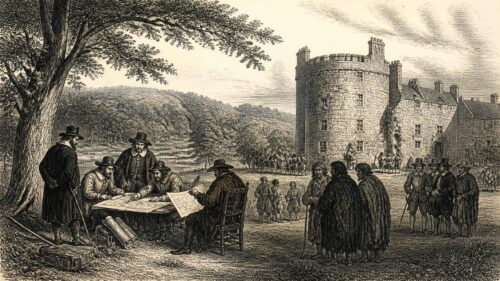
Aghaboe’s Burned Shrine1346 CE
In 1346, Ireland experienced political instability, warfare and dearth following the death of Sir Ralph Ufford, the royal justiciar. Gaelic and settler forces contested Leinster, capturing castles, raiding communities and damaging churches. On 5 May, Diarmaid Mac Giolla Phádraig and an Ó Cearbhaill ally burned Aghaboe, including its church, cemetery and St Canice’s shrine, a religious and communal loss. Wheat prices reflected scarcity, worsened by conflict. Walter de Bermingham became justiciar in May but violence continued, including northern defeats, killings and winter raids. John Clyn’s annals document events, while evidence does not place the Black Death in Ireland before 1348–49.

Dateline
The most vivid Irish event securely dated to 1346 occurred at Aghaboe, in the borderland between Ossory and Ely. On Friday 5 May, Diarmaid Mac Giolla Phádraig, called monoculus or ‘the one-eyed’ in the Latin annals, joined with an Ó Cearbhaill ally to burn the settlement, its cemetery and church. The attack also destroyed the shrine containing the bones and relics of St Cainnech or Canice, the sixth-century abbot remembered as Aghaboe’s founder and patron. Yet this was not an isolated act of sacrilege in an otherwise ordered realm. It came in a year when the death of an unusually forceful royal governor was followed by war, castle-taking, retaliatory raids and acute dearth across much of the English lordship of Ireland.
Ireland in 1346 was not governed as a single political unit. The crown’s lordship was strongest in Dublin and in parts of Leinster, Munster and the east-coast towns, but depended on magnates, local officers, castle garrisons and negotiated relationships. Beyond and within those zones, Gaelic lordships exercised their own authority. Alliances crossed linguistic and inherited political boundaries. The year’s records accordingly describe conflict not as a simple contest of ‘English’ against ‘Irish’, but as a shifting struggle involving royal officials, resident lords, Gaelic dynasties and armed local followings.
The End of Ufford’s Regime
On Palm Sunday, 9 April, Sir Ralph Ufford died at Kilmainham, near Dublin. He had served as justiciar since 1344, arriving with his wife, Matilda of Lancaster, countess of Ulster, and a substantial armed retinue. Ufford’s commission had required him to investigate abuses in government, examine grants and franchises, and improve the revenues of the lordship. In practice he pursued a hard, centralising policy. He removed officials, challenged liberties claimed by powerful families and made conspicuous use of military force.
His confrontation with Maurice fitz Thomas FitzGerald, earl of Desmond, had dominated 1345. Ufford confiscated Desmond lands and castles, compelled supporters to give hostages and imposed expensive terms on men seeking the king’s peace. His actions made a powerful statement of royal authority, but made enemies as well. Later commentary from Dublin welcomed his death with remarkable hostility; that judgement reflects political feeling rather than a neutral verdict. Modern historians note both sides of the record: Ufford substantially improved oversight and revenue, but his costly style of government and armed household were difficult for successors to sustain.
The eve of his death brought another grim consequence of this regime. Maurice FitzPhilip, previously arrested by the justiciar, died in Dublin Castle prison on 8 April. Friar John Clyn, the Franciscan annalist writing from Kilkenny, remembered him as generous and liberal, though neither particularly rich nor powerful. The juxtaposition of the two deaths captures the instability of the transition. Ufford’s authority had rested heavily on personal direction; when he died, disputes which his government had contained or inflamed did not disappear.
Castles Taken in Leinster
Within weeks, warfare spread visibly across Leinster. Clyn wrote that the Irish of the province had generally entered war against the English and against those he called the ‘peaceful’. His wording is partisan and sweeping, and should not be read as proof that every community in Leinster acted together. It does, however, convey the scale of insecurity experienced by settlers and churchmen connected to the colonial towns and lordships. He records burnings and plunder, including attacks on churches and cemeteries at Duleek, Fennor and Cloghan.
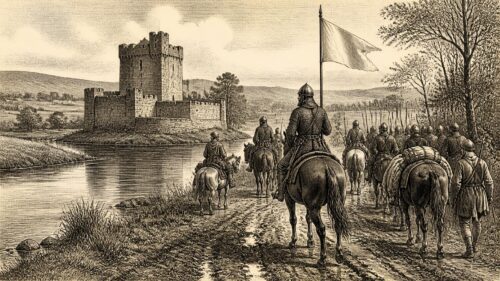
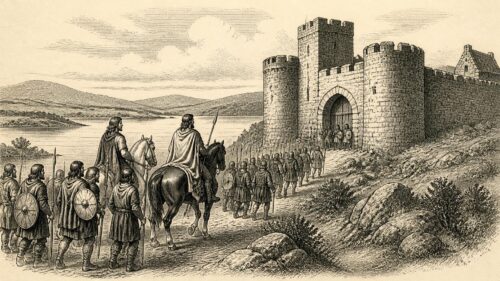
More concrete are the attacks on fortifications. In the week after Low Sunday, the forces of the Ó Mórdha, Ó Conchobhair Fáilghe and Ó Díomasaigh captured and broke the castles of Lea, Kilmohide and Ballylathan. These sites lay in the contested zone west of the more securely governed coastal districts. A castle was not simply a military building: it was a base for collecting rents, storing supplies, sheltering dependants and enforcing a lord’s claims. Its seizure therefore exposed surrounding tenants and travellers as well as undermining the prestige of its proprietor.
Royal and lordly responses were immediate but uneven. Shortly after Easter, John de Carew repaired and regarrisoned Ballymote, also called Clerevoyse. Repairing a castle and placing a guard within it was a practical declaration that a route or district remained worth defending. The need to do so in the wake of Ufford’s death illustrates the limits of government by proclamation. Authority on the ground depended on men, food, weapons, horses, wages and a defensible place from which to operate.
Aghaboe and Sacred Violence
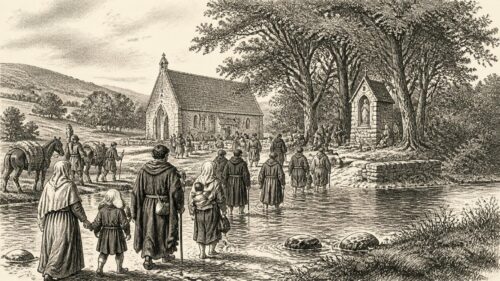
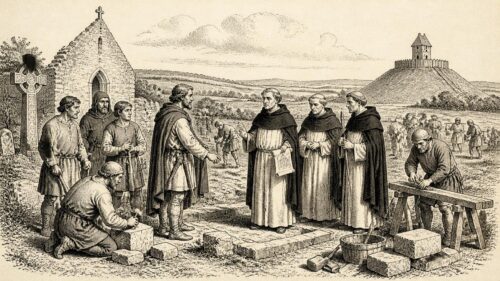
The burning at Aghaboe was especially shocking because it struck a revered ecclesiastical landscape. Aghaboe had long been associated with St Canice, and although the diocesan centre of Ossory had moved to Kilkenny centuries earlier, the saint’s church, shrine and burial ground retained religious and local significance. Clyn presented the destruction of the shrine in deliberately moral language, likening its perpetrator to a degenerate son acting against his father. That rhetoric reveals a Franciscan chronicler’s outrage; it does not allow us to reconstruct every motive behind the attack.
What can responsibly be said is that the assault joined political violence to an attack on a protected sacred place. Churches and cemeteries could be places of refuge, markers of jurisdiction and repositories of communal memory. Relics were not ornamental objects. They gave tangible focus to devotion, pilgrimage, oaths and the honour of a locality. Destroying Canice’s shrine was consequently an assault upon a religious inheritance as well as a material loss. The event also warns against imagining medieval warfare as confined to battlefields and castles. Townships, crops, ecclesiastical property and civilian stores were all vulnerable.
A Dear and Sterile Year
Clyn added a brief but important judgement on conditions in 1346: it was a sterile and expensive year, with a crannoc of wheat selling for twelve shillings. The measure varied by place and period, so the price cannot safely be converted into a modern quantity or purchasing value. Nevertheless, the annalist plainly meant readers to recognise exceptional pressure in the grain market. For households dependent on purchased corn, whether in towns, garrisons or among land-poor rural workers, a sharp rise in the price of wheat could quickly become a crisis.
The record does not prove one single cause. Poor harvests, disruption to cultivation, damaged transport, military requisitioning and local hoarding could reinforce one another, while conditions differed sharply from district to district. But the conjunction of warfare and dearth matters. Raids and castle campaigns consumed food, drove off cattle and made it dangerous to move produce. In late July Roger de la Freigne, sheriff of Kilkenny, seized what Clyn called an exceptionally great prey from Cearbhall Mac Giolla Phádraig and his followers. Such a ‘prey’ usually meant livestock and movable goods: wealth taken from one community was sustenance, breeding stock and security lost to another.
Walter de Bermingham’s Arrival
The crown appointed Walter de Bermingham justiciar on 10 May. A resident Anglo-Irish lord of Carbury, he was a more politically feasible choice than another imported governor at a time when Edward III was preoccupied by war in France. Clyn places Bermingham’s arrival in Ireland around the feast of St John the Baptist, late in June; the biographical and administrative evidence indicates that he returned to Dublin at the end of that month with an armed retinue. His appointment restored a head to the Dublin administration, but did not instantly restore peace.
Near the feast of St John, Clyn reported that some 400 men of Uriel and Dundalk were killed by Irish forces. Medieval figures in chronicles deserve caution, yet the entry points to a serious northern reverse affecting the region around modern County Louth. In September, Fulk de la Freigne killed Tadhg mac Ruaidhrí Ó Cearbhaill, described by Clyn as lord of Ely Ó Cearbhaill, and captured Ruaidhrí Ó Mórdha on the same day. The annalist’s hostile portrait of Tadhg reflects his own political loyalties, but the episode shows how royal and settler interests relied on well-connected local captains such as the Freignes.
During the winter, Bermingham, the earl of Kildare, the Ó Mórdha and the Ó Díomasaigh were involved in further attacks and burnings. Clyn says few men were killed, a rare reminder that the principal object of many expeditions was not always pitched battle. Destroying crops, taking cattle, burning houses and compelling submission could be more useful than risking a decisive encounter. Such methods inflicted lasting hardship while leaving chroniclers with only compressed notices of the people most affected.
Chronicles, Learning and a Necessary Caution
Our unusually close view of 1346 owes much to John Clyn’s Latin annals, produced within the learned Franciscan world of Kilkenny. His record moves between the death of a justiciar, grain prices, castle repairs, ecclesiastical damage and small-scale campaigns. That range is itself revealing: literate religious communities were not detached from secular affairs, but observed the movements of armies, magnates, markets and local violence around them.
It is equally important not to bring later catastrophe prematurely into this year. The Annals of Ulster place a plague in Moylurg under their entry labelled 1346, alongside several Connacht conflicts. Parallel annals of Loch Cé, Connacht and the Four Masters place the same cluster of events in 1349, and Clyn independently records the first severe Irish pestilence in 1348–49. The apparent 1346 notice is therefore a problem of annalistic chronology, not sound evidence that the Black Death had already devastated Ireland in calendar year 1346. For this year, the securely dated evidence is grim enough: political transition, regional war, a ruined shrine and a costly harvest.
Primary Sources
- Annalium Hiberniae Chronicon ad annum MCCCXLIX
- The Annals of Ulster, Year U1346
- Annals of Loch Cé, Annal LC1349
- Annála Connacht
- Annals of the Four Masters, Part 18
- A Tract on the Plague
- Ufford (D'Ufford, de Ufford, Offord), Ralph
- Bermingham, Walter
- FitzGerald, Maurice fitz Thomas
- Clyn, John
- Larcher (L'Archer), John
- The Earls of Desmond in the Fourteenth Century
- ‘Hobbes’, ‘Dogs’ & Politics in the Ireland of Lionel of Antwerp
- The identification of some pestilences recorded in the Irish Annals
- ‘Unheard-of Mortality’….The Black Death in Ireland
- The Annals of Ireland by Friar John Clyn: Edited and translated with an Introduction by Bernadette Williams
- Irish Historic Towns Atlas: Kilkenny Text
- Irish Historic Towns Atlas
- Graveyard, Aghaboe, County Laois
- Chronology of Key Events 1169 to 1799