Bunratty’s Captured Earl1311 CE
In 1311, conflict at Bunratty in Thomond brought rival Uí Bhriain branches, Richard de Clare, William Liath de Burgh and forces from Connacht and Meath into shifting alliances. Although de Clare’s side suffered heavier losses, it captured de Burgh and northern nobles, briefly altering regional power. Thomond endured further killings, including King Donnchad Ó Briain’s murder, contested succession, hostage agreements and later fighting. Raids also struck the Dublin marches, exposing weak governmental control. Church appointments in Dublin and Armagh revealed competing royal, papal and local interests. Deaths, raids and scarcity heightened insecurity, foreshadowing vulnerabilities later exploited during the Bruce invasion.

Dateline
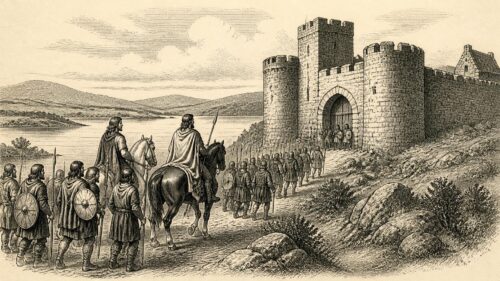
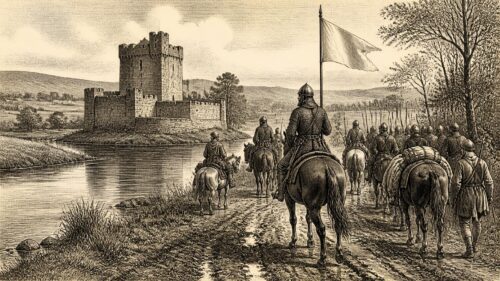
In 1311, the most consequential Irish fighting took place not on a distant frontier of the English lordship but beside Bunratty, on the lower Shannon. There, on 20 May, a contest within Thomond drew together rival branches of the Uí Bhriain dynasty, the de Clare lord of Bunratty, William Liath de Burgh and his Connacht following, and men connected with Meath. The encounter ended in a result as revealing as it was dramatic: William de Burgh, one of the greatest Anglo-Irish lords in the west, was captured, even though his side could claim success in the wider fighting. The episode exposed the limits of both lordly power and royal administration in a country where alliances crossed ethnic, linguistic and legal boundaries.
War at Bunratty
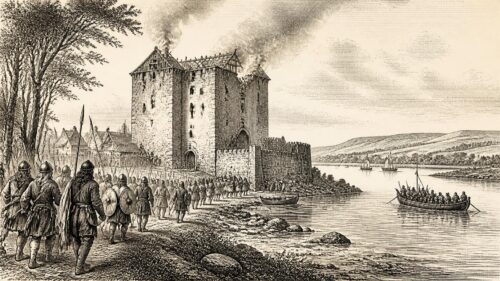
Bunratty was the principal base of Richard de Clare, heir to his family’s ambitious but insecure lordship in Thomond. His father had received a royal grant of the region decades earlier, but a grant on parchment did not amount to control on the ground. De Clare’s authority centred on the castle and settlement at Bunratty, on the River Ratty near its meeting with the Shannon. From there he sought to enlarge a settler lordship among communities whose political loyalties were shaped above all by the rival kindreds of the Uí Bhriain.
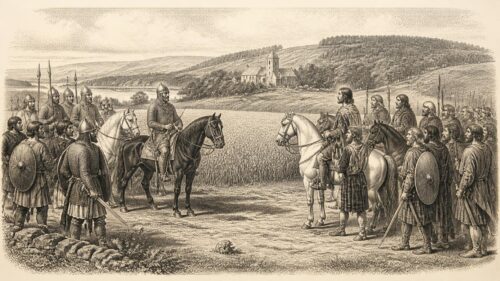
The conflict of 1311 cannot responsibly be reduced to a struggle of “English” against “Irish”. Richard de Clare was a lord of the English crown, but he fought alongside Diarmait Cléirech Ó Briain, a claimant from Clann Bhriain Ruaidh. Opposed to them were Donnchad Ó Briain, then king of Thomond from the Clann Tadhg line, and William Liath de Burgh, whose Connacht power was extensive. The latter coalition also included Connacht forces and ‘foreigners of Meath’—a contemporary Irish phrase normally referring to settlers of the English lordship. Irish dynastic competition thus gave the conflict its immediate energy, while Anglo-Irish magnates supplied troops, fortifications, resources and their own territorial ambitions.
The Annals of Inisfallen date the confrontation to Ascension Thursday, 20 May. They say that de Burgh’s army came to Bunratty and gave battle to de Clare, Sir Maurice Rocheford and a comparatively small force of both Gaels and settlers. The annal’s account is unusually useful because it preserves the ambiguity of the outcome. De Clare’s side lost more men, yet achieved a tactical success: de Burgh and about twelve or thirteen northern noblemen were taken prisoner. The English-language annalistic tradition similarly records the seizure of William de Burgh, John fitz Walter de Lacy and others, while noting deaths among both Irish and English combatants.
It is tempting to imagine a clean victory outside a familiar castle, but the evidence will not bear such certainty. A later narrative elaborates the fighting, and modern reconstructions place it on or near the hill by Bunratty; neither permits confidence about every movement or number. What is secure is that the battle was serious enough to produce prominent prisoners, casualties on both sides, and a rapid change in the balance of power within Thomond. Captivity was not merely a military inconvenience. It could mean ransom, hostages, negotiated obligations and an opportunity for the captor to dictate terms to a rival.
A Kingdom Fractured From Within
The Bunratty battle belonged to a far broader year of violence in Thomond. Earlier fighting had erupted between the people of Uí Blait and Uí Caisín, local territorial groupings whose chiefs and followers formed the working substance of lordly armies. Donnchad Mac Conmara and other prominent men were killed in a major encounter. Such losses mattered beyond the battlefield: a chief’s household, dependants, tenants and allies could be suddenly exposed, while surviving rivals sought advantage from a broken network of protection and obligation.
Then came a still more consequential killing. Donnchad Ó Briain, king of Thomond, was murdered by Murchad son of Mathgamain Ó Briain. The Connacht annalist calls Donnchad a good candidate for the kingship of Ireland; the Inisfallen annalist describes his death as a calamity, emphasising his standing, retinue and capacity to harm enemies. These are not neutral verdicts, but they convey the stature of the man lost. The same source explicitly clears de Clare and Diarmait of direct responsibility, attributing the murder to an older enmity. That caution is important: the political beneficiaries of an assassination were not necessarily its organisers.
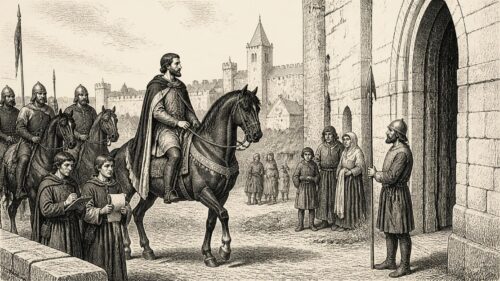
In the immediate aftermath, Thomond’s leaders gave pledges and hostages to Diarmait and de Clare, and Diarmait was made king with support from both Gaels and settlers. Yet this was not a durable settlement. Muirchertach Ó Briain and other opponents left Thomond for Connacht, from where they continued to injure the territory. William de Burgh, meanwhile, was released only after giving a knightly undertaking and further guarantees. The prisoners of May therefore did not mark the end of the war. They marked a pause in which coercion was converted into agreements that everyone knew might be tested again.
Lordship, Service and the Cost of War
The year demonstrates how a lordship functioned in practice. Castles such as Bunratty were not isolated symbols of conquest. They were places from which a lord gathered rents and foodstuffs, housed followers, received envoys, confined prisoners and projected force into surrounding districts. An army was assembled through ties of landholding, fosterage, kinship, service and alliance; its make-up could include mounted men, foot soldiers and retainers from communities otherwise described as Gaelic or English. The annals’ language itself shifts according to the viewpoint of the writer, a reminder that medieval labels could be politically charged rather than fixed descriptions of identity.
On 12 November, an annal reports that Richard de Clare slew 600 gallóglaigh. This is a firmly dated report, but its scale should be handled carefully. No independent contemporary narrative supplied here confirms the total, and medieval chroniclers could use large numbers to express the magnitude of a rout. The entry is nevertheless significant. Gallóglaigh were heavily armed professional or semi-professional foot soldiers associated with the Gaelic and Norse-Gaelic military world, especially valued for close combat. Whether the number was exact or rhetorical, the notice records another severe blow delivered by de Clare late in a year when Thomond was repeatedly mobilised and devastated.
For ordinary households, warfare was experienced through more than casualty lists. Hosts needed grain, livestock, transport, shelter and intelligence. Raiding removed cattle and portable wealth; the burning of buildings destroyed stored food, tools and seed as well as homes. The preceding year had seen scarcity in Ireland recorded in one annal, including an extraordinary price for wheat. That does not prove that scarcity continued through 1311, and it should not be presented as a famine year without evidence. It does, however, underline how vulnerable communities already were when military demands, raids and the disruption of cultivation intensified.
Unrest on the Dublin Marches
Conflict was not confined to the Shannon. The annals record attacks on Saggart and Rathcoole, west of Dublin, by groups identified as O’Byrnes and O’Tooles. A more detailed Latin account places the initial raid on the day after the Nativity of St John the Baptist, 25 June, and says that a large Leinster force was gathered in the autumn to attack the raiders in Glenmalure and other wooded places. The choice of terrain mattered. Glenmalure’s valleys, woodland and uplands made it difficult country for a conventional expedition, while offering local groups cover, routes of retreat and opportunities to strike at settlements on the edge of the lordship.
The annalists call these men ‘robbers’, but that is the language of the government’s side. Their actions were certainly raids upon communities and lands claimed by the crown, yet they also belonged to the continuing contest over the Wicklow marches. The contrast with Bunratty is instructive. In Thomond, great lords and kings fought through shifting alliances. Near Dublin, groups beyond secure governmental reach could threaten agricultural settlements and roads, forcing the administration to assemble a response. In both places, royal peace was an aspiration that depended on local military capacity.
Churches and Distant Authority
1311 also brought changes in the higher church. John Lech, a royal clerk backed by Edward II, was consecrated archbishop of Dublin in May and received the temporalities of the see in July. His appointment overrode the preference of Dublin’s cathedral chapters, which had elected Alexander de Bicknor. The dispute illustrates how ecclesiastical office in the lordship was entwined with royal patronage and papal authority. Lech himself remained largely outside Ireland, but the archbishopric’s revenues, legal privileges and influence made control of the office important.
In November, Roland Jorz was provided to the archbishopric of Armagh after the resignation of his brother Walter. The temporalities were not restored until the following year, so his appointment should not be mistaken for immediate control on the ground. Meanwhile, bishops of Cashel, Killaloe, Lismore, Emly and Cloyne were summoned to Pope Clement V’s general council at Vienne in France; the Annals of Inisfallen state that none attended or sent satisfactory representatives, fearing adverse consequences. This was a small but telling sign of distance: Irish churches were part of Latin Christendom, but travel, expense, politics and insecurity could limit their participation in its grand assemblies.
A Year of Shifting Possession
Other entries give 1311 its human texture. John de Cogan, a leading Munster baron, died. William Roche died from an arrow wound inflicted by a member of the Uí Bhriain. Máel Ísa Ó Dálaigh, remembered as a master of poetry and generosity, also died, a brief notice that points to the learned families whose work sustained elite culture across political borders. In Connacht, raids, killings and succession struggles continued alongside the grander contest at Bunratty. No single authority could contain all of these disputes.
For Ireland, 1311 was not yet the year of the Bruce invasion; that lay four years ahead. It was, however, a revealing prelude to the vulnerabilities that invasion would exploit. Thomond showed that the English lordship could intervene deeply in Gaelic succession politics, but not command its outcome. De Burgh’s capture showed that even the greatest magnates could be exposed in the field. The Wicklow raids showed the fragility of the colony’s approaches to Dublin. And appointments in Dublin and Armagh showed how authority was still being negotiated between king, pope, cathedral chapters and local society. The prisoners taken at Bunratty were the year’s most vivid symbol: power in medieval Ireland was real, armed and ambitious, but rarely secure.
Primary Sources
- Annála Connacht: Annal 1311
- Annals of Inisfallen: Annal AI1311
- Annales Hibernie ab anno Christi 1162 usque ad annum 1370: Annal M1311
- Annales Hiberniae
- CELT Project: Annales Hiberniae
- Mac Carthaigh’s Book: MCB1311
- Caithréim Thoirdhealbhaigh, Part 1
- Clare, Richard de
- Wogan, John
- Lech, John
- Jorz (Jorse), Walter
- Bicknor, Alexander
- Bruce, Edward
- English Lords in Late Thirteenth and Early Fourteenth Century Ireland: Roger Bigod and the de Clare Lords of Thomond
- The Impact of the Bruce Invasion, 1315–27
- The Bruces in Ireland, 1315–18
- County Clare Urban Archaeology Survey 1990–1
- Battlefield, Bunratty West, Bunratty East, Clonmoney North, County Clare
- O’Brien’s March from Limerick to Tulla in 1317
- Documents on the Early Stages of the Bruce Invasion of Ireland, 1315–1316
- The Bruce Invasion
- English Lords in Late Thirteenth and Early Fourteenth-Century Ireland: Roger Bigod and the de Clare Lords of Thomond