Editorial — Yet the
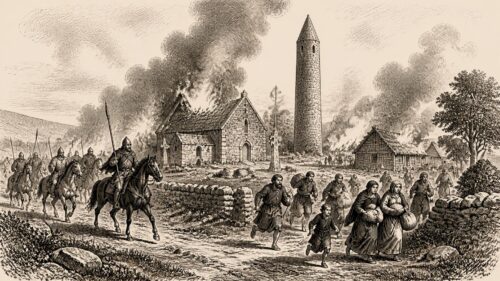
Welcome to the Emerald Archives Gazette. In today’s issue we look back at the latest additions to the archive. Six Burnings — For Ireland, 1360 is remembered most clearly through a stark cluster of fires. The Annals of Connacht record “great burnings” at Roscommon, Devenish, Sligo, the monastery of Lisgoole, Fenagh and Drumlease. The entry gives no date within the year, no named commander and no narrative explaining whether these were connected attacks, separate raids, or destruction arising from several local conflicts. That silence matters. It would be unsafe to turn the notice into a single, neatly organised campaign.
Dateline
The Day in Irish History
Welcome to the Emerald Archives Gazette. In today’s issue we look back at the latest additions to the archive.
Six Burnings — For Ireland, 1360 is remembered most clearly through a stark cluster of fires. The Annals of Connacht record “great burnings” at Roscommon, Devenish, Sligo, the monastery of Lisgoole, Fenagh and Drumlease. The entry gives no date within the year, no named commander and no narrative explaining whether these were connected attacks, separate raids, or destruction arising from several local conflicts. That silence matters. It would be unsafe to turn the notice into a single, neatly organised campaign. Yet its geographical reach, from Connacht into Fermanagh and the north-west, makes it an unusually vivid indication of insecurity in a year otherwise…
Ballyshannon Victory — In 1359, the most clearly recorded Irish military event was a victory at Ballyshannon, or Áth Seanaigh, where Cathal Óg Ó Conchobair defeated forces of Cenél Conaill. The encounter belonged to the intensely local but far-reaching politics of the north-west: control of routes along the Erne, relationships between Connacht and Tír Chonaill, and the standing of leading kindreds whose authority depended on followers, hostages, cattle, land and reputation. Its consequences reached beyond the battlefield. Prisoners taken there became part of ransom negotiations, and a later manuscript note connects those negotiations with the movement of one of Ireland’s greatest surviving books.…
Dublin Scholars — In 1358, Ireland’s political map was a patchwork of lordships, towns, church jurisdictions and rival dynasties rather than a country governed uniformly from one centre. The king of England, Edward III, was lord of Ireland, and royal officials operated from Dublin; yet Gaelic rulers and great Anglo-Irish families exercised decisive power across much of the island. The year’s surviving notices are therefore strikingly dispersed. They record a royal intervention to support learning in Dublin, serious fighting in Ulster and Leinster, a killing within Fermanagh’s ruling world, the death of a bishop, and an extraordinary summer hailstorm. Together they show a…
Art Mór — The evidence for Ireland in 1357 is unusually revealing precisely because it is uneven. Official records from the English lordship, a contemporary English chronicler and Irish annals preserve different sorts of fact: offices and commissions around Dublin; a reported renewed visitation of plague; warfare and settlement in Leinster; and, in the north and west, the deaths, killings and negotiated peace recorded by Gaelic learned communities. None provides a complete national picture. Together they show an island governed through several overlapping political worlds rather than a single state. A Child in a Contested Leinster One event conventionally placed in 1357 was…
Connacht Retribution — In Connacht, 1356 brought a sudden and violent change at the summit of regional politics. Áed, son of Toirrdelbach Ó Conchobair, was killed at Baile Locha Deacair, named in the annals as Balloughdacker. The killing was not represented as the outcome of a set-piece battle between great armies. Rather, it emerged from a personal grievance with major political consequences: Áed was said to have carried off the wife of Donnchad Carrach Ó Cellaig, a daughter of Seoinín Burke. Donnchad, the Clann an Bhaird and the Uí Maine acted together against him. Afterwards, Áed son of Feidlim Ó Conchobair took what…
Desmond’s Justiciarship — In 1355 the most securely dated Irish development was a change at the summit of the English lordship’s administration. On 8 July Edward III appointed Maurice fitz Thomas FitzGerald, first earl of Desmond, as justiciar of Ireland. He was acting from 8 August. The office made him the king’s chief governor in Ireland: responsible, in theory, for royal justice, defence, finance and the conduct of government from Dublin Castle. In practice, his appointment acknowledged a basic reality of fourteenth-century Ireland. Royal authority depended heavily on powerful local lords, among whom Desmond himself was pre-eminent. A Magnate Becomes Justiciar Maurice’s elevation…
Mac Murchada — In 1354, Ireland’s surviving records register a year of execution, local warfare, deaths and administrative scrutiny rather than a single national turning point. The clearest contemporary-style annalistic notices come from Connacht and Loch Cé, with the Annals of the Four Masters preserving a fuller retrospective compilation. They agree on several major matters: a Mac Murchada was put to death by the Galls; the death or killing of rulers affected Laois, Uí Fhiachrach and other lordships; and an alliance of Clann Aedha Buidhe and the Galls of Dundalk inflicted a serious defeat on Aodh Ó Néill. Royal records, meanwhile, place the…
Kilconnell Friary — The clearest Irish landmark conventionally attached to 1353 is a religious foundation in eastern Connacht: the Franciscan friary of Kilconnell, in the lordship of Uí Maine. Yet the word conventionally matters. The Annals of the Four Masters, compiled in the seventeenth century from earlier materials, place the foundation in this year and name its patron as William Buí Ó Ceallaigh, lord of Uí Maine. Other evidence and later Franciscan tradition have produced a rival date of 1414. The surviving ruins chiefly reflect later building campaigns. Kilconnell therefore offers an unusually revealing starting point for 1353: it is an event recorded…
Ballindoon Defences — In 1352, the most clearly dated Irish evidence points towards a violent reordering of power in Connacht, Breifne and Tír Chonaill. The year’s annalists do not provide a continuous national narrative: they record claims to lordship, killings, the breaking of a defended place and the destruction of livestock. Yet those compressed notices reveal a great deal. Authority was personal and contested, warfare could reach the resources on which communities depended, and a lord’s position was secured not by a fixed constitutional office but through kinship, alliances, armed followings and the capacity to reward supporters. Reading a Difficult Year The best…
Christmas Hospitality — In 1351, Ireland’s political life was conducted in several overlapping worlds. In the lordship governed for Edward III, Sir Thomas Rokeby’s administration tried to make English royal law effective in a country where its reach had become uneven. In Connacht, rival branches of the Ó Conchobhair dynasty struggled for the kingship, while the capture of a returning pilgrim triggered warfare that devastated Moylurg. Yet the year is also remembered for a very different display of power: Uilliam Buide Ó Ceallaigh’s Christmas gathering for Ireland’s learned classes. Taken together, these events show a country in which force, law, faith, learning and…
Connacht Coup — For Ireland, 1350 was above all a year in which the aftershocks of pestilence met the ordinary, dangerous business of lordship. The first great outbreak of plague had already been noticed in Irish records in 1349, but a contemporary marginal note written in 1350 describes the year as the second since the disease’s arrival in Ireland. The epidemic therefore belongs securely to the setting of this year, even where its local progress cannot be dated more precisely. At the same time, the annals preserve an unusually concentrated record of depositions, killings and retaliations in Connacht, Breifne and Thomond. Far from…
Black Death — The year 1349 is one of the clearest turning-points in later medieval Irish history, yet it must be approached with unusual care. The plague’s first arrival was remembered differently by different writers: Friar John Clyn’s Kilkenny annals describe its appearance around Dublin, Howth, Dalkey and Drogheda under 1348, while his final notice states explicitly that the first pestilence in Ireland became severe in 1349. The Connacht annals, meanwhile, place a great plague in Moylurg and throughout Ireland in 1349. Rather than forcing these records into a falsely precise timetable, it is safest to see 1349 as the year in which…
Taughmoling Pilgrimage — In 1348 Ireland entered one of the most traumatic episodes in its medieval history: the first great outbreak of the pestilence later called the Black Death. Yet the year was not defined by disease alone. It also saw local war in Connacht, the repair and coercive reordering of lands in Ormond, changes in lordship, and an extraordinary movement of pilgrims to the water of St Moling at Taughmoling, now St Mullins, on the Carlow–Wexford border. The surviving evidence is uneven. It is fullest for the English-controlled towns and lordships of the east and south, and for the Franciscan annalist John…
Nenagh Rising — In 1347, Ireland’s political map was defined less by a single government than by a crowded field of lordships, dynasties, church jurisdictions and fortified towns. The strongest evidence for the year comes from annals written in different regions and languages. They do not provide a complete national narrative, but together they record killings, successions, church initiatives and one especially dramatic attack: the destruction of Nenagh and much of the surrounding Butler lordship at Christmas. This was not an isolated outbreak of disorder. It exposed the vulnerability of an Anglo-Irish frontier in north Tipperary while regional Gaelic rulers continued to pursue…
Aghaboe Burning — The most vivid Irish event securely dated to 1346 occurred at Aghaboe, in the borderland between Ossory and Ely. On Friday 5 May, Diarmaid Mac Giolla Phádraig, called monoculus or ‘the one-eyed’ in the Latin annals, joined with an Ó Cearbhaill ally to burn the settlement, its cemetery and church. The attack also destroyed the shrine containing the bones and relics of St Cainnech or Canice, the sixth-century abbot remembered as Aghaboe’s founder and patron. Yet this was not an isolated act of sacrilege in an otherwise ordered realm. It came in a year when the death of an unusually…
Ufford’s Campaign — In 1345, the sharpest political struggle in the English lordship of Ireland unfolded not at a frontier ford but across the towns, castles and lordships of Munster. Sir Ralph Ufford, justiciar of Ireland and the king’s chief governor, moved against Maurice fitz Thomas FitzGerald, first earl of Desmond. Their quarrel exposed a basic weakness in royal administration: the Crown needed the co-operation of the great Anglo-Irish magnates, yet Ufford sought to discipline them with an unusually forceful assertion of central authority.The year also brought a violent change of ruler in Connacht, fighting upon Lough Neagh in Ulster, and smaller but…
Ufford’s Arrival — In 1344, Ireland was not a single political unit in any practical sense. Edward III was lord of Ireland, and royal institutions at Dublin claimed authority across the island; yet that authority depended on cooperation from great Anglo-Irish lords, towns, churchmen and regional officeholders. Beyond and between the areas most securely governed from Dublin, Gaelic kingships and lordships pursued their own rivalries, successions and alliances. The year is unusually clear in one respect: it brought a new and forceful royal chief governor. Elsewhere, the Irish annals show that local sovereignty could change hands with startling speed.A New JusticiarThe best-dated development…
Kilronan Church — The annals open 1343 with the first day of January falling on a Wednesday, but Ireland’s political year was anything but orderly. Authority was dispersed among competing kings, lineage heads, Anglo-Irish lords, churchmen and local communities. The most consequential developments recorded for this calendar year occurred in Connacht, Thomond and Tír Conaill, where successions were made, unmade and defended by force. Yet the year was not solely one of raids and killings. A church was built at Kilronan in north-west Roscommon, a new belfry rose at St Mary’s in Kilkenny, and monasteries remained central places of burial, worship and elite…
Connacht Usurpation — In 1342, the most consequential Irish crisis unfolded in Connacht, where a dispute between leading dynasties grew into a provincial war and briefly overturned a king. The year is unusually well illuminated by Annála Connacht, whose entry opens with a calendrical notice placing 1 January on a Tuesday and then follows the conflict in detail. Its narrative must still be read as an annalistic account rather than a modern campaign history: it preserves vivid incidents and named participants, but seldom supplies precise dates, troop numbers or the experiences of ordinary people. What it does show unmistakably is the destructive reach…
Roscommon Seizure — In 1341, political authority in Ireland was contested at several levels at once. In Connacht, Toirrdelbach Ó Conchobair seized the royal castle of Roscommon, a conspicuous assertion of Gaelic power at a fortress raised by the English crown. In the lordship governed from Dublin, Edward III’s ministers attempted an equally dramatic assertion of royal control: they ordered the resumption of grants and the removal of officials rooted in Irish society. The reaction of the English of Ireland, expressed at Dublin and Kilkenny late in the year, revealed how little confidence they had in a distant government’s remedies. The annals also…
Ballymote Peace — The surviving notices for 1340 show an Ireland in which authority was intensely local, mobile and precarious. The year’s clearest events lie in Connacht and its borderlands: a provincial king imposed his choice upon Uí Maine, imprisoned a dangerous kinsman, faced retaliation from the Mac Diarmata of Moylurg, and was forced into a peace after being driven into Ballymote. Elsewhere, predatory warfare in Breifne killed a leading O’Rourke; a ruler of Uí Fhiachrach Aidhne was slain by his own followers; and the royal government in England made terms with a powerful de Burgh lord. These were not fragments of one…
Winter Hardship — A Year of Hard Weather and Hard PowerThe evidence for 1339 presents Ireland as a land in which a damaging winter, local war and dynastic manoeuvre overlapped. The most detailed contemporary-style record, Annála Connacht, explicitly heads its entry with the year 1339. Its notices range from Uí Maine and Connacht to Tír Chonaill, Meath and Dublin, a useful warning against treating the island as a single political unit. Ireland remained a mosaic of lordships, ecclesiastical territories, towns and royal jurisdictions. Edward III was lord of Ireland, but his government’s effective reach was uneven; Gaelic dynasties and increasingly Gaelicised descendants of…
Lough Mask — A Killing That Changed ConnachtThe most consequential Irish event securely placed in 1338 was the killing of Sir Edmund de Burgh, known in the annals as the son of the Earl of Ulster. He was captured by his kinsman Edmund Albanach de Burgh, had a stone tied about his neck, and was cast into Lough Mask. The stark formula occurs in both the Annals of Connacht and the Annals of Loch Cé. Neither supplies a day or month, and none should be invented; but both place the killing firmly within their annal for 1338.Its importance lay not merely in the…
Athleague Stronghold — In 1337, Ireland’s political map was not governed by a single rhythm. The English crown maintained a formal lordship centred on Dublin, while powerful Anglo-Irish lordships, Gaelic kingships and regional kindreds negotiated, fought and made peace on their own terms. The year’s surviving records are especially rich for Connacht and its neighbouring regions. They show a country in which a settlement over rents, a defensive position at a river crossing, a hostage-taking and the deaths of learned churchmen all belonged to the same political world: authority depended on land, armed followings, kinship and reputation. A Peace Measured in Rent The…
Mac Goisdelb — The surviving record for 1336 is unusually rich for Connacht, though it remains a record of lordly action rather than a complete account of Irish life. It preserves one precisely dated death, a sequence of raids and changes of power, a notable marriage alliance, the destruction of a major stronghold, and a severe winter disaster reported on an all-Ireland scale. These notices belong to a country divided among many political communities: Gaelic lordships, Anglo-Irish lineages, ecclesiastical institutions and towns all had overlapping interests, while the authority claimed by the English crown was highly uneven beyond its stronger eastern and southern…
Claregalway Killings — In 1335, Ireland’s political landscape was marked less by any single authority than by competing lordships, family alliances and local armed power. The most sharply dated Irish event of the year was a killing at a meeting recorded as taking place at Clar-Goly, generally identified with Claregalway. Elsewhere, Connacht endured destructive conflict among the de Burgh kindred and their allies; the Dublin administration raised men, ships and money for a campaign in Scotland; and churchmen, townspeople, physicians and learned households continued to shape public life. A severe spring snow, remembered for killing small birds across Ireland, offers a rare glimpse…
Kilkenny Paving — In 1334, Ireland’s political landscape remained divided among Gaelic lordships, Anglo-Irish liberties, ecclesiastical jurisdictions and royal offices that did not neatly overlap. Yet the year can be approached through unusually vivid local evidence. Friar John Clyn, writing from the Kilkenny Franciscan milieu, recorded weather, civic works, castle seizure, killings and religious observance with a precision absent from many fourteenth-century Irish annals. In Connacht, another annalistic tradition preserved a very different but equally stark event: a joint Gaelic and settler force campaigning into Munster, extracting hostages and causing a mass death in a church. Together, these notices reveal an island in…
Carrickfergus Murder — On 6 June 1333, William de Burgh, third earl of Ulster and lord of Connacht, was murdered near Carrickfergus. He was only twenty years old, yet his inheritance joined two of the greatest aristocratic lordships in Ireland: the earldom of Ulster in the north-east and the de Burgh lordship of Connacht in the west. His death was therefore not simply a killing within a noble household. It removed the young figure through whom an exceptionally large and already troubled landed power was meant to be held together. The event is firmly dated, unusually so for much fourteenth-century Irish history. Irish…
Bunratty Destruction — In 1332, authority in Ireland was measured less by formal titles than by whether a lord could keep a castle, command a town, protect a road or carry a prisoner to Dublin. The year brought a striking sequence of events across the lordship: the execution of William de Bermingham, the destruction of Bunratty Castle in Thomond, a renewed royal hold on Arklow, and outbreaks of violence at Limerick and Nenagh. These were not isolated disturbances. Together they exposed the limitations of government from Dublin, the strength of regional lordships, and the enormous pressure placed upon communities already affected by scarcity…
Fragmented Authority — In 1331, authority in Ireland was asserted, evaded and fought over in several very different places at once. At Dublin, Edward III’s government sent a new justiciar and issued ambitious instructions for reform. In Leinster, raiders captured a royal castle and struck at the estates of the archbishop of Dublin. In Connacht, a lord abandoned secular rule for the monastery just as an army burned through his son’s territory. The surviving records do not create a complete national narrative: they are annals, administrative measures and later compilations, each with its own priorities. Yet together they show a lordship in which…
Boyne Floods — In 1330, Ireland’s most securely dated drama was not a battle or a coronation but a season of destructive weather. A chronicle associated with Kilkenny records exceptionally violent storms, the collapse of a house that killed the wife and daughter of Milo Verdon, and a great flood on the Boyne. It says that every bridge on the river except one called “Babe’s” was swept away, while Trim and Drogheda suffered further damage. The report is vivid, but it should be read as an annalistic record rather than as a modern survey: it does not identify every crossing, locate Babe’s bridge…
Bermingham Murder — In 1329, the killing of John de Bermingham, earl of Louth, at Braganstown near Ardee exposed the brittleness of lordship in fourteenth-century Ireland. Bermingham had been among the foremost men of the English lordship: a veteran of the war against Edward Bruce, former justiciar, and the holder of an earldom created in reward for service at Faughart. Yet on 10 June he and many members of his following were killed by men drawn from the English gentry of Louth. The event was not a rising of ‘Irish’ against ‘English’. It was a violent reckoning within a frontier society where political…
Thank you for reading today’s Gazette. Follow any of the links above to read the full article and explore its sources.