Mac Goisdelb’s Great Castle1336 CE
In 1336, Connacht remained fragmented after William de Burgh’s murder, as Gaelic and Anglo-Irish lords pursued raids, alliances and territorial advantage. Tomaltach Mac Diarmata of Moylurg died and was buried at Boyle Abbey, succeeded by Conchobar. Forces led by Toirrdelbach Ó Conchobair captured and destroyed Mac Goisdelb’s Great Castle, allowing its mercenary garrison safe departure. Ruaidhri Ó Ceallaigh, king of Uí Maine, was killed, while Toirrdelbach reshaped alliances through marriage. Edmund Mac William de Burgh was expelled. Warfare reached Tír Chonaill. Legal scholar Trinnoit Ó Naan died. Severe snow and frost devastated cattle and winter growth, straining communities across Ireland.
Dateline
The surviving record for 1336 is unusually rich for Connacht, though it remains a record of lordly action rather than a complete account of Irish life. It preserves one precisely dated death, a sequence of raids and changes of power, a notable marriage alliance, the destruction of a major stronghold, and a severe winter disaster reported on an all-Ireland scale. These notices belong to a country divided among many political communities: Gaelic lordships, Anglo-Irish lineages, ecclesiastical institutions and towns all had overlapping interests, while the authority claimed by the English crown was highly uneven beyond its stronger eastern and southern districts.
Connacht After the Earls
Events in 1336 unfolded in the unsettled aftermath of the killing of William de Burgh, earl of Ulster, in 1333. That murder had removed the leading figure in the vast de Burgh lordship of Connacht and Ulster. The inherited rights of the earldom did not simply disappear, but practical command in Connacht fragmented among competing Burke branches and their allies. Gaelic rulers such as Toirrdelbach Ó Conchobair, styled king of Connacht by the annals, could exploit that division; so could lesser lordly families whose lands lay across the province.
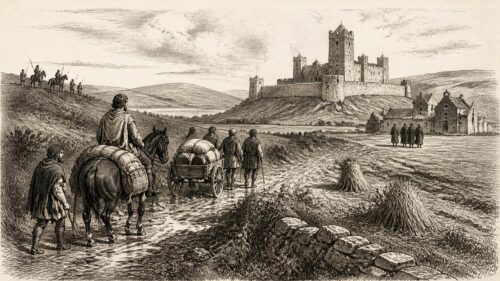
This broader background must not obscure the year’s own evidence. The Annals of Connacht, a source especially close to the politics of the western province, places its entries explicitly under 1336. They show no single, continuous war. Instead, power was exercised through short campaigns, cattle-raids, attacks on fortified places, negotiated withdrawals and the ability to assemble allies. Such activity affected households well beyond the men named in the annals: herds had to be driven to safety, food and horses supplied to armed followings, and local people faced the loss of stock, labour and security.
A Succession at Boyle
The year’s clearest date is 24 May, the eve of Trinity Sunday, when Tomaltach Mac Diarmata, king of Moylurg, died at his own residence at Caladh na Cairrge. The annalist praised him in the conventional but revealing language of lordship: formidable to enemies, yet distinguished by generosity, protection and dignity. He was buried “nobly and honourably” at Boyle monastery, and his son Conchobar succeeded at once.
Moylurg, in the north of modern County Roscommon, was a Mac Diarmata lordship of real regional consequence. Boyle was not merely a convenient burial place. Its Cistercian abbey had long been associated with the Mac Diarmata rulers and was among Connacht’s foremost religious houses. Tomaltach’s burial therefore joined dynastic continuity, religious patronage and public ceremony. Conchobar’s accession mattered immediately because he inherited a lordship already participating in the province’s armed alliances. The annals do not describe an inauguration ritual, nor should one be invented; they simply state that he became king after his father.
Other deaths register the instability of elite society. Theobald Burke, son of William, and Mailir Mac Jordan d’Exeter died during the year. Diarmait Ó Flannacáin, chieftain of Clann Chathail, also died. These brief notices give little explanation, but they remind us that political relationships rested on people whose disappearance could alter obligations, rivalries and claims to land.
Raids, Herds and a Captured Stronghold
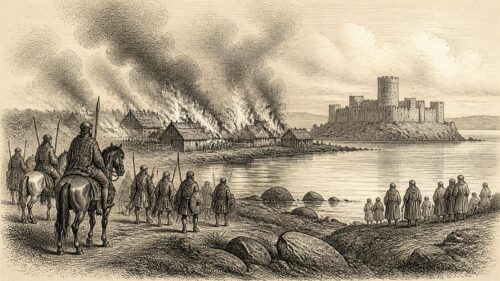
Conflict was active across Connacht. Eogan Ó Madadhain defeated descendants of Richard Burke, reportedly killing sixty-six people “gentle and simple”. The wording deliberately counts both leading men and followers, although it supplies neither a place nor a date. Elsewhere, sons of Diarmait Gall Mac Diarmata, together with a son of Feidlim Ó Conchobair, raided Clann Goisdelb; Maidiucc Mac Goisdelb was killed while pursuing the raiders and their prey.
Edmund, son of William Burke, then made what the annalist calls a great raid into Clann Chathail. Conchobar Ó Flannacáin and many others were despoiled, Máel Sechlainn Ó Flannacáin was killed in pursuit, and a brother of Mac an Mhílid was captured. The detail matters because a raid was not a vague gesture of hostility. It involved the taking of moveable wealth, prisoners and prestige, while pursuit could turn a withdrawal into a fatal encounter.
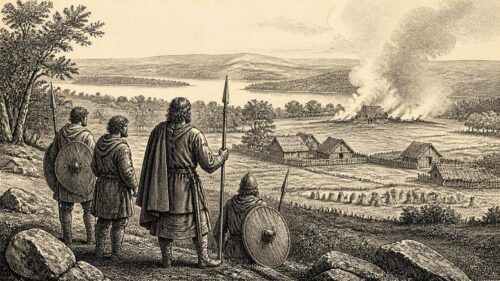
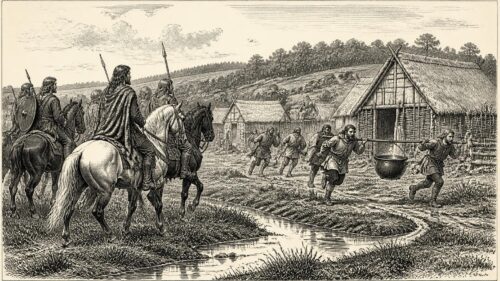
Conchobar Mac Diarmata joined Aed, a member of the Ó Conchobair dynasty, household troops of Ó Conchobair, Clann Donnchada, and newly levied men from Carbury under Cormac Ó Conchobair for an expedition into Tíreragh. The inhabitants removed their cattle before the force arrived, a small but vivid sign of practical preparedness. Even so, the raiders carried away dead stock, horses, a few steeds and smaller animals, killed some people and returned safely. Cattle and horses were both economic resources and political assets: their seizure weakened an opponent while rewarding a lord’s fighting men.
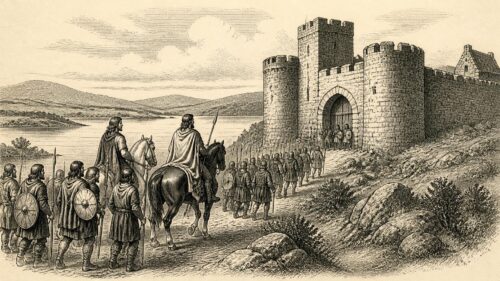
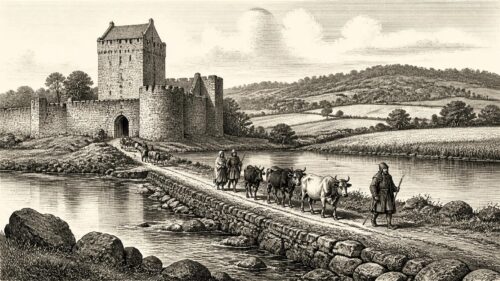
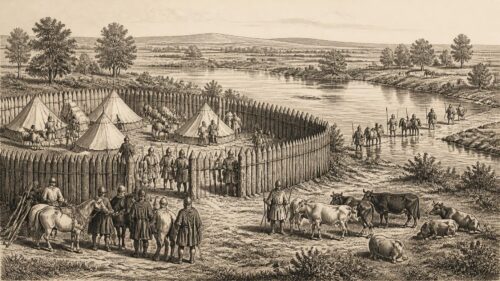
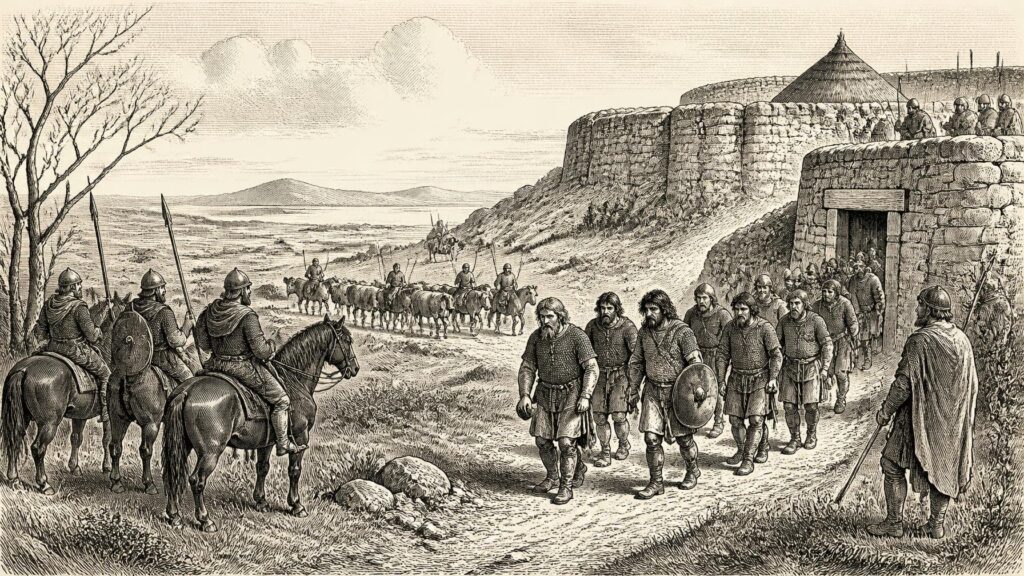
The largest operation recorded in Connacht was led by Toirrdelbach Ó Conchobair. He assembled the forces of the Tuatha, Clann Chathail, Clann Chonchobair and Moylurg at Airtech, then captured and destroyed the “Great Castle” of Mac Goisdelb. The annal does not locate the castle with modern precision or describe its fabric, so it is unsafe to picture a particular surviving ruin. It does, however, call it great and records a mercenary garrison. Crucially, that garrison was allowed to depart under the safeguard of Mac Diarmata. The episode was thus more than destruction: it ended with a negotiated guarantee, demonstrating that warfare could include recognised protections even amid ruthless competition.
Leadership, Marriage and Expulsion
The killing of Ruaidhri Ó Ceallaigh, king of Uí Maine, was one of the year’s gravest political shocks. According to the Annals of Ulster, Cathal, descendant of Aed and Eogan Ó Conchobair, killed him after Ruaidhri had left Toirrdelbach Ó Conchobair’s house for his own. The same annalist calls Ruaidhri the most eminent man in Ireland “without dispute”, an exceptional tribute that reveals his standing, even if it is not a literal census of national opinion. No exact place or date of the killing is given. What can be said firmly is that the death removed the ruler of an important southern Connacht kingdom at a moment of provincial conflict.
Dynastic marriage was another instrument of politics. Toirrdelbach Ó Conchobair took as wife the daughter of Toirrdelbach Ó Briain, who had been the wife of the son of the earl of Ulster; at the same time he put aside Derbail, daughter of Aed Ó Domnaill. The annal provides no private explanation, and its language should not be turned into a modern account of consent or feeling. Publicly, however, the change linked the king of Connacht with an Ó Briain connection extending towards Thomond, while ending a union with an Ó Domnaill woman of Tír Chonaill. Marriage could reorder networks of kinship, hospitality, military support and diplomacy as surely as a campaign could.
The annalists also state that Edmund Mac William de Burgh was expelled in 1336. They do not identify where this occurred, who expelled him or how long the exile lasted. The notice should therefore stand as evidence of displacement within the fractured de Burgh world, not as proof of a fully documented conquest. In Breifne, Thomas Mag Samradhain was released from the custody of Clann Muirchertaigh after repudiating the daughter of Donnchad Riabach; his two sons also escaped during the year. Here too, captivity, marriage and political leverage were tightly entwined.
Northward Warfare and Learned Communities
Conflict was not confined to Connacht. Aed Remor Ó Néill led a great hosting into Tír Chonaill, where the people of Ó Dochartaigh killed a son of John Ó Néill and Geoffrey Ó Domnaill. The compact entry does not permit reconstruction of a battle, but it records the capacity of the Ó Dochartaigh to inflict losses on a force associated with the leading dynasty of Cenél nEógain.
Amid these notices of lordship and violence, the Annals of Connacht record the death of Trinnoit Ó Naan, described as a master in many arts and in both civil and canon law. The phrase indicates a learned world in which legal and ecclesiastical expertise carried prestige. Such scholarship did not stand apart from politics: rulers, churches, kin-groups and communities required people able to interpret rules, write documents, preserve learning and advise on disputes. The source offers no details of Ó Naan’s school or pupils, but it is valuable evidence that advanced legal learning was recognised and commemorated in 1336.
Snow, Frost and Failing Winter Grass
The year closed under environmental pressure of a different order. The Annals of Ulster report a great plague of snow and frost from early winter into part of spring. Much cattle died, and the “green crops” went to nothing. The Irish wording has also been understood as referring to winter grass or winter grazing; either way, the annalist’s point is plain. Frost and snow destroyed the feed on which animals depended and imperilled the agricultural cycle.
This was especially serious in a society where livestock represented food, traction, dairy produce, manure, rents, gifts and the readily moveable wealth fought over in the year’s raids. The annal does not expressly report a famine, a price crisis or mass human mortality, and those outcomes should not be claimed. Yet cattle deaths and the loss of winter growth would have placed severe strain on households, tenants, religious houses and lordly estates alike. The contrast with the raiding record is stark: in 1336 livestock were not only seized by enemies but also lost to weather beyond anyone’s command.
Thus 1336 appears not as a single national story but as a hard year in which Connacht’s rival powers manoeuvred through force, alliance and succession while Ireland’s northern lordships remained volatile. The fall of Mac Goisdelb’s Great Castle, Tomaltach Mac Diarmata’s burial at Boyle, Ruaidhri Ó Ceallaigh’s killing and the destructive winter all show how power, religion and survival were inseparable in medieval Ireland.
Primary Sources
- Annála Connacht, Annal 1336
- The Annals of Ulster, Year U1336
- Annala Uladh: Annals of Ulster otherwise Annala Senait, Annals of Senat
- Annála Connacht: CELT Project Document Details
- Annals of Ulster: CELT Project Document Details
- Annals of Loch Cé: CELT Project Document Details
- Annals of the Four Masters
- Boyle Cistercian Abbey
- County Roscommon Urban Archaeology Survey: Boyle
- Boyle Abbey, Boyle
- Adapting to the Little Ice Age in Pastoral Regions: An Interdisciplinary Approach to Climate History in North-West Europe
- Medieval Irish Chronicles Reveal Persistent Volcanic Forcing of Severe Winter Cold Events, 431–1649 CE
- Climate, Disease and Society in Late-Medieval Ireland
- Extremes of Weather Recorded in the Annals of Connacht, 1224–1562
- Urban Rebels in Medieval Connacht: The Revolt of Galway, 1388–9
- The Rise and Fall of the Clann Éinrí Aimhréidh Uí Néill: Dynastic Feuding and Geopolitics in the Late Medieval Irish Sea World
- The Administration of Ireland 1172–1377
- The Transmission of Irish Law in the Fourteenth and Sixteenth Centuries: Exploring the Social and Historical Contexts
- Exploring the Irish Annals
- Understanding Whether Environmental Conditions Can Provoke Violence