Collooney Conflict1291 CE
In 1291 Ireland’s most consequential recorded developments lay in the north and west: the campaigning of Richard de Burgh, earl of Ulster, known to later history as the Red Earl; disputed kingships among the Ó Néill, Ó Domnaill and Ó Conchobair; and a sharp Connacht struggle centred on the weir at Collooney. These events are principally preserved in Irish annals, which organise material by year but do not normally supply dates or a dependable sequence within the year. The campaigns and battles described below can therefore be responsibly assigned to 1291, while their precise seasons and order cannot.
Dateline
In 1291 Ireland’s most consequential recorded developments lay in the north and west: the campaigning of Richard de Burgh, earl of Ulster, known to later history as the Red Earl; disputed kingships among the Ó Néill, Ó Domnaill and Ó Conchobair; and a sharp Connacht struggle centred on the weir at Collooney. These events are principally preserved in Irish annals, which organise material by year but do not normally supply dates or a dependable sequence within the year. The campaigns and battles described below can therefore be responsibly assigned to 1291, while their precise seasons and order cannot. Royal administrative records, by contrast, occasionally preserve exact dates and reveal a different Ireland of courts, ports, religious houses and official finance.
Magnate Power in the North
Richard de Burgh was already one of the island’s strongest territorial lords. He held the earldom of Ulster and the lordship of Connacht, with wide resources, military followers and political relationships extending across the Irish Sea. His power was not identical with the authority of the English crown in Ireland: it rested substantially on his own estates, alliances and capacity to bring armed men into the field. Yet it was also exercised within a wider lordship headed by King Edward I and administered in Dublin by the justiciar, William de Vescy. De Burgh’s 1291 expeditions show both the reach and the limits of such magnate power.
The annals report that the earl led a great host into Tír Eógain, the broad lordship associated with the Ó Néill dynasty. He removed Domnall, son of Brian Ó Néill, and installed Niall Culanach Ó Néill. The arrangement did not hold. Once the earl had departed, Domnall killed Niall Culanach. De Burgh then backed Brian, son of Áed Buide Ó Néill, who was raised to the kingship through the support of Mac Martin, Mac Eoin and others; Domnall was driven out. This was not a simple conquest of Tír Eógain. It was intervention in a dynastic contest, conducted through local allies whose support was indispensable. The swift death of the earl’s first nominee makes the point especially clearly: imposing a ruler was possible; securing acceptance after the army left was much harder.
Tír Chonaill Under Raid
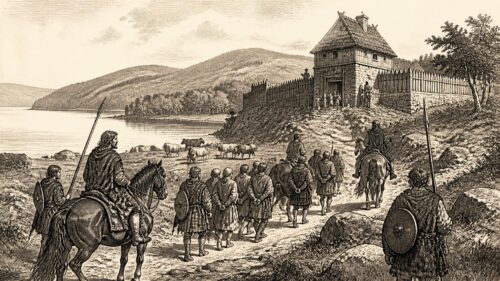
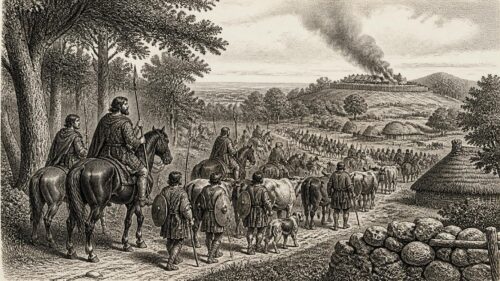
De Burgh next campaigned in Tír Chonaill against Toirrdelbach Ó Domnaill. Annála Connacht offers an unusually severe account of the raid, saying that the earl’s force plundered churchmen and lay people alike, and stripped the churches of Cenél Conaill so thoroughly that no altar-cloth, missal or chalice remained. Such language may carry the moral force of an ecclesiastical annalist’s condemnation, and it should not be turned into an exact inventory of every church. Nevertheless, it records that religious property was vulnerable in secular warfare and that an attack on a lordship could directly damage its churches, books, vessels and clergy as well as its farms and households.
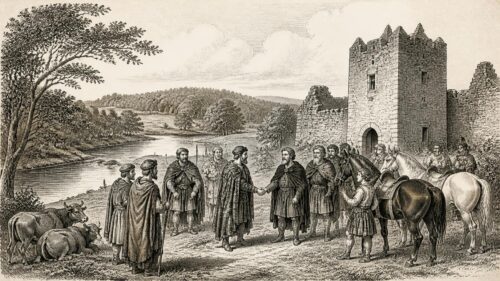
The host then moved south into Connacht, carrying its booty with it. At Elphin, according to the same annal, Connacht made a show of submission before the earl withdrew. The phrasing is revealing. It distinguishes outward compliance from durable settlement, and events of 1292 confirm that the relationship remained unsettled. A submission, hostage, tribute or negotiated peace could be politically meaningful without ending rivalry.
The Weir of Collooney
Connacht’s internal politics were violent even as de Burgh’s army moved through the province. The annals record the killing of Toirrdelbach, son of Eogan Ó Conchobair, by Niall Gelbuide Ó Conchobair. They praise the dead man in extravagant conventional terms as outstanding in generosity, martial skill and victory, but the essential fact is stark: a prominent member of the ruling kindred was killed by a rival. Conchobar Ó Dubda, lord of Uí Fhiachrach, also drowned in the Shannon while travelling to meet the earl. His death illustrates the hazards of travel and diplomacy in a year when leading men were trying to reckon with a major military intervention.
The central conflict was an attempt by Cathal Ó Conchobair and Niall Gelbuide, supported by followers described as both Gaels and Galls, to depose Magnus Ó Conchobair, king of Connacht. “Gaels and Galls” did not describe fixed opposing armies in this instance. The wording instead records Irish and settlers of Anglo-Norman background fighting in the same political coalition. Kinship, lordship, landholding and immediate advantage could matter more than any simple division between “Irish” and “English”.
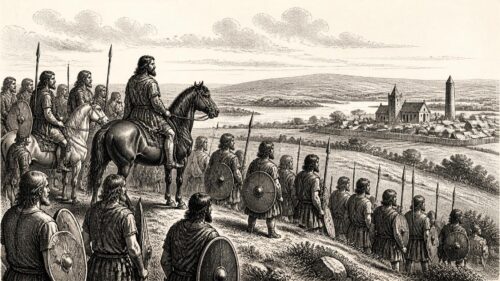
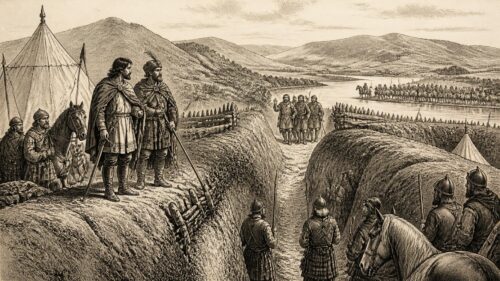
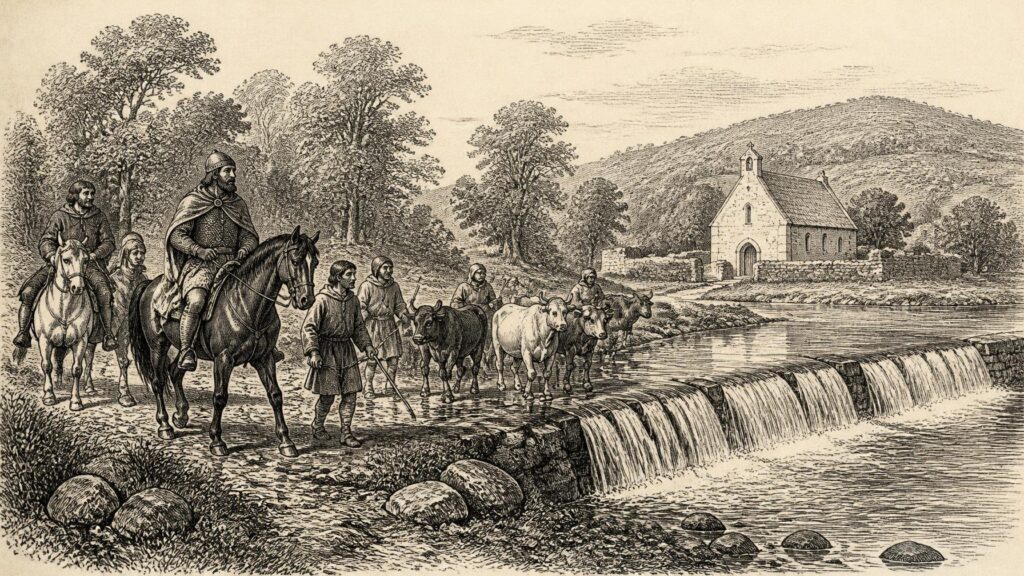
The opposing forces met at the weir of Collooney. Cathal was wounded; Murchad, of the Ó Conchobair kindred, and others were killed; Magnus was defeated and escaped covertly, while many of his horses were taken. The loss of horses was serious. Mounted retainers were vital to a lord’s military mobility and prestige, while horses themselves were valuable property. In Cathal’s absence through his wound, the victorious side drove cattle from Carbury, reportedly ranging from Cnoc Laighean eastwards to Ballysadare. Such a prey was not incidental looting: cattle were movable wealth, food, breeding stock and a visible measure of a household’s security. For families along the raiders’ route, it meant an immediate blow to subsistence and status.
Magnus recovered remarkably quickly. With the assistance of the Síol Muirí, his trusted officers and the Galls of Roscommon, he pursued the raiders on the following day, caught them at Sraith in Ferain and Aenach, recovered the cattle and routed them. Thomas and David Mac Gosdelb were among those caught up in the aftermath; the annal preserves uncertainty over David’s fate, reporting either that both were killed or that David was spared initially and killed in captivity. Niall Gelbuide escaped, later returned under peace terms and recovered his land, but distrust resumed. Magnus then raided and despoiled him, damaging Niall’s standing. The episode compresses much of Connacht’s political world into one struggle: battlefield leadership, cattle wealth, cross-community followings, negotiated restoration and the fragility of peace.
Changing Lordships and Local Losses
Further annalistic notices show that 1291 was not solely de Burgh’s year. Áed Ó Domnaill seized the kingship of Tír Chonaill and banished Toirrdelbach, the very ruler against whom the earl had campaigned. This succession change again demonstrates how little a military expedition guaranteed a lasting political outcome. In the midlands, Congalach Mac Eochagáin, chief of Cenél Fiachach, died; Áed Ó Fallamain, chief of Clann Uatach, and Diarmait Ó Flainn, chief of Síol Máelruain, also died. Annals tend to preserve such losses because the deaths of local rulers altered the balance within their own territories, opened succession questions and reshaped obligations among neighbours.
Church, Law and Towns
Military reporting should not obscure the institutional life recorded in more documentary sources. Lucas Mac Gilla Ruaid, archdeacon of Elphin, died in 1291, as did Edruth Mac Raith, abbot of Holy Trinity on Lough Key. Their notices indicate the continuing importance of clerical offices and monasteries in Connacht’s social landscape. Religious communities were centres of worship, learning, hospitality, land management and commemoration; their leaders’ deaths mattered beyond the cloister.
In the English lordship’s towns and dioceses, dated royal business continued despite warfare elsewhere. On 8 January, the king ordered the restoration of the temporalities of St Thomas’s Abbey, Dublin, to Ralph of Wiltshire, its abbot-elect; on 12 January, he ordered the restoration of the temporalities of the bishopric of Ross to its bishop-elect, Laurence. On 27 March, Stephen, archdeacon of Glendalough, received restoration of the temporalities of Cashel after papal confirmation of his election as archbishop. Such orders concerned the estates and revenues attached to an office during a vacancy. They show the close entanglement of papal confirmation, royal authority and local ecclesiastical wealth.
There were disputes as well as appointments. A royal writ of 3 October ordered an inquiry at Kilmallock after Dominican friars alleged that they had been expelled from land given by a burgess and that their dwelling had been demolished by servants of the bishop of Limerick, the lord of the fee. The allegation was to be tested by a local jury; it is not proof that every claim was accepted. But it reveals a busy town in which bishops, friars, burgesses, sheriffs and royal officials could contest land, protection and jurisdiction.
Ports, Grain and Administration
Ireland also remained connected to overseas commerce. On 31 May, the crown instructed William de Vescy and other officials to restore goods belonging to Flemish merchants which had been arrested in the ports of Waterford, Youghal and Cork. The order does not identify the goods, but it demonstrates that merchants from Flanders were trading through southern Irish ports and could appeal to royal power when their merchandise was seized. Meanwhile, proceedings in the Kildare liberty during August and September recorded land sown with wheat and heaps of wheat and oats among property distrained in a dispute over church patronage. These are narrow legal glimpses, not a national harvest report, but they bring grain cultivation, rent and legal process into view beside the better-known raids and armies.
Thus 1291 was neither a year of uniform conquest nor one confined to isolated Gaelic lordships. In the north and west, the Red Earl’s armed interventions reshaped successions without settling them. At Collooney, Connacht’s ruling family fought for its own kingship through alliances that crossed cultural labels. In towns and dioceses, officials maintained courts, revenues, elections, ports and contested religious property. The surviving record is uneven, but together it presents an Ireland of formidable local power, recurrent negotiation and ordinary institutions persisting amid conflict.
Source References
Hover over a number to see the source. Select it to open the source.

- [1] Annála Connacht: Annal 1291
- [2] Annals of the Four Masters: 1291
- [3] Annals of the Four Masters: Irish text, Part 12
- [4] Annals of Ulster: Part 10
- [5] Annals of Ulster otherwise Annála Senait, Annals of Senat
- [6] Annales Hiberniae
- [7] Annales Breves Hiberniae
- [8] Burgh, Richard de
- [9] Burgh, Walter de
- [10] Burgh, Richard de
- [11] Fitzroger, William
- [12] Close Roll 20 Edward I (1291-1292), Item 22
- [13] Close Roll 20 Edward I (1291-1292), Item 10
- [14] Volume 2, Plate 83: Payments at the Dublin Exchequer, 1291-2
- [15] Calendar of Documents Relating to Ireland, Volume 3, Item 847
- [16] Calendar of Documents Relating to Ireland, preserved in Her Majesty’s Public Record Office, 1171-1307
- [17] The Red Book of the Earls of Kildare
- [18] The Crusades to 1291 in the Annals of Medieval Ireland
- [19] Irish History Online: The Crusades to 1291 in the Annals of Medieval Ireland
- [20] Exploring the Irish Annals
- [21] The Construction of the Irish Annals, 429-466
- [22] Inquisitions and Extents of Medieval Ireland
- [23] William de Vescy, named 1221 to 1507
- [24] Kilmallock Dominican Priory
Primary Sources
- Annála Connacht: Annal 1291
- Annals of the Four Masters: 1291
- Annals of the Four Masters: Irish text, Part 12
- Annals of Ulster: Part 10
- Annals of Ulster otherwise Annála Senait, Annals of Senat
- Annales Hiberniae
- Annales Breves Hiberniae
- Burgh, Richard de
- Burgh, Walter de
- Burgh, Richard de
- Fitzroger, William
- Close Roll 20 Edward I (1291-1292), Item 22
- Close Roll 20 Edward I (1291-1292), Item 10
- Volume 2, Plate 83: Payments at the Dublin Exchequer, 1291-2
- Calendar of Documents Relating to Ireland, Volume 3, Item 847
- Calendar of Documents Relating to Ireland, preserved in Her Majesty’s Public Record Office, 1171-1307
- The Red Book of the Earls of Kildare
- The Crusades to 1291 in the Annals of Medieval Ireland
- Irish History Online: The Crusades to 1291 in the Annals of Medieval Ireland
- Exploring the Irish Annals
- The Construction of the Irish Annals, 429-466
- Inquisitions and Extents of Medieval Ireland
- William de Vescy, named 1221 to 1507
- Kilmallock Dominican Priory