Connacht Victory1270 CE
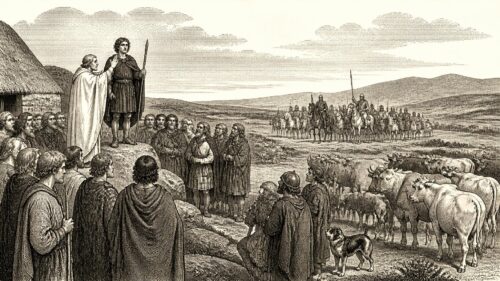
In 1270, Áed Ó Conchobair defeated Walter de Burgh’s Connacht expedition at Áth an Chip after manoeuvres around the Shannon, failed negotiations and hostage-taking. Local forces harassed the invaders, broke their vanguard and rear guard, and inflicted notable losses. Áed subsequently attacked castles, towns and settlements, including Roscommon, although conflict and reprisals continued across Connacht, Sligo, Corann and Thomond. The campaign demonstrated the strength of Gaelic kingship against Anglo-Irish magnates without ending de Burgh’s influence. Ireland also suffered widespread hunger and destitution. The year saw Archbishop Máel Pátraic Ó Scanaill’s death and Tanaide Mór Ó Maelchonaire’s succession as Connacht’s ollamh.
Dateline
In 1270, the sharpest contest in Ireland unfolded in Connacht, where Áed Ó Conchobair, king of Connacht, faced Walter de Burgh, earl of Ulster and lord of Connacht. The central episode was the defeat of de Burgh’s force at Áth an Chip, after a campaign that crossed the Shannon and drew in the king’s justiciar, Anglo-Irish magnates and Gaelic allies. The medieval annals do not give a day or even a season for the fighting, and the precise site of Áth an Chip remains uncertain. Yet they agree on its consequence: a major lordly expedition into Connacht was broken, and Áed emerged with formidable military authority.
A Host Moves Into Connacht
The background to the campaign was not a simple opposition between an English power and an Irish one. Walter de Burgh was a great Anglo-Irish lord, but his claim to lordship in Connacht was contested by a native kingship with its own vassals, alliances and military resources. Áed, son of Fedlimid Ó Conchobair, had been king since 1265 and had already struck hard at colonial settlements and castles in the province. De Burgh, whose interests joined the earldom of Ulster to extensive Connacht lordship, could not accept the steady expansion of Ó Conchobair power.
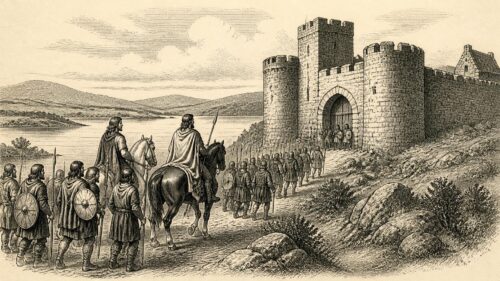
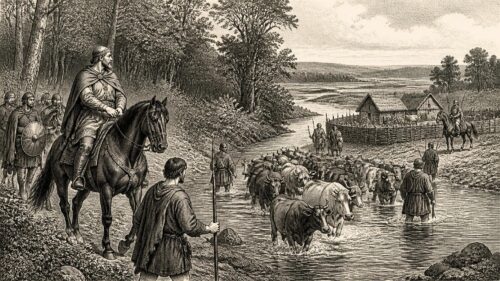
Annála Connacht and the Annals of Loch Cé place the outbreak of ‘great war and dissension’ between the two men in this year. Their narrative records a large force gathered by the earl together with the justiciar and other ‘Foreigners’ of Ireland. That word, used in Gaelic annals, conventionally distinguished settlers and rulers of English, Welsh, Norman or related origin from the Gaels; it did not describe a uniform national army. The expedition travelled through Roscommon, then to Oilfinn and Port na Leice near Elphin, where it encamped. Its leaders decided to cross the Shannon at Áth Carad Conaill, apparently near the strategically important ford at Carrick-on-Shannon.
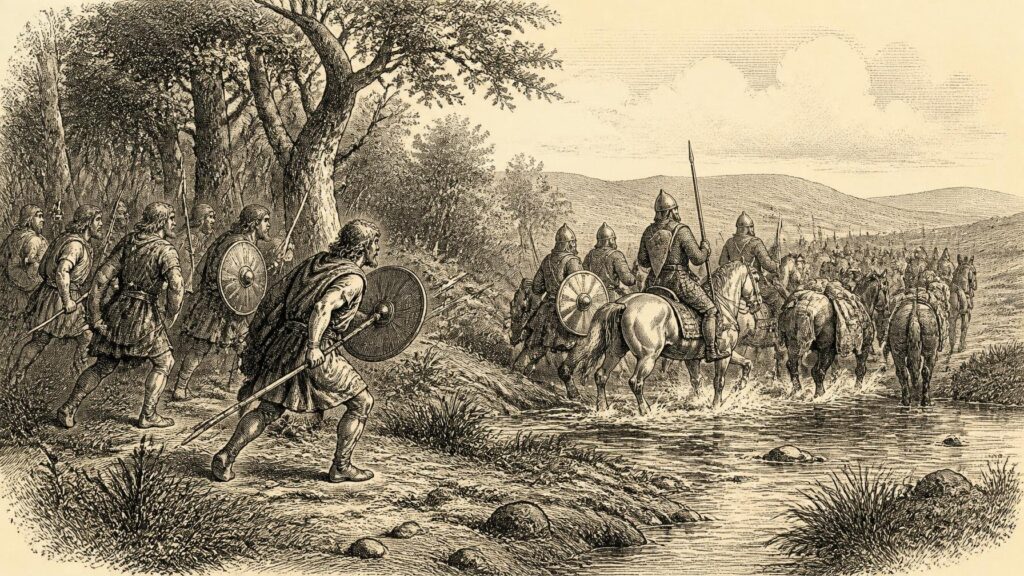
The route mattered. Rivers, woods, fords and open moorland shaped campaigning in a country with few permanent roads fit for a large mounted host. Control of a crossing could decide whether an army could bring horses, supplies and armour forward, or whether it would be exposed while divided between banks. The annals say that the justiciar remained on the western side with a smaller body of men while the earl and the main host moved eastward. Áed was at Magh Nise with only some leading followers, but he was close enough to observe the invaders and to harass them in the woods of Conmaicne.
Negotiation, Hostage and Rout
The annalists present the next stages as a sequence of manoeuvre, failed diplomacy and violence. Men attached to Áed attacked the earl’s party in woodland. The invaders continued to Magh Nise and camped there, but their position was plainly insecure. According to Annála Connacht, Anglo-Irish advisers urged Walter de Burgh to make peace. William Óg de Burgh, the earl’s younger brother, was handed into Ó Conchobair custody while terms were supposedly discussed. Instead, William was detained, while two men named Seoán Doilifín and his son were killed.
This episode must be read as an annalistic account rather than as a transcript of negotiations. It nevertheless reveals the importance of hostage-taking in political dealings. Hostages were a recognised means of guaranteeing agreements, but their safety depended on a settlement holding. Once trust collapsed, a hostage could become both a bargaining counter and a target for vengeance. Walter reacted by marching early the following day towards Áth an Chip. The annalist dramatically says that Áed’s men gave their opponents no rest or food over two nights. That imagery cannot yield a precise tactical timetable, but it conveys a plausible reality: an army operating beyond secure bases could be weakened by constant local attacks and by the difficulty of feeding men and horses.
At Áth an Chip, Toirrdelbach Ó Briain attacked the host. Walter de Burgh personally killed him, according to the Connacht account. Almost immediately, however, the men of Connacht struck the main body. The rear guard was driven off and the vanguard broken. The annal records the deaths of nine prominent knights, among them Richard of the Wood and John Butler, and says that a hundred horses, with saddles and breast-plates, were left on the field. Numbers in medieval battle reports deserve caution, but the detail about horses and equipment points to a substantial loss of costly military resources. William Óg de Burgh was then killed in captivity, apparently in retaliation for Toirrdelbach’s death.
Áth an Chip was therefore not simply a skirmish at a ford. It was a serious reverse for an expedition led by the foremost Anglo-Irish lord in the north and west. It did not remove de Burgh power from Ireland, nor did it create a united Irish kingdom. But it demonstrated that the Dublin administration and a magnate coalition could be defeated in Connacht by a Gaelic king who used local knowledge, mobile followers and provincial connections effectively.
Castles, Towns and Retaliation
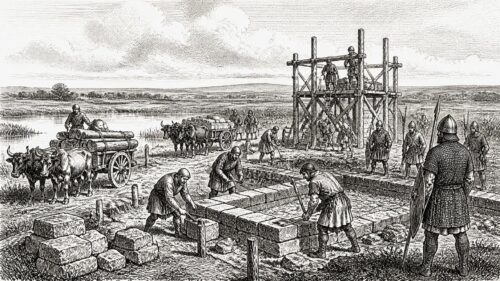
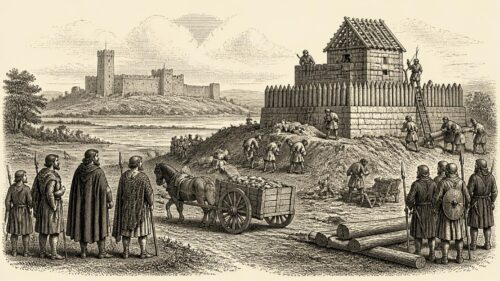
Áed followed victory with attacks on the physical markers of lordship. Annála Connacht says that he levelled the castles of Áth Angaile, Sliabh Luga and Kilcolman, and burned Roscommon, Rindoon and Onagh. These actions were politically charged. Castles housed garrisons, stored supplies, protected administrative officers and proclaimed a lord’s claim to land. Their destruction could disrupt collections of rent and food-renders as well as deny an enemy a base for future campaigns.
Roscommon was especially significant. Work on the royal castle there had begun in 1269, a recent assertion of governmental authority in the Connacht heartland. The annals’ language in 1270 says that Roscommon was burned; it does not securely establish which structures were destroyed, or how complete the damage was. A different annal, whose chronology is not always aligned exactly with the others, associates the justiciar with hostages and the building of Roscommon Castle under its entry for 1270. Archaeological and documentary research places the start of construction in 1269 and shows that the fortress was repeatedly attacked, repaired and enlarged over subsequent decades. For 1270, the responsible conclusion is that Áed’s victory exposed the new royal stronghold and the surrounding settlement to a destructive assault, not that the whole later stone castle vanished at once.
The fighting also spread beyond the immediate battlefield. The same Connacht annal says that Walter de Burgh and the Connacht settlers later raided Tírerrill, territory associated with Áed’s supporters, and that David Cusin was killed. In the north-west, Domnall Ó Domhnaill and Cenél Conaill burned Sligo; an Ó Máelbrénainn was killed during that operation. The Annals of Ulster additionally place a raid into Corann by Jordan de Exeter in 1270, followed by a costly and ill-judged pursuit by Connacht leaders in which several men of rank were killed. These notices show a region in which victory at one place did not produce peace. Raiding, reprisals and local feuds continued alongside the contest between kings and magnates.
In Thomond, across the Shannon to the south-west, Brian Ruad Ó Briain also turned against the settlers. The Connacht annal records extensive plundering and his capture of Clare Castle. This was a distinct struggle within the Ó Briain world, but it directly affected the balance of power around the lower Shannon. The coincidence of Brian Ruad’s action with Áed’s Connacht offensive illustrates how fragile Anglo-Irish advances could be where castles stood amid powerful Gaelic lordships rather than in a densely controlled colonial landscape.
Famine Across Ireland
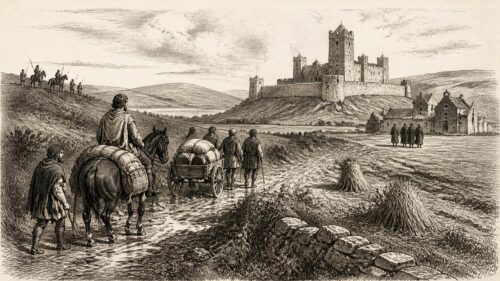
War was not the year’s only affliction. Both Annála Connacht and the Annals of Loch Cé record ‘hunger and great destitution throughout Ireland’. This is one of the clearest year-specific statements about ordinary hardship in 1270. It should not be inflated into precise claims about harvest totals, prices or mortality, for the annals provide none. Nor can one safely assign a single cause. Warfare would have damaged crops, livestock movements and local access to food in contested districts, but an island-wide scarcity implies broader failures of production, distribution or both.
The notice is all the more striking because medieval Ireland depended heavily on seasonal agricultural output, cattle and the ability to move food along rivers, roads and sea routes. Poor households, landless people, labourers and those displaced by raiding had the least reserve when supplies tightened. Later annalistic material links the continuing crisis to severe weather and reports that cold and hunger killed many poor people, but that testimony belongs to the following year’s record. For 1270 itself, the secure fact is the contemporary annalists’ emphasis on widespread hunger and destitution. Campaigning armies competed for the same food, fodder and transport on which vulnerable communities depended.
Church, Kingship and Learning
The year also brought a significant ecclesiastical death. Máel Pátraic Ó Scanaill, archbishop of Armagh and coarb of Patrick, died on 16 March at St Leonard’s priory, Dundalk, and was buried at the Dominican priory in Drogheda. The office of coarb of Patrick combined the inherited prestige of Armagh’s Patrician tradition with the authority of a metropolitan archbishop. Ó Scanaill had defended Armagh’s rights against powerful secular interests and had promoted new religious institutions and cathedral building. His death removed an experienced churchman at a moment when political authority was under exceptional strain.
Yet the annals also preserve a quieter sign of cultural continuity. In Connacht, Tanaide Mór Ó Maelchonaire succeeded Dubshúilech and Dúnlang Ó Maelchonaire in the province’s ollamhsip. An ollamh was not merely a learned individual but a recognised professional authority in disciplines including history, genealogy, law and poetry. The succession demonstrates that learned families and their institutions endured amid military crisis. Annála Connacht later celebrated Tanaide’s long tenure at Liss Lerthaile, making 1270 the starting point of a scholarly career remembered for four decades.
By the close of the year, Connacht had not become secure, nor had Walter de Burgh been permanently expelled. He remained a magnate of immense reach and would die only in July 1271. But the broken host at Áth an Chip altered the immediate balance. It confirmed Áed Ó Conchobair as the dominant force in Connacht, damaged castles and settlements intended to contain him, and unfolded against a background of scarcity that made every raid more destructive. In Ireland’s fragmented political landscape, 1270 was a year when a contested river crossing, a failed hostage arrangement and a hungry countryside converged with lasting effect.
Source References
Hover over a number to see the source. Select it to open the source.

- [1] Annála Connacht: Annal 1270
- [2] Annála Connacht (Irish text): Annal 1270
- [3] Annals of Loch Cé: Annal 1270
- [4] Annals of Loch Cé (Irish text): Annal 1270
- [5] The Annals of Ulster: Year U1270
- [6] Annals of the Four Masters (Irish text): Annal M1270
- [7] Annals of Inisfallen: Annal AI1270
- [8] Burgh, Walter de
- [9] O'Brien (Ó Briain), Brian Ruad
- [10] Ó Scanaill, Máel Pátraic (Patricius)
- [11] O'Connor (Ó Conchobair), Fedlimid
- [12] Exeter, Richard
- [13] Roscommon Castle, County Roscommon Urban Archaeological Survey
- [14] Roscommon Castle
- [15] Roscommon Castle: A Visitor’s Guide
- [16] Excavation Report 2002: Roscommon Castle
- [17] The Normans in Thomond
- [18] Royal Revenue, 1270–1450 — Delving Deeper
- [19] Irish Exchequer Payments, 1270–1326
- [20] Exploring the Irish Annals
- [21] From Boom to Bust: The Lordship of Ireland and the European ‘Commercial Revolution’
- [22] A Critical Edition of Aided Chonchobair: The Violent Death of Conchobar
Primary Sources
- Annála Connacht: Annal 1270
- Annála Connacht (Irish text): Annal 1270
- Annals of Loch Cé: Annal 1270
- Annals of Loch Cé (Irish text): Annal 1270
- The Annals of Ulster: Year U1270
- Annals of the Four Masters (Irish text): Annal M1270
- Annals of Inisfallen: Annal AI1270
- Burgh, Walter de
- O'Brien (Ó Briain), Brian Ruad
- Ó Scanaill, Máel Pátraic (Patricius)
- O'Connor (Ó Conchobair), Fedlimid
- Exeter, Richard
- Roscommon Castle, County Roscommon Urban Archaeological Survey
- Roscommon Castle
- Roscommon Castle: A Visitor’s Guide
- Excavation Report 2002: Roscommon Castle
- The Normans in Thomond
- Royal Revenue, 1270–1450 — Delving Deeper
- Irish Exchequer Payments, 1270–1326
- Exploring the Irish Annals
- From Boom to Bust: The Lordship of Ireland and the European ‘Commercial Revolution’
- A Critical Edition of Aided Chonchobair: The Violent Death of Conchobar