Maurice Jakis’s Liffey Bridge1319 CE
In 1319, Ireland remained unsettled after Edward Bruce’s defeat, with famine, warfare and administrative disruption still affecting lordships and towns. Maurice Jakis, canon of Kildare, built a stone bridge across the Liffey at Kilcullen, improving travel and encouraging the settlement’s later growth. English officials sought missing financial accounts, reflecting weakened government. In Tyrone, Domhnall Ó Néill was expelled, sheltered in Fermanagh, restored, then lost his heir Brian to enemies. Annals also recorded killings, deaths of Gaelic and Anglo-Irish lords, and several episcopal vacancies. The year combined local reconstruction, ecclesiastical continuity, family feuds and precarious political authority across the island overall.
Dateline
In 1319, Ireland was not a country at peace simply because Edward Bruce had been killed at Faughart in October 1318. The Scottish attempt to establish a kingship in Ireland was over, but its effects remained immediate: authority was contested, settlements and rural districts had been damaged by years of campaigning, and the recent famine had reduced the margin on which households, lords and towns survived. The year’s records are therefore striking for their mixture of recovery and insecurity. A new bridge across the Liffey at Kilcullen offered a durable piece of useful infrastructure in Leinster, while in Ulster a leading Ó Néill was driven out, returned, and lost his heir in continuing conflict.
The evidence is uneven and must be read carefully. The Irish annals preserve brief notices of deaths, killings and political reversals, while an English administrative record reveals a government still trying to reconstruct its own accounts after invasion. A later annalistic compilation gives the memorable notice of the Kilcullen bridge. Together, they do not provide a complete national narrative, but they show that 1319 was a year in which local power, movement and institutional repair mattered greatly.
A New Crossing at Kilcullen
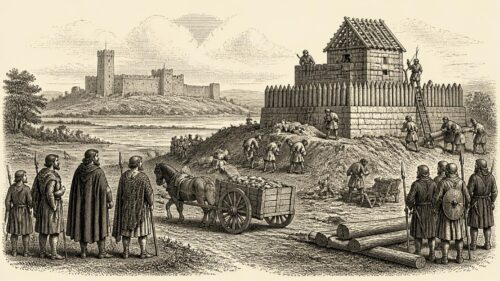
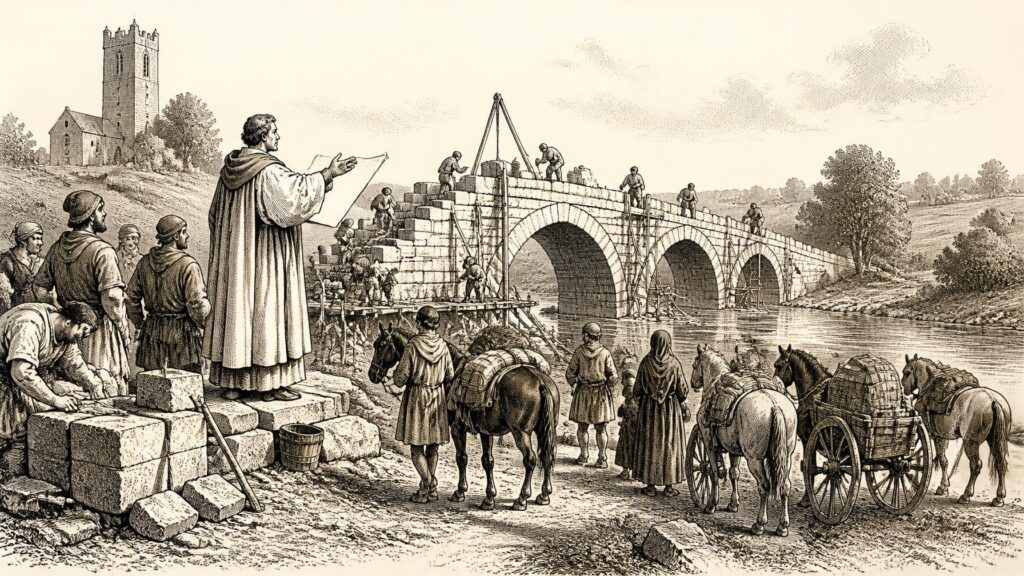
The most securely year-specific work of construction was the bridge at Kilcullen, County Kildare. The Annales Breves Hiberniae records under 1319 that a bridge at Kilcullen was built by Maurice Jakis, a canon of Kildare Cathedral, at his own expense and after permission had been obtained. The same notice adds that he built the bridge at Leighlin in the following year. Other antiquarian testimony identifies the Kilcullen structure as a stone bridge. Its patron was therefore not merely associated with a pious gift, but with a substantial and technically demanding work on a principal river crossing.
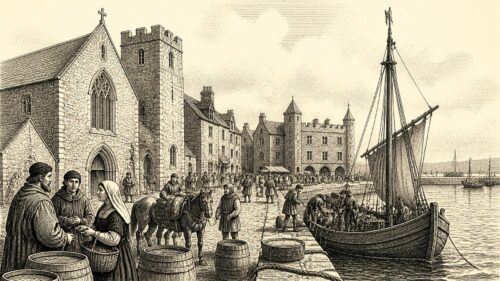
The bridge’s importance lay in what it made easier: the dependable passage of people, animals, carts and goods across the Liffey. It stood about two kilometres north-east of the older ecclesiastical and borough settlement now called Old Kilcullen. Later descriptions make clear that Kilcullen Bridge gradually became the more important settlement, eventually eclipsing the old town. That long-term shift should not be projected too abruptly on to 1319. The sources do not show an instant removal of population or market activity in that year. They do, however, permit a reasonable inference: a permanent crossing altered the practical geography of travel and created an attractive focus for services, dwellings and exchange.
The project also illustrates the material role of the church in medieval Ireland. A cathedral canon could deploy wealth, connections and legal permission in a work that served lay travellers as well as ecclesiastical interests. Such a bridge was an act of charity, prestige and local investment at once. It is especially significant in a period when travel could be made hazardous by warfare, damaged routes, river conditions and the costs of maintaining escorts or carrying goods through contested country.
After Bruce, No General Settlement
The wider setting was one of political exhaustion rather than settled restoration. Edward Bruce’s invasion had lasted from 1315 until his defeat and death in 1318. It had coincided with the severe food crisis of 1315–18 and with destructive military requisitioning and raiding. Modern scholarship treats the invasion and famine together as a profound blow to the already strained English lordship, but neither should be used to claim that all Ireland experienced identical conditions in 1319. The surviving evidence does not allow a national harvest report, a national death toll or a neat declaration that famine had ended everywhere.
What can be dated to 1319 is the continuing difficulty of government. On 12 November, clerks of the English Exchequer at Westminster ordered Alexander Bicknor, archbishop of Dublin and former treasurer of Ireland, to produce his accounts for audit. The later inquiry exposed an administration struggling with incomplete records and uncertain responsibility. Dublin’s civic authorities stated in 1319 that complete tax records had not been maintained because defending the city during the Scottish invasion had taken priority. This was not simply bureaucratic untidiness. Revenue, military defence and record-keeping were intertwined: a government unable to account fully for receipts also found it harder to reward service, maintain castles and exercise authority beyond its more secure centres.
England itself was politically troubled. The Annals of Ulster noted a “great war” between the king of the English and his earls. Although that conflict was not an Irish campaign, it mattered to a lordship dependent upon royal attention, money and appointments across the Irish Sea. In 1319, Irish political life was shaped both by local rivalries and by the limits of support available from the English crown.
Domhnall Ó Néill’s Reversal
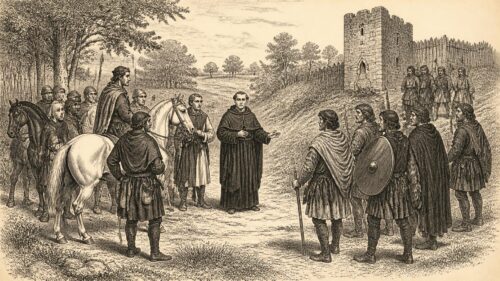
The sharpest political episode recorded for the year occurred in Tyrone. The Annals of the Four Masters states that Domhnall Ó Néill, lord of Tyrone, was expelled from his lordship through the combined power of “the English” and Clann Aodha Buidhe, the Clandeboye branch of the wider Ó Néill kindred. He went west into Fermanagh under the protection of Flaithbertach Maguire. Protection from a lord, however, did not guarantee safety for an arriving following: the annal says that the people of Fermanagh plundered Domhnall’s men.
This detail matters because it reveals the practical burden of defeat. A displaced lord travelled not alone but with dependants, fighting men, animals and portable property. To receive such a company could be politically useful, but it also imposed costs on the inhabitants of the receiving territory. The plundering of the refugees demonstrates that hospitality, alliance and local interest could pull in different directions. Fermanagh was a refuge, but not an uncomplicated sanctuary.
Domhnall nevertheless recovered his lordship later in the same annalistic year. No precise date, battle narrative or negotiated settlement survives, and it would be unsafe to invent one. His return did not produce security. Brian, his son and tánaiste, or designated heir, was killed by Clann Aodha Buidhe and Henry MacDavill, the Anglo-Norman de Mandeville figure associated with the opposing force. The death was one of a series of violent losses among Domhnall’s sons that would shape the succession in Tyrone. In 1319, then, restoration of a ruler did not mean restoration of a stable dynasty.
Deaths, Feuds and Regional Lordship
The annals also record smaller-scale but revealing changes across the island. In Annaly, Murchadh Ó Fearghail, chief of Anghaile, was killed by his nephew John Ó Fearghail; Muirchertach Ó Fearghail was killed by his own brother on the same day. Such compressed notices conceal much, but they show kinship as a field of deadly competition rather than an automatic source of cohesion. In the same year Henry Mac Gille-Finnein, chief of Muintir-Peodacháin, was killed by sons of Amlaíb Maguire, another reminder that power around the north Midlands and Fermanagh depended upon armed family networks and local alliances.
On 5 August, Gilbert Ó Ceallaigh, king of Uí Maine, died. Uí Maine, extending across parts of modern east Galway and south Roscommon, had been an important Gaelic lordship whose rulers operated amid the rival claims of Connacht dynasties and neighbouring Anglo-Irish powers. The death of a regional king was consequential even where the annals do not describe the succession: it opened the possibility of negotiation, rivalry or recalibration among dependants and neighbours. The deaths of Richard Mac Feorais Birmingham, an Anglo-Irish baron, and William de Burgh “the Grey” likewise marked change within families that commanded land, military followings and political connections in the west.
Not every recorded death was martial. Donnchadh Mac Diarmata died, as did Áine Mac Diarmata, wife of Mac Consnava. These notices are sparse, but their inclusion reflects an annalistic world in which lineage, marriage and the fortunes of ruling households were historical facts worth preserving. Even a short entry could signal the weakening or strengthening of claims to property and status.
Churches and Continuity
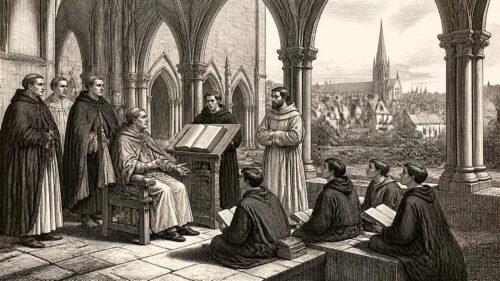
Ecclesiastical life was also marked by unusual turnover. Henry Mac an Chrosáin, bishop of Raphoe, died, and Thomas Ó Domhnaill, abbot of Assaroe, was elected in his place. The Annals of the Four Masters additionally records the deaths of the bishops of Derry, Clogher and Clonfert. The Annals of Ulster notes the death of Matthew Ó hEothaigh, bishop of Ardagh. Medieval bishops were spiritual leaders, but they were also landholders, patrons, judges and political actors. Vacancies and elections thus had consequences extending beyond the altar.
Thomas’s move from Assaroe abbey to the see of Raphoe is particularly suggestive of the ties between monasteries, dioceses and regional lordship in the north-west. It should not be treated as evidence of a general reform programme: the sources only record the succession. Yet the ability to replace a bishop in a troubled year points to the resilience of ecclesiastical institutions. Churches, cathedral chapters and religious houses continued to organise authority, memory and patronage even while secular politics remained violent.
A Year of Reconnection
Seen from Kilcullen, 1319 can look constructive: a canon’s bridge joined two banks of the Liffey and helped create the conditions for a new settlement to grow. Seen from Tyrone, it was a year of expulsion, return and bereavement. Seen from Dublin and Westminster, it was a year when officials were still trying to establish what the state had received and spent during the recent crisis. These perspectives belong together. Ireland’s recovery after the Bruce invasion was not a single national process directed from one centre. It consisted of local repairs, fragile lordships, contested routes, ecclesiastical succession and the continuing work of households trying to preserve people and property.
The bridge at Kilcullen endured in memory because it converted charitable resources into a lasting change in the landscape. The death of Brian Ó Néill and the displacement of Domhnall show the opposite truth: political arrangements could remain precarious even after a major invading army had gone. In 1319, the making of a crossing and the struggle to hold a lordship were equally characteristic of Ireland’s unsettled, adaptive post-invasion world.
Primary Sources
- The Annals of Ulster: Year U1319
- Annals of the Four Masters: Annal M1319
- Annales Breves Hiberniae
- Revealing the (corrupt) record in 14th-century Ireland
- O'Neill (Ó Néill), Domhnall
- O'Neill (Ó Néill), Aodh Reamhar (Aodh Mór)
- The Impact of the Bruce Invasion, 1315–27
- The Bruces in Ireland, 1315–18
- From Boom to Bust: The Lordship of Ireland and the European ‘Commercial Revolution’
- Crises and opportunities: Irish royal towns during the Bruce invasion
- Mapping and measuring the impact of the Bruce invasion
- Bruce Invasion
- The Administration of Ireland 1172–1377
- The Early to High Medieval Period in South Kildare
- Archaeological Assessment: Main Street, Kilcullen
- Kilcullen Settlement Plan
- Carloviana, No. 48
- Kilcullen-Bridge, A Topographical Dictionary of Ireland
- The Tour of the French Traveller M. de La Boullaye Le Gouz in Ireland, A.D. 1644
- Irish Texts at CELT