

O’Donnell’s Wicker Bridge1483 CE
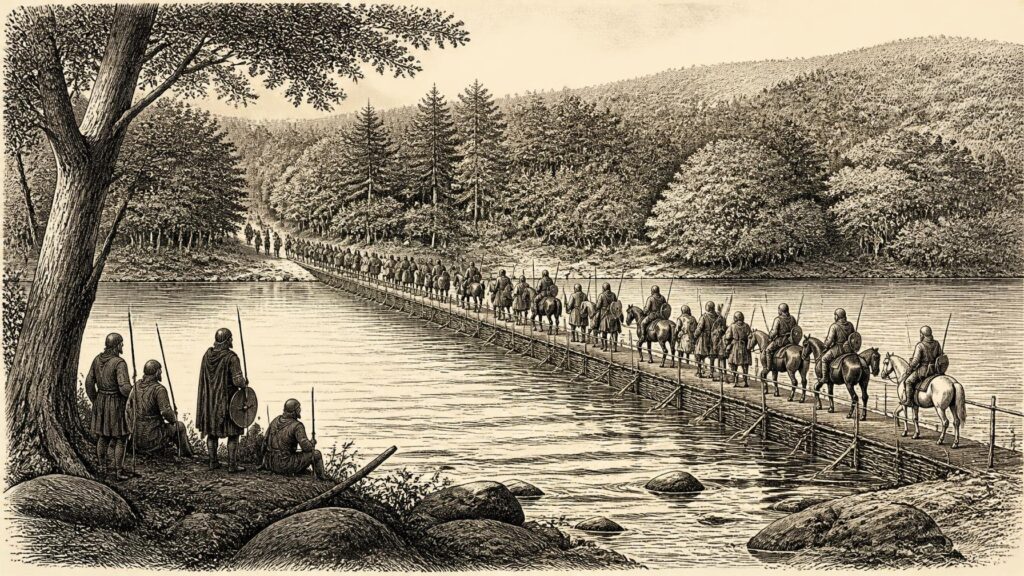
In 1483, Conn O’Neill was released from captivity, inaugurated lord of Tír Eógain, and entered a major conflict with Aodh Ruadh O’Donnell. O’Donnell’s coalition, including Clandeboye forces, raided the Dundalk district, burned Traghbhaile and Baile-Lugh-mhaigh, defeated Kildare’s pursuing army, and exacted protection payments. Returning through Tír Eógain, it cleared woodland and built a wicker bridge across the Abhann Mór, escaping pursuit. Other conflicts occurred across Ireland, while bishops and learned hereditary officials died or succeeded. English dynastic change brought Richard III’s accession, but Kildare remained deputy. The annals depict interconnected lordships, warfare, landscape, church institutions, learning, and local livelihoods alike.
Dateline
In 1483, Ireland’s most consequential recorded events were not the decisions taken in London, though the English crown changed hands twice. They were the release and inauguration of Conn O’Neill in Tír Eógain, the resulting war with Aodh Ruadh O’Donnell of Tír Chonaill, and a destructive expedition that reached the Dundalk district. The Irish annals provide unusually vivid particulars: a force made up of several lordships, a defeated pursuit by Gerald FitzGerald, eighth earl of Kildare, the burning of settlements, payments for protection, woodland felled to open a route, and a temporary wicker bridge floated away after an army had crossed. These are firmly assigned to 1483 by the annalistic record. They reveal how power, warfare, landscape and local livelihood were bound together.
Conn O’Neill’s Return
The immediate cause of the northern crisis was Conn O’Neill’s return from captivity. He was the eldest son of Énrí O’Neill, the ageing ruler of Tír Eógain, and had been seized amid an O’Neill dynastic struggle in 1481. Conn of Clann Aodha Buidhe, the eastern O’Neill lordship usually called Clandeboye, transferred him to Aodh Ruadh O’Donnell. His two-year detention was therefore neither an incidental imprisonment nor simply a private feud: it was part of the contest between related but competing O’Neill branches, and between Tír Eógain and the expanding power of Tír Chonaill.
The Annals of Ulster and the Annals of the Four Masters agree that Conn was freed in 1483 by his father and kinsmen. The latter adds that he was ransomed from O’Donnell and the Clann Aodha Buidhe O’Neills. He was then inaugurated lord, or king in the annals’ language, of Tír Eógain with the consent of his father and of the people of the lordship. That wording matters. Gaelic succession was not a mechanical inheritance from father to eldest son. It required the recognition of the leading kindred and political community, while rival branches could and did contest the outcome. Conn’s installation marked both a restoration of his own standing and an assertion that Tír Eógain could act collectively after a damaging internal division.
It also made a new clash with Aodh Ruadh highly likely. O’Donnell had held Conn prisoner and had spent the preceding decades building authority across north-western Ireland and into Connacht. Conn, meanwhile, returned with personal reasons to oppose him and political reasons to demonstrate that Tír Eógain had recovered a vigorous ruler. The annals accordingly record a “great war” between the two lords in the same year. This was not a war between modern states. It was a struggle among lordships whose rulers defended kin, dependants, tribute rights, livestock, routes and prestige, while constantly negotiating alliances across ethnic and linguistic boundaries.
Fire at Traghbhaile
Aodh Ruadh’s campaign displayed the reach of his coalition. He gathered the Cenél Conaill of Donegal and forces from Lower Connacht. Hugh Óg, son of Hugh Boy O’Neill of Clandeboye, joined him with his own men. The participation of an eastern O’Neill prince alongside O’Donnell is a reminder that Conn of Tír Eógain faced more than one opponent within the wider O’Neill world. Alliances were practical and changeable: shared descent did not guarantee shared interests.
The host moved east to Traghbhaile in the Dundalk district. The Four Masters states plainly that it plundered and burned the town and surrounding country. This is the year’s clearest evidence for the experience of communities caught in war. Burning could destroy houses, stored food, outbuildings and fodder; plunder removed portable wealth, particularly animals. The annal does not permit a reliable count of casualties or damaged properties, and none should be invented. Yet the destruction of both settlement and countryside indicates an assault upon the resources that sustained inhabitants as well as upon the status of those who claimed lordship there.
Gerald FitzGerald, earl of Kildare, responded as lord justice with what the annalist calls a great English army. “English” here is the annal’s contemporary political description for the forces of the lordship centred on the Pale; it should not obscure the complex backgrounds and local interests of the men involved. Kildare pursued and caught the raiders, but O’Donnell’s coalition beat off the attack, killing an unspecified large number of Kildare’s men. The victors also suffered losses: MacQuillan and a son of Turlough Carragh O’Connor were killed. The encounter showed both the willingness of the Dublin-centred administration to defend its north-eastern frontier and its limited ability to dictate events beyond it.
O’Donnell then moved to Baile-Lugh-mhaigh, which the annal says he burned. Its people or authorities paid him for sparing and protecting it thereafter. Such payments were not benign commercial transactions; they were imposed in the shadow of armed force. Even so, they show that warfare could have an economic logic beyond outright devastation. A lord on campaign sought food, cattle, recognition and revenue. For local people, payment might be the grim price of preventing further loss.
The Bridge Across Abhann Mór
After separating from Hugh Óg, who travelled towards Trian Conghail through Glenree, O’Donnell turned through Tír Eógain. The annal says that his force spoiled and burned country on either side of its route until it reached the Abhann Mór, “the great river”. The precise modern identification of every place in this itinerary is not secure, and the record should not be made more exact than it is. What is secure is the remarkable description of how the army crossed.
Dense woodland beside the river blocked the way. O’Donnell’s pioneers cut and felled it to make a passage, then constructed a strong wicker bridge. Infantry and cavalry crossed without the loss of a person or horse, after which the bridge was allowed to float downstream, leaving enemies watching from the opposite bank. The passage is surely shaped by the annalist’s admiration for O’Donnell’s victory, but it remains valuable evidence of military organisation. An army required more than mounted leaders and fighters: it depended on labourers able to clear timber, organise materials, build quickly and move animals, weapons and supplies through difficult country.
The episode also restores physical terrain to the history of political power. Rivers, woods and wetlands were not empty spaces between lordships. They channelled movement, hindered pursuers and offered protection to communities familiar with them. To cut a route and improvise a bridge was to turn environmental knowledge and manpower into a temporary strategic advantage. The dramatic disposal of the bridge prevented easy pursuit and helped make O’Donnell’s return home a demonstration of command rather than a retreat.
Other entries for 1483 confirm that conflict was not confined to this one expedition. O’Donnell launched another hosting against John, son of Philip Maguire, taking “great preys and booties”; on the following day Donnell O’Neill raided the same opponent. In the midlands, Art O’Connor Faly defeated Con O’Melaghlin in a battle in which two sons of Rory Carragh O’Carroll and many others died. These notices are brief, but they underline a basic condition of late fifteenth-century Ireland: lordships were linked by marriage, fosterage, ecclesiastical ties and trade, yet armed competition over authority and resources could break out in many regions at once.
Church, Learning and Hospitality
War was only part of the year’s record. Death notices illuminate institutions that sustained society. Rossa Maguire, bishop of Clogher, died and was buried at Aghalurcher, as he had chosen. The annalists praise his wisdom, piety, hospitality and learning; the Annals of Ulster call him exceptionally knowledgeable in every science. Such language is formulaic in part, but it reflects real expectations of a senior churchman. A bishop could be a religious leader, learned patron, political figure and keeper of a guest-house, where food and shelter expressed both Christian obligation and social rank.
Mahon O’Greefa, bishop of Killaloe, also died in 1483 and was buried at the monastery of the Canons in Corca Bhaiscinn. His obituary similarly commends hospitality and wisdom. The two deaths, one in the Clogher diocese and the other in Thomond, caution against treating the church as an institution detached from regional society. Clerical households, monasteries, churches and guest-houses formed local centres of food, education, commemoration and authority.
The year also brought losses among professional learned families. Ruaidhrí Ó Cianáin, ollamh or chief historian to the Maguires, died; so did John Ó Fialáin, ollamh in poetry to the sons of Philip Maguire and herenagh of Botha, a hereditary church-land officer. Conor Óg Mac Clancy, an ollamh of Thomond celebrated for literature and poetry, died, and Hugh Mac Clancy succeeded him. Conor Mac an Bhreithimh, intended ollamh of Muintir-Mhaolruain, died after a long illness. These notices show that historical memory, poetry, legal and genealogical expertise were specialist occupations, often maintained within particular lineages and attached to rulers or ecclesiastical communities. Succession in learning, as in lordship, was an important public matter.
A Distant Crown, A Local Government
Events in England nevertheless affected the framework of the lordship of Ireland. Edward IV died on 9 April 1483 and his son succeeded as Edward V. Richard, duke of Gloucester, displaced him and began to rule as Richard III on 26 June; he was crowned on 6 July. The Four Masters records the succession but gives Richard’s accession as 22 June, an illustration that annalistic dates should be checked against other evidence where precision matters.
For Ireland, the essential consequence in 1483 was continuity rather than an immediate overhaul. Richard III confirmed Kildare as deputy governor during the year. Kildare’s energetic field response in the Dundalk campaign demonstrates why the Crown relied on a magnate with extensive local connections, military following and influence in the Irish council. Walter Champfleur, abbot of St Mary’s Abbey, Dublin, had held the seal after the death of the previous chancellor; Robert St Lawrence, Lord Howth, filled the chancellorship in January. Such offices mattered, but the year’s northern war makes clear that official titles alone did not deliver control.
Thus 1483 can be seen most clearly from the river crossing after the burning of Traghbhaile: a polity of overlapping jurisdictions, where a powerful Donegal lord could lead a coalition to the edge of the Pale, defeat Kildare’s pursuit, negotiate protection payments and carry an army home through wooded country. At the same time, bishops, poets, historians and church officers continued to organise learning, hospitality and remembrance. Ireland’s history that year was not a simple contest between “English” and “Irish”, but a connected and often violent landscape of lordships, towns, churches and skilled communities.
Primary Sources
- Annals of the Four Masters: Annal M1483
- The Annals of Ulster: Year U1483
- Annála Connacht: Annal 1483
- Annals of the Four Masters
- The Annals of Ulster
- FitzGerald, Gerald (Gearóid Mór)
- O’Neill (Ó Néill), Conn
- O’Donnell (Ó Domhnaill), Aodh Ruadh
- O’Neill (Ó Néill), Aodh Buidhe
- O’Neill, Niall Mór
- Champfleur (de Champfleur), Walter
- MacMahon (Mac Mathghamhna), Aodh Ruadh
- O’Kelly (Ó Ceallaigh), Aodh
- O’Rourke (Ó Ruairc), Donnchadh
- Instructions by the King to William Lacy, sent into Ireland, relating to the Earl of Kildare who was to be desired to accept the office of Deputie Lieutenant under Prince Edward. (1483)
- The Red Book of the Earls of Kildare
- Taking a Long-term View: a Note on Richard III and Dublin
- English Lordship of Ireland and the Irish Sea World: Re-assessing the Origins of the Kildare Ascendancy, c.1390–c.1513
- Factions, feuds and noble power in the lordship of Ireland, c. 1356–1496
- Richard III
- Richard III (r. 1483–1485)
- Edward IV (r. 1461–1470 and 1471–1483)
- The Voyage of Sir Richard Edgecomb into Ireland, in the Year 1488
- Statute Law Revision Act 2007, Schedule 2