Áed’s Faes Victory1268 CE
In 1268, Áed Ó Conchobair of Connacht defeated an army termed the Galls of Ireland at the Faes after answering a challenge at Athlone, strengthening Gaelic resistance to lordship expansion. The year also brought severe famine across Ireland, compounding warfare and pressures. In Thomond, King Conchobar Ó Briain, his family and followers were killed amid dynastic conflict, followed by reprisals and mutilation. Other rulers died or were killed in struggles. Ecclesiastical succession continued at Armagh, Clogher and Annadown, while the death of poet-host Aengus Ó Dálaigh reflected cultural life. Sea travel, northern captivity and escape show a fragmented, connected society.
Dateline
For Ireland, 1268 is most securely seen through a cluster of contemporary annalistic notices rather than a single, uncomplicated national story. The fullest year-entry, in Annála Connacht, places Connacht, Thomond and the central midlands in sharp focus. It records a victory by Áed Ó Conchobair over an army identified as the Galls of Ireland, the violent death of Conchobar Ó Briain of Thomond, and a sequence of lesser killings and deaths that reveal how authority was contested at every level. The Annals of Ulster add a countrywide famine, changes in the church at Armagh and Clogher, and conflict in eastern Ulster. Together, the evidence makes 1268 a year of military resistance, dynastic fracture and acute material strain.
A Challenge at Athlone
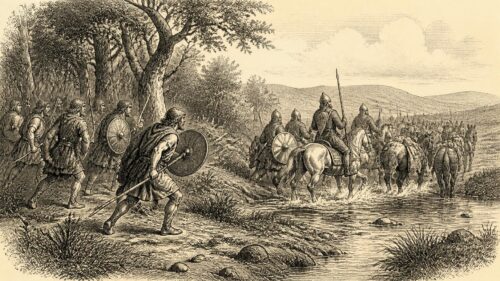
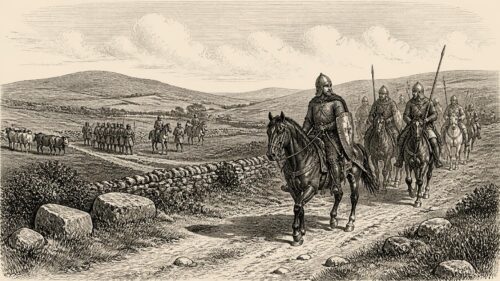
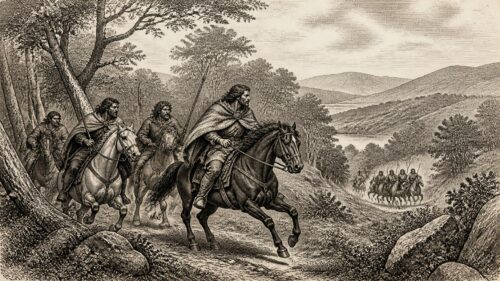
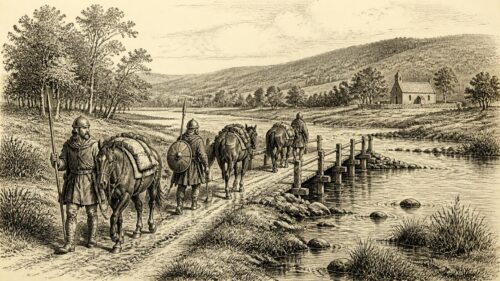
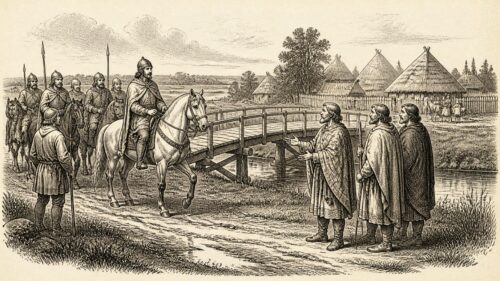
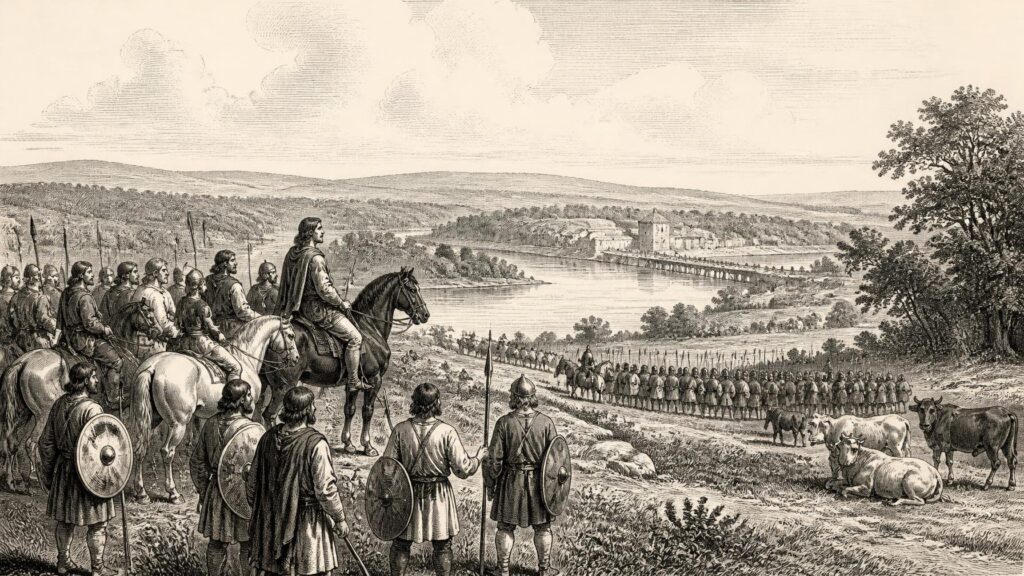
The clearest military event firmly entered under 1268 comes from Annála Connacht. The Galls of Ireland challenged Áed Ó Conchobair to meet them at Athlone. Áed assembled an army, met the challenge and defeated them in the Faes, where, the annalist says, many were killed. The brevity of the notice leaves important questions unanswered: it does not name the commander of the opposing host, give a day or month, or describe the battlefield in detail. Nor should the word Galls be treated as a precise ethnic roll-call. In the Irish annals it normally denotes the foreign, settler or Anglo-Norman side, but forces in thirteenth-century Ireland could include men of several local backgrounds and political loyalties.
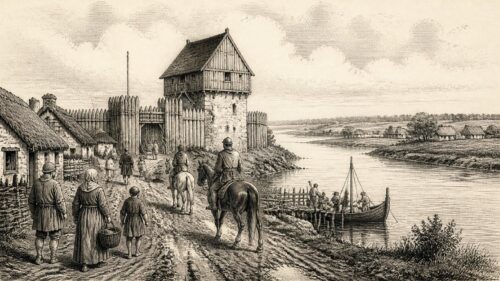
Even so, the place and manner of the encounter matter. Athlone was a vital crossing-point on the Shannon, joining the lordship’s midland interests to the approaches of Connacht. A challenge there was an assertion that military movement, tribute and political influence could be projected across the river. Áed’s response was therefore more than a raid or private feud. As king of Connacht, he had to demonstrate that the Ó Conchobair kingship could mobilise its allies and defend its sphere against an organised advance from the east. Victory in the Faes did not remove the threat of the colonial lordship, but it checked a hostile army and enhanced Áed’s standing among the Connacht lordships on which his kingship depended.
The conflict belonged to a wider contest with Walter de Burgh, earl of Ulster and lord of Connacht. Walter’s inherited and granted claims gave him extraordinary theoretical reach, while the Ó Conchobairs retained their own claims to provincial kingship and their own networks of client rulers. Neither side controlled Connacht in a simple or uninterrupted fashion. Castles, river crossings, hostage agreements, military hosting and the allegiance of local dynasties all mattered. The Faes victory is securely associated with 1268; it shows that the balance of power was still capable of being shifted by a Gaelic royal army in the field.
Keeping the Dates Straight
The year is sometimes confused with the much more famous defeat of Walter de Burgh’s forces at Áth in Chip, near Carrick-on-Shannon. The Annals of Ulster place an account of that battle under their entry labelled 1268 and describe the capture and later killing of Walter’s younger brother William, the deaths of named knights, and the abandonment of one hundred armoured and saddled horses. Yet modern chronological discussion and biographical reference works place the decisive battle at Áth in Chip in 1270. The discrepancy is a reminder that medieval annals, though indispensable, do not always preserve a modern calendar sequence without difficulty.
Accordingly, Áth in Chip should not be presented as a firmly dated event of 1268. It is better understood here as evidence of the escalating war in which the Faes encounter formed an earlier, securely dated episode. The distinction is important. It does not diminish the 1268 victory; rather, it prevents a later triumph from being incorrectly absorbed into this year’s record.
Famine and the Cost of War
The Annals of Ulster record “great, unbearable famine in Ireland” in this year. It offers no figures, no weather narrative and no regional breakdown, so the causes cannot responsibly be reduced to a single failed harvest, warfare or disease. Nevertheless, the language is unusually severe. In an overwhelmingly agrarian society, famine meant pressure on households dependent on grain, cattle, dairy produce and stored food. It would also have narrowed the margin for keeping seed corn, supporting dependants, paying dues or sustaining a war-band.
Conflict made such hardship harder to withstand. Hosts on campaign consumed food and fodder; movement through contested country could interrupt cultivation, carry off cattle or expose stores to seizure. Conversely, scarcity could make military service, raiding and the defence of a lord’s territory more urgent and more burdensome. The evidence does not permit a reconstruction of ordinary meals or prices in 1268, but it does establish that the contests described by the annalists unfolded amid a severe national shortage. The victory in the Faes was won not in a year of abundance, but during a crisis that affected the resources from which every army and household drew sustenance.
Thomond’s Violent Succession
Far to the south-west, the year brought an especially stark act of dynastic violence. Annála Connacht reports that Conchobar Ó Briain, king of Thomond, was killed along with his son Seoinín, his daughter and her son. It names Ruaidrí Ó Gráda, Dublochlann Ó Lochlainn, Tomás Ó Beolláin and many other men and women as participants, acting through Diarmait, son of Muirchertach Ó Briain. The annal adds that Diarmait was killed immediately in return. This was not an anonymous battlefield casualty but a killing within a political world of kindreds, dependants and rival claimants.
Conchobar’s death ended a reign stretching back to 1242. Thomond had long faced intense pressure from settler expansion around the lower Shannon and from the growth of lordly centres at Bunratty and Clare. Conchobar had at different times attempted accommodation and resistance, while divisions within the Ó Briain dynasty complicated every response. His murder in 1268 therefore removed a ruler whose authority had been shaped by both external encroachment and internal rivalry. The immediate killing of Diarmait did not settle matters. The annals also record that Mathgamain Ó Briain was captured and mutilated by Brian Ruad Ó Briain in vengeance for his father, an episode that underlines both the personal logic of retaliation and the brutal stakes of succession politics.
Other entries show the same fragility on a smaller scale. Fergal Ó Máelmuaid, king of Fir Cell, and Máel Sechlainn Mac Cochlain were killed by the Galls. Conchobar Ó Cellaig, king of Uí Maine, died. Lochlainn, son of Diarmait Ó Conchobair, was killed by David Aulb and the Uí Cinaetha, whose attackers then died in the retaliation. These notices should not be made to imply a single coordinated war across Ireland. They do, however, reveal a landscape in which royal and chiefly positions could be abruptly ended, and in which vengeance, alliance and local competition remained inseparable from wider struggles between Gaelic rulers and the lordship.
Churches, Offices and Hospitality
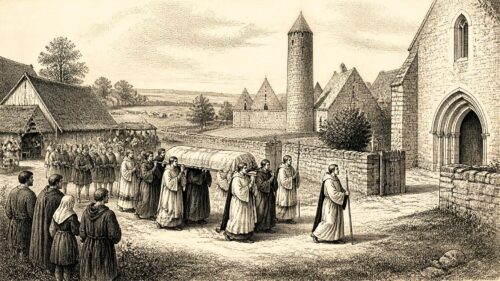
Political instability did not suspend ecclesiastical life. The Annals of Ulster record the death of Máel Pátraic Ua Sgannail, successor of St Patrick and archbishop of Armagh. His office was one of the most prestigious in the Irish church, combining pastoral leadership with the symbolic inheritance of Patrick. In the same year Michael Mac an tSair, official of Armagh, was consecrated bishop at Clogher on 9 September, the day after the feast of the Nativity of the Virgin. Such a precise liturgical date is valuable: amid otherwise broad annual notices, it records a formal act of succession and ordination at a major northern see.
Annála Connacht also notes the death of Áed, official of Annadown. An official was an important ecclesiastical administrator and judge, not merely a minor clerk. These notices point to the routine institutional work that continued through war and scarcity: dioceses needed bishops, church courts and estates needed officers, and religious communities required learned personnel. They also show that the annals did not divide the world into secular politics and religion. Church office, patronage, learning and lordship were closely connected.
The death of Aengus Ó Dálaigh, described as a noted poet and keeper of a guesthouse, gives an unusually human glimpse of cultural life. Poetry was a serious learned profession, preserving genealogy, praise, memory and political reputation. Hospitality, meanwhile, was both a moral obligation and a practical institution: a household capable of maintaining a guesthouse displayed status while feeding travellers, dependants and visitors. In a year remembered for famine, the annalist’s decision to identify Ó Dálaigh as a host is especially striking, though it does not tell us how his household met the year’s shortages.
Sea Routes and Northern Power
1268 also reveals Ireland’s continuing connections across the Irish Sea. Muiris Ruad Mac Gerailt drowned with the entire crew of his ship while returning from the king of England. The annal supplies no destination or explanation for the loss, but the notice confirms that Irish political figures and their followers travelled to the royal court by sea, and that such journeys carried real danger. Royal power was exercised through letters, grants, service and personal access as well as through castles and armies; the sea route between Ireland and England was an essential, hazardous link in that system.
In the north, Eachmarcach Ua hAnluain, king of the Oirthir, was captured by Walter de Marisco, constable of Ros na Cairge, but escaped within the same year. This compact entry records another contest between a Gaelic ruler and a royal or settler officer in the orbit of the north-eastern castle network. Its outcome was not a permanent conquest but an escape, a fitting reminder that authority in 1268 was negotiated, resisted and repeatedly remade.
Thus 1268 was neither a pause between famous battles nor a year reducible to one victory. At the Faes, Áed Ó Conchobair demonstrated military capacity against an external challenge. In Thomond, the killing of Conchobar Ó Briain exposed the lethal divisions inside a major dynasty. Famine tested communities across Ireland, while bishops were consecrated, poets and hosts were remembered, and men still crossed the sea in pursuit of royal business. The surviving record is fragmentary, but it preserves a society in motion: hungry, violent, devout, connected and far from politically settled.
Primary Sources
- Annála Connacht: Annal 1268
- The Annals of Ulster: Year U1268
- Annala Uladh: Annals of Ulster Otherwise Annala Senait, Annals of Senat
- The Annals of Ulster: Year U1270
- Annals of Loch Cé A.D. 1014–1590
- Annals of Loch Cé A.D. 1014–1590: Irish Text
- Annals of Inisfallen
- Annals of the Kingdom of Ireland by the Four Masters
- The ‘Annals of Multyfarnham’
- Burgh, Walter de
- O'Brien (Ó Briain), Conchobar
- Multyfarnham
- Multyfarnham Franciscan Friary
- Parchment Conquest, 1171–1307: Calendar of Documents Relating to Ireland 2.0
- Calendar of Documents, Relating to Ireland: National Library of Ireland Catalogue
- Calendar of Documents Relating to Ireland, Vol. 2, 1252–1284
- Henry III Fine Rolls
- Henry III Fine Rolls Project
- The Anglo-Irish and the Gaelic Military in the Thirteenth Century
- Ireland and the Barons' Wars
- Urban Archaeology Survey: County Westmeath
- From Kingdom to Colony: Framing the English Conquest of Ireland