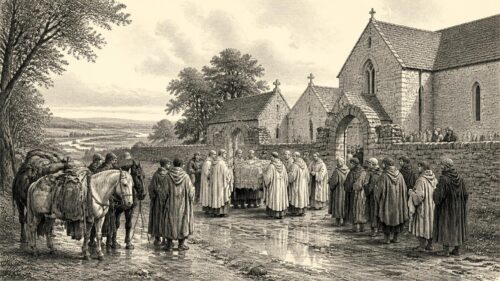
Ormond’s Fateful Arrow1371 CE
In 1371, Ireland remained politically fragmented, with royal, urban, Anglo-Irish, Gaelic and ecclesiastical authorities competing through law, warfare, patronage and local alliances. Dublin successfully petitioned Edward III against exactions imposed by lieutenant William de Windsor. In Ormond, Murchadh Ó Madden was killed by an exceptional arrow-shot, while Brian Ó Cennétig died amid regional conflict. Tadhg Óg Ó Conchobair was murdered after captivity in Sligo Castle. Annals associate Domhnall Ó Dubhda with capturing north Connacht castles and redistributing land. Archbishop John Ó Gráda died, plague claimed musician Amlaim Mac Senaig, and obituaries stressed hospitality, learning, patronage and genealogical memory across Ireland.

Dateline
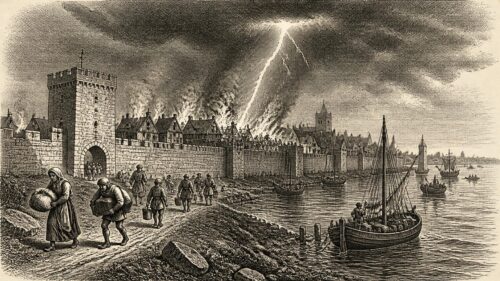
In 1371, Ireland was not governed as a single political unit in any practical sense. The English crown retained institutions, towns and legal claims centred on Dublin and the older lordship, while Gaelic and Gaelicised dynasties exercised power across much of the island through kinship, landholding, military following and negotiated local authority. The year’s records do not describe one national crisis. Instead, they preserve a series of sharp local episodes: a killing on an Ormond foray, a murder in Sligo Castle, the seizure of strongholds in Tír Fhiachrach, a dispute between Dublin and royal government, and losses among churchmen, patrons and learned households. Read together, they show a political landscape in which violence, hospitality, religious patronage and distant authority were tightly connected.
A Divided Political Landscape
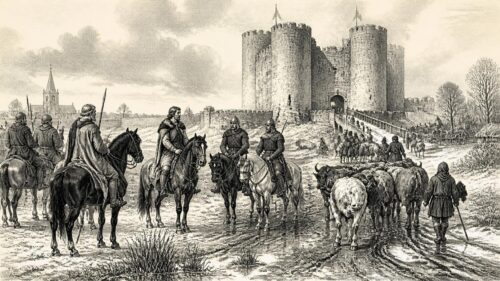
The broader setting must be stated carefully. Fourteenth-century Ireland contained overlapping jurisdictions rather than a simple division between an ‘English’ east and a ‘Gaelic’ west. Great Anglo-Irish lordships, borough communities, church estates and royal officers remained important, but many Gaelic dynasties had strengthened their positions after the shocks of famine, plague and war earlier in the century. English common law, Gaelic legal customs and local arrangements could coexist or compete, especially in frontier districts. The annals’ language reflects this world: they regularly distinguish Gallaibh, often rendered ‘Foreigners’ or ‘English’, from Gaelic lords, yet alliances and conflicts did not always follow that divide.
For 1371 itself, the sources are unusually rich in small but revealing notices. The Annals of Ulster, the Annals of Connacht and the Annals of the Four Masters overlap on several major deaths, though their phrasing and occasional chronology differ. The convergence matters. It gives particular weight to the fall of Brian Ó Cennétig of Ormond, the death of Archbishop John Ó Gráda of Tuam, and the killing of Murchadh Ó Madden. Other events, including the Ó Dubhda offensive in north Connacht, survive principally in the later compilation of the Four Masters and should therefore be treated as annalistic testimony rather than as fully documented campaigns.
Dublin Challenges Royal Exactions
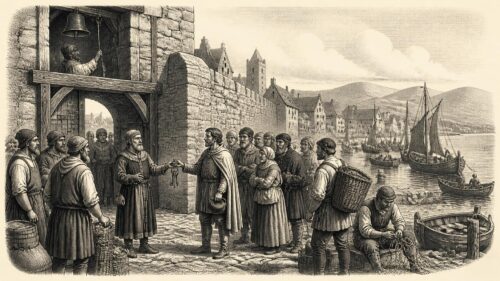
In Dublin, 1371 brought a conflict that illuminates the limits of royal government within the lordship itself. William de Windsor, Edward III’s lieutenant in Ireland from 1369, had pursued heavy financial demands to support administration and warfare. He had already left Ireland by April 1371, but Dublin’s complaints continued before the king in England. On 10 September Edward III ordered Windsor to stop levying sums said to have been imposed unlawfully on Dublin’s mayor, commonalty and citizens. A further order of 20 October required an end to tallages, fines, ransoms and imposts imposed upon people in Ireland; in December, the king directed the Irish exchequer to halt legal proceedings against Dubliners over the disputed subsidies.
These were not merely quarrels among officials. They concerned what townspeople were expected to pay, whether their consent had been properly obtained, and their right to seek royal redress across the Irish Sea. Dublin’s ability to petition the crown was itself a mark of the borough’s political standing. Yet the episode also shows the fragility of authority: a royal lieutenant had sought revenue from a government short of money, while a principal colonial city successfully appealed above him. The kingdom of England could intervene by writ, but that did not make its Irish administration either financially secure or politically obedient.
The Arrow in Ormond
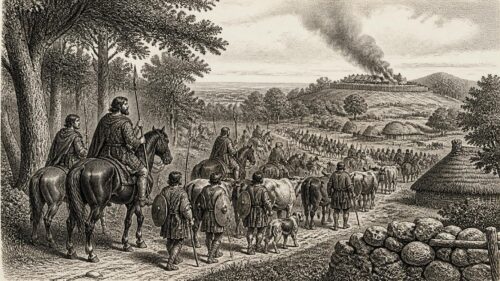
The annals place the most striking Irish killing of the year in and around Ormond. Murchadh Ó Madden, described as a general or universal patron, was killed by a single arrow-shot while at the rear of a raiding party. The Annals of Ulster call it one of the greatest feats of archery ever recorded in Ireland; the Annals of Connacht likewise preserve his death under 1371. Such praise does not permit a modern reconstruction of the shot, its range or its weapon. It does, however, reveal the annalist’s astonishment that one missile could decide the fate of so prominent a man.
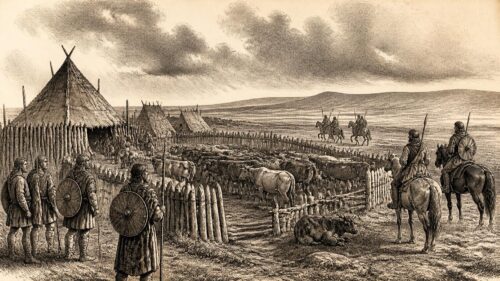
Murchadh’s death came amid a tense local sequence. Fergal Mac Cochlain died while held captive by Ó Cennétig, and Brian Ó Cennétig, king or lord of Ormond, was then killed ‘by the Foreigners’ or ‘English’, in the words of the annals, which also describe his fall as treacherous. The sources do not establish that these events formed one operation, nor do they identify every participant. It would be unsafe to turn them into a single battle narrative. Their proximity nevertheless demonstrates the instability of lordship in the region: imprisonment, raiding, ambush and politically charged killing were instruments through which rival groups pursued advantage.
The descriptions of Murchadh also point beyond warfare. A patron was expected to support dependants and retainers, but patronage could extend to clerics, poets, scholars, poor people and travellers. His death on a foray was therefore not only the loss of a fighting man. It removed a distributor of resources and protection from a network that linked households, dependants and learned people. In an economy where lordly generosity conferred reputation as well as obligation, such a loss could be socially consequential.
Captivity and Killing at Sligo
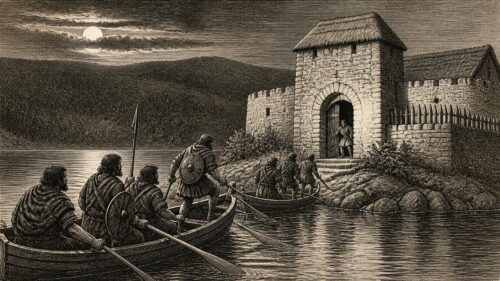
Connacht’s dynastic politics supplied another firmly dated episode. Tadhg Óg, son of Maghnus Ó Conchobair, was killed in Sligo Castle by Domhnall, son of Muircheartach Ó Conchobair. The Annals of Connacht add an important detail: Tadhg had lain in fetters for a long time as Domhnall’s captive, and was killed by Domhnall’s own hand. The annalist judged it an exceptionally grave murder. The Four Masters connects the killing to an earlier seizure of Tadhg after he had been brought to the stronghold of Ruaidhrí Ó Conchobair, then king of Connacht.
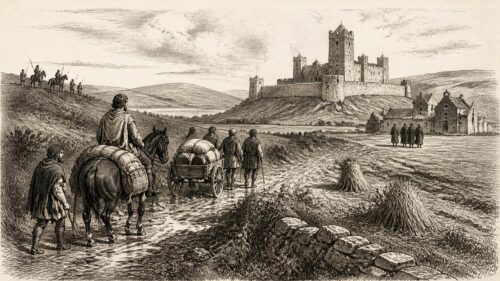
This was a struggle within the wider Ó Conchobair kindred, not a straightforward contest between Irish and English power. Sligo Castle, a fortified urban site with a long and contested history, became the setting for detention and dynastic elimination. Captivity could be a means of bargaining, restraint or humiliation; in this case it ended in death. The episode is a reminder that castles were not solely symbols of outside conquest. By the later Middle Ages, they were also embedded in Irish political conflict, used and contested by families whose interests crossed inherited ethnic labels.
Tír Fhiachrach Reclaimed
Further north, the Four Masters records a major success for Domhnall Ó Dubhda in Tír Fhiachrach Muaidhe, the territory around the lower River Moy. According to that account, Ó Dubhda ravaged the country, took the castles of Ard na Ríagh and Castle Mac Conor, drove out the English occupants, and distributed the land among his kinsmen and followers. A later genealogy of the Ó Dubhda country repeats the essential tradition, presenting the episode as the expulsion of English power from Tíreragh.
The exact scale and sequence of the operation cannot now be recovered. Nor should ‘the English’ be imagined as a uniform national army: the phrase could cover settlers, garrisons, tenants or locally rooted Anglo-Irish interests. What can responsibly be said is that the annalistic tradition associates 1371 with a change in control over castles and land in this north Connacht lordship. The reported redistribution is especially significant. Conquest in such a setting was not complete when a stronghold fell; it required the allocation of lands, the rewarding of followers and the practical remaking of local authority.
Tuam, Religious Patronage and Plague
Church affairs were also prominent. John Ó Gráda, Archbishop of Tuam, died in 1371; a Franciscan compilation dates his death to 19 September. The annals praise him as pre-eminent for wisdom, hospitality or bounty. Such formulae are laudatory, but they are not empty. An archbishop’s household was a place of administration, ecclesiastical patronage, almsgiving and learned exchange, especially within a western province where the authority of Tuam reached across varied lordships.
The papal register material for 29 July offers a glimpse of clerical life before the archbishop’s death. Gregory XI granted a further dispensation to Donogh Ó Gráda, a Franciscan lector in theology at Nenagh, allowing advancement within his order despite impediments arising from illegitimacy. On the same date, a petition concerning a proposed Franciscan foundation at Kenelechin in the diocese of Clonfert reached the papacy. The site had formerly contained a small Carthusian oratory and cells, said to have been abandoned for thirty years. The surviving record proves the petition and papal attention; it does not by itself prove that the Franciscan house was successfully established.
The Annals of Ulster also records the death from plague at Tuam of Amlaim Mac Senaig, celebrated as an accomplished master of melody. This is clear evidence of an individual plague death in 1371, not proof of a nationwide epidemic in that calendar year. Yet it is a sobering indication that epidemic disease remained part of ordinary insecurity after the first Black Death. His description also confirms the continuing prestige of musical accomplishment within elite culture.
Hospitality, Memory and Continuity
The year’s obituaries repeatedly measure people by hospitality. Eachmarcach Mag Uidhir of Lough Erne was remembered as a general host to the men of Ireland; Murchadh Ó Madden as a protector and patron; Archbishop Ó Gráda as a leader in generosity. These notices should not be read as proof that everyone was well provided for. Rather, they show the ideal against which powerful households wished to be judged: the ability to receive guests, sustain followers, reward learning and assist the needy. Hospitality was both moral language and political practice.
One precise personal record closes the year’s scattered picture. The Annals of Ulster dates the birth of Cathal Mór Mac Maghnusa, of the Maguire learned family, to 12 January 1371. Alongside killings and crises, this carefully preserved birth demonstrates the annals’ other purpose: maintaining genealogical memory. Ireland in 1371 was shaped by immediate contests for people, cattle, castles, revenue and territory. It was also sustained by institutions of remembrance—churches, learned families and annalists—through which a local event could become part of the island’s historical record.
Primary Sources
- The Annals of Connacht
- Annála Connacht
- The Annals of Ulster, Year U1371
- Annala Uladh: Annals of Ulster otherwise Annala Senait, Annals of Senat
- Annals of the Four Masters, Part 20
- Annals of the Four Masters: English Translation and Bibliographical Information
- The Genealogies, Tribes, and Customs of Hy-Fiachrach, Commonly Called O'Dowda's Country
- Materials for the History of the Franciscan Province of Ireland, A.D. 1230–1450
- Windsor, William
- Dublin and the Windsor Crisis, 1369–78
- Calendar of the Close Rolls Preserved in the Public Record Office: Edward III, 1369–1374
- His Majesty's Castle of Dublin
- ‘Geographical loyalty’? Counties, palatinates, boroughs and ridings
- Afterlives of the ‘Brehon laws’
- An Tulach Tinóil: Gathering-sites and Meeting-culture in Gaelic Lordships
- Ireland’s ‘Norman’ Castles
- Exploring the Irish Annals
- Annals of the Kingdom of Ireland: Library Catalogue Record
- The Annals of the Four Masters
- Irish Texts at CELT