Roscommon’s Counter-Castle1418 CE
During 1418, Ireland’s fragmented landscape was shaped by dynastic deaths, raids, fortification and scholarship. In Breifne, the deaths of Tigernán Mór Ó Ruairc, his heir Eógan, and East Breifne’s Risderd Ó Raigillig triggered contested successions; Risderd and his household drowned in Lough Sheelin. At Roscommon, Uilliam Ó Cellaig built a castle opposite the stronghold, resisting an Ó Conchobair-led siege. A royal council met at Naas, while Furnival’s raids in Iveagh met resistance and northern conflict involved Ó Domnaill and Ó Néill. Connacht saw cattle raids and violence. Meanwhile, the Great Book of Lecan neared completion, demonstrating scholarly patronage amid warfare.
Dateline
The events assigned to 1418 show Ireland as a landscape of fiercely local power, where a death, a lake crossing, a cattle raid or a hastily built fortification could alter the balance between neighbouring lordships. No island-wide government directed these affairs. The English crown’s lordship retained institutions and armed followers in the towns and shires of the east, but Gaelic and Gaelicised dynasties exercised authority across most of the country. The year’s annals are especially rich for Breifne and Connacht, while an English administrative record places a royal council at Naas in Leinster.
Dates must be handled carefully. Medieval Irish annals normally group events under a year rather than give modern calendar dates; compilation, regional perspective and differing year-beginnings can also produce apparent one-year shifts between chronicles. Where the Annála Connacht supplies a feast-day reference, it is useful evidence for sequence, not a licence to attach an invented day or month to every event.
Death and Succession in Breifne
Breifne, spanning much of present-day Leitrim, Cavan and neighbouring districts, experienced a sudden concentration of dynastic losses. Annála Connacht records that Brian Ballach Ó Conchobair, a claimant considered worthy of the kingship of Connacht, died shortly before St Brigid’s Day. Its obituary praises his military success and generosity, and says that he was buried at Roscommon. Such notices are shaped by the values of the learned elite: prowess, hospitality, almsgiving and a penitential death were political as well as moral credentials. They do not make Brian king of Connacht, but they demonstrate that he was a serious figure in the competition for it.
Farther north, Eógan, son of Tigernán Mór Ó Ruairc and an eligible successor to the kingship of Breifne, drowned in Lough Finvoy while travelling from Cherry Island to see his father, who was dying. The annalist used a vivid proverbial phrase for this catastrophe: Eógan fell at the threshold of the assembly, dying on the verge of acquiring power. Tigernán Mór himself then died, apparently around St Brigid’s Day, at his own stronghold and was buried in the Franciscan house at Sligo. The Annals of Loch Cé likewise place both deaths in 1418 and record the accession of Tigernán’s son Aodh Buidhe.
Aodh’s succession was immediate but not settled. Annála Connacht says that the sons of Tadc Ó Ruairc made war upon him, joined by the Fir Manach, Clann Muircheartaigh and Tellach Dunchada. This was not a simple contest between two coherent states. It was a coalition struggle involving branches of the Ó Ruairc kindred and neighbouring peoples whose support could decide whether a claimant exercised real authority. The death of an established lord did not mechanically transfer land, followers or tribute to his eldest son. Kingship depended upon acknowledged fitness, kinship, armed support and the ability to protect a territory.
A Disaster on Lough Sheelin
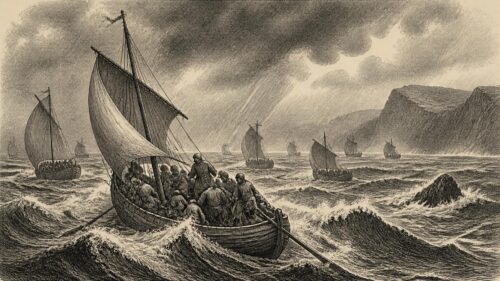
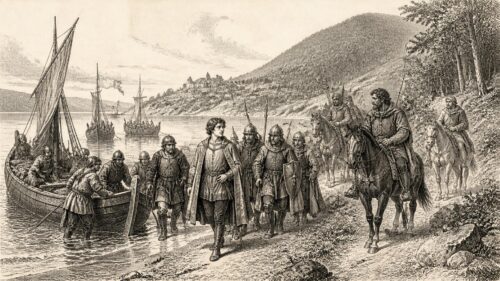
Another drowning made the fragility of lordship especially stark. Risderd Ó Raigillig, king of East Breifne, was lost in Lough Sheelin with his young son Eógan, his wife’s companions and leading members of his household. Among those named were Pilip Mac Gafraid, dean of Drumlane and vicar of Annagh, and Domnall Ó Ceocháin. Finnguala, Risderd’s wife and a daughter of Mag Ragnaill, survived by swimming. The Annals of Ulster adds that Risderd had taken a boat to meet Gall, or foreigners. That detail hints at contact across the political and cultural frontiers of the region, but it does not identify the visitors or explain the purpose of the meeting.
The loss was political, clerical and personal at once. A lord, his heir and trusted officials could travel together on water because lake routes were useful communications corridors; the same route could erase a ruling household in a moment. Eógan, son of Seán son of Pilip, succeeded Risderd in the kingship of Muintir Maelmórda. The annals’ precise naming of clergy among the dead also reveals how closely ecclesiastical offices and lordly society were interwoven. Churchmen were not outside the networks of travel, patronage and danger that bound a regional court together.
Fortifying Roscommon
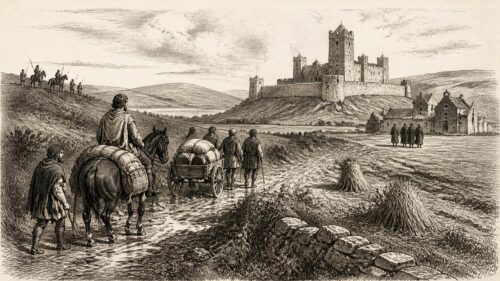
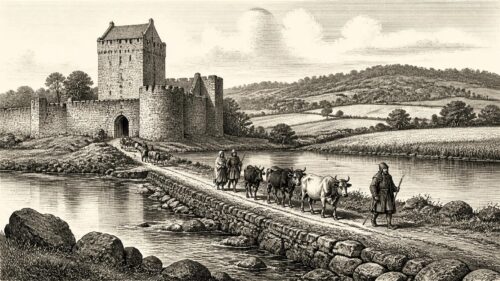
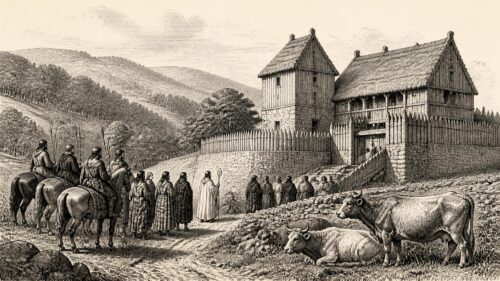
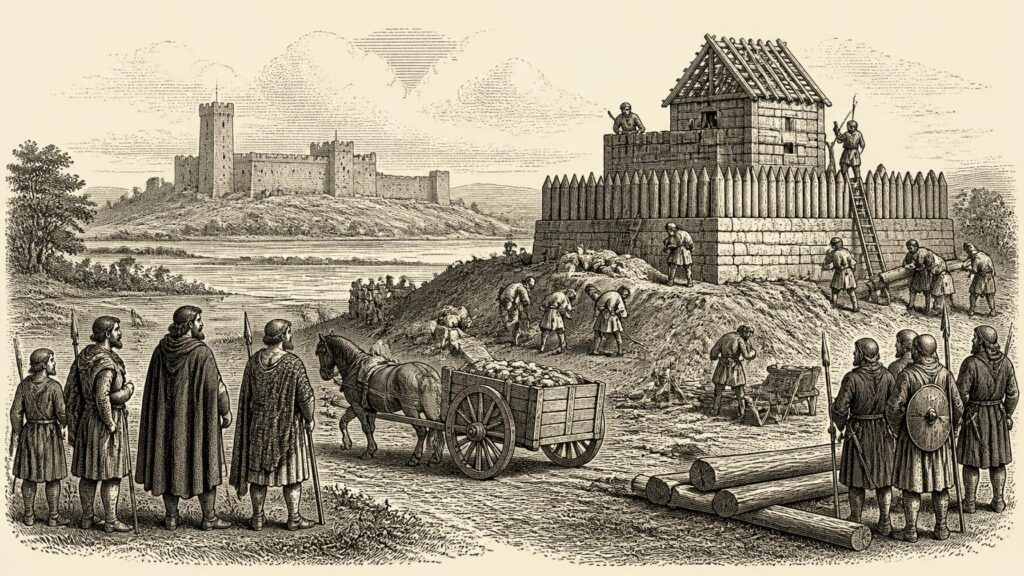
The year’s most tangible political act took place at Roscommon. Uilliam Ó Cellaig spent fifteen days constructing a small castle opposite the great castle of Roscommon, despite opposition from both Gaels and Galls in Connacht and from descendants of Toirdelbach Ó Conchobair. The brief record does not permit a modern reconstruction of its masonry, size or exact site. Yet its location and the speed of construction matter. A fort raised directly opposite an existing stronghold was an assertion of presence, a challenge to movement and supply, and a bargaining instrument in a contested lordship.
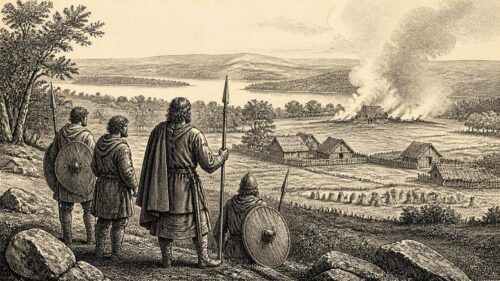
The response came quickly. The sons of Domnall, son of Muirchertach Ó Conchobair, accompanied by Clann Donnchada, brought a large force, encamped around the new castle and attempted to destroy it. They failed because its defenders held it firmly. Instead, the attackers victualled the older great castle and Kilcooley was burned despite the Ó Conchobair sons. The sequence exposes the practical character of warfare: not merely a clash of warriors, but siege, supply, destruction of settlement and control of fortified points. Food stores and livestock were essential military resources. So was the ability to deny them to an opponent.
Roscommon was therefore not simply a town in the background of aristocratic quarrels. Its castles, religious houses and surrounding routes lay within the political heartland of Síol Muiredaig and the wider contest for Connacht. The burial of Brian Ballach there and the confrontation around its castles in the same annalistic year make the place a fitting focal point for 1418: dynastic ambition was expressed both through commemoration of the dead and through the immediate, costly work of defence.
Naas, Iveagh and Northern Raiding
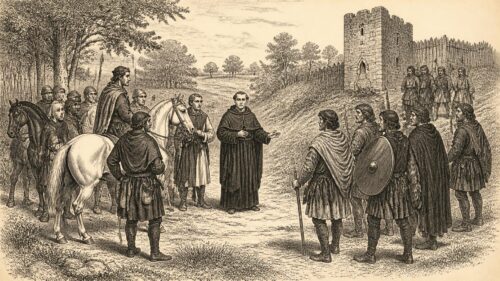
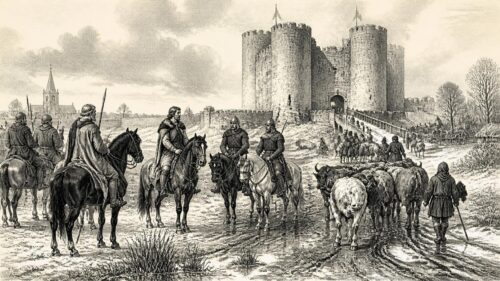
In Leinster, the Annales Breves Hiberniae records a royal council at Naas which resolved to pursue the king’s Irish enemies. The entry is frustratingly terse. It gives neither the membership of the council nor a list of operations, and it should not be treated as proof of a successful island-wide campaign. It does show, however, that the English administration still met formally in a major Leinster town and framed its policy in the language of pursuit and war.
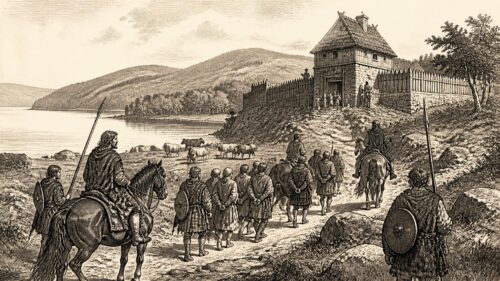
Annála Connacht supplies a northern consequence associated with Lord Furnival, John Talbot, the king’s lieutenant. It reports extensive depredations by Furnival against Aodh, son of Art Mag Aonghusa, king of Iveagh. Mag Aonghusa and Mac Néill Buidhe followed the trail of the cattle and of the Galls, killing and capturing an uncounted number. Cattle were not incidental plunder. They represented movable wealth, food, breeding stock and the means to reward dependants. Recovering a herd was therefore an act of survival, restitution and lordly authority.
The same Connacht annal assigns to 1418 a major raid by Niall Ó Domnaill against Ó Néill, driving his rival east across the Bann to seek refuge with Mac Uigillín. The Annals of Loch Cé places the wider Ó Néill–Ó Domnaill confrontation under 1419 instead. The prudent conclusion is that serious northern conflict belonged to this immediate period, while the exact placement of each movement within a modern calendar year remains uncertain. What is clear is that rivers such as the Bann were frontiers to be crossed, defended and used to seek protection from allied lords.
Raids, Deaths and Religious Memory
Connacht’s internal rivalries continued on a smaller scale. Magnus, son of Feidlim Clerach Ó Conchobair, raided Ó Gadhra, but Tomaltach Mac Diarmata intercepted the raiders at Bél an Átha Mín. The prey was recovered, men on both sides were wounded, several followers were killed and Magnus was captured until satisfaction was obtained. The episode captures the calibrated violence of lordship: raids sought wealth and advantage, while captives and compensation could convert victory into a negotiated settlement.
Several deaths recorded during the year offer glimpses of the social ideals behind such politics. Muirgius Mac Diarmata of Moylurg was remembered as a potential king and, for wisdom, learning and humility, even as a potential bishop. Tadc Ó Cellaig of Clonmacnowen was praised for liberality and safeguarding suppliants, and was said to have received unction and repented before dying around Christmas. In west Cork, Mac Con Ó hEtersceoil of Corca Laighde, his brother the bishop, and Diarmait Mag Carthaig of Uí Chairpri also died. Obituaries gave learned writers a way to measure authority in generosity, religious preparation and protection, rather than conquest alone.
A Manuscript at Lecan
Amid the conflict, scholarly work continued in north Connacht. The Royal Irish Academy’s Great Book of Lecan was being compiled at Lecan in County Sligo under Gilla Ísu Mór Mac Fir Bhisigh, hereditary poet and historian to Ó Dubda, with the scribes Adam Ó Cuirnín and Murchad Riabhach Ó Cuindlis. Scribal evidence indicates work began in 1417 and that transcription and colouring may have been completed by August 1418. “May” is important: the manuscript’s completion cannot be fixed more exactly.
Its contents—genealogy, place-lore, hagiography, learned texts and historical material—show that the intellectual life of Gaelic Ireland rested upon organised households of scholarship and powerful patrons. The manuscript does not cancel the violence recorded in the annals; it belongs to the same world. Lords required genealogies, inherited learning and skilled scribes to articulate legitimacy, while scholars relied on lordly protection and resources. In 1418, the making of a major book at Lecan was as real a development in Irish public life as a council at Naas or a new castle at Roscommon.
Thus the year is best understood not as a single national story but as a set of connected regional crises and achievements. Breifne lost rulers and heirs to illness and water; Roscommon saw a bold fortification and failed siege; English authority issued plans at Naas but met armed resistance in Ulster; and learned craftsmen at Lecan preserved and reshaped Ireland’s historical inheritance. The surviving evidence is uneven, but it records a society in which power was continually made, contested, remembered and written down.
Primary Sources
- Annála Connacht: Annal 1418
- Annála Connacht
- Annals of Loch Cé A.D. 1014–1590
- Annals of Ulster Otherwise Annala Senait, Annals of Senat
- Annals of the Four Masters, Volume 4
- Annales Breves Hiberniae
- MS 23 P 2: The Book of Lecan
- CELT: List of Published Texts
- Exploring the Irish Annals
- O'Rourke (Ó Ruairc), Aodh Buidhe
- Butler, Thomas
- English Lordship of Ireland and the Irish Sea World: Re-assessing the Origins of the Kildare Ascendancy, c.1390–c.1513
- Crisis and Survival in Late Medieval Ireland: The English of Louth and Their Neighbours, 1330–1450
- The Lordship of Ireland in the Middle Ages
- The Annals of the Four Masters: Irish History, Kingship and Society in the Early Seventeenth Century
- The Breifny Antiquarian Society's Journal, Volume II, Number III
- The Breifny Antiquarian Society's Journal, Volume III, Number I
- The Annals of the Kingdom of Ireland, by the Four Masters, Volume VII
- The Annals of the Kingdom of Ireland, by the Four Masters, Volume VII
- The Bailiffs, Provosts and Mayors of Dublin