Sulcoit and Limerick967 CE
In 967, Mathgamain son of Cennétig, leader of the rising Dál Cais, defeated Limerick’s Norse forces at Sulchuait and burned the port the following morning. Recorded by Inisfallen, the episode weakened but did not end Norse power: Limerick and its ruler Ímar remained significant, requiring further action in 972. The victory strengthened Mathgamain’s claim to Munster kingship, though later tradition disproportionately associated it with his brother Brian Boru. Limerick was a commercially and strategically vital Norse-Gaelic settlement, not merely a raiders’ base. The year saw Connacht king Ferga Ua Ruairc die and Mungret abbot Conn son of Corcrán pass away.
Dateline
In 967, a short annalistic notice marks one of the most consequential reverses suffered by the Norse rulers of Limerick in the tenth century. The Annals of Inisfallen, a chronicle compiled in Munster, records that Mathgamain son of Cennétig defeated the “foreigners of Limerick” at Sulchuait and burned Limerick before noon on the following day. Behind its compressed wording lies a hard-fought contest for power in Munster: not a simple struggle between Irish and Scandinavian peoples, but a contest between ambitious dynasties, port-based rulers and regional client kingdoms.
The evidence for this year is unusually clear in one respect and strikingly thin in others. Sulchuait and the burning of Limerick are firmly placed in 967 by the Inisfallen annalist. Yet that source gives neither the size of the armies nor the precise site of the battle, nor does it explain exactly how the attackers entered or burned the settlement. Later writing supplied a much fuller and more dramatic story, especially in Cogadh Gáedhel re Gallaibh, a work composed long after the events and strongly favourable to Mathgamain’s brother Brian. Its vivid narrative is valuable as evidence of later memory and political argument, but its details cannot simply be treated as a contemporary battlefield report.
A Defeat at Sulchuait
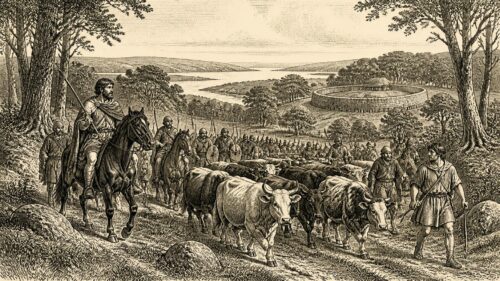
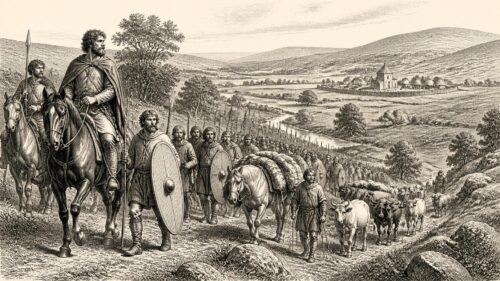
The certain core is formidable enough. Mathgamain, leader of the rising Dál Cais dynasty of northern Munster, defeated Limerick’s Norse forces at Sulchuait. The next morning, according to the annal, Limerick was burned before midday. The wording suggests a rapid follow-up rather than a distant raid: victory in the field opened the way to an attack on the settlement itself. The Annals of Ulster also place Mathgamain’s plundering and burning of Limerick in the annal conventionally associated with 967, though their internal chronological notation warns that its year numbers can stand one year apart from modern reckoning. Together, the sources support the event securely, while also reminding us that medieval Irish chronologies need careful handling.
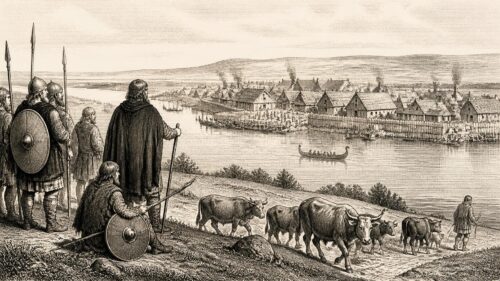
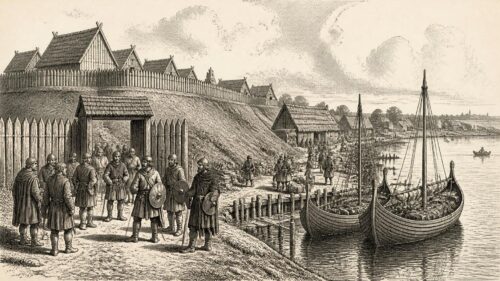
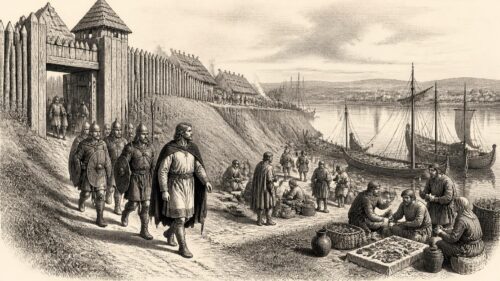
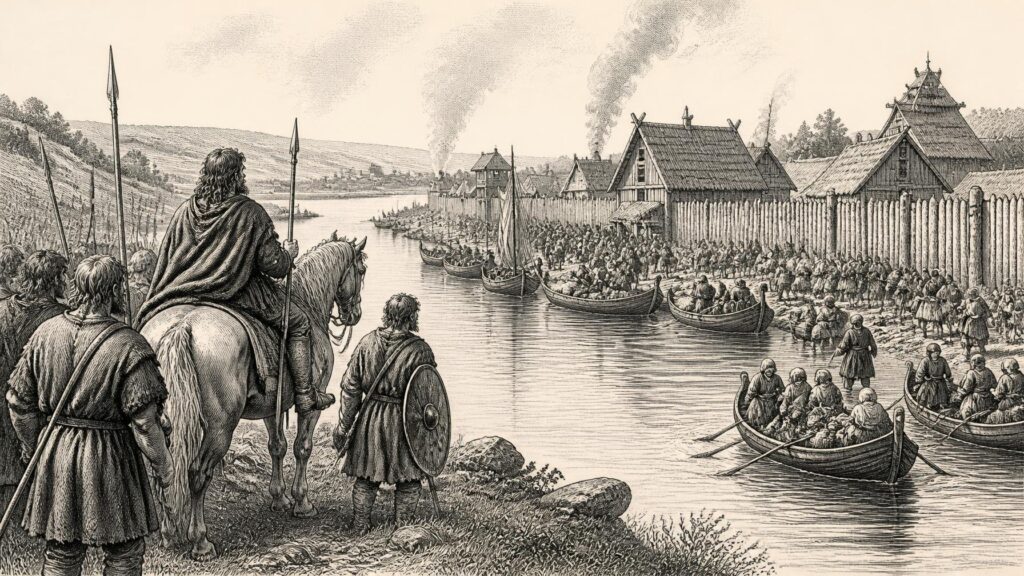
Sulchuait was a major achievement because Limerick was no isolated raiding camp. By the later tenth century it was a Norse-controlled river port connected to the Shannon estuary, Munster’s interior and the wider Irish Sea. Its rulers possessed ships, fighting men and commercial reach. They could draw wealth from exchange as well as from coercion, and their position made them attractive allies or dangerous neighbours to Irish kings. An assault on Limerick therefore struck at a centre of maritime power, craft production and trade, as well as at a military opponent.
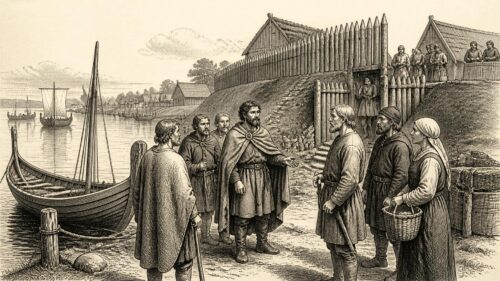
The men whom the annals call Gall, usually translated as “foreigners”, should not be imagined as a uniform invading army newly arrived from Scandinavia. By 967, Norse and Norse-Gaelic communities had long been established in Ireland and around the Irish Sea. Individuals and families moved between Ireland, western Britain, the Hebrides and Man; alliances could cross language, religious and cultural boundaries. Limerick’s rulers were Scandinavian in origin, but they operated within Irish political conditions. Their opponents likewise were not acting for an Irish nation-state. Mathgamain fought for supremacy in Munster and for the fortunes of his own kindred.
The Dál Cais Advance
Mathgamain’s victory belongs to the rapid ascent of Dál Cais. His family had its principal strength in the north-west of Munster, in the region later associated with Thomond. For generations, the dominant royal tradition of Munster had been Éoganacht, centred more strongly on Cashel and the southern and eastern parts of the province. By the mid-tenth century that older order was under strain from rival branches, local lordships and the Norse towns. Mathgamain’s campaigns created an opening for a new power to claim provincial authority.
The Ulster annalist styles him “king of Caisel”, an exceptionally important title. Cashel was not merely a defended hill or ceremonial place: it represented the kingship of Munster. The title does not mean that every community in the province obeyed Mathgamain without qualification. Medieval Irish kingship was negotiated through tribute, military service, fosterage, marriage, ecclesiastical patronage and, above all, the giving of hostages. Still, the designation shows that Mathgamain’s authority had become significant enough to be articulated in the language of provincial rule.
Sulchuait did not instantly destroy Norse Limerick or settle Munster’s future. Later annals show that Ímar of Limerick remained active, while Mathgamain continued campaigning. In 972, the Annals of Inisfallen record a programme associated with Munster’s leading men: the expulsion of Norse officials, the expulsion of foreigners from Limerick, and the burning of its fortress. Those later measures underline both the importance of the 967 victory and its limits. The first blow was not the final settlement; control of the port had to be asserted repeatedly.
Nor should the battle be presented merely as the opening act in Brian Boru’s later career. Brian was Mathgamain’s younger brother and would eventually transform Dál Cais power into a claim over Ireland as a whole. But in 967 Mathgamain was the named victor. The contemporary annals credit him, not Brian, with the defeat at Sulchuait and the burning of Limerick. Keeping that distinction matters. Retrospective fame has often drawn attention away from the leader who actually dominates the record for this year.
Limerick’s Burning
To burn Limerick was to make a political statement, but it also imposed immediate human costs. The annal does not describe casualties, captives or the parts of the settlement affected. It would be unsafe to invent them. Yet a riverine town depended on timber structures, waterfront landing places, stores, workshops, animals, vessels and households concentrated within a relatively compact space. Fire could destroy property rapidly and interrupt commerce even where it did not end occupation. Those who fled would have included more than warriors: dependants, traders, craftworkers, enslaved people and families were all vulnerable in a settlement whose prosperity rested on movement and exchange.
Archaeology and wider Viking-age evidence caution against reducing such places to fortresses full of raiders. Ireland’s Scandinavian towns were centres where imported goods, silver, metalworking, ship traffic and local agricultural produce met. Their inhabitants participated in both violence and ordinary economic life. The destruction recorded in 967 may have damaged Limerick’s material fabric, but the settlement’s strategic location on the Shannon ensured that it remained politically important. In this period, a burned town could be rebuilt, reoccupied or held by a new alliance.
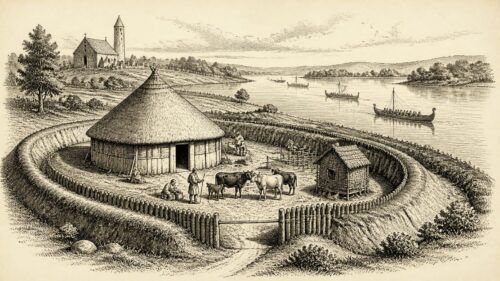
For people in Munster beyond the port, the campaign would have been felt through demands for food, livestock, transport and service. Armies did not move independently of rural society. Cattle were a major measure of wealth and a portable supply; grain, dairy produce and provisions sustained households and war-bands alike. Roads were limited, while rivers, coastal waters and established routeways mattered greatly. A royal host’s passage could mean requisition, plunder or negotiated provisioning, depending on whether a community was an ally, a subject or an enemy.
Deaths and Monastic Continuity
The same Inisfallen entry for 967 records the death of Ferga Ua Ruairc, king of Connacht. No cause is supplied, so it should not be assumed that he died in battle or that his death resulted from events in Munster. Nevertheless, the notice points to a wider pattern of instability: provincial and regional kingship depended heavily on adult male leaders whose deaths could quickly reopen contests within a dynasty. Connacht was politically distinct from Munster, but its kings, churches and lordships were part of the connected network of Irish politics in which hostages, cattle-raids and alliances travelled far beyond local borders.
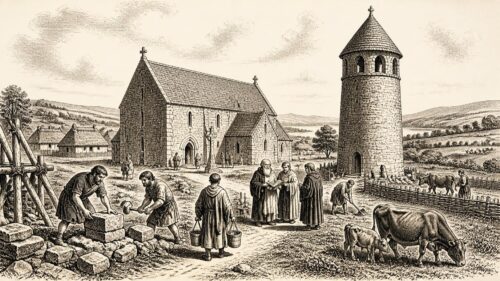
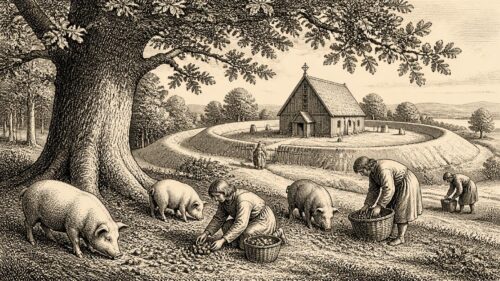
The annalist also notes the repose of Conn son of Corcrán, abbot of Mungret. This quieter notice is important. Mungret, close to Limerick, belonged to the dense ecclesiastical landscape of Munster: churches and monastic communities were religious centres, landholders, places of learning and employers of skilled scribes and craftsmen. An abbot’s death affected administration, patronage and local influence, not simply worship. The survival of such notices alongside accounts of burning and battle shows the annals’ dual concern with secular power and ecclesiastical continuity.
There is no securely dated report for 967 of a harvest failure, epidemic or exceptional weather in the principal southern annal. It would therefore be wrong to attach a famine, plague or environmental crisis to this year merely because such events occurred in other decades. The evidence instead offers a more focused picture: a decisive campaign in Munster, the death of a Connacht king, and a change within a major religious institution near the contested port.
A Year with a Long Afterlife
In its immediate terms, 967 was a year in which Mathgamain demonstrated that Limerick’s Norse rulers could be beaten and their town attacked. In longer perspective, Sulchuait helped establish Dál Cais as a serious contender for Munster. It exposed the vulnerability of a maritime power whose wealth and connections had made it formidable, while showing that Irish provincial kingship could be advanced through control of ports as well as through dominance over rural kingdoms.
The year should not be made into a tale of a permanently united Ireland overthrowing alien Vikings. Its reality was more intricate and more revealing: rival Irish dynasties, Norse rulers rooted in Irish towns, ecclesiastical institutions and agricultural communities all formed part of one contested political world. At Sulchuait and Limerick, Mathgamain gained a victory that later generations would place on the road to Brian Boru. But in 967 itself, it was Mathgamain’s achievement, and it marked a sharp turn in the struggle for Munster.
Primary Sources
- Annals of Inisfallen
- Annals of Inisfallen, Annal AI967
- Annals of Inisfallen: Original Irish Text
- The Annals of Ulster
- The Annals of Ulster, Year U967
- The Annals of Ulster: Original Irish and Latin Text
- Annals of the Four Masters, Part 7
- Annals of the Four Masters
- Cogadh Gaedhel re Gallaibh: The War of the Gaedhil with the Gaill
- Cogadh Gaedhel re Gallaibh: The War of the Gaedhil with the Gaill
- Network Analysis of the Viking Age in Ireland as Portrayed in Cogadh Gaedhel re Gallaibh
- Vikings in Early Medieval Ireland
- Church-Raiding And Subjugated Vikings, 980–1014
- The Irish Sea and the Atlantic Trade in the Viking Age
- The Vikings and the Fall of the Old Order
- The Vikings in Munster
- The Vikings in Ninth-Century Ireland: Sources and Settlements
- Early Medieval Archaeology Project
- Early Medieval Ireland: Archaeological Excavations, 1930–2009
- Viking Activity in Ireland by County in the Annals
- Exploring the Irish Annals
- List of Published Texts at CELT