Domnall’s Two-Month Siege968 CE
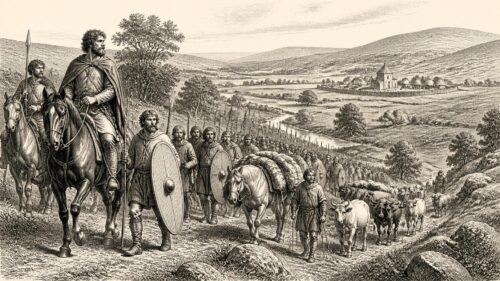
In 968, Domnall ua Néill, king of Tara, campaigned in Leinster, ravaged territory between the Barrow and the sea, exacted cattle tribute, and blockaded the Leinstermen and Dublin’s Scandinavian rulers for two months. The annals do not record Dublin’s capture. In Munster, Mathgamain son of Cennétig raided Uí Énna Áine, where Cathal son of Fogartach died, continuing Dál Cais expansion after successes against Limerick. Imlech Ibuir, or Emly, was plundered by unnamed forces. Deaths of prominent ecclesiastical successors and King Flaithbertach highlighted political and religious change. The records depict fragmented authority exercised through warfare, tribute, mobility and control of resources.
Dateline
The surviving notices for 968 CE are brief, but they catch Ireland at a moment of sharp regional pressure. In the east, Domnall ua Néill, king of Tara and leader of the northern Uí Néill, carried war into Leinster and sustained a two-month blockade against the Leinstermen and the ‘foreigners’—the Scandinavian-led rulers of Dublin. In Munster, Mathgamain son of Cennétig continued the forceful advance of his Dál Cais kindred, while an important church at Imlech Ibuir, now Emly in County Tipperary, was plundered. Several senior churchmen died in the north and midlands.
That is not a full portrait of a year. Medieval Irish annals were selective records, not daily chronicles, and the entries do not tell us the season of campaigns, the size of armies, the names of every victim, or the experience of ordinary households. Yet their silences are as important as their detail. They reveal a country without a single permanent government: power was made through expeditions, alliances, tribute, control of ecclesiastical centres and the capacity to mobilise followers. The events firmly assigned to 968 show that such contests reached from Munster to Dublin and Ulster.
A Campaign into Leinster
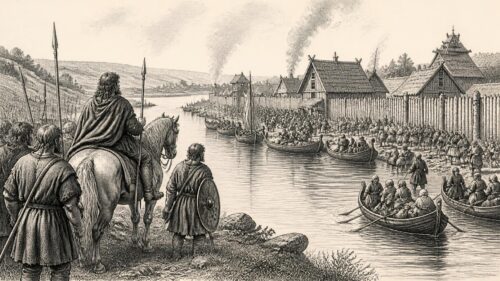
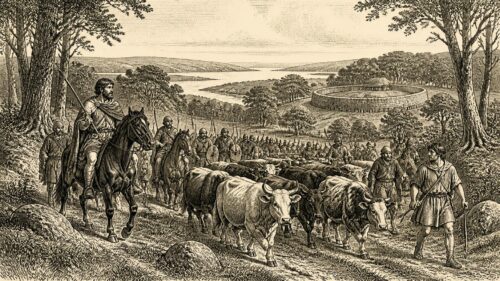
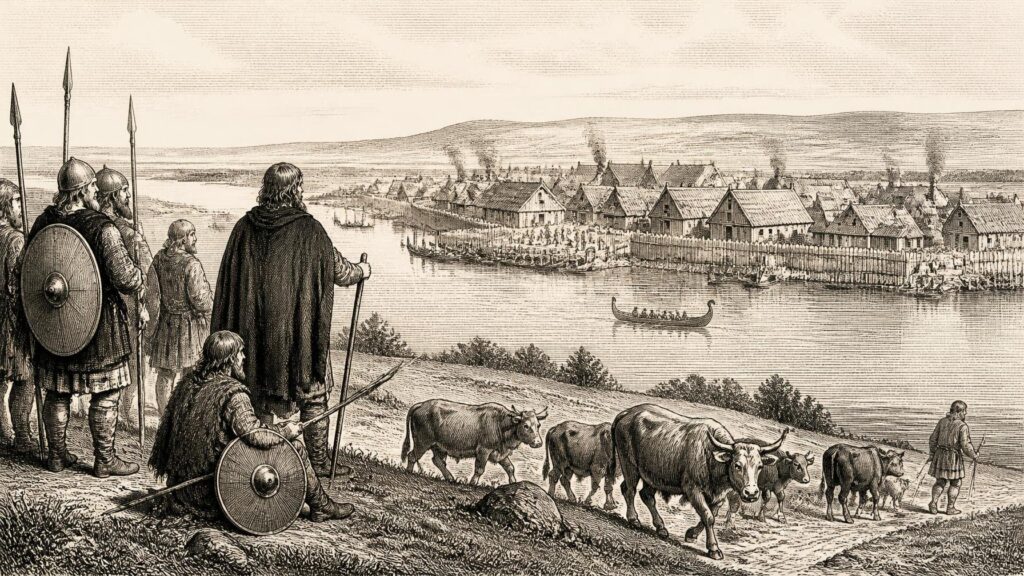
The clearest national-scale event is Domnall ua Néill’s expedition to Leinster. Both the Annals of Ulster and Chronicon Scotorum place it in 968. Domnall led an army into Leinster, devastated territory between the River Barrow and the sea, and carried off a great cattle tribute. The annals then say that he besieged, or closely blockaded, both the ‘foreigners’ and the Leinstermen for two months.
The original notices do not explicitly name the place of the siege. Modern historians reasonably connect the ‘foreigners’ with the Norse kingdom based at Dublin, then ruled by Amlaíb Cuarán, and understand the operation as a sustained attack upon Dublin and its Leinster allies. This should be stated as an interpretation rather than a certainty supplied by the annalists. What is certain is that Domnall’s target was not an isolated Viking raiding party. It was an alliance linking the rulers of Leinster with a prosperous, politically active Irish Sea port.
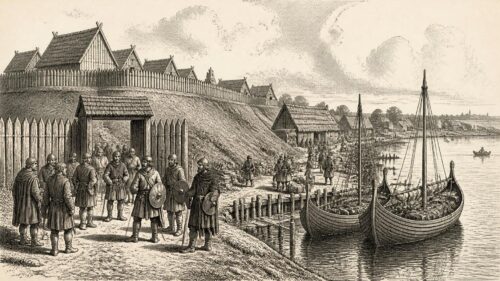
Two months was a formidable commitment in an age when armies had to feed themselves, maintain cohesion and keep open routes through contested country. A blockade did not necessarily mean a stone-walled siege in the later medieval sense. The wording permits a range of methods: surrounding or observing access routes, ravaging an opponent’s hinterland, preventing movement, demanding submission, and demonstrating that the king of Tara could remain in the field. The annals do not report Dublin’s capture, and it would be wrong to claim one. Domnall’s achievement was the extraction of cattle and the imposition of prolonged military pressure, not a recorded conquest of the town.
Cattle, Kingship and Dublin’s Reach
The reference to a ‘great’ cattle tribute explains much about the campaign’s purpose. Cattle were not merely food. They represented movable wealth, compensation, hospitality, rank and political obligation. Driving herds away punished a rival’s dependants, supplied an army and advertised the victor’s superiority. An expedition that returned with cattle could be presented as a successful assertion of overlordship even if it had not destroyed an enemy’s stronghold.
Domnall’s title needs care. He was king of Tara and the leading ruler of the northern Uí Néill; later annalistic language could call him king of Ireland or high king. His authority, however, was not a modern state’s territorial administration. It depended on recognition, hostages, tribute and military success, and was continually challenged by other kings. His 968 campaign was therefore an attempt to make a claim of precedence real in Leinster and at Dublin’s frontier.
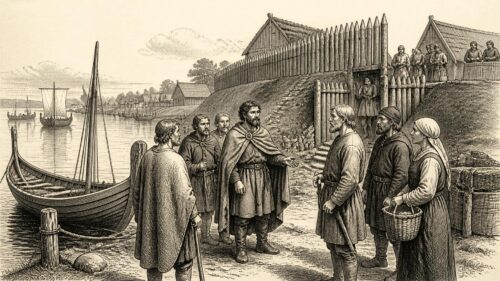
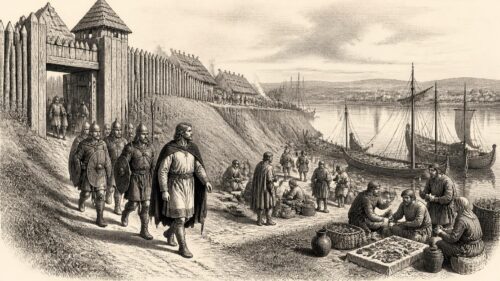
Dublin was not simply an external Scandinavian enclave set against an otherwise separate Irish world. By 968 it was an established town whose rulers negotiated, fought and allied with Irish dynasties. Archaeology shows a settlement of houses, workshops, pathways and waterfront activity, connected to maritime exchange and sustained by an agricultural hinterland. Craftspeople worked wood, leather, textiles, iron, antler and precious metals; weights, scales, bullion and imported objects testify to commercial links. None of this proves precisely what happened inside Dublin during Domnall’s blockade, but it explains why control of the town mattered. It was a source of ships, wealth, skilled labour and access to the Irish Sea, not merely a battlefield objective.
Silver also circulated in tenth-century Ireland, often as ingots, hack-silver and imported coin rather than through an Irish royal mint. Dublin’s first recorded native silver pennies belong to about 997 or 998, almost three decades after this campaign. In 968, therefore, cattle remained central to the political vocabulary of extraction, while port-based trade supplied another kind of wealth and influence.
Mathgamain in Munster
Munster’s notice for 968 is compact but revealing. The Annals of Inisfallen record a raid by Mathgamain son of Cennétig upon Uí Énna Áine, a people and territory associated with the Áine district in what is now east County Limerick. During that raid, Cathal son of Fogartach was ‘left’ dead. The annal calls Cathal a royal mercenary of Ireland, a striking designation that indicates a fighting man of recognised standing, though it does not explain whom he served, how he died, or whether he fell in a set battle. Those details cannot responsibly be recovered from the entry.
Mathgamain’s movement nevertheless belongs to a wider, securely documented shift in Munster. In the preceding annal year, 967, he had defeated the foreigners of Limerick at Sulcoit and Limerick was burned the following day. That earlier victory should not be collapsed into 968, but it gives the proper immediate context: Mathgamain was already emerging as a major Dál Cais war leader at the expense of established rivals and the Limerick-based Norse. The 968 raid on Uí Énna Áine shows that his ambitions were not confined to one dramatic clash. They extended into the dense local politics of inland Munster.
The same Munster annal records the plundering of Imlech Ibuir and the pitching of a camp there for two days. Imlech Ibuir, Emly, was one of the foremost ecclesiastical institutions of Munster. Crucially, the notice does not identify the raiders or the people who camped there. It must not be turned into a confidently named attack by Mathgamain, Limerick’s Scandinavians or any other force. What can be said is that a great church and its surrounding community were exposed to military exaction in 968. A two-day encampment implies the presence of an armed group requiring food, fodder and space; whether this was occupation, negotiation, coercion or simply the aftermath of plunder is not recorded.
Churches and Succession
The Annals of Ulster add a quieter but significant register of change. Cellach ua Banan, successor of Comgall, died; so did Muiredach, successor of Cainnech; Connmach, successor of Ultán, ‘rested’; and Flaithbertach son of Muiredach, king of Uí Echach, also died. The annal’s language joins secular and ecclesiastical succession in one political landscape.
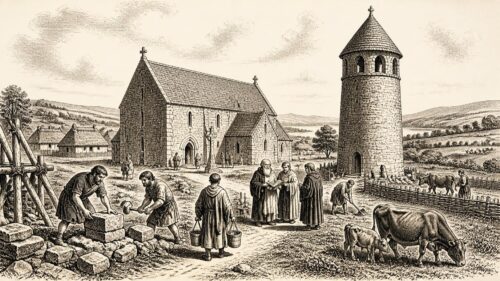
A comarba, literally a successor, was not simply a parish priest. The title expressed succession to the authority, estates, cult and social standing of a founding saint. Cellach’s office invoked Comgall of Bangor. Muiredach’s succession to Cainnech is conventionally associated with Cainnech’s principal church at Aghaboe, while the succession of Ultán recalled another prestigious saintly foundation. Such offices could involve land, client communities, learning, relics and relationships with kings. Their holders’ deaths therefore mattered beyond the cloister.
These notices also caution against imagining a neat division between a violent political world and a sheltered religious one. Churches possessed resources, offered ideological legitimacy and stood at important nodes of communication. Emly’s plundering makes the vulnerability plain; the recorded deaths of church leaders show institutional continuity being renewed through succession. Manuscripts, Latin learning and Irish-language scholarship remained part of this ecclesiastical world, even when annalists chose in 968 to record warfare more fully than teaching or book production.
The Limits of the Record
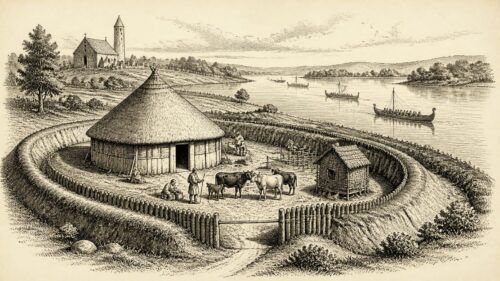
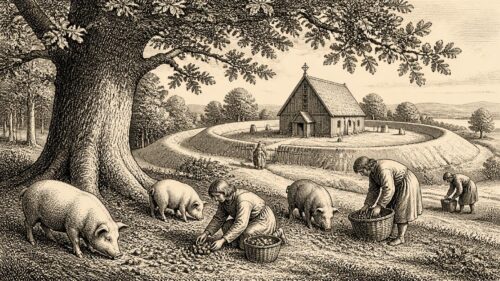
For everyday life, 968 offers no direct annalistic report of harvest, weather, disease, prices or building. There is no responsible basis for declaring the year prosperous or famine-stricken. Broader archaeology supplies the setting rather than a dated event: much of the rural population lived in farmsteads enclosed by ringfort banks and ditches or, in stonier districts, by cashels; households worked the land, tended livestock and used timber, iron, leather, bone and textiles. Towns such as Dublin concentrated specialist crafts and overseas commerce, but did not replace the overwhelmingly rural foundations of Irish society.
The year’s record is thus best understood as a sequence of pressures rather than a single national narrative. Domnall ua Néill tested the Leinster–Dublin alliance and returned with cattle. Mathgamain pressed his Munster rivals while an unnamed force plundered Emly. Senior ecclesiastical officeholders died, opening consequential successions. Ireland in 968 was connected by rivers, roads, sea routes, churches and dynastic ties, yet its political order remained intensely local and contingent. The two-month siege, the cattle drive and the two-day camp each show power being exercised through movement, supply and possession—not through fixed frontiers or permanent central control.
Primary Sources
- The Annals of Ulster: Year U968
- Chronicon Scotorum
- The Annals of Inisfallen: Annals AI960–AI969
- Ua Néill, Domnall
- The Vikings & Ireland
- Annals of the Four Masters
- The Annals of Tigernach
- Viking
- Early Medieval
- 950-1450: Vikings, Normans and Medieval Mints
- Irish Field Monuments
- An Ecclesiastical Institution in Medieval Munster: A Study of Emly to c. 1100
- Cainnech
- The 9th-Century Latin to Irish Translation App
- Lost in the Lake: the Lough Kinale Shrine
- Viking Silver Arm-Rings Discovered on the Shores of Clew Bay, Co. Mayo
- The Vikings in Ninth-Century Ireland: Sources and Settlements
- Exploring the Irish Annals
- Annals of Inisfallen to Go on Public Display in University College Cork
- List of Published Texts at CELT