Inis Mac nInill’s King1306 CE
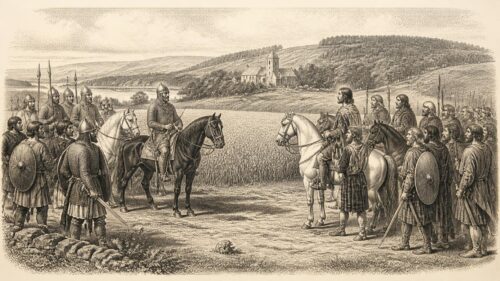
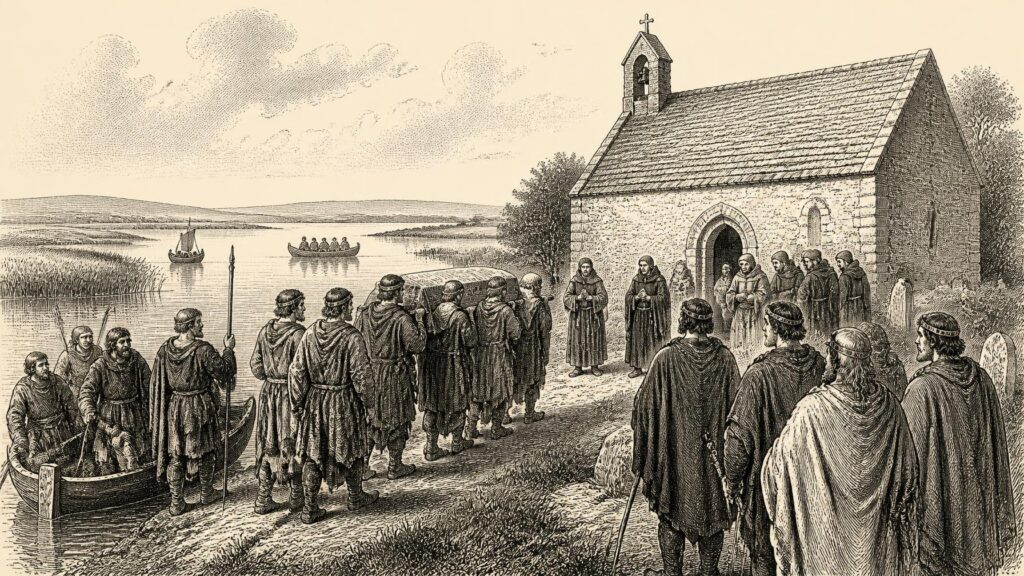
In 1306, Ireland experienced contested succession, warfare and political instability rather than decisive national change. Toirdelbach Ó Briain, king of Thomond, died and was buried at his foundation for friars on Inis Mac nInill, while his son Donnchad succeeded amid opposition. Connacht suffered prolonged conflict between Ó Conchobair rivals, involving raids, cattle seizure, arson and killings. Betrayals and lordship struggles affected Fermanagh, Meath, Leinster and Desmond, where prominent captives and rivals were killed. Annals also record clerical deaths, church damage, maritime trade and fortification. Robert Bruce’s Scottish accession had Irish significance, although no invasion followed. Sources require caution over chronology.
Dateline
In 1306, Ireland’s political map did not alter through one island-wide battle or royal decree. Instead, it changed through a succession of deaths, contested accessions, raids, betrayals and local acts of lordship. The most consequential loss was that of Toirdelbach Ó Briain, king of Thomond, whose burial in the church he had founded for friars on Inis Mac nInill marked the end of a long and forceful reign. His son Donnchad succeeded, but not without opposition. At the same time, Connacht was convulsed by warfare among branches of the Ó Conchobair kindred and their allies in Breifne, while violence touched Meath, Leinster, Desmond, Fermanagh and the north-west.
The surviving record is unusually rich, but it requires care. Irish annals commonly enter events under annual headings, rather than providing a continuous narrative, and different compilations can preserve different emphases or chronologies. The death of Toirdelbach and Donnchad’s succession are securely placed in 1306 by both the Annals of Inisfallen and the Annals of Connacht. Other notices, especially in the Annals of Ulster, belong to a sequence whose chronological heading itself signals dating complications. Such entries illuminate the political atmosphere of the period, but should not always be read as proof that every episode happened on a precisely recoverable modern calendar date.
A King Buried Among Friars
Toirdelbach Ó Briain’s death was a major event in western Munster. The annalists praise him in the language expected for a successful Gaelic ruler: brave, wise, pious, charitable and capable in war. Such praise was not a neutral biography, but it does reveal the values against which a king was judged. A ruler was expected to defend his people, reward followers, maintain ties with the church and display liberality. Toirdelbach had spent decades navigating the divided politics of Thomond, where rival Ó Briain claimants, the de Clare lordship around Bunratty, and powerful neighbouring dynasties all shaped the limits of kingship.
His burial place mattered. Inis Mac nInill, generally identified with Inishmacsaint in the Shannon estuary, was the site of a church that he had built for friars. The foundation joined political memory, personal devotion and dynastic display. A religious house offered prayers for a patron’s soul, but it also made a permanent statement that the king and his family possessed both resources and spiritual standing. The choice of burial there presented Toirdelbach not only as a war leader but as a Christian benefactor. This was an important part of rulership in fourteenth-century Ireland, not an ornament detached from politics.
Donnchad Ó Briain was made king after his father, yet the Annals of Inisfallen specifically say that he did so “with opposition”. The phrase is brief, but significant. Gaelic succession was not automatic primogeniture. Eligibility within a royal kindred, military support, alliances and the ability to command clients all mattered. Donnchad’s accession therefore represented a claim that had to be made effective, not merely inherited. Later conflict between him and another Ó Briain claimant would confirm how precarious the settlement was, but that later outcome should not be projected backwards as though civil war had already been decided in 1306.
War on the Shannon Frontier
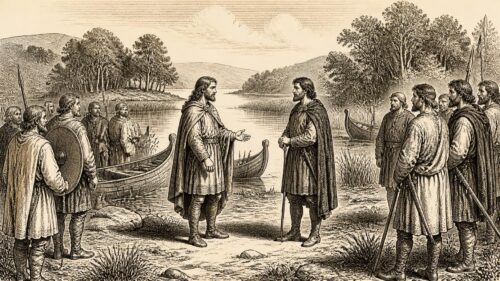
Connacht’s annals provide the year’s fullest picture of conflict and its effects on ordinary communities. Aedh, son of Eógan Ó Conchobair, king of Connacht, faced Aedh, son of Cathal Ó Conchobair, backed by elements of Breifne as well as Connacht men. The opposing forces remained on either side of the Shannon for three or four months. This was not a single set-piece battle: it was a sustained contest over authority, access to land and the right to take provisions and tribute.
Raiding lay at the centre of that contest. Followers of Aedh mac Cathail entered the Tuatha, taking spoil and damaging the resources on which rival lordships depended. A pursuing force killed leading men, including Flann Ó Flainn, who was eligible for the chieftainship of Síol Máelruain, and Brian, son of Donnchad Riabhach Ó Conchobair. Much of the captured livestock was recovered, though some was carried away. The record then relates that raiders reached an Ó Conchobair stronghold and burned the king’s residence and the houses around it. When the king caught them, he recovered the prey and killed Donnchad, son of Conchobar ‘of the Goblet’, a man described as fit for the kingship of Moylurg because of his success, generosity and valour.
These notices show why warfare was so disruptive even when chroniclers named only nobles. Cattle were wealth, food, breeding stock and a means of paying followers. Burning a residence meant more than attacking one household: it struck storehouses, dependants, hospitality and a lord’s public standing. The people who suffered capture, displacement or loss of grain and animals are usually unnamed. Yet their labour made the palaces, cattle herds and armed retinues possible, and their vulnerability was built into the military methods of the age.
Other betrayals reveal the same political fragility. Fergal Mag Ragnaill, chief of Muintir Eolais in what is now south Leitrim, was killed by his brother Mathgamain and members of his own council at Clachoilen. The Annals of Connacht preserve the phrase “the Clachoilen betrayal”, suggesting that the killing remained a notorious local memory. In Fermanagh, Mac Craith Mag Uidhir, a royal heir, and Domnall Mac Gilla-Míchil of Clann Conghaile were subjected to plunder and burning by Ralph Mac Mathghamhna. Such events were not marginal feuds. They determined who could claim lordship, exact dues and protect communities.
Violence Across Lordships
The year also saw conflict in regions where Gaelic and colonial powers were closely entangled. The Annals of Inisfallen record a victory by Ó Máel Sechnaill and Mac Eochagáin over “the foreigners” and Mac Feórais, or Bermingham, in Meath. In this vocabulary, “foreigners” meant the descendants and associates of the Anglo-Norman settler community, not simply people newly arrived from abroad. The notice is a reminder that the lordship of Ireland was neither a uniform English realm nor a land divided into two fixed blocs. Alliances shifted; Gaelic dynasties fought one another and sometimes fought settler lords, while settler families competed among themselves and relied on local military partnerships.
A later Anglo-Irish annalistic compilation places further disorder in 1306: an Ó Díomasaigh leader was killed at Geashill, Peter Bermingham lost men on the Meath borderlands, and Ballimore in Leinster was burned in May. The compressed character and later compilation of this source counsel restraint about detail, but its notices fit the wider pattern of armed pressure around the midlands. Castles, market settlements and defended residences were targets because they concentrated authority, supplies and revenue.
In Desmond, Domnall Óg Mac Carthaig was captured as he left Cork, held in irons and executed on 24 September by Domnall Cairprech Mac Carthaig. The annalist calls it a shocking deed to both Gaels and foreigners. That judgement does not mean political killing was rare; rather, it signals that imprisonment followed by execution of a rival of such standing breached powerful expectations about kinship, status and honour. Earlier, on 5 July, Dáuíd Ó Caím had been treacherously killed by William de Barry and In Mairtélach. The repeated emphasis on treachery in the year’s records points to the danger facing magnates even away from open battle.
Church, Learning and Loss
Religious life appears not as a separate sphere but as part of the same social world. The deaths recorded in 1306 include Donnchad Ó Flaithbertaig, bishop of Killala, who died while travelling towards Dublin and was buried with honour at Mullingar in the house of the Blessed Virgin Mary. The journey itself hints at the interconnections binding dioceses, religious houses and the administrative centre of the lordship. Master Tomás Ó Naáin, archdeacon and bishop-elect of Raphoe, also died. His title of master indicates formal learning, while his unfinished elevation shows how the death of one cleric could leave a diocese in an uncertain position.
The annals additionally remember Nicol Ó Donnchada, a priest at Drumcliff, killed by Gerran Dub Barrett without stated cause. The entry casts the priest as a martyr and attaches an indulgence to prayers for his soul. Whether or not every detail reflects the language of later commemoration, it shows how violence could be absorbed into local religious memory. A lightning strike that burned the church of Tulach Léis was likewise recorded as a remarkable misfortune. Churches were places of worship, burial, assembly, storage and local identity; damage to one was a communal loss.
Sea Roads and a Northern Shadow
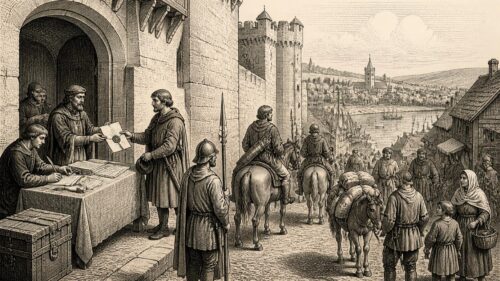
One striking Ulster annal reports that twenty tons of wine were washed ashore at Magh Cédne, near the north-west coast. The entry cannot establish the ship’s origin or intended destination, but it offers a vivid glimpse of the Irish Sea and Atlantic trading world. Wine was a high-value imported commodity, carried in bulk by sea and consumed by ecclesiastical institutions, towns, castles and elite households. Its appearance on shore also reminds us how weather and wreck could abruptly redistribute valuable goods beyond the control of merchants and lords.
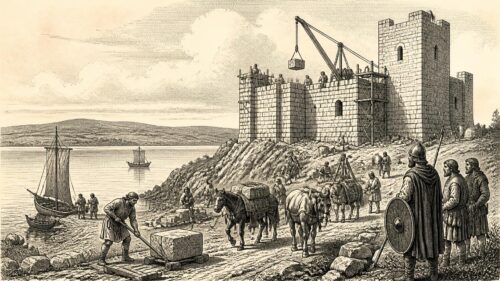
The same annalistic sequence attributes the building of a castle at Sligeach to “the Earl”, generally understood as Richard de Burgh, earl of Ulster. Modern accounts often date the rebuilding of Sligo’s castle and town to 1310, so the notice should be treated as evidence of de Burgh’s early fourteenth-century fortification programme rather than as a securely dated construction day in 1306. Even with that caution, the political meaning is clear: stone castles and planned settlements were instruments for holding routes, collecting dues and projecting lordship into contested Connacht.
Beyond Ireland, Robert Bruce forcibly claimed the Scottish kingship in 1306. The Annals of Connacht noticed the event immediately. No Bruce invasion of Ireland occurred that year, and it would be wrong to turn this notice into a prediction of 1315. Yet Scotland’s upheaval already mattered to Irish politics. The de Burgh family had Scottish connections, Irish Sea crossings linked Ulster and western Scotland, and warfare in Scotland drew men, supplies and attention across the channel.
Thus 1306 was a year of succession rather than settlement. Toirdelbach’s burial at Inis Mac nInill gave Thomond a potent image of Christian kingship, but Donnchad inherited opposition. In Connacht and the midlands, raids and betrayals exposed the human cost of contested lordship. Across Ireland, churches, castles, cattle, roads and sea-borne cargoes were all bound into the struggle to command people and resources.
Primary Sources
- The Annals of Ulster: Year U1306
- The Annals of Ulster
- Annála Connacht
- Annála Connacht: Annal 1306
- Annals of Inisfallen: Annal AI1306
- Annals of Inisfallen
- Annals of the Four Masters: Annal M1306
- Annals of the Four Masters
- Mac Carthaigh's Book: Annal MCB1306
- Mac Carthaigh's Book
- Annales Hiberniae
- Annales Breves Hiberniae
- O'Brien (Ó Briain), Toirrdelbach
- Burgh, Richard de
- Gaveston, Piers de
- N16 Sligo to County Boundary Route Selection Report, Volume 3, Part C
- An Introduction to the Architectural Heritage of County Sligo
- Irish Castles: 1180 to 1310
- National Monuments Service: Archaeological Survey
- A King in Search of his Throne
- Projecting Dynastic Majesty: State Ceremony in the Reign of Robert the Bruce
- Bruce Invasion