Cináed and the Ruined Fruit975 CE
In 975, uneven annalistic evidence records a pressured Ireland where political, maritime, ecclesiastical, cultural and environmental concerns intersected. In Munster, Mathgamain mac Cennétig’s army killed Cormac son of Faelán, demonstrating his contested authority. Ímar escaped overseas while an island stronghold, possibly near Limerick, was retaken, confirming continuing Irish Sea rivalry. Cináed ua hArtacáin, renowned chief poet, died, depriving learned culture of an influential custodian of history and place-lore. Fogartach, abbot of Daire, died, and Ferdal of Rechru was killed by heathens. Exceptionally wet weather damaged crops, worsening vulnerability amid conflict, mobility and competition for resources across the island’s linked communities.
Dateline
The Irish evidence for 975 CE is unusually revealing precisely because it is so uneven. No surviving source offers a continuous narrative of the year. Instead, separate annalistic records preserve terse notices from Munster, the north-east, Brega and the Irish Sea world: a killing by the army of Mathgamain mac Cennétig; the escape of an Ímar overseas and the recapture of an island site; the death of the celebrated poet Cináed ua hArtacáin; the killing of an ecclesiastical superior by “heathens”; and a year of notably poor weather. Taken together, they show an Ireland in which political authority, church communities, maritime power, learning and food supply were closely entwined.
The dating needs care. The Annals of Inisfallen, compiled from a Munster-centred tradition, place two major notices under 975. The Annals of Ulster label their year “974 alias 975”, while the seventeenth-century Annals of the Four Masters place related material under 973 but explicitly correct it to 975. These are not grounds for inventing a precise sequence of months or days. They do, however, allow several events and conditions to be responsibly connected with this calendar year.
Mathgamain’s Army in Munster
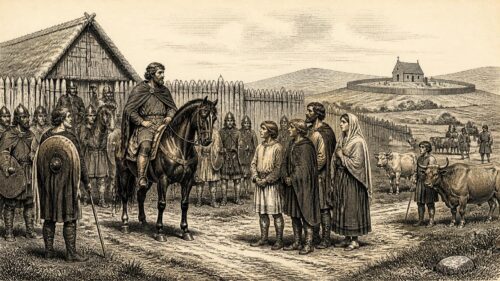
The clearest Munster event is recorded by the Annals of Inisfallen: “the death of Cormac, son of Faelán, by the army of Mathgamain”. The wording does not describe a named battle, give a location or explain Cormac’s political position. It does establish that Mathgamain, ruler of Cashel and the leading figure of the rising Dál Cais, could deploy an army against a rival in 975. Modern discussion commonly connects Cormac with the Déisi of south-east Munster, but the annal itself is more restrained. It is safest to see the notice as evidence of a violent assertion of power within Munster rather than as a fully documented conquest.
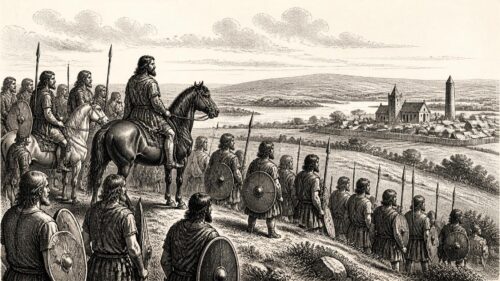
That act belongs to a tense, rapidly changing provincial contest. This broader setting must not be confused with an event of 975 itself. In 967 Mathgamain had defeated the foreigners of Limerick at Sulcoit and burned Limerick; in 972 a Munster coalition had issued ordinances against Norse officials and the foreigners of Limerick; and in 974 the son of Bran had taken hostages in Munster and advanced against Mathgamain. Those earlier entries reveal why a killing by Mathgamain’s army mattered in 975. His kingship did not rest on an uncontested inheritance at Cashel. It was being made and defended through hostages, armed followings, regional alliances and pressure upon communities controlling strategic routes.
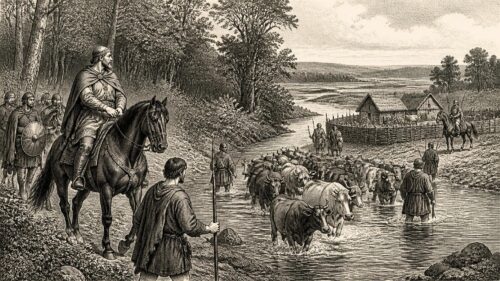
For ordinary inhabitants, such politics were not remote. An army needed food, cattle, horses, guides and temporary camps. A campaign could bring the taking of stock, forced provisioning, damaged crops and insecurity along roads and river crossings even when a chronicle reduced the outcome to one man’s death. The annals chiefly name rulers and churchmen, but the practical burden of their rivalry fell far more widely.
Ímar, the Sea and an Uncertain Island
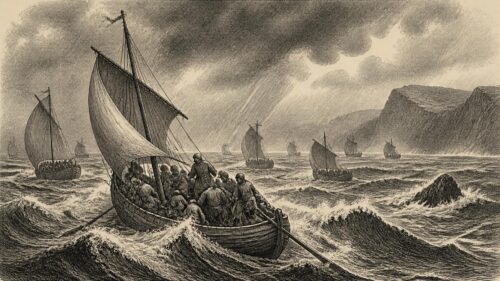
The second Inisfallen entry is equally compact: “Ímar escaped over sea, and Inis Ubdan was captured again.” It is important not to supply details the source does not give. The entry does not identify the captor, explain how Ímar had been held, specify his destination, or describe the fighting. Nor is the location of Inis Ubdan beyond dispute. It has often been interpreted as Inis Sibtonn, later King’s Island at Limerick, but that remains an identification rather than an explicit statement in the annal.
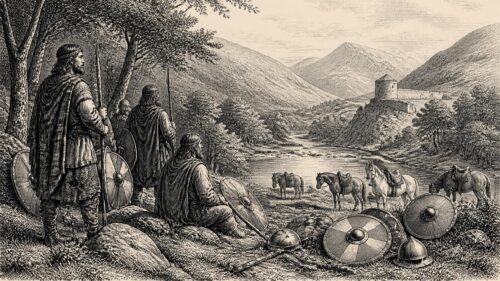
Even with those limits, the notice illuminates the political geography of 975. Ímar was evidently a figure important enough to be named without further introduction in a Munster chronicle, and his escape “over sea” shows that power around Limerick reached beyond the Shannon estuary into the wider Irish Sea. The recovery of an island strongpoint, whether or not the proposed King’s Island identification is accepted, points to the importance of defensible waterside places. Rivers and estuaries were not merely boundaries: they were transport corridors, commercial routes and avenues for sudden attack or flight.
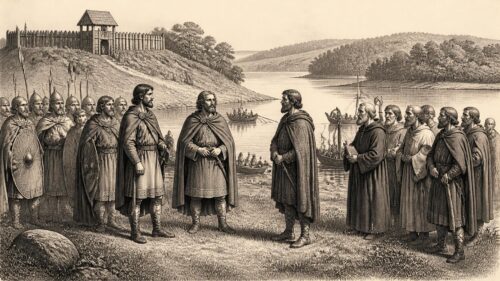
The episode should also correct a simple picture of “Irish” kings on one side and “Vikings” on the other. The people called gaill or foreigners in Irish records formed communities with their own leaders, ships and interests, but they participated in Irish political rivalries and were capable of alliance, captivity and negotiation with neighbouring rulers. Limerick’s Scandinavian settlement had suffered heavily in the campaigns before 975, yet the Ímar notice demonstrates that maritime leadership and fortified positions still mattered. It was an unsettled frontier of power, not a vanished enclave.
The Death of a Chief Poet
Far to the north-east, several annalistic traditions record the death of Cináed ua hArtacáin. The Annals of Ulster call him prím-éces Érenn, chief poet of Ireland; the Annals of Tigernach and Chronicon Scotorum style him chief poet of Leth Cuinn, the northern half of the island in the conventional division of Ireland. The difference is instructive rather than contradictory. Both descriptions register exceptional standing in a learned world whose authority extended across regional boundaries.
Cináed belonged to Síl Cernach Sotal, a Brega lineage, and was one of the few tenth-century Irish poets known by name with a substantial surviving body of work. Poems attributed to him preserve lore about Tara, Brú na Bóinne, Emain Macha, heroes, royal graves and famous places. Such verse was neither decorative leisure nor simply oral legend. Genealogy, place-lore and accounts of earlier kingship could support claims to status and territory. A poet capable of ordering that knowledge in memorable Irish verse was valuable to rulers, churches and communities seeking to articulate their past.
His known associations underline the point. Cináed wrote of Congalach Cnogba, formerly king of Tara, and of Amlaíb Cuarán of Dublin. By 975, therefore, his death marked the loss of a cultural intermediary who had worked across the boundaries between Brega, Uí Néill politics and the Hiberno-Norse town. His obit is one of the year’s strongest reminders that Ireland’s political history cannot be separated from its learned culture. The composition, transmission and performance of historical poetry were themselves forms of power.
Churches Under Pressure
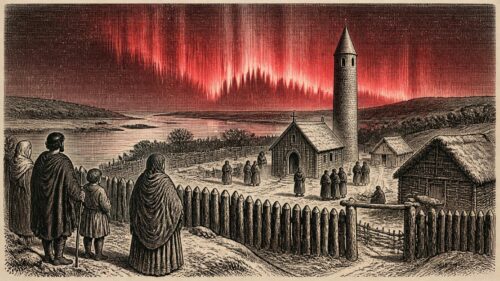
The year also brought losses to church leadership. The Annals of Ulster record the death of Fogartach, abbot of Daire, and state that Ferdal, superior of Rechru, was killed by “the heathens”. The latter phrase is the annalist’s label, not a precise ethnic description. Rechru itself is disputed by scholars, with Rathlin Island and Lambay Island among the proposed identifications. What can be said firmly is that a church superior at an island-associated ecclesiastical site died violently in 975.
This was not an isolated or archaic survival of a raiding age. Island churches were exposed to sea traffic, but they also benefited from it: they could receive travellers, maintain contacts and stand near productive fisheries and maritime routes. Their religious importance, landed resources and portable valuables made them politically visible. The notice of Ferdal’s death therefore belongs beside the movements of Ímar and the conflict in Munster. Church communities were participants in the same connected landscape of lordship, travel and competition.
At the same time, ecclesiastical life was broader than spectacular violence. Churches and monasteries anchored local settlement, held land, employed craftspeople, supported hospitality and preserved learning. Their senior offices were often entangled with powerful kin groups. The deaths of Fogartach and Ferdal would have mattered not only devotionally but administratively, affecting the management of people, property and obligations.
Rain, Harvest and Vulnerability
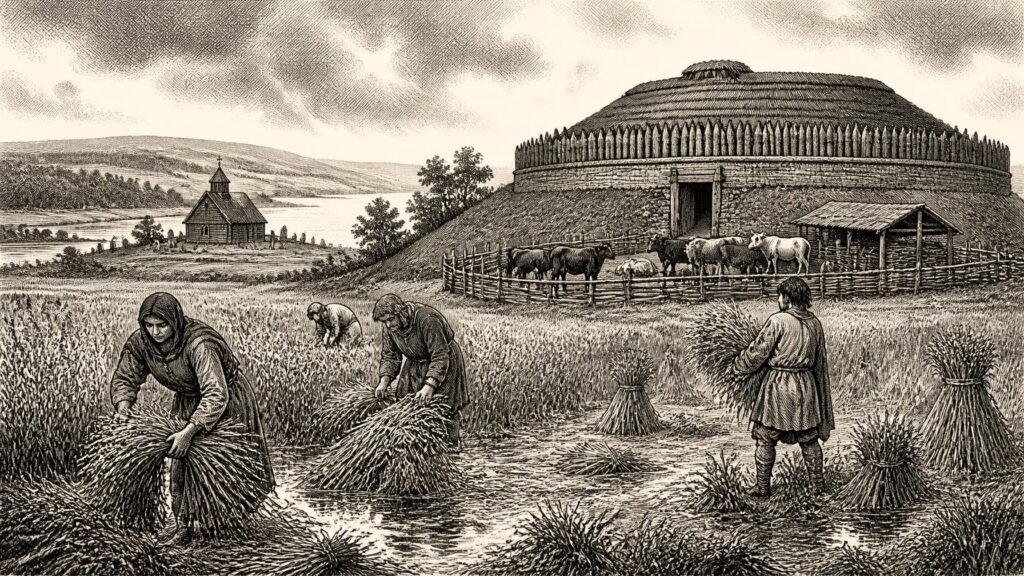
The Annals of Ulster close their 975 notices with an unusually direct environmental observation: there was “very bad weather” in the year. The Annals of the Four Masters, in its chronologically displaced but explicitly corrected entry for 975, is more specific, reporting excessive wetness such that “the fruits were destroyed”. Neither source permits a modern reconstruction of rainfall totals, temperatures or a nationwide famine. It does permit the conclusion that contemporaries considered the weather serious enough to record and associated it with damaged produce.
That mattered in a predominantly rural society. Cattle were a principal measure of wealth and a frequent object of raiding, while cereal cultivation supplied food, seed, ale and dues. Wet conditions could impede sowing and harvest, spoil stored crops, reduce fodder and make military movement harder. A bad season need not have affected every district equally, but it increased vulnerability at a moment when armies were active and maritime strongholds were changing hands. The year’s political and environmental notices belong together: rivalry became more costly when food and fodder were uncertain.
Thus 975 was not defined by one decisive battle or a single ruler’s triumph. Its surviving record instead captures a pressured Ireland: Mathgamain’s armed authority was active in Munster; maritime politics around Limerick remained volatile; an eminent poet died in Brega; church leaders were lost by death and violence; and persistent wet threatened the fruits of the land. These fragments are enough to show how closely the island’s kingdoms, churches, ports and farms depended upon one another.
Primary Sources
- The Annals of Ulster: Year U975
- The Annals of Ulster: Year U975 (Irish and Latin text)
- Annals of Inisfallen: Annals AI972–AI980
- Annals of Inisfallen: Annals AI965–AI969
- The Annals of Tigernach
- Chronicon Scotorum: Annals CS975–CS979
- Chronicon Scotorum: Background Details and Bibliographic Information
- Annals of the Four Masters: Annals M973–M976
- Annals of the Four Masters: CELT Project Record
- Ua hartacáin, Cináed
- Literature and Learning in Early Medieval Meath
- Brian Bórama (Bóruma, Boru)
- Ua Néill, Domnall
- Brian Boru and the Rise to Provincial Kingship
- Kingship of Limerick
- Landscapes of Kingship in Early Medieval Ireland, AD 400–1150
- How Did Early Church Sites Differ from One Another? A Comparative Approach Within the Kingdom of Fir Maige, Ireland
- Theme and Variations: Christianity and Regional Landscapes in Early Medieval Ireland
- Farming and Archaeology
- Medieval Ireland: Territorial, Political and Economic Divisions
- Early Medieval Ireland: Archaeological Excavations, 1930–2009
- The Vikings in Ninth-Century Ireland: Sources and Settlements
- The Metrical Dindshenchas
- The Death of Finn Mac Cumaill