Carnfree’s Bitter Settlement1228 CE
In 1228, Áed Ó Conchobair of Connacht was murdered in Leinster, intensifying dynastic conflict. Richard de Burgh, newly appointed justiciar, helped oversee a Connacht assembly that inaugurated Áed son of Ruaidrí at Carnfree, rejecting his elder brother Toirrdelbach. The settlement failed: warfare, cattle seizures and plunder devastated much of Connacht, causing hunger, displacement, and the flight of clergy and learned people. Elsewhere, lineage killings affected Breifne, royal administration promoted Magna Carta and land claims, and Dublin’s archiepiscopal succession became contested. Coleraine’s fortification was renewed, while Irish annalists noted Francis of Assisi’s canonisation, revealing Ireland’s wider ecclesiastical connections during the year.
Dateline
In 1228, the struggle for Connacht became one of the clearest demonstrations of how precarious power could be in thirteenth-century Ireland. A king was killed while away from his province; rival branches of his dynasty fought over the succession; the newly appointed royal justiciar intervened; and an inauguration at Carnfree was followed by devastation serious enough for Irish annalists to describe famine, plunder and the dispersal of clergy and learned people. The year also saw changes in Dublin’s political church, a renewed fortification at Cúil Rathain on the Bann, and a fresh assertion of English royal law within the lordship. These were not separate stories. They reveal an island of overlapping jurisdictions, where Gaelic kingship, Anglo-Norman lordship, ecclesiastical institutions and royal administration were inseparably entangled.
A King Killed in Leinster
The year opened under the shadow of Connacht’s unsettled succession. Áed, son of Cathal Crobderg Ó Conchobair, had held the provincial kingship for about four years after his father’s death in 1224. Cathal had been a formidable ruler, able to negotiate with the English crown while maintaining a Connacht kingship grounded in Gaelic lordship, clientship and military power. His death exposed rival claims within the wider Ó Conchobair dynasty, while the de Burgh family possessed royal grants and ambitions in the province.
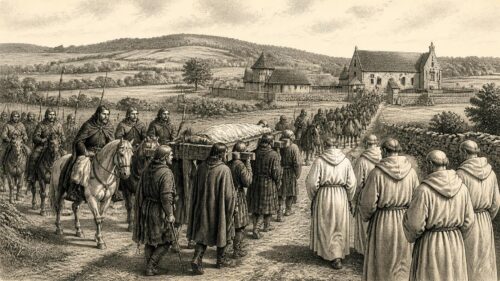
In 1228 Áed was killed at Buaile Mór in Leinster, in the household or court of Geoffrey de Marisco. The core fact is repeated in several annalistic traditions: the king died violently while in the orbit of an important Anglo-Norman official. The detailed version in Annála Connacht says that he was struck with a carpenter’s axe while being bathed and that Geoffrey promptly hanged the killer. It further attributes the killing to the prompting of the sons of Hugh de Lacy and William, son of the justiciar. Those accusations, and the supposed personal motive of the killer, belong to a narrative written from a later perspective and cannot be treated as independently proven. What is firm is that Áed’s death was understood as treacherous, and that Geoffrey de Marisco’s immediate punishment of the assailant did not prevent suspicion from falling on powerful men.
The murder was politically explosive because the king was not simply a local ruler. Connacht lay at the western edge of the English lordship, but it was also a major Gaelic province whose rulers dealt with kings, magnates and churchmen across Ireland. Áed’s elimination removed a figure with a recognised claim and left a contested inheritance at precisely the moment when Richard de Burgh, lord with extensive claims in Connacht, acquired greater authority in Ireland.
Richard de Burgh and Carnfree
Richard de Burgh was appointed justiciar of Ireland in February 1228, replacing Geoffrey de Marisco. A royal mandate of 17 March addressed him in that office, demonstrating that his authority was already operational in the crown’s documentary business. The justiciar was the king of England’s chief governor in Ireland: a military, judicial and administrative office, not a kingship over the whole island. His practical reach was strongest in the lordship’s towns, castles and settled counties, but its holders could make decisive interventions beyond those areas through alliances, campaigns and negotiations.
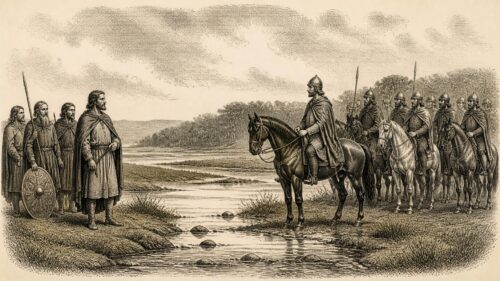
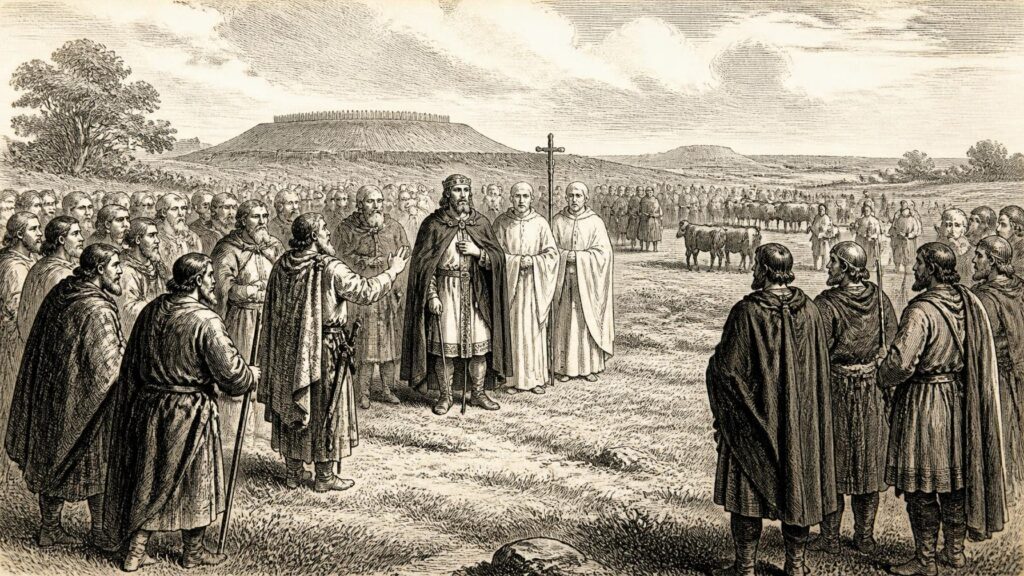
Irish annals record that Richard came from England with his appointment and that a great gathering of Gaels and Galls – Gaelic and Anglo-Norman leaders – met in Connacht to settle the claims of Toirrdelbach and Áed, sons of Ruaidrí Ó Conchobair. The gathering chose the younger brother, Áed son of Ruaidrí, and rejected Toirrdelbach, who was the elder. At Carnfree, the traditional inauguration place of Connacht kings near Rathcroghan, Áed was installed according to customary practice.
That episode is important precisely because it was neither an uncomplicated English imposition nor an untouched survival of an earlier Gaelic order. The annalists present the Connachtmen as electing Áed, but they also make the justiciar and leading outsiders part of the decision. Carnfree supplied legitimacy rooted in Connacht’s own political culture; the presence of Richard de Burgh and other magnates supplied a different, coercive kind of recognition. The settlement therefore expressed a balance of pressures rather than a durable peace.
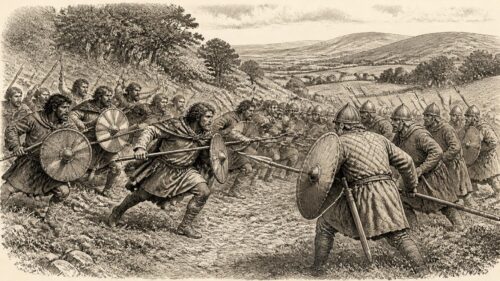
It was also a damaging choice. The annalist of Connacht calls the decision disastrous, condemning the displacement of Toirrdelbach and stressing his qualities as a noble and capable lord. Such judgements should not be read as neutral reporting, yet they capture the essential outcome: the succession was not resolved. Toirrdelbach’s sons, Máel Sechlainn and Brian, gathered cattle and people and moved through the disturbed country. Áed’s forces pursued them, recovered the cattle and killed Máel Sechlainn. Cattle were wealth, food, status and a means of sustaining households and followers; their seizure and recovery were therefore central acts of war, not incidental raiding.
War, Hunger and Displacement
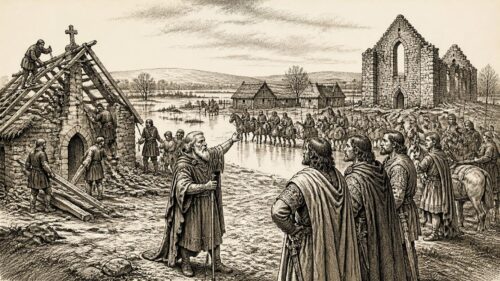
The human cost in Connacht is the year’s gravest theme. Annála Connacht reports that warfare between Áed and Toirrdelbach turned much of the province into a “continuous desert”, naming a broad tract from Ballysadare south towards the river of the Uí Fhiachrach, with only limited areas spared. The Annals of Ulster likewise state that churches and territories were plundered, and that clergy and “folk of learning” were driven into foreign lands, exposed to cold and hunger. The Annals of the Four Masters, compiled much later but drawing on annalistic material, adds that some died from these privations.
These statements should be handled carefully. They do not provide a harvest figure, a death toll, or evidence for a weather-driven island-wide famine in 1228. They do, however, provide unusually direct testimony that conflict produced food shortage and displacement in Connacht. Plundering churches and lay estates meant taking the stores, livestock and movable goods on which communities relied. Burning or driving off people interfered with cultivation and the care of animals. Clerics and learned men were especially visible to annalists because monasteries, churches and learned families were centres of literacy, hospitality, education and commemoration. Their flight was therefore both a personal disaster and a blow to the province’s social infrastructure.
The same year’s notices from Breifne and the midlands show that succession violence was not confined to Connacht. Niall Ó Ruairc, lord of Dartry and Clann Fermaige, was killed by kinsmen; his son Amlaíb Gerr was then killed while bathing. Fergal Ó Ruairc was slain by the sons of Niall, and Áed Ó Fergail was killed by another member of his own kindred. These concise annals cannot reconstruct every cause, but their accumulation conveys a political world in which disputes inside ruling lineages could quickly become lethal. Kinship supplied claims to lordship, followers and protection; it also multiplied rivals.
Dublin, Law and a Vacant Archbishopric
While Connacht suffered, royal government continued to make its claims in the lordship. In 1228 the justiciar was ordered to summon archbishops, bishops, abbots, priors, earls, barons, knights, free tenants and county bailiffs to hear Magna Carta read. This did not mean that the charter’s protections were suddenly enjoyed evenly across Ireland, nor that English common law displaced Gaelic legal practice throughout the island. The language of the order itself identifies its intended political community: landholders, office-holders and churchmen within the crown’s administrative orbit. Even so, the instruction mattered. It publicly connected the authority of the Irish administration with the chartered laws and customs associated with the English crown.
Royal governance was also apparent in more routine business. In March, Richard de Burgh was told to secure possession for Ralph fitz Nicholas of lands formerly held by William Pipard and to locate the heir, then in Ireland. Such a mandate is a small document, but it illustrates the daily work expected of the justiciar: claims to inheritance, seisin and landholding had to be made effective through officials, bailiffs and royal orders.
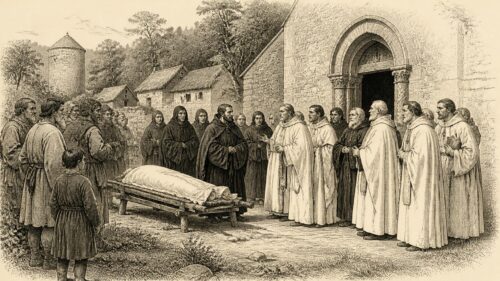
Dublin’s church underwent a consequential transition. Henry of London, archbishop of Dublin and a former justiciar, died before November 1228 and was buried at Christ Church. He had been an energetic defender of archiepiscopal and royal interests, associated with the development of both St Patrick’s Cathedral and Dublin Castle. In December, the canons of St Patrick’s sent a representative to the king for the election of Luke as Henry’s successor. This was not the final settlement of the vacancy: the canons of Holy Trinity, Christ Church, contested their exclusion, and the election was later reconsidered at Rome. Yet the December move shows that the contested relationship between Dublin’s two cathedral chapters remained a live constitutional issue at the end of the year.
Walls, Saints and Wider Connections
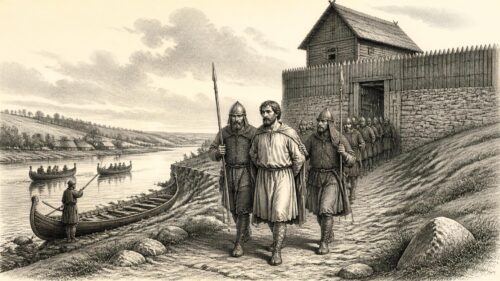
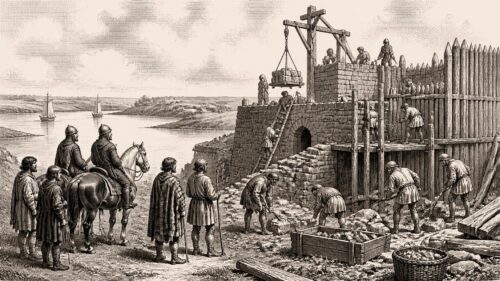
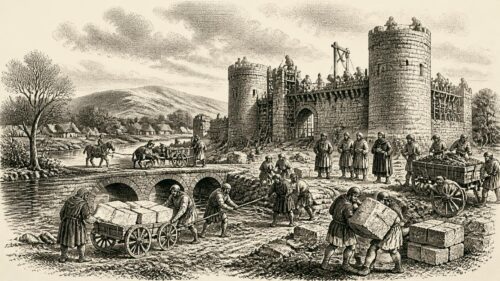
In the north, the Annals of Ulster record that a castle at Cúil Rathain, modern Coleraine, was built in 1228. Earlier annals record a castle there in 1214 and its destruction during the conflicts of the early 1220s. The brief 1228 notice does not identify the builder or describe the structure, so it is safest to see it as evidence of renewed or rebuilt fortification rather than to supply details the source does not give. Its location beside the Bann nevertheless indicates the continuing importance of controlling river movement, routes and a strategic frontier in north-eastern Ulster.
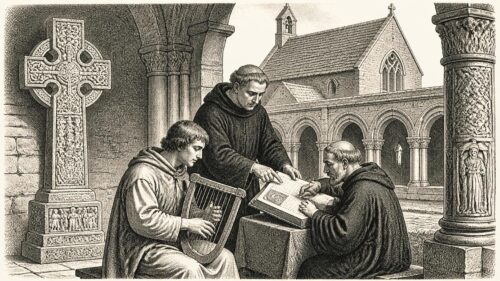
The same annal notes Pope Gregory IX’s canonisation of Francis of Assisi on 16 July 1228. This was an event in Italy, but its inclusion in an Irish chronicle is revealing. Irish religious communities followed developments in the wider Latin church and selected them for record. It should not be used to claim an immediate Franciscan transformation in Ireland during this year; rather, it shows the intellectual and devotional horizons within which Irish annalists worked.
By the close of 1228, no settlement in Connacht could be called secure. Carnfree had provided a king, but not peace; royal intervention had given Richard de Burgh unmatched authority, but it had not ended the rivalry from which that authority profited. For ordinary people in the affected districts, the year was measured less by installations and mandates than by lost cattle, disrupted food supplies, flight and hunger. That is why the bitter settlement at Carnfree remains the defining image of 1228: a public act of kingship set against a landscape already being damaged by the war it failed to end.
Primary Sources
- Annála Connacht: Annal 1228
- Annála Connacht
- The Annals of Ulster: Year U1228
- The Annals of Ulster
- Annals of the Four Masters: Annal M1228
- Annála Ríoghachta Éireann: Annal M1228
- Annals of Inisfallen: Annal AI1228
- Mac Carthaigh’s Book: Annal MCB1228
- The Annals of Ulster: Year U1222
- The Annals of Ulster: Year U1214
- Burgh, Richard de
- Henry of London
- Luke
- Calendar of Documents Relating to Ireland, Volume 1, Item 1580 (17 March 1228)
- Calendar of Documents Relating to Ireland, Volume 1, Item 1614 (17 June 1228)
- Parchment Conquest, 1171–1307
- Confirmation by Luke, Archbishop of Dublin, to the Prior and Canons of Holy Trinity, Dublin
- Irish Parliaments in the Reign of Edward II
- History of the Law in Ireland
- Magna Carta 1214–1225
- His Majesty’s Castle of Dublin
- 4 October: Saint Francis of Assisi, Patron Saint of Italy