St Stephen’s Red Sky992 CE
In 992, Irish annals record Máel Sechnaill mac Domnaill’s cattle-taking expedition into Connacht, demonstrating Mide’s military reach and the central value of livestock. Brian son of Cennétig subsequently led Munster and Connacht forces into Mide, apparently as a restrained but purposeful show of strength. Regional politics were further marked by deaths and probable violence among rulers in Tethba, Uí Diarmata and Corcu Baiscinn. Ecclesiastical succession affected Clonfert, Clonmacnoise and Inis Cathaig, institutions entwined with wealth and power. The records also illuminate rural dependence on livestock, Ireland’s trade connections, and a blood-red sky observed on St Stephen’s night, possibly an aurora.
Dateline
For Ireland, 992 is a year best approached through careful reading of the annals rather than through the later, simplified story of a contest between Brian Boru and Máel Sechnaill. The surviving records do not offer a single continuous narrative. They preserve a Connacht expedition, deaths in several regional kingdoms and ecclesiastical centres, and an extraordinary report from the night of St Stephen’s Day. Their dating also needs care: the Annals of Ulster head this material as 991 “alias 992”, while the Annals of the Four Masters likewise correct their annal to 992; the Annals of Inisfallen place its southern notices directly under 992. Taken together, they give a responsible, if selective, view of the calendar year.
A Cattle-Taking Expedition
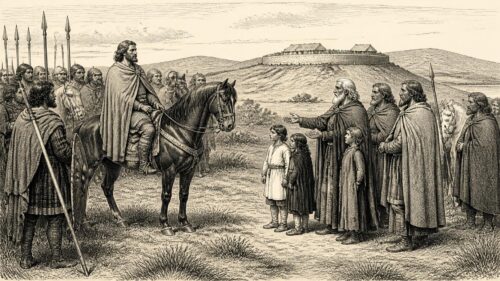
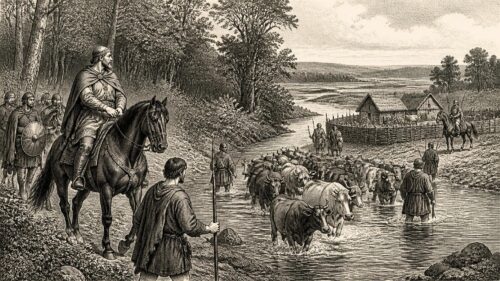
The principal political event securely associated with 992 was an expedition by Máel Sechnaill mac Domnaill, king of Mide and claimant to the kingship of Tara, into Connacht. The Annals of Ulster say simply that he “brought away great spoils”. Chronicon Scotorum is more specific: he extracted a great cattle-tribute. The later Annals of the Four Masters, drawing on annalistic traditions at a considerable remove from the event, magnify it as an exceptionally large cattle prey. The core point is secure even if the superlative is not: Máel Sechnaill’s force entered Connacht and returned with livestock and movable wealth.
This was not mere banditry. In late tenth-century Ireland cattle were a principal measure of productive wealth, status and political obligation. They supplied food, dairy produce, hides, traction and, crucially, the means to reward followers or exact submission. A large cattle-taking raid therefore damaged communities immediately while advertising the reach of the king who organised it. It also required substantial logistical capacity: armed men, local intelligence, routes through difficult country, drovers and the ability to bring animals safely back across the Shannon-facing approaches to Mide.
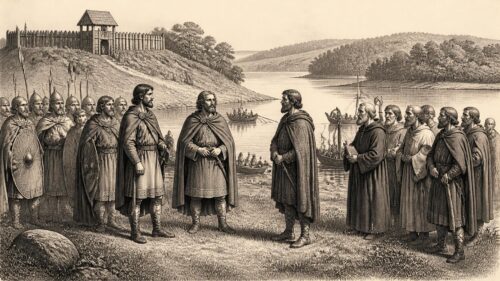
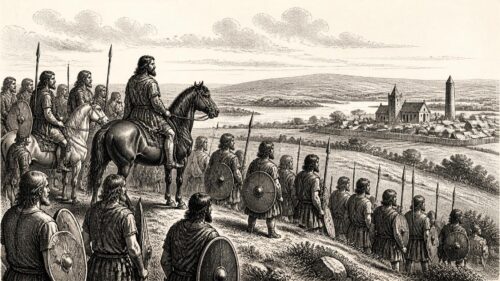
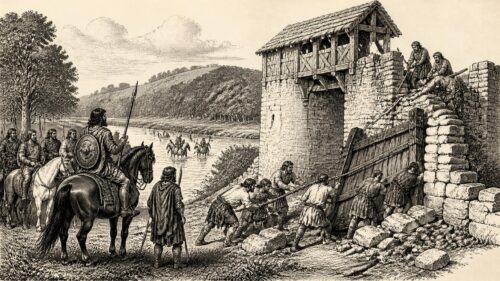
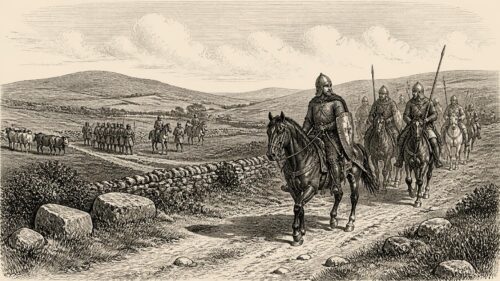
Connacht was not an empty target on the edge of Ireland. It comprised competing dynasties and powerful local interests, linked to the midlands by river, lake and overland routes. Máel Sechnaill’s expedition showed that he could project force westwards from his Clann Cholmáin base in Mide. Yet an annal records an answer of a different kind. After the raid, Brian son of Cennétig came into Mide with men of Munster and Connacht as far as Loch Aininn. The same source says that he took neither cattle nor people and then departed. That restraint should not be romanticised as peace: a large army entering a rival’s sphere was itself a calculated political act. But the wording distinguishes this demonstration from a full-scale retaliatory devastation.
By 992 Brian was already the dominant ruler in Munster, while Máel Sechnaill had held the kingship of Tara since 980. Their eventual accommodation and division of spheres of authority lay five years ahead, in 997. It would be wrong to read that later settlement back into 992. This year instead captures an unsettled phase, in which the two rulers tested influence through expeditions, alliances and carefully limited displays of force rather than through a decisive battle between them.
Deaths and Vulnerable Lordship
The annals also show how many levels of authority existed beneath the ambitions of leading overkings. Donn, son of Donngalach and grandson of Donn Cúán, king of Tethba, died in the year. The Annals of Ulster record his death without detail; Chronicon Scotorum and the Four Masters preserve a harsher tradition, saying that he was treacherously killed by his own men. Tethba lay in the midlands, broadly in the Longford–Westmeath region, close enough to the political heartland of Mide for its instability to matter greatly. The disagreement in detail is a reminder not to turn every annalistic entry into certainty, but the record strongly suggests a violent local succession crisis rather than a quiet passing.
Two lesser rulers, Gilla Colmán son of Niall of Uí Diarmata and Cú Cenann son of Tadc, were said to have fallen by each other in their own territory. Such a brief formula leaves the circumstances obscure: it may describe a duel, a clash between rival lordships, or a killing remembered as mutual. Its importance lies in scale. Irish politics did not operate solely through the decisions of Tara, Cashel or Dublin. Kingship was distributed among many small and medium-sized peoples, and disputes over land, tribute, honour and succession could become lethal without entering the record as famous battles.
In the south-west, the Annals of Inisfallen record the death of Dúnadach son of Diarmait, king of Corcu Baiscinn, the kingdom occupying much of modern west Clare. This was a coastal territory with access to the Shannon estuary and to the sea routes that connected Munster, the Irish Sea world and Atlantic coasts. The entry does not identify a successor or a cause of death. It nevertheless marks a change at the head of an important regional people at a time when Brian’s Munster kingship was expanding its influence beyond the Dál Cais homeland.
Monasteries, Memory and Office
Three ecclesiastical deaths place religious institutions at the centre of the year’s record. Máel Petair ua Tolaig, coarb or successor of St Brendan at Clonfert, died; both northern and southern annals note him. Clonfert, on the Shannon in eastern Connacht, was more than a church precinct. Its saintly foundation, landed interests, learned personnel and riverine position made it a significant node between Connacht and the midlands. The death of its head mattered to the surrounding political world as well as to its religious community.
Máel Finnia ua Maenaig, successor of Ciarán of Clonmacnoise, also died. Clonmacnoise stood on the Shannon’s central corridor and had long been a major ecclesiastical and intellectual settlement. Its churches, graveyards, workshops and manuscript culture drew together clerics, tenants, pilgrims, craftsmen and patrons. Calling Máel Finnia Ciarán’s “successor” did not mean that he merely inherited a spiritual title. He assumed an office tied to property, prestige, protection and the management of a community whose influence reached across kingdoms.
The Munster annals add Cathal son of Ledbán, abbot of Inis Cathaig, or Scattery Island, at the Shannon estuary. The clustering of these notices does not demonstrate coordinated reform or a common crisis; it does, however, reveal the density of Ireland’s ecclesiastical landscape. Major churches were embedded in political society, preserving learning and worship while also holding resources that rulers sought to protect, influence or exploit. Monastic offices could be contested, hereditary within powerful kindreds, and inseparable from regional networks of patronage.
Work, Wealth and the Wider World
The cattle-tribute extracted from Connacht offers the clearest route into everyday life in 992. Most people lived in a managed rural landscape of enclosed farmsteads, fields, grazing, trackways and waterways. Herding cattle, tending sheep and pigs, sowing grain, milling, dairying, weaving and repairing buildings filled the year for households whose names the annals do not preserve. A king’s raid transformed those routines: cattle could be driven away, stores seized, labour diverted to defence, and dependants made more vulnerable through the loss of animals on which food and social standing depended.
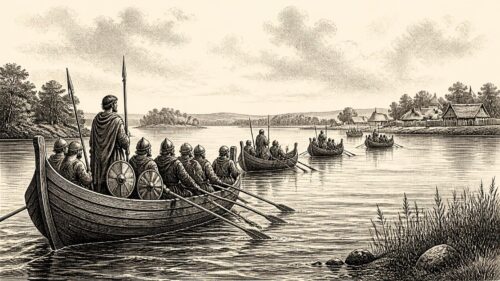
Yet Ireland was not economically isolated. Dublin, still ruled by the Hiberno-Scandinavian dynasty of Uí Ímair, was an established port, craft centre and trading town, although no surviving Irish annal assigns a specific Dublin event to 992. Archaeology demonstrates its workshops, maritime links and use of silver. Its first known local coinage belongs to about 997, not securely to this year; 992 should not be given a false “first mint” milestone. The important context is that inland cattle wealth, ecclesiastical resources and coastal trade were increasingly connected, even when the year’s annals focus chiefly on military movement.
A Blood-Red Night
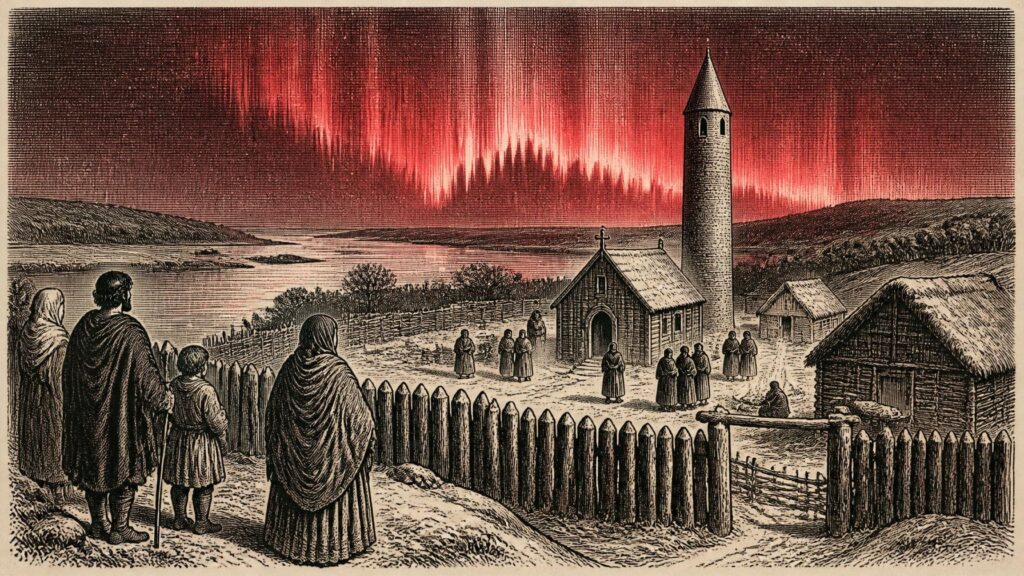
The most memorable notice comes at the year’s end. The Annals of Ulster report a “remarkable manifestation” on St Stephen’s night: the sky appeared blood-red. St Stephen’s Day fell on 26 December, making this the closest thing the Irish evidence provides to a firmly dated observation in 992. The annalist recorded appearance rather than explanation. For contemporaries, an alarming red sky could invite religious and political interpretation, especially in a culture accustomed to read unusual natural phenomena as signs requiring attention.
Modern researchers have proposed that the sighting may have been an auroral display, and have compared it with red-sky reports from elsewhere in the closing months of 992 and early 993. That is plausible rather than proven: the entry supplies no direction, duration, movement or other detail that could make identification certain. What is beyond doubt is that someone considered the spectacle extraordinary enough to enter into the historical record. Against a year of raiding, contested lordship and institutional succession, the red sky was preserved as a final, unsettling image.
Thus 992 was not a turning point announced by one great battle or royal settlement. It was a year of pressure across several regions: Connacht compelled to yield cattle, Mide confronted by a Munster–Connacht force, local rulers lost to violence or death, and leading churches changing hands. Its surviving notices show an Ireland of closely connected yet competing lordships, where pastoral wealth, river routes, monasteries and armed followings shaped political life—and where, on a winter night, the heavens themselves seemed to demand notice.
Primary Sources
- The Annals of Ulster
- CELT Project: The Annals of Ulster
- Annals of Inisfallen
- Part 55 of Annals of Inisfallen
- Chronicon Scotorum
- Part 9 of Annals of the Four Masters
- Brian Bórama (Bóruma, Boru)
- Máel-Sechnaill
- Exploring the Irish Annals
- The Chronology and Sources of the Early Irish Annals
- An Evaluation of Astronomical Observations in the Irish Annals
- Historical Auroras in the 990s: Evidence for Great Magnetic Storms
- Agriculture, Settlement and Society in Early Medieval Ireland
- The Archaeology of Livestock and Cereal Production in Early Medieval Ireland, AD 400–1100
- Kingship, Society, and Sacrality: Rank, Power, and Ideology in Early Medieval Ireland
- Clonmacnoise Monastic Site
- Irish School of Illumination
- Viking
- Early Medieval Ireland: Archaeological Excavations, 1930–2009
- Dublin City Urban Archaeological Survey
- Mints in Britain and Ireland, c. 600–1066
- Early Medieval Archaeology Project