Raiders And Rivalries1019 CE
In 1019, five years after Clontarf, Ireland remained politically fragmented despite Máel Sechnaill’s high-kingship. Donnchad mac Briain survived a sword attack that severed his right hand, while the death of Munster’s heir Mathgamain weakened Dál Cais networks. Sitriuc Silkbeard’s Dubliners raided Kells, killing inhabitants and carrying off captives and spoils. Lightning burned Kildare, and attackers violated Durrow’s stone church to seize and kill Mael Muad. Dynastic killings affected Ailech, Leinster and smaller kingdoms; northern raids, revenge killings and disease in Ára compounded insecurity. Annals portray churches as wealthy, vulnerable institutions and record interconnected sacred authority, warfare, succession and local life.
Dateline
The surviving Irish annals make 1019 a year of sharp local violence, damaged churches and uncertain succession rather than one of a single island-wide campaign. It fell only five years after the battle of Clontarf, when Brian Bóruma and many of his leading kinsmen had died, and three years before the death of Máel Sechnaill mac Domnaill, the Uí Néill king of Mide who again held the high-kingship after Brian. The evidence for the year is uneven: some events are recorded in several annalistic traditions, while others appear in only one. What can be said responsibly is that 1019 shows an Ireland in which great kings still sought overlordship, but most immediate political life was driven by regional dynasties, monastic lordships, hostage-taking, raiding and revenge.
After Clontarf
The shadow of 1014 lay over the year. Brian’s death had not produced a single settled succession, either in Munster or in Ireland as a whole. Máel Sechnaill remained the senior claimant to island-wide authority, but no annal for 1019 presents him as directing the main events. Instead, the entries reveal a fractured political landscape in which Dublin, Munster, Leinster, the northern Uí Néill and smaller midland peoples all acted with considerable independence.
The most dramatic Munster incident was the assault on Donnchad mac Briain, one of Brian’s surviving sons and a central Dál Cais figure. The Annals of Ulster say that the Uí Chaiséni made a planned attack on him and that his right hand was cut off. The Annals of Inisfallen and Chronicon Scotorum give a fuller version: a son of Catharnach son of Aed struck Donnchad on the head and hand with a sword; Donnchad survived, while the attacker was killed. The precise location is not supplied. The injury was serious enough for the annalists to single it out, and later memory treated it as a defining episode in Donnchad’s career. It did not end his political life, but it underlines how dangerous the Munster succession remained after Brian. Leadership was not secured by inheritance alone; it had to be defended in person, often violently.
Munster also lost Mathgamain son of Conaing son of Donn Cuan, described as heir-designate of Mumu. His death is recorded without a cause in several annals. The title matters. Donn Cuan had been Brian’s brother, and Conaing had fallen at Clontarf, so Mathgamain belonged to the wider royal network through which Dál Cais power was maintained. His death in 1019 narrowed the field of possible successors and allies at a time when Donnchad and other branches of the family were still negotiating the legacy of Brian’s kingship.
Dublin And Kells
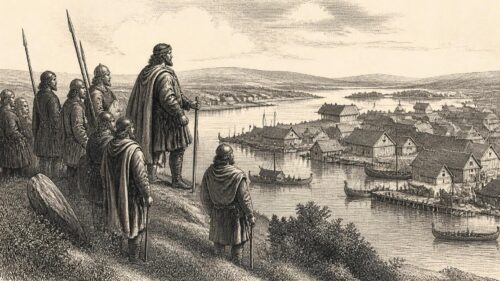
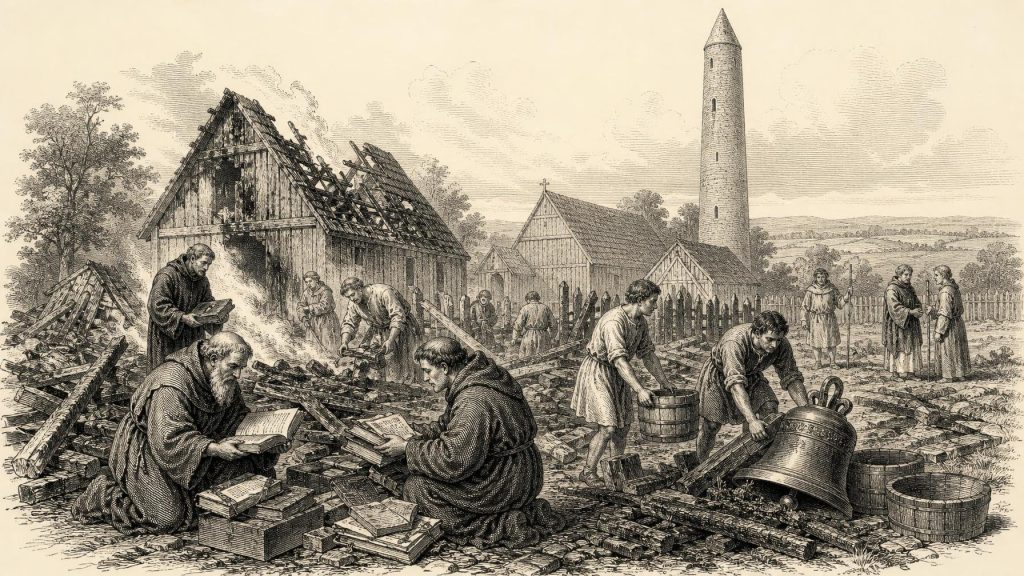
The year also brought a major raid by Sitriuc Silkbeard, king of Dublin, on Cenannas, or Kells. Chronicon Scotorum states that Sitriuc son of Amlaíb and the foreigners of Dublin plundered Kells and that people were killed there. The Annals of Tigernach and the Four Masters add that captives and spoils were carried away; the Four Masters further place killings in the middle of the church. As with many annalistic notices, the sources do not give a day or explain the campaign’s wider strategy, but the event is securely connected with 1019 in more than one tradition.
Kells was not an ordinary village. It was one of the great Columban ecclesiastical settlements, associated with Iona and with the preservation of the Book of Kells. An attack on it therefore had political, economic and religious meaning at once. Monasteries contained food stores, precious metalwork, books, livestock, dependants and captives; they were also bound into secular power. A raid on Kells by Dubliners was a blow at a rich sacred centre in the midlands and a reminder that the Hiberno-Norse kingdom of Dublin remained active after Clontarf. Sitriuc was not swept from history by Brian’s victory. He continued to rule, raid, trade and negotiate in a mixed Irish Sea world.
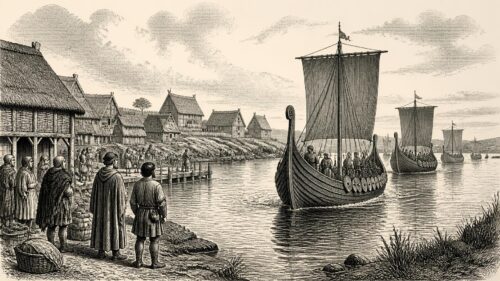
The raid also helps correct the older, simplified picture of Clontarf as the end of Viking power in Ireland. By 1019 Dublin was Christianising and deeply entangled with Irish dynasties, but it was still a maritime kingdom with ships, warriors and an appetite for inland plunder. The annals call its people “foreigners”, yet their politics were inseparable from those of Leinster, Mide and Munster.
Kildare, Durrow And Sacred Places
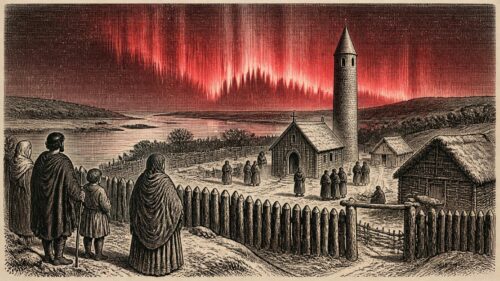
Several entries show how exposed ecclesiastical sites could be. The Annals of Ulster record that all Cell Dara, Kildare, was burned by lightning; the Four Masters say that all was burned except one house. Kildare was the church of Brigid, one of Ireland’s most prestigious female and monastic cults. A lightning fire there was not simply an accident in a built environment of timber halls, churches and workshops. To contemporaries it was a disaster at a holy place and a sign worth preserving in writing.
Durrow, the Columban monastery in modern County Offaly, appears in a more human act of violence. The Annals of Ulster state that the stone church of Dermag was broken down by Muirchertach ua Carraig during an attack on Mael Muad, king of Fir Chell; Mael Muad was dragged from it and later killed. The Annals of Loch Cé preserve the same outline. The detail that a stone church was forced open is striking. Stone churches were symbols of sanctity, permanence and protection. Yet sanctuary could be violated when political revenge or ambition demanded it. The killing of a king after removal from a church illustrates the uneasy boundary between reverence for holy ground and the realities of armed lordship.
The Four Masters also place in the corresponding corrected year the plundering of the shrine of Ciarán by Domnall son of Tadc, followed by Domnall’s death within a week, interpreted as a miracle of God and Ciarán. That moralising explanation belongs to the annalists’ religious worldview. Whether or not every detail can be checked independently, it shows how strongly attacks on relics were imagined as offences requiring divine response. Relics, bells and shrines were not passive devotional objects; they embodied a saint’s protection, a community’s honour and often its legal rights.
Northern And Leinster Succession
In the north, Flaithbertach ua Néill entered Tír Conaill and plundered Tír Énna and Tír Lugdach. Flaithbertach belonged to the Cenél nÉogain branch of the northern Uí Néill and would remain one of the major northern figures of the early eleventh century. The raid is brief in the annals, but it points to rivalry within the northern Uí Néill world, where Cenél nÉogain and Cenél Conaill interests overlapped and competed.
Another northern entry records that Ardgar and Árchú, sons of Máel Sechnaill son of Máel Ruanaid and heirs-designate of Ailech, were killed by their own people. Such notices are easy to pass over, but they expose the internal violence of dynastic politics. An “heir-designate” was not safe because he was named as eligible; in fact, eligibility could make a man a target. The killing of two such figures in one year suggests a serious disturbance within the ruling kindreds of Ailech.
Leinster likewise saw an heir removed. Gilla Caeimgein son of Dúnlang, heir-designate of Laigin, was killed by the Leinstermen themselves, with the Four Masters specifying the people of Laois. Again the annals give no narrative of motive. The silence is important: Irish annalists often recorded the outcome of elite conflict rather than its causes. The result, however, is clear enough. Leinster’s royal succession was being contested internally, even as Dublin remained a military neighbour and sometime ally or enemy.
Local Wars And Everyday Risk
Other entries bring smaller kingdoms into view. Ailéne son of Oiséne, king of Mugdorna, and Oiséne ua Cathasaig, king of Saithne, were killed by the Gailenga. Ruaidrí ua hAilelláin, king of Uí Echach, was killed by the men of Fernmag, and two sons of Ceinnétig, Congalach and Gilla Muire, were promptly killed in revenge. Cú Luachra son of Conchobar, king of Ciarraige Luachra, was, according to the Annals of Inisfallen, treacherously killed. Domnall son of Muiredach, lord of Uí Maine, and Aed ua hInnrechtaig, lord of Uí Méith, are also attached to the same annalistic horizon in later compilations.
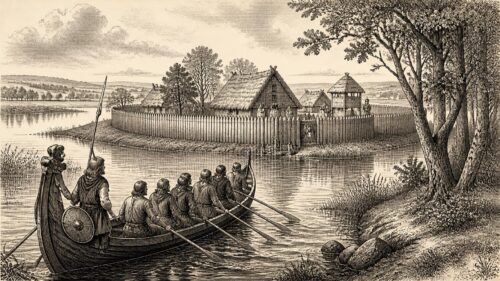
These notices reveal a society in which kingship was local as well as provincial. Ireland contained many small overkingdoms and sub-kingdoms, each with its own ruling line, clients, churches and cattle wealth. Raids were not random disorder; they were a recognised, if destructive, instrument of politics. They seized livestock, captives and pledges, punished enemies, asserted superiority and tested alliances. For ordinary people, the consequences were immediate: burned buildings, broken harvest routines, lost cows, displaced families and dependants carried away as prisoners.
The Annals of Inisfallen add a different kind of suffering: a great pestilence, described as a colic, in Ára, where many died. The entry gives no numbers and should not be expanded into a nationwide epidemic. It is nevertheless a rare glimpse of bodily vulnerability in a record dominated by kings and clerics. Disease, like fire and raiding, could devastate a district without leaving much trace beyond a terse monastic note.
A Year In The Annals
Culture and learning in 1019 are visible above all through the act of recording. The annalists noted kalends, deaths, raids, fires, killings and prodigies because monastic communities maintained chronological memory. Their terse Latin and Irish notices were shaped by local interests: Kildare, Kells, Durrow, Clonard and other churches mattered not merely as spiritual centres but as landholders, schools, treasuries and guardians of saints’ cults.
Domnall son of Máel Sechnaill, described as successor of Finnian and Mo-Cholmóc, died in 1019. The Annals of Inisfallen call him an ex-layman, martyr and coarb of Finnian. A coarb held the inheritance or office of a saintly founder, and such a person might carry authority across more than one church. His death therefore belongs to the religious history of the year as much as to dynastic politics. It reminds us that some leading ecclesiastics came from royal families and that the worlds of monastery and kingship were closely connected.
Economically, the annals do not provide market accounts or harvest figures for 1019. Yet the year’s events point to the structures of wealth. Kells was plundered for spoils and captives; cattle and portable valuables were the normal targets of warfare; churches were attacked because they concentrated resources; Dublin’s power rested partly on sea-borne trade, silver and access to Irish Sea networks. Rural Ireland remained overwhelmingly agricultural, with cattle central to status, tribute and compensation, while major monastic and Hiberno-Norse settlements formed nodes of craft, exchange and literacy.
Thus 1019 was not a pause between famous battles. It was a year in which post-Clontarf Ireland continued to be remade at many levels: a Dublin king raided a Columban monastery; lightning burned Kildare; a church at Durrow was violated in pursuit of a local king; heirs in Ailech, Leinster and Munster disappeared from the political field; Donnchad mac Briain survived a mutilating attack; and disease struck Ára. The annals leave us fragments, but together those fragments show an island where sacred authority, dynastic ambition and everyday insecurity were tightly bound.
Primary Sources
- The Annals of Ulster: Year U1019
- Chronicon Scotorum: Annal CS1019
- CELT: Annals of Inisfallen Bibliographic Details
- Annals of the Kingdom of Ireland by the Four Masters: M1018–M1019
- Annals of Loch Cé: LC1019
- CELT: Annals of Tigernach Bibliographic Details
- CELT: Annals of Ulster Bibliographic Details
- CELT: Chronicon Scotorum Bibliographic Details
- CELT: Annals of the Four Masters Bibliographic Details
- CELT: Annals of Loch Cé Bibliographic Details
- Sitriuc Silkbeard | Dictionary of Irish Biography
- Donnchad | Dictionary of Irish Biography
- Ua Néill, Flaithbertach | Dictionary of Irish Biography
- Tadc | Dictionary of Irish Biography
- Kells Monastic Site | Heritage Ireland
- Irish Historic Towns Atlas: Kells Text
- Durrow Church and High Cross | Heritage Ireland
- St Brigid’s Cathedral Before the Normans | Kildare eHistory Journal
- Irish Historic Towns Atlas: Kildare Text
- Irish Script on Screen: MS D ii 3, The Stowe Missal and Bookshrine
- 950–1450: Vikings, Normans and Medieval Mints | National Museum of Ireland
- ‘Emperor of the Irish’: Brian Boru and the Battle of Clontarf 1014 | Trinity College Dublin Library
- Clontarf in the Wider World | History Ireland
- Three Kings and a Queen | The Irish Times
- The Economy of Early Medieval Ireland | UCD Research Repository
- The Economy of Early Medieval Ireland | EMAP Report PDF
- Agriculture, Settlement and Society in Early Medieval Ireland | Quaternary International
- Reassessing the Irish ‘Monastic Town’ | Irish Historical Studies