Athlone’s Fatal Escort1374 CE
In 1374, Ireland was shaped by contested local lordships rather than unified conflict. Cú Choicriche Óg Mac Eochagáin, chief of Cenél Fiachach, was murdered near Athlone while accompanying the Bishop of Meath; his killer was brutally executed. William de Windsor returned as royal lieutenant, but crown authority remained limited. Connacht saw Theobald Burke, Mac William’s heir, killed by Uí Maine, while Annaly warfare claimed Máel Sechnaill Ó Fearghail. Feuds followed disputed killings. Annals also record Niall Ó Néill’s victory over Ulster settlers, though its date is uncertain. Deaths including historian Máel Sechnaill Ruad Ó Duibhgeannáin underline violence and fragmented authority.

Dateline
In 1374, Ireland’s political geography was defined less by a single national struggle than by a series of dangerous local frontiers. The English crown claimed lordship over the island, but its officials depended on towns, castles, landed settlers and negotiated alliances. Beyond – and often within – those areas, Gaelic and Hiberno-Norman lordships defended their own interests through kinship, armed followings, hostage-taking, raiding and settlement. The year’s annals preserve this world in unusually sharp fragments: an assassination beside Athlone, the killing of an heir in Connacht, a disputed victory over settlers in Ulster, and feuds whose origins were sometimes as uncertain to contemporaries as they are to historians.
A Killing on the Road to Athlone
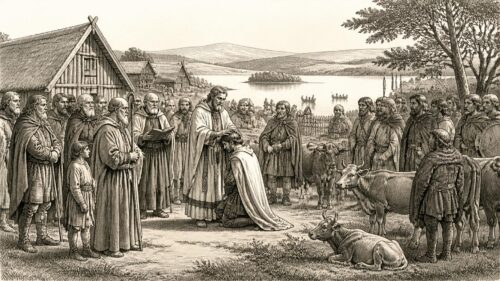
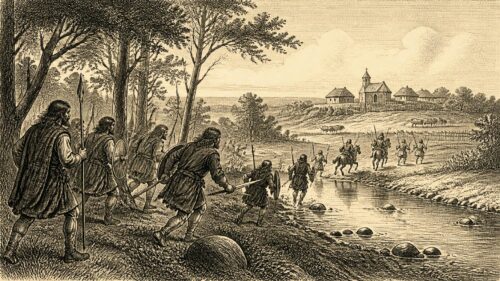
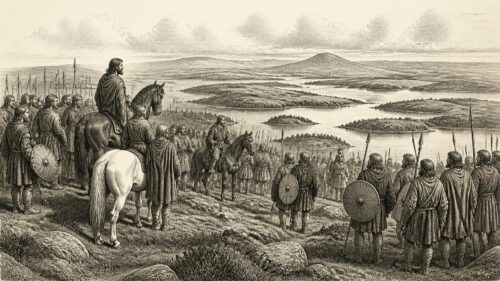
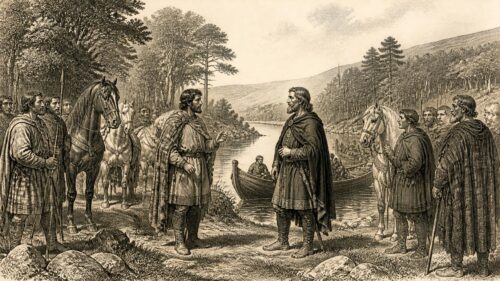
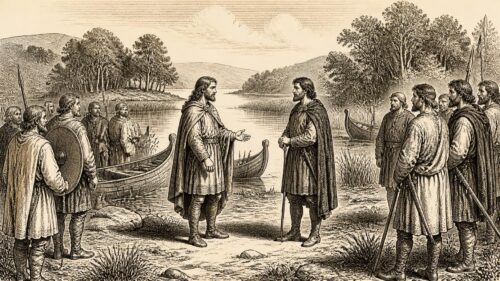
The most precisely dated Irish event assigned to 1374 occurred on 27 August. Cú Choicriche Óg Mac Eochagáin, chief of Cenél Fiachach, was killed treacherously while travelling in the company of the Bishop of Meath, identified in the annalistic tradition as Bishop de Valle. The party was connected with Athlone, the strategically important crossing and castle town on the Shannon. The killer was Sinnach Mac Meráin, described as one of the people of William Dalton. The Annals of Connacht date the attack specifically to the sixth day before the Kalends of September – 27 August – while the Annals of Loch Cé and the Four Masters preserve essentially the same account.
This was not merely an isolated roadside killing. Cenél Fiachach, associated with the Mac Eochagáin family, occupied a lordship in the central Midlands, in territory now divided between parts of Westmeath and Offaly. Its position made it vulnerable to pressure from the English lordship of Meath and from neighbouring Irish powers. Athlone itself was a place where routes, jurisdictions and military interests met. A chief travelling with the bishop suggests business requiring recognised protection or mediation, although the sources do not tell us its purpose. It would be unsafe to turn that journey into a peace conference, court hearing or formal negotiation without evidence.
The aftermath was brutal. Sinnach Mac Meráin was himself seized, drawn and cut into pieces, according to the annals. The wording records an exemplary punishment, but does not give the legal process behind it; it should not be assumed that a modern-style trial preceded it. What can be said is that the murder of a chief in a bishop’s company demanded an emphatic response. The episode also followed a violent 1373 in the same region, when the men of Cenél Fiachach and Ó Melaghlin had killed William Dalton and the sheriff of Meath. The chronicles do not expressly call the August 1374 murder retaliation, so that connection remains possible rather than proven. Yet the sequence shows why roads through the Midlands could become theatres of political violence.
Windsor’s Return and Limited Reach
The central government was not absent from Ireland in 1374. Sir William de Windsor, Edward III’s experienced but deeply unpopular lieutenant, returned to Ireland on 18 April. His administration sought money, military service and obedience from the English colony, whose resources had been badly strained by war and falling revenues. Windsor represented the crown’s attempt to revive authority after earlier complaints about his government. But the events recorded elsewhere in Ireland demonstrate the practical limits of that authority. A royal lieutenant in Dublin or Kilkenny could issue orders, hold councils and work through sheriffs, yet could not make a journey through Cenél Fiachach safe, prevent fighting in Annaly, or dictate outcomes in Connacht and Ulster.
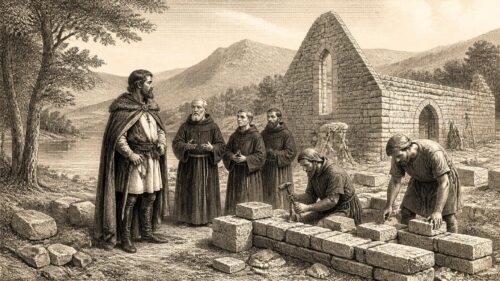
Churchmen and religious institutions formed part of this political machinery. William Tany, prior of the Hospitallers at Kilmainham, was chancellor of Ireland during 1374, custodian of an office central to royal documents and the great seal. He was not, however, newly appointed that year: reliable administrative evidence places his appointment in early September 1372, and he remained chancellor until June 1377. This correction matters because later lists have sometimes placed his appointment in 1374. The bishop accompanying Mac Eochagáin and the Hospitaller chancellor both illustrate how ecclesiastical office overlapped with government, landholding and high politics. Clergy could offer mediation and literacy, but they were not detached from the risks of lordship.
Connacht’s Contested Lordships
In Connacht, the annals record the killing of Theobald Burke, heir of Mac William, by the Uí Maine. “Mac William” denoted the leading Burke lordship of Lower Connacht, a power that had emerged from the fragmentation of the great de Burgh inheritance after the early fourteenth-century collapse of the earldom of Ulster. Theobald’s death did not end Burke influence, but it exposed how insecure succession could be in a landscape shared by powerful Gaelic dynasties, Gaelicised descendants of settlers, church lands and smaller local lineages.
The Uí Maine were a major east-Connacht people whose lordship extended across parts of modern Galway and Roscommon. Their ability to kill the Mac William heir is important precisely because the annals offer no tale of a crown intervention or a decisive settlement. Local strength, rather than a fixed hierarchy, governed the outcome. The death of Tadhg, grandson of Cathal Ruad Ó Conchobair and described as a worthy candidate for the title of Ó Conchobair, adds a further reminder that Connacht’s royal politics remained divided among rival branches and claimants. In this setting, genealogy was not antiquarian decoration: it established who could credibly seek lordship, land, clients and tribute.
Annaly’s Fight and a Feud of Uncertain Cause
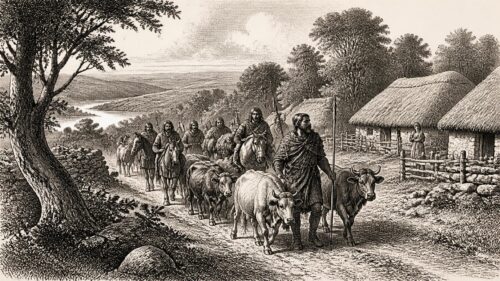
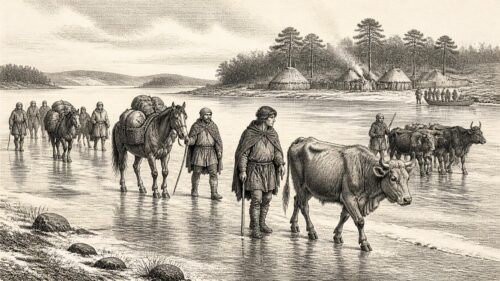
The Four Masters alone preserve fuller detail on the death of Máel Sechnaill Ó Fearghail. He left Annaly, the Ó Fearghail lordship in what is now much of County Longford, to wage war in Muintir Maelmóra against the English. A severe encounter followed, in which Ó Fearghail and many others were killed. The Annals of Connacht record his death but not the campaign’s narrative. Even allowing for the partial nature of the evidence, the entry conveys a familiar reality of the borderlands: war was usually undertaken by lordly households and regional allies, not by national armies. It placed a direct burden upon tenants, herders and cultivators whose cattle, stores, movement and labour supported such expeditions.
Another death generated conflict rather than closing it. Tadhg Óg Mac Ragnaill was struck by a javelin and died of the wound. Crucially, the Four Masters say that nobody knew for certain who had thrown it. Muintir Birn blamed Clann Muirchertaigh; Clann Muirchertaigh blamed Muintir Birn. In the resulting uncertainty, war broke out between Muintir Eolais and Muintir Birn. This is one of the year’s most revealing passages. The annalist did not invent certainty where none existed. Instead, the account shows how suspicion, competing versions of an encounter and obligations of kinship could turn one death into a broader feud.
Niall Ó Néill’s Victory – and a Date Problem
Two Connacht-centred annals and the Four Masters place a major victory by Niall Ó Néill over the Gallaibh, or “Foreigners”, under 1374. Named among the dead were a knight called Roche, Bocsa of Carrickfergus, Sandal, a Burke, and William of Baile Dalad, whom the annals condemn as a leading figure of inhospitality. Modern scholarship connects the engagement with Niall Mór Ó Néill’s expanding power in Tír Eógain and with the settler community around Carrickfergus. His career belongs to the larger transformation of Ulster after the de Burgh earldom’s decline: Gaelic rulers could press eastwards against colonial districts that had once seemed secure.
But the calendar year must be handled carefully. The Annals of Ulster enter what appears to be the same victory under 1369, whereas the Annals of Connacht, Loch Cé and the Four Masters place it in 1374. The discrepancy may reflect differing annalistic chronologies or the copying history of the texts. Therefore, it cannot be asserted without qualification that the battle occurred in 1374. It is responsible, however, to say that several important annalistic traditions remembered it under 1374, and that it was associated with Niall Ó Néill’s advance against the English of Ulster. The disagreement is not a minor technicality: it is evidence of the care required when converting medieval annals into modern calendar history.
Loss, Learning and Historical Memory
Other notices give the year its human scale. Senicin Savage was killed by Mag Aengusa; Domnall Óg Ó Dochartaigh died; Tigernán Mac Tighearnáin died; and Cormac Ó Fearghail and Fearghal Ó Ruairc were slain. The chroniclers also record that Máel Sechnaill Ruad Ó Duibhgeannáin, described as a learned historian, and Mathghamhain an Chinn Ó Ruairc fell at one another’s hands. The death of a historian is especially suggestive. Learned families such as the Ó Duibhgeannáins sustained genealogical, legal and historical knowledge on which lordship depended. Their work helped preserve claims, precedents and reputations – including the terse, often partisan notices through which 1374 is now known.
Thus the year should not be imagined as one coherent campaign or a simple contest between “Irish” and “English”. It was a year in which overlapping communities confronted each other at particular roads, crossings and lordship boundaries. Royal officials returned to shore up the lordship; bishops travelled through contested country; regional rulers pursued armed advantage; and chroniclers noted not only victories but uncertainty, treachery and the deaths of those who maintained political memory. The fatal escort near Athlone offers the clearest image of 1374: authority was present, but it was never guaranteed to be secure.
Primary Sources
- Annála Connacht
- Annála Connacht: Irish text
- Annals of the Four Masters, Volume 4: English translation
- Annals of the Four Masters: Irish text, Annal M1374
- Annals of Loch Cé, Part 2: English translation
- Annals of Loch Cé: Irish text
- Annals of Ulster, Part 19: Irish text
- Annals of Ulster otherwise Annala Senait, Annals of Senat
- O’Neill (Ó Néill), Niall Mór
- Tany, William
- Windsor, William
- The Rise and Fall of the Clann Éinrí Aimhreidh Uí Néill: Dynastic Feuding and Geopolitics in the Late Medieval Irish Sea World
- The Archbishops of Armagh and the O’Neills 1347–1471
- Richard II and the Wider Gaelic World: A Reassessment
- Patentee Officers in Ireland, 1173–1826
- The Mediaeval Irish Chancery
- Order, 14 October 1374, Westminster
- Covenant between Mageoghegan and the Fox
- Assembly Places and Elite Collective
- Understanding the Place: Rahan Conservation Plan
- Codices Hibernenses Eximii III: Book of Uí Mhaine
- Dublin City Charter No. 35: 24 January 1374 [13 Henry III]
- William of Windsor and the Administration of Ireland, 1369–76