Membership is completely free, giving members unlimited access to all available resources, services, features, and benefits without any restrictions or fees.
Welcome back. Sign in to continue enjoying unlimited access to all available resources, services, features, and member benefits at no cost.
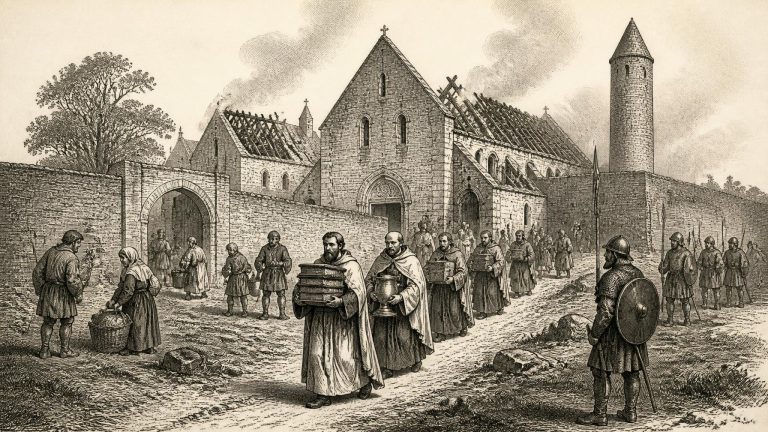
The most immediately striking event was the burning of the house of the Canons Regular of Saints Peter and Paul at Armagh, together with its churches and a substantial part of the surrounding enclosed precinct, or rath. The Annals of Ulster date this firmly to 1196, but do not name those responsible or explain how the fire began. It would therefore be unsafe to attach it to a particular raid or faction. Nonetheless, the destruction was grave. Armagh was both a major religious settlement associated with St Patrick and an important political place in the north. Its churches, clerical community, books, movable treasures, food stores and dependent households would all have been exposed to loss or disruption.
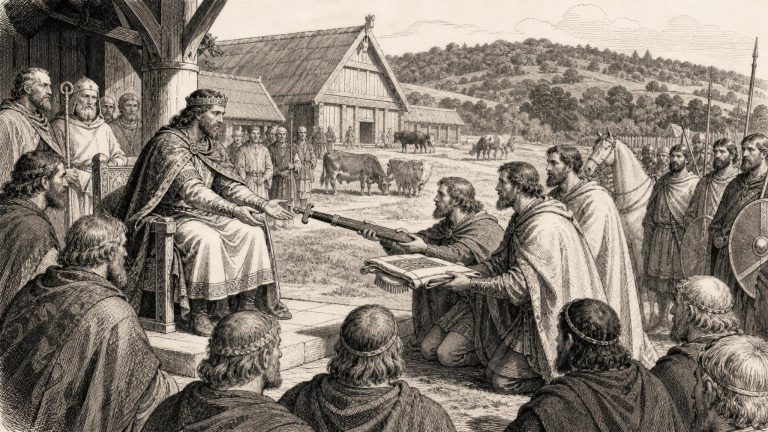
Diarmait had risen from the Uí Cheinnselaig of south-east Leinster to dominate Leinster, Dublin and much of southern Ireland. Control of Dublin gave him access to ships, warriors, craftsmen, commerce and connections across the Irish Sea. His position was nevertheless less secure than its grand titles suggest. Irish overkingship depended upon personal authority, alliances, tribute and the delivery of hostages; it was not a permanent office supported by a central administration. A king who lost relatives, military strength or the obedience of subordinate rulers could see his influence contract rapidly.
Ireland had no single government in 1068. Provincial and regional kings exercised power through dynastic alliances, hostages, tribute, military followings and relationships with important churches. The title of high king remained a claim to supremacy rather than an office supported by permanent national administration. Two rulers stood above most competitors: Diarmait mac Maíl na mBó, king of Leinster and overlord of Dublin, and his former protégé Tairdelbach Ua Briain, king of Munster. Their cooperation had helped Tairdelbach overthrow his uncle Donnchad mac Briain in 1063, but the balance between them was changing.
The Ireland of 1030 is visible mainly through terse monastic annals: notices of deaths, killings, pilgrimages, church offices, portents and local conflicts. These entries do not make a modern narrative, and their dates are sometimes shifted by a year between related chronicles. Even so, 1030 can be described responsibly as a year of unsettled regional kingship, striking religious mobility and notable losses among Ireland’s learned and ecclesiastical elite.
The year opened with close calendrical attention. The Annals of Ulster place the Kalends of January on the third feria and note two eclipses in the same lunar month: a lunar eclipse on 10 January and a solar eclipse on 24 January. Chronicon Scotorum compresses the matter into a vivid report of an eclipse of the sun at midday and an eclipse of the moon in the same month, while the Annals of Inisfallen remember the solar event as “the spring of the black cloud”. Such notices should not be treated as omens automatically believed by everyone in Ireland, but they do show the observational and chronological habits of monastic record-keepers. Eclipses helped annalists anchor time, and their inclusion reminds us that Irish monasteries were intellectual communities as well as religious and economic institutions.
The Irish year 1022 is dominated by the death of Máel Sechnaill mac Domnaill, king of Mide and the leading claimant to the kingship of Ireland after the fall of Brian Bóruma at Clontarf. The annals give several other killings, church deaths and military actions, but his passing on 2 September at Cró Inis on Lough Ennell gave the year its largest political meaning. It closed the career of the most important southern Uí Néill ruler of his generation and exposed how fragile island-wide authority remained in early eleventh-century Ireland.
The shadow of 1014 lay over the year. Brian’s death had not produced a single settled succession, either in Munster or in Ireland as a whole. Máel Sechnaill remained the senior claimant to island-wide authority, but no annal for 1019 presents him as directing the main events. Instead, the entries reveal a fractured political landscape in which Dublin, Munster, Leinster, the northern Uí Néill and smaller midland peoples all acted with considerable independence.
The political background to the year was the partial restoration of Máel Sechnaill. Brian Bórama’s rise had interrupted the older Uí Néill claim to overarching authority, and Brian’s death at Clontarf did not create a united kingdom. Instead, it reopened competition. Máel Sechnaill’s own power rested most firmly in Mide, but the annals still treat his campaigns and officers as matters of national importance. The killing in 1018 of Cais Mide, described in the Annals of Ulster as Máel Sechnaill’s steward, is therefore more than a local casualty. It shows the practical machinery of kingship: rulers depended on lawmen, stewards, raiding parties and client kings, not merely on titles.
The main political fact of 1016 was the continuing reassertion of Máel Sechnaill’s authority. Chronicon Scotorum places in this year an expedition by Máel Sechnaill into Ulaid, where he took hostages. In eleventh-century Irish politics hostages were not symbolic ornaments; they were living guarantees of submission, alliance or good behaviour. Such an expedition suggests that the king of Mide was not merely claiming an old title after Brian’s death, but actively repairing a network of obedience across the northern half of Ireland.
The clearest political development of the year was Máel Sechnaill’s renewed authority in the midlands and east. Before Brian’s rise, Máel Sechnaill had been the leading Uí Néill king of Tara and Mide; after Brian’s death he again became the most plausible claimant to island-wide leadership. In 1015, according to the Annals of Ulster, Flaithbertach Ua Néill of Cenél nÉogain went into Mide to assist him. That detail is important. It shows that Máel Sechnaill was not acting alone but could still draw support from the northern Uí Néill, whose cooperation had often been decisive in struggles for wider power.
Ireland in 1014 was not a unified state in the later sense. Kingship worked through layered authority: local rulers owed service to provincial overkings, and the high-king or overking of Ireland relied on hostages, tribute, marriage alliances and military pressure rather than permanent administration. Brian Bórama, better known as Brian Boru, had risen from the Dál Cais power base in Thomond and Munster to displace Máel Sechnaill mac Domnaill, king of Mide and Tara, as the dominant ruler in Ireland. His authority was real, but it depended on continuing submission by other kings.
The year 1013 in Ireland is best understood as a year of war without a final settlement. The great battle beside Dublin still lay in the following spring, but the political and military pattern that made it possible was already visible. The annals do not give a continuous narrative. They record raids, deaths, hostages, burned churches, cattle-taking, fort-building and the movements of kings. Read together, and cautiously, they show Brian Bórama’s high-kingship under severe strain, the kingdom of Dublin and Leinster acting together, Máel Sechnaill of Mide still a major power, and provincial politics far beyond Dublin becoming unstable.
The Annals of Ulster place the Kalends of January for 1009 on a Saturday, with the first day of the moon. The Annals of Inisfallen give the same weekday and lunar detail. Such entries remind us that the annalists were not writing modern narrative history: they arranged events under annual headings, often without exact dates, and different chronicles sometimes place related material under adjacent years. The Annals of the Four Masters, compiled much later from earlier materials, place several events corresponding to 1009 under their 1008 heading, while their 1009 entry is marked by the editors as “recte 1010”. For a responsible account of 1009, the safest course is to focus on events assigned to the year by the earlier annalistic tradition, especially the Annals of Ulster, while noting corroboration or variation where other annals preserve it.
The most unstable region in the record for 1007 is Ulaid, roughly north-eastern Ireland. The annals name a grim succession of deaths. Máel Ruanaid son of Ardgar, styled king of Ulaid in Chronicon Scotorum and killed by Matudán son of Domnall, appears first. Matudán himself was then killed by a figure called “the Torc” in the middle of Dún dá Lethglas, modern Downpatrick, in Brigit’s church. The annalists stress the sacred setting and, in one version, say that this happened despite the protection of the saints of Ireland. Later notices add that the Torc, also called king of Ulaid, was killed by Muiredach son of Matudán in revenge for his father, and that Domnall son of Dub Tuinne, another king of Ulaid, was killed by Muiredach son of Matudán and Uargaeth of Sliab Fuait.
The firmest and most dramatic event of the year is the battle of Cráeb Tulcha. The Annals of Ulster date it precisely to Thursday, 14 September, and describe it as a battle between the Ulaid and Cenél nEógain. The Ulaid were defeated, and their losses were severe. Eochaid son of Ardgar, king of Ulaid, fell with members of his close kindred, including Dub Tuinne and two sons of Eochaid. The annal also names other leaders among the dead and says that the fighting and rout extended as far as Dún Echdach and Druim Bó.
The most important political fact was Brian’s relationship with Máel Sechnaill. The former high-king did not disappear from public life; he remained king of Mide and was still a necessary partner in campaigns beyond Munster. The Annals of the Four Masters place in this year a joint expedition by Brian and Máel Sechnaill into north Connacht, as far as Tráig Eothail, with an apparent intention of making a circuit of Ireland. The same notice says that the Northern Uí Néill prevented their advance. Whether every detail belongs to the calendar year exactly as later compiled, the notice captures the unfinished nature of Brian’s overlordship. Connacht, Mide, Leinster and Dublin could be compelled or negotiated into submission, but Ailech and the northern dynasties were not yet simply at Brian’s command.