Muine Brócáin’s Counterstroke950 CE
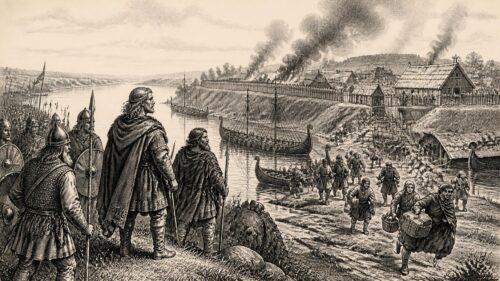
In 950, Ruaidrí ua Canannáin of Cenél Conaill pursued a serious claim to Tara, maintaining pressure on Mide and Brega for six months. His campaign ended at Muine Brócáin, where Dublin’s foreigners killed him and his kinsman Niall, preserving Congalach Cnogba’s position. Annalistic dates and battle figures vary, but the principal events are secure. Dublin’s forces also burned Sláine’s bell-house, killing clergy and destroying sacred objects. Elsewhere, Donnchad of Mide and Matudán of Ulaid died in kin-based conflicts. The year exposed fragmented kingship, politically engaged churches, Dublin’s inland influence, rural warfare, and seasonal environmental conditions, including an exceptional mast crop.
Dateline
The year 950 was decisive not because it produced a settled ruler of Ireland, but because it destroyed the most formidable challenger to one. Ruaidrí ua Canannáin of Cenél Conaill, a northern Uí Néill dynast, had spent months pressing into the midlands and Brega. By the year’s end he was dead at Muine Brócáin, together with his kinsman Niall, after a counterstroke by the foreigners of Dublin. The immediate winner was Congalach Cnogba, ruler of Brega and claimant to the kingship of Tara. Yet the annals show a country in which victory remained provisional: kings were killed by relatives, churches were burned, and regional alliances could join Gaelic rulers and Dublin’s Scandinavian-descended leadership against a common rival.
A Year of Competing Chronologies
The date needs a brief caution. Medieval Irish annals were compiled and recopied through several chronological systems. The Annals of Ulster place these events under U950, while noting “AD 949 alias 950”; modern reference works conventionally identify Ruaidrí’s death with 950. The Annals of the Four Masters, compiled much later, place their fuller account of the campaign under an earlier annal heading. Such variation is a warning against treating every detail as an exact contemporary record. Nevertheless, the convergence of the major annalistic traditions makes Ruaidrí’s death, the killing of Matudán of Ulaid, the murder of Donnchad of Mide, and the attack on Sláine securely connected with this year.
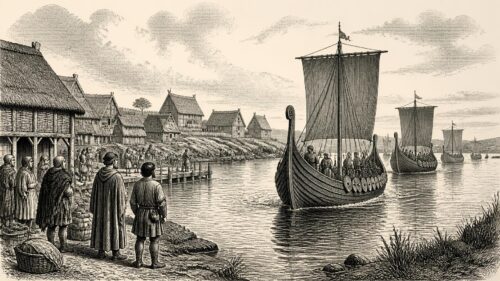
There is a further distinction to keep in view. The annals’ label Gall, usually rendered “foreigners”, was a political and cultural description, not a simple ethnic census. Dublin was a major maritime settlement whose rulers and forces participated deeply in Irish politics. Its interests could align with one Irish king one year and with his enemy the next. In 950, its military intervention was central to the struggle over the midlands.
Ruaidrí’s Bid for Tara
Ruaidrí belonged to Cenél Conaill, a branch of the Northern Uí Néill rooted in the north-west. He had emerged during a period when the old balance between the great Uí Néill kindreds was unstable. Congalach Cnogba, of Síl nÁedo Sláine in Brega, had claimed the prestigious overkingship centred on Tara after the deaths of stronger predecessors in the 940s. Ruaidrí was no minor raider: the Annals of Ulster call him rígdamna Érenn, “royal heir of Ireland”, a phrase indicating eligibility for the highest kingship rather than uncontested possession of it. The Annals of Inisfallen instead calls him high-king of Cenél Conaill. The differing titles capture the issue precisely: he was a king with a serious all-Ireland claim, not an accepted sovereign of a unified kingdom.
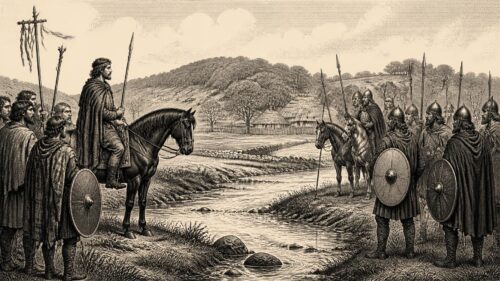
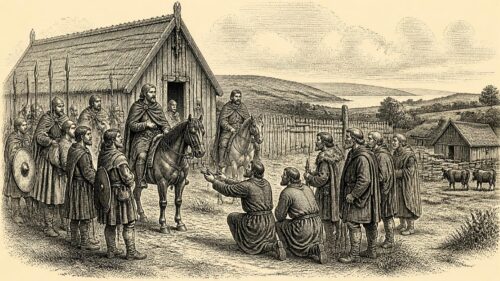
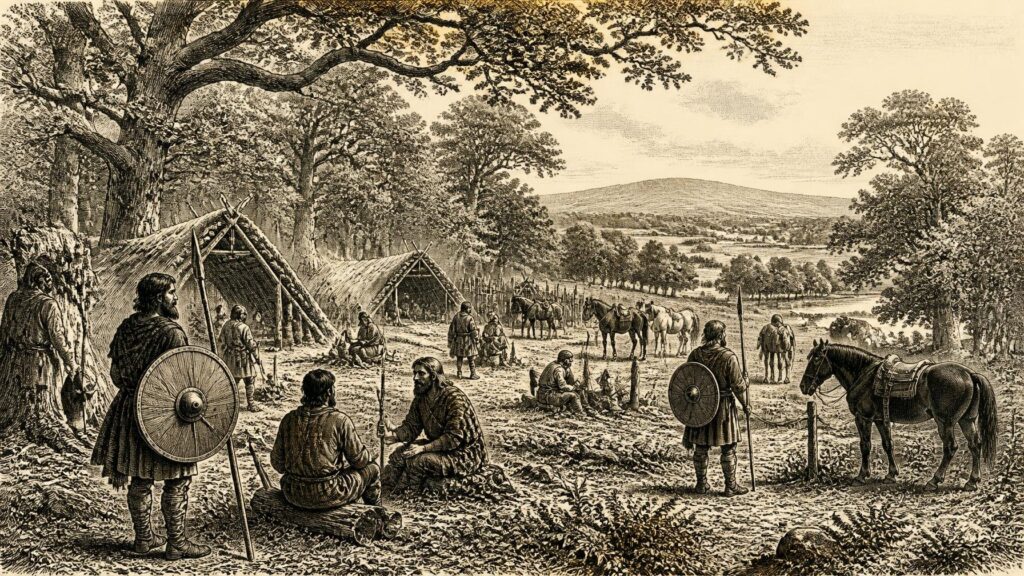
His campaign was directed at Mide and Brega, the lands around the Boyne and the central plain where control of Tara carried exceptional political weight. The Annals of Ulster says he had “beleaguered” Mide and Brega for six months and had inflicted a great slaughter on the foreigners before he himself fell. A six-month encampment was not a siege of a single walled city in the later medieval sense. It was a sustained armed presence: a force living off, threatening and extracting submission from a contested region, while seeking to break the resources and loyalty of its ruler. Later tradition says that royal dues were sent to Ruaidrí from many directions; that is revealing as a claim about authority, but it should not be read as proof that the whole island had submitted to him.
The campaign’s geography also mattered. Brega was Congalach’s home territory, and Mide lay between Ruaidrí’s northern power base and Tara. A northern army could not simply declare a high kingship; it had to move south, compel allies, secure routes, obtain food and fodder, and remain intact through changing seasons. Ruaidrí’s prolonged pressure therefore showed both ambition and logistical capacity. But it also made his force vulnerable to a relief attack from Dublin, reached by river and sea routes and able to draw upon an urban, maritime base.
The Battle at Muine Brócáin
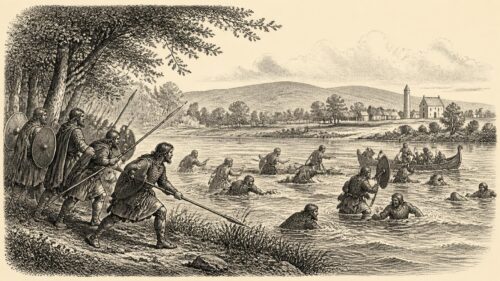
At Muine Brócáin, a place generally located in the Meath–Brega sphere but not securely identified on the ground, Ruaidrí’s campaign ended. The concise Ulster account records that he and Niall ua Canannáin were killed by the foreigners in a counterattack. Chronicon Scotorum adds that Gofraid fled and names Congalach son of Máel Mithig as victor. These reports make the political outcome clear: Congalach survived a challenge that had brought him under severe pressure, and the Dublin force acted to his advantage.
The sources differ over the scale and sequence of fighting. Ulster gives a figure of more than 2,000 foreigners killed before Ruaidrí’s death; the later Four Masters gives a far larger total and adds that the battle occurred on St Andrew’s feast, 30 November. The precise numbers cannot be verified and are best understood as annalistic measures of devastating loss, not a modern battlefield count. Nor can the feast-day date be treated as equally firm, since it comes from a later and chronologically displaced account. What can responsibly be said is that a hard-fought engagement late in 950 ended with Ruaidrí killed and Congalach’s position rescued.
The consequences were substantial. Ruaidrí’s death removed the Cenél Conaill bid for Tara from immediate contention. It did not create peace or a stable Irish monarchy; Congalach himself would be killed only a few years later. But it showed that Dublin could decisively shape inland politics, and that an aspiring overking could be undone even after months of apparent success. The episode also undercuts a simple story of an Irish–Viking war. Ruaidrí’s conflict was principally a contest among Irish dynasties for supremacy, in which Dublin’s rulers and warriors were powerful allies and adversaries.
Sláine and the Cost to the Church
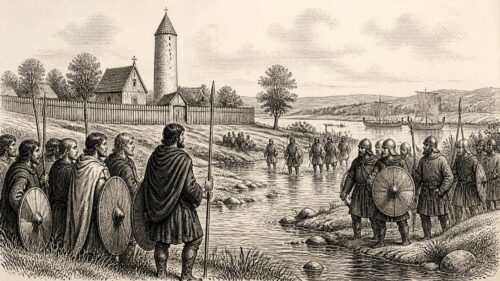
Conflict reached a religious community at Sláine, beside the Boyne in Brega. The Annals of Ulster reports that the bell-house of Sláine was burned by the foreigners of Áth Cliath, Dublin. The destruction was grievous: the founder’s episcopal staff, a celebrated bell, the lector Caenachair and many others perished. Chronicon Scotorum likewise remembers the bell-tower, people within it and Caenachair the lector.
This was more than damage to a building. Bells regulated worship and marked a community’s identity; croziers embodied the authority and memory of a saintly founder; a lector was a learned ecclesiastical office-holder, responsible for public reading and teaching. Their loss struck worship, learning, prestige and material wealth together. The report does not allow us to reconstruct the circumstances—whether people sought refuge in the tower, or whether its burning occurred in a wider assault—but it records a human catastrophe as well as the destruction of treasures.
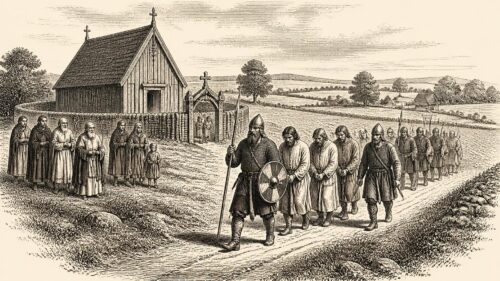
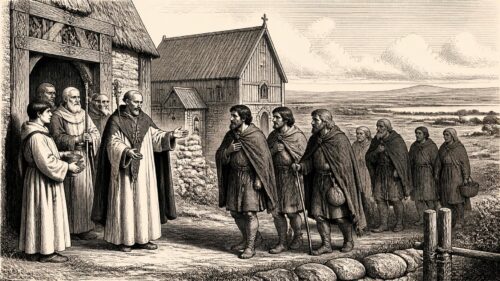
Monasteries and churches were not detached from politics. They held land, livestock, food stores, skilled personnel and portable objects of high value. They also preserved dynastic memory and could support particular royal claims. The Columban community, associated with foundations such as Kells and Derry, appears to have favoured Ruaidrí’s cause, while Congalach cultivated other ecclesiastical connections. That wider context helps explain why religious institutions mattered in political competition, but it does not justify assigning every attack a single ideological motive. Raiding could pursue provisions, captives, valuables, strategic intimidation or revenge at once.
Fractured Kingships
Other notices from 950 reveal insecurity beyond the main contest. Donnchad son of Domnall, king of Mide, was killed by his own kinsmen; Chronicon Scotorum identifies the killer as Fergal Got son of Óengus. This was a lethal succession dispute within Clann Cholmáin, the dynasty that had long dominated Mide. Its fragmentation made the central region still more vulnerable to the ambitions of Congalach, Ruaidrí and Dublin.
In Ulaid, Matudán son of Áed was killed by the Uí Echach, specifically the sons of Bran, according to Ulster. Inisfallen simply records the death of Matudán, king of Ulaid. The contrast is useful: one annal preserves the local political agency behind the killing, while another reduces the event to a royal death. Together they show that no island-wide contest should eclipse the violence of provincial and kindred rivalries. The annalist’s assertion that God quickly avenged Matudán belongs to the moral language of the record, not to evidence from which the subsequent deaths can be reconstructed.
The same annal notes the deaths of Scothíne, superior of Dairmag (Durrow), Máel Finnáin, bishop of Cell Dara (Kildare), and Cleirchéne, superior of Daire Calgaig (Derry). Such notices demonstrate the connected ecclesiastical landscape through which learning, property and political influence moved. They should not be mistaken for proof of a single centrally governed Irish church. Authority was dispersed among major churches, their hereditary office-holders, local communities and the rulers who protected or preyed upon them.
Town, Countryside and Woodland Plenty
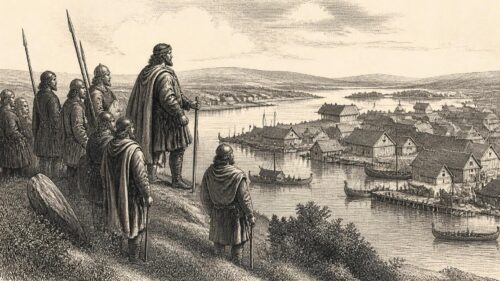
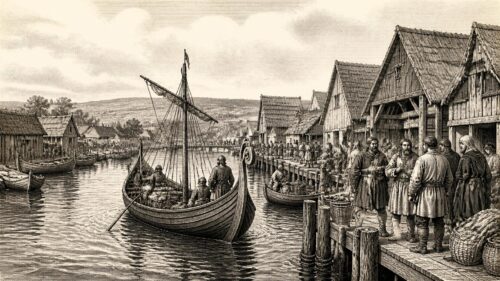
Behind the year’s warfare lay economies that made campaigning possible. Archaeology shows tenth-century Dublin as far more than a raiders’ base. Houses, workshops, property boundaries and walkways, together with tools for metalwork, textile manufacture, leatherworking, woodworking and trade, point to a dense settlement dependent on craft, shipping and a productive hinterland. Silver circulated in several forms; imported English, Carolingian and Islamic coins were present in Ireland during the century, although Dublin did not begin striking its own silver pennies until around 997 or 998. In 950, therefore, silver by weight, ingots, ornaments and foreign coin mattered more than a native coinage.
Most people, however, lived in rural communities where cattle, grain, dairying and woodland resources sustained households and armies. The Ulster annalist’s seemingly modest final observation—an “abnormally great mast-crop”—belongs in this setting. Mast meant the nuts of woodland trees, especially acorns and beechnuts, and an exceptional crop could provide valuable autumn forage, notably for pigs. It is not evidence for a universally prosperous year: armed movement, plunder and the burning of Sláine could devastate particular districts regardless of natural plenty. But it is a rare glimpse of the seasonal environmental conditions that shaped everyday subsistence.
Thus 950 combined high politics with local vulnerability. At Muine Brócáin, an overking’s ambition was checked by an alliance of rivals and Dublin forces. At Sláine, a religious community paid a terrible price. In Mide and Ulaid, kin killed kings. And in the woods, an abundant mast crop offered a quieter reminder that the rhythms of animals, food and landscape continued beneath the annals’ stories of war.
Primary Sources
- The Annals of Ulster, Year U950
- The Annals of Ulster, Year U947
- The Annals of Ulster
- Chronicon Scotorum, Annal CS950
- Chronicon Scotorum
- Annals of Inisfallen, Annal AI950
- Annals of Inisfallen
- Annals of the Four Masters, Annals M943–M952
- Annals of the Four Masters, Irish text
- Annals of the Four Masters
- Annales Breves Hiberniae
- Ua Canannáin, Ruaidrí | Dictionary of Irish Biography
- Congalach Cnogba | Dictionary of Irish Biography
- Donnchad Donn | Dictionary of Irish Biography
- Viking | National Museum of Ireland
- Early Medieval | National Museum of Ireland
- 950-1450: Vikings, Normans and Medieval Mints | National Museum of Ireland
- The Viking Age of Ireland: Guide to National Museum of Ireland Collections
- Vikings in Ireland and Scotland
- The Vikings in Ninth-Century Ireland: Sources and Settlements
- Landscapes of Kingship in Early Medieval Ireland, AD 400–1150
- Irish Kingship and Society: Nation, Kingship and the Early Irish Annals
- Mobility in the Early Middle Ages, and Beyond
- County Meath Urban Archaeological Survey: Slane