
Alliances and Fractures1180 CE
In 1180 Ireland remained politically fragmented, as Ruaidrí Ua Conchobair’s weakened high-kingship, Henry II’s overlordship and expanding Anglo-Norman lordships overlapped with resilient Gaelic dynasties. Hugh de Lacy’s marriage to Ruaidrí’s daughter demonstrated frontier diplomacy, despite royal suspicion. Connacht’s Battle of the Conors strengthened Ruaidrí’s family but devastated Uí Maine leadership, while local killings reflected persistent instability. Ecclesiastical politics shaped events at Derry and Armagh, where Tommaltach Ua Conchobair’s appointment required negotiation. Archbishop Lorcán Ua Tuathail died in Normandy during diplomacy with Henry. Castles at Carrickfergus and Meath advanced settlement, although Gaelic communities, pastoral economies and established ports retained substantial influence.
Dateline
Ireland entered 1180 divided among overlapping claims rather than neatly separated realms. Ruaidrí Ua Conchobair still asserted the high-kingship from Connacht, while Henry II claimed overlordship and exercised direct authority through Anglo-Norman lords in parts of Leinster, Meath and the southern ports. John de Courcy held Downpatrick and an expanding lordship in eastern Ulaid. Elsewhere, Gaelic kings and local dynasties retained power, fought their neighbours and negotiated with newcomers. The year is unusually revealing because its firmly dated events include a major Connacht battle, important ecclesiastical changes, a politically sensitive marriage and the death of Dublin’s archbishop, Lorcán Ua Tuathail.
A Divided Political Order
The settlement attempted by the Treaty of Windsor in 1175 was visibly failing. Under its terms, Ruaidrí had acknowledged Henry II as overlord while retaining authority over Irish rulers outside the lands controlled by the king and his settlers. In practice, neither monarch could reliably restrain ambitious subordinates. The speculative grants and decisions made by Henry at Oxford in 1177 had encouraged further colonisation, while Ruaidrí’s influence over distant provincial and local kings continued to weaken.
Henry’s young son John had been designated lord of Ireland in 1177, but he was only twelve or thirteen during 1180 and remained outside the country. Royal government therefore depended upon powerful magnates and officials on the ground. Hugh de Lacy, lord of Meath and a former royal governor, was the foremost of these. His authority rested upon castles, military followers, grants to tenants and arrangements with neighbouring Gaelic rulers. Such power served Henry’s interests but could also appear dangerously independent.
De Lacy’s Marriage Alliance
In 1180 Hugh de Lacy married an unnamed daughter of Ruaidrí Ua Conchobair. The union was a significant act of diplomacy between the leading Anglo-Norman lord in the Irish midlands and the high-king whose position had been damaged by settlement and warfare. It may have offered both families security across the frontier between Meath and Connacht, while giving de Lacy a place within the network of Gaelic dynastic relationships.
The marriage was contracted without Henry II’s permission and was later presented as evidence that de Lacy might seek an independent Irish kingship. That conclusion should not be accepted uncritically: royal suspicion and hostile chroniclers magnified the ambitions of successful frontier lords. Nevertheless, the match demonstrated how quickly conquest could be followed by accommodation. Political life was not divided into permanent Gaelic and Anglo-Norman camps; marriage, fosterage, tribute, hostages and military cooperation could cross cultural boundaries.
The Battle of the Conors
The largest conflict securely assigned to the year occurred in Connacht. The annals call it the Battle of the Conors because both principal leaders were named Conchobar. On one side stood Conchobar Máenmaige, son of Ruaidrí Ua Conchobair. Opposing him was Conchobar Ua Cellaig, king of Uí Maine, whose territory extended across parts of what are now counties Galway and Roscommon. The Annals of Loch Cé locate the encounter at Mag Sruibhe Gealáin, near Daire na gCapall, although the precise modern site remains uncertain.
Conchobar Ua Cellaig was killed, together with his son Tadc, his brother Diarmait, Máel Sechlainn son of Diarmait and other leading members of Uí Maine. A Ua Conchobair relative was also among the dead. Conchobar Máenmaige emerged as the dominant combatant, strengthening the position of Ruaidrí’s immediate family. Yet the battle also exposed the fragility of Connacht. A provincial king needed the cooperation of powerful subordinate dynasties, and the destruction of much of the Uí Maine leadership could secure obedience only at a heavy political and human cost.
Other annalistic notices show violence continuing on a smaller scale. Muirges Ua hEidhin, king of Uí Fhiachrach Aidhne in south Galway, was killed by men of Munster. Áed Ua Caithnia, lord of Erris, was treacherously slain at Kilcommon, while the death of Domnall son of Tadc Ua Cennétig removed a ruler in Ormond. These brief entries rarely explain motives, but together they reveal a landscape of contested successions, raids, vengeance and shifting local alliances.
Violence at Derry
The northern annals concentrate heavily upon Derry, the chief Irish centre of the Columban federation. Mac Raith Ua Daigri, the settlement’s erenagh, died during the year. The erenagh was responsible for managing hereditary church lands, revenues and hospitality, so his office linked sacred authority with the practical economy of a great ecclesiastical community.
Two members of the Ua Cairelláin family, Ragnall and Donnchad, were killed in separate incidents involving Cenél Moain and Cenél Conaill. Ragnall’s death occurred in the middle of Derry. The annalists interpreted both killings through the honour and miraculous intervention of Colum Cille, while Donnchad’s death was also connected to his violation of guarantees sworn during a failed peace in 1179. Their language reflects a world in which churches, saints’ relics and sacred pledges were central to diplomacy. Violence inside a sanctuary was not merely a secular offence; it threatened the moral order represented by the patron saint.
Armagh and Church Leadership
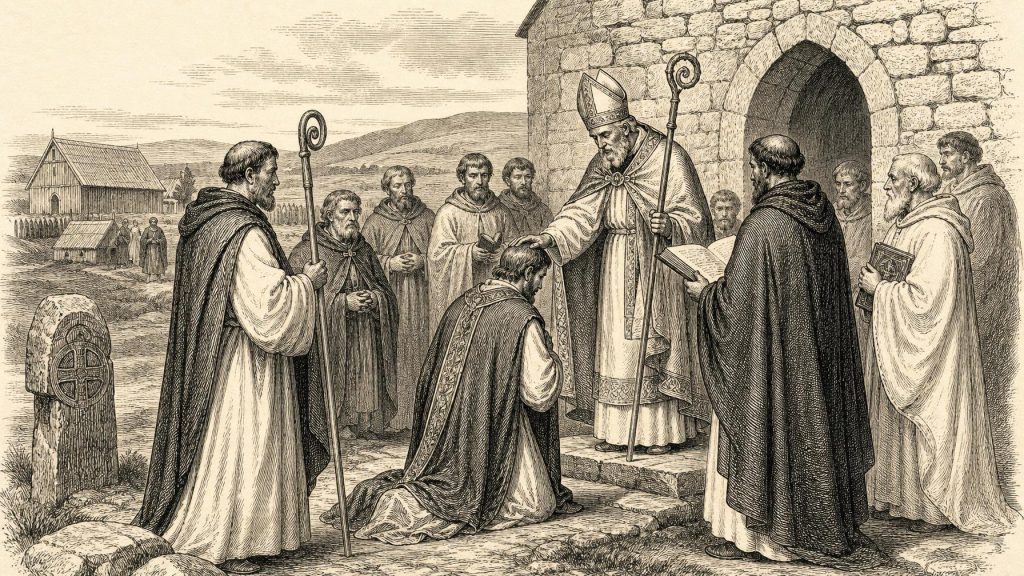
The Annals of Ulster record the death of Gilla in Choimded Ua Caráin, successor of Patrick and archbishop of Armagh. Early in 1180 Lorcán Ua Tuathail, acting as papal legate, installed Tommaltach Ua Conchobair as archbishop. Tommaltach was a nephew of Ruaidrí and had previously been bishop of Elphin, making his promotion both an ecclesiastical appointment and an extension of Connacht influence.
Acceptance was not automatic. The offices of reforming diocesan archbishop and traditional coarb, or successor, of Patrick did not yet overlap perfectly. Tommaltach’s episcopal position could be established by the legate, but his recognition among the northern kindreds required customary ceremonies and political consent. He was not fully accepted as Patrick’s coarb until 1181. The episode illustrates how Irish church reform operated through negotiation between papal authority, diocesan structures, hereditary ecclesiastical interests and royal dynasties.
The Death of Lorcán Ua Tuathail
The defining ecclesiastical event of the year was the death of Lorcán Ua Tuathail, archbishop of Dublin. A former abbot of Glendalough and the first Irish-born archbishop of Dublin for generations, Lorcán had tried to protect his church and mediate between Gaelic rulers, Anglo-Norman magnates, Henry II and the papacy. After attending the Third Lateran Council in 1179, he returned with authority as papal legate and with papal protection for the rights of Dublin and Glendalough.
Late in 1180 Ruaidrí sent him on another embassy to Henry II, apparently concerning tribute and the deteriorating Windsor settlement. When Lorcán reached England, Henry had departed for his continental lands. The archbishop followed but fell ill with fever and died at the Augustinian priory of Eu in Normandy on 14 November. Some Irish annals describe him as having suffered martyrdom in England, but the better-supported account places his death from illness in Normandy. The annalistic wording expresses reverence and political grievance rather than a literal execution.
Lorcán’s death removed one of the few figures able to speak with recognised authority in Irish, royal and papal circles. It was a serious setback for Ruaidrí’s diplomacy and for the Irish leadership of the Dublin church. His reputation for austerity, charity and peacemaking quickly encouraged a cult at Eu; he was eventually canonised in 1226. In immediate terms, however, Dublin had lost a mediator at a moment when English royal influence over its archbishopric was increasing.
Castles, Churches and Settlement
Archaeology places the beginning of Carrickfergus Castle between 1177 and 1181, meaning that substantial work can responsibly be connected with 1180 even though no exact foundation day is known. John de Courcy’s fortress occupied a rocky coastal position overlooking Belfast Lough. Its great tower and enclosure protected a garrison, proclaimed lordship and secured communication by sea. The parish church of St Nicholas at Carrickfergus is also conventionally dated to about 1180, indicating that military occupation was being accompanied by organised Christian settlement.
In Meath, de Lacy’s network of castles and delegated lordships continued to transform strategic river crossings and older centres. Trim, where construction had begun earlier in the 1170s, represented the scale of his ambitions. These new fortifications did not mean that the countryside was fully conquered or uniformly settled. Control was strongest around castles, roads, rivers and estates granted to dependable followers, while Gaelic communities and rulers remained influential nearby.
Work, Wealth and Exchange
For most people, the year was measured less by embassies than by livestock, crops, rents and seasonal labour. Cattle remained fundamental to wealth in Gaelic lordships, serving as food, movable property, tribute and payment for warriors. Church estates supported clergy, tenants, craftspeople and guests through rents and produce. Warfare endangered this economy because raiders could remove herds quickly, while the burning of houses or grain stores could impoverish a district beyond the campaign season.
Dublin, Waterford, Wexford, Cork and Limerick linked Ireland with Britain and continental Europe. Dublin’s excavated twelfth-century levels reveal timber houses, workshops, property boundaries and crafts including leatherworking, woodworking, comb-making and metalworking. Coins were known, particularly in towns, but much exchange and obligation still operated through silver by weight, livestock and goods. Anglo-Norman colonisation was beginning to redirect estates towards castle boroughs and markets, yet in 1180 the older port economies and pastoral systems remained essential.
A Year of Transition
No single power mastered Ireland in 1180. Ruaidrí retained prestige but faced internal challenges; Henry II possessed an expanding claim but relied on lords whose ambitions concerned him; and regional dynasties continued to determine events locally. Marriage joined political rivals even as battle divided neighbouring peoples. Churchmen invoked Rome while negotiating hereditary traditions at Armagh and sacred honour at Derry. The year’s record is therefore one of transition: conquest continued, but so did adaptation, resistance and the durable institutions of Gaelic Ireland.
Primary Sources
- The Annals of Ulster: Year U1180
- Annals of the Four Masters: Annal M1180
- Annals of Loch Cé A.D. 1014–1590
- Ua Tuathail, Lorcán (O'Toole, Laurence)
- Ua Conchobair, Ruaidrí
- Ua Conchobair, Tommaltach
- Lacy, Hugh de (I)
- Courcy, John de
- John, Lord of Ireland and King of England
- Gilla meic Liac (Gelasius)
- Thomas, Abbot of Glendalough
- Carrickfergus Castle
- Carrickfergus Castle: Works to the Great Tower Roof
- Excavations at Carrickfergus Castle, Co. Antrim, Carried Out in November 2014
- St Nicholas Church, Carrickfergus: Historic Building Record
- Anglo-Norman Trail
- Hugh de Lacy
- About Saint Mary’s Cathedral, Limerick
- Late Medieval Ireland
- 950–1450: Vikings, Normans and Medieval Mints
- Viking Collections
- The Archaeology of Medieval Rural Settlement in Ireland
- Building on the Past: Three Medieval Settlements
- Derry – Slí Cholmcille, St Columba Way
- Henry II, the Council of Oxford and Angevin Overlordship in Leinster, 1177–85
- From Kingdom to Colony: Framing the English Conquest of Ireland