
Fractured Lordships1032 CE
In 1032, annalistic records portray Ireland as a patchwork of competing lordships after the decline of island-wide kingship. Domnall ua Maíl Doraid of Cenél Conaill and Mathgamain Ua Riacáin of Brega were killed, while Mathgamain’s killer was blinded. Sitriuc of Dublin defeated neighbouring groups at the Boyne estuary. In Munster, Donnchad mac Briain married Ragnall’s daughter, reinforcing Norse-Gaelic connections amid regional tensions. Deaths of local rulers, officials and prominent churchmen reveal dispersed authority. The killing of Étrú Ua Conaing after violation of Emly underscored ecclesiastical protection. These fragmentary notices vividly depict warfare, alliance, church power, and political instability throughout Ireland.
Dateline
The surviving Irish record for 1032 is not a continuous narrative but a set of brief annalistic notices. They name deaths, killings, churchmen, battles and a dynastic marriage, while leaving motives and outcomes mostly unstated. The year can therefore be reconstructed only cautiously. Two annals mark the Kalends of January as falling on a Saturday, with the fifteenth day of the moon, but most events are not given a precise day. One later compilation, the Annals of the Four Masters, places the killing of Mathgamain Ua Riacáin on the Sunday before Easter; otherwise the year is best treated as a cluster of firmly assigned incidents rather than a dated sequence.
A Kingdom Without Rest
Ireland in 1032 was still living with the political consequences of the age of Brian Bórama and Máel Sechnaill mac Domnaill. Brian had died at Clontarf in 1014; Máel Sechnaill, the last broadly effective claimant to the old Uí Néill high-kingship, died in 1022. By 1032 no single ruler controlled the island. Power was held and contested through provincial kings, overkings, ecclesiastical alliances, hostages, marriages, raids and local settlements. The annals’ emphasis on killings and blindings is not accidental: disabling or removing rivals was a recognised part of dynastic politics, especially where several branches of a ruling kindred could claim legitimacy.
The year’s entries show politics operating on many scales at once. A ruler of Cenél Conaill in the north-west was killed; Brega, north of Dublin and beside the lower Boyne, saw assassination and retaliation; the king of Dublin fought at Inber Bóinne; Munster’s leading dynasty sought a marriage link with a Norse-Gaelic family; and churches at Armagh, Emly, Ardfert, Clonmacnoise and elsewhere appear through the deaths of office-holders. These are not disconnected curiosities. They reveal an island in which royal power depended on controlling routes, churches, tribute districts and alliances across both Gaelic and Hiberno-Norse society.
The North-West And Cenél Conaill
One of the clearest notices of the year is the death of Domnall ua Maíl Doraid, king of Cenél Conaill. The Annals of Ulster simply state that he was killed; Chronicon Scotorum and the Annals of Tigernach add that the killers were the sons or descendants of Fiangus. Cenél Conaill, rooted in what is now Donegal and neighbouring districts, was one of the great northern Uí Néill peoples. A slain king there mattered beyond his immediate territory, because northern politics were shaped by rivalry among Cenél Conaill, Cenél nEógain, Airgialla and other lordships.
The notice gains significance from its context. In the preceding years, the annals record raids and killings involving Cenél Conaill, Ua Canannáin, Ua Néill and neighbouring powers. We cannot say from the sources that Domnall’s death in 1032 was a direct result of any one of those earlier incidents, but it belongs to the same pattern: leadership in the north-west was dangerous, contested and bound to kin-strife as well as inter-kingdom rivalry. The entry is short, yet it marks the removal of a named king from a major dynasty at a time when northern overkings were competing for influence after the weakening of old island-wide authority.
Brega, Dublin And The Boyne
The most vivid eastern event of 1032 concerns Mathgamain Ua Riacáin, king of Brega. The Annals of Ulster say he was killed by Domnall Ua Cellaig “by a stratagem”. The Four Masters, writing much later but preserving useful material, place the killing on the Sunday before Easter. Brega lay in the rich east midlands, between the power of Mide, the approaches to Armagh, and the Hiberno-Norse kingdom of Dublin. Its kings could be partners, rivals or victims of Dublin’s rulers, and the lower Boyne formed a route of political as well as economic value.
The annals also record that Domnall Ua Cellaig, the killer of Mathgamain, was blinded by Muirchertach Ua Cellaig. That notice suggests a swift reckoning within, or against, the same political network. Blinding was not merely personal cruelty; in medieval Irish kingship it normally disqualified a man from rule by marking him as physically blemished. Thus the year gives us both assassination and political mutilation in Brega, a small but telling glimpse of how fragile local kingship could be.
The Four Masters add another eastern conflict: Sitriuc son of Amlaíb, king of Dublin, won the battle of Inber Bóinne over the Conailli, Uí Tortáin and Uí Méith, with a reported loss of three hundred killed or captured. The number may be formulaic or rounded, as annalistic casualty figures often are, but the event itself fits the strategic setting. Inber Bóinne, the Boyne estuary, connected inland Brega and Meath to the Irish Sea. A Dublin victory there shows that Sitriuc’s power in 1032 was not confined within town walls. It reached along waterways and frontier zones where Gaelic communities, coastal traffic and Dublin’s military interests met.
Munster And The Ua Briain Alliance
In Munster, the Annals of Inisfallen preserve an important notice: Donnchad son of Brian married the daughter of Ragnall, followed by a proverbial phrase remembered as “the spring of Ragnall’s daughter”. Donnchad mac Briain, Brian Bórama’s son, was the leading Ua Briain ruler of Munster. The bride’s father is not identified in the entry with complete certainty, but scholarly discussion connects the marriage with Norse-Gaelic dynastic politics, especially families linked to Waterford, the Isles or the wider Irish Sea world. The responsible conclusion is that Donnchad used marriage to strengthen ties beyond purely Gaelic Munster.
This alliance mattered because Munster’s political future depended on more than military inheritance from Brian. Donnchad faced pressure from rival Munster lineages, from Leinster, from Dublin and from members of his own extended family. A marriage to Ragnall’s daughter offered access to maritime prestige, possible trading connections and Hiberno-Norse allies. It also reminds us that eleventh-century Ireland was not divided cleanly between “Irish” and “Viking”. By 1032, Norse-Gaelic rulers were embedded in Irish politics through marriage, fosterage, warfare and tribute.
Several Munster deaths in 1032 point to regional strain. Flann son of Mathgamain, king of Ciarraige Luachra, was slain. Diarmait son of Eochu, described in the Annals of Inisfallen as a royal official of Munster, died. Ua Fogartaig, king of Cera, died. These entries lack narrative explanation, but they show the density of lesser kingships and offices beneath the provincial level. Munster was not simply ruled from Cashel or by the Ua Briain; it was a mosaic of local peoples whose rulers had to be managed, courted or coerced.
Churches, Learning And Sacred Immunity
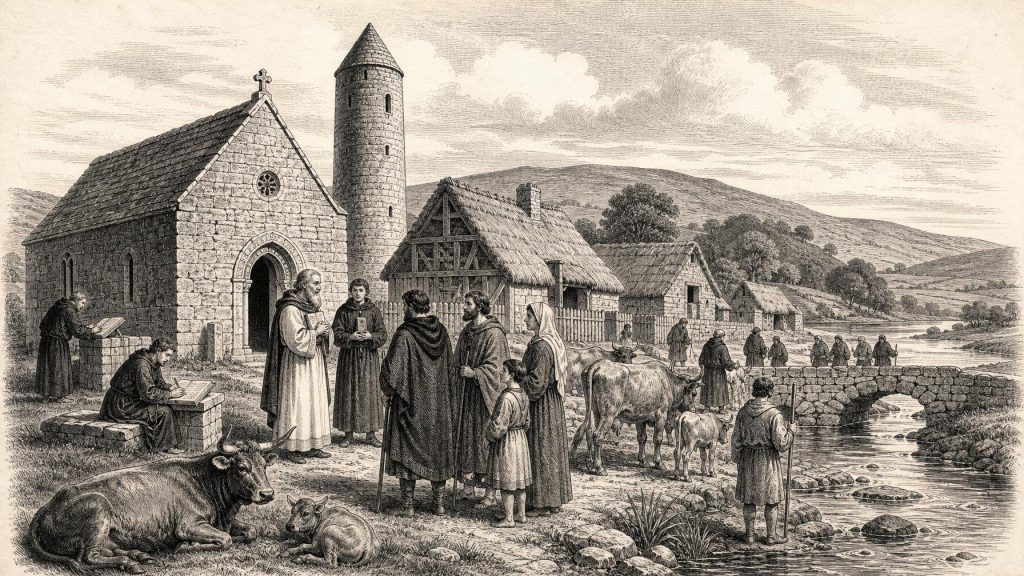
The ecclesiastical notices for 1032 are unusually rich. Máel Tuile, bishop of Armagh, died. Armagh’s status as the church of Patrick gave its clergy authority far beyond the north. In the early eleventh century the Irish church had not yet been reorganised into the later diocesan system of the twelfth-century reform, and great churches often functioned as landholders, schools, political brokers and custodians of relics. A bishop’s death at Armagh was therefore both a religious and public event.
Munster’s churches also feature prominently. Mac Delbaíth, coarb of Crónán, died; Ailill Ua Flaithim, erenagh of Ard Ferta Brénainn, died and is called the leading jurist of Munster; Murchad Ua Níoc, coarb of Iarlaithe and a learned bishop, died. These titles are important. A coarb was the successor of a founding saint, holder of an office that carried spiritual prestige and often substantial property. An erenagh managed church lands and obligations. A jurist attached to a major church such as Ardfert shows that law and learning were not abstract pursuits: they were part of how land, status, compensation and sanctuary were negotiated.
The most dramatic church-related entry concerns Étrú Ua Conaing, a royal heir of Munster. The Annals of Inisfallen say he was killed while violating the church of Ailbe; the Annals of Tigernach say he was slain by the people of Imlech Ibair, that is Emly. Emly, associated with St Ailbe, was one of Munster’s premier ecclesiastical centres before Cashel’s later dominance. The entry cannot be expanded into a full story, but its meaning is clear enough: sacred places had protectors, and violation of a church could be answered violently. The annalist’s wording presents Étrú’s death not merely as politics but as punishment for sacrilege.
The Four Masters add the death of Duibhinnsi, bell-ringer of Clonmacnoise. That small notice is valuable because it brings an ordinary but essential ecclesiastical role into view. Clonmacnoise, on the Shannon, was a great centre of worship, learning, burial and craftsmanship. Its bell-ringer helped regulate the soundscape of monastic life: prayer, work, gathering and ceremony. The annals usually remember kings and abbots, so the naming of such an officer hints at the many specialised people who sustained Ireland’s major churches.
Society, Trade And Everyday Conditions
The entries for 1032 do not describe harvests, weather in Ireland, prices or household life. Still, the year sits within a well-documented eleventh-century world. Cattle remained the principal measure of wealth in Gaelic society, and nearby annalistic entries record great cattle preys, captives and ransoms. Dublin and Waterford connected Ireland to Britain, the Isles and continental routes. Dublin had minted silver pennies since the late tenth century under Sitriuc’s authority, while hoards and excavations show craftwork, silver exchange, imported goods and urban manufacture in the Hiberno-Norse towns.
For most people, the politics recorded in the annals translated into very practical dangers: cattle raiding, hostage-taking, church sanctuary, tribute demands and the movement of armed retinues through farmland. The battle at Inber Bóinne and the killing of Brega’s king would have affected not just aristocrats but farmers, boatmen, clerics, captives and traders along the Boyne corridor. In Munster, a royal marriage may have been celebrated at elite level, but its consequences would have been felt through alliances, obligations and the redistribution of favour among local rulers and churches.
The Shape Of The Year
What stands out about 1032 is not one island-changing battle but the fragmentation of authority. Kings were killed in Cenél Conaill, Brega, Ciarraige and elsewhere. A Dublin king fought successfully at the Boyne. Donnchad mac Briain looked outward through marriage. Armagh lost a bishop; Munster lost churchmen, a jurist and a royal heir who died in conflict with Emly. The year shows Ireland as a land of overlapping powers: royal, ecclesiastical, legal, maritime and local.
Because the evidence is annalistic, we should resist turning 1032 into a neat story. Yet the fragments are eloquent. They show a society where churches guarded learning and property, where kingship was intensely competitive, where Dublin remained militarily active, and where Munster’s rulers linked themselves to the Norse-Gaelic world. In 1032, Ireland’s history was being made not by a single sovereign, but by many lordships struggling to survive in the unsettled decades after Brian Bórama and Máel Sechnaill.
Primary Sources
- The Annals of Ulster: Year U1032
- Annals of Inisfallen: AI1032
- CELT Project: Chronicon Scotorum
- Annals of the Four Masters: M1032
- Annals of Tigernach: T1032
- TEI Header for The Annals of Ulster
- CELT Project: Annals of Inisfallen
- CELT Project: Annals of the Four Masters
- CELT Project: Annals of Tigernach
- Donnchad | Dictionary of Irish Biography
- Sitriuc Silkbeard | Dictionary of Irish Biography
- Brian Bórama | Dictionary of Irish Biography
- Echmarcach | Dictionary of Irish Biography
- Ailbe | Dictionary of Irish Biography
- Ua Máelshechlainn, Conchobar | Dictionary of Irish Biography
- 950–1450: Vikings, Normans and Medieval Mints | National Museum of Ireland
- Viking | National Museum of Ireland
- Clonmacnoise, County Offaly | National Monuments Service
- St Patrick | Archdiocese of Armagh
- An Ecclesiastical Institution in Medieval Munster: A Study of Emly to c. 1100
- Emerging from the Mist: Ireland and Man in the Eleventh Century