Flaithbertach at Fir Lí949 CE
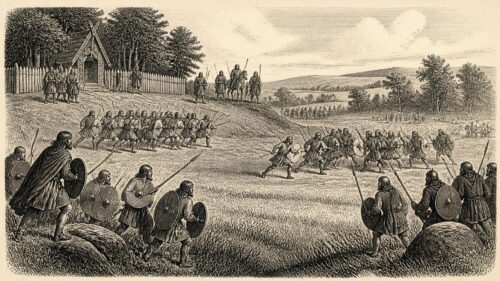
Records conventionally associated with 949 illuminate violence and chronological uncertainty in tenth-century Ireland. Annals differ over the date of Ruaidrí Ua Canannáin’s raid into Fir Lí, during which Flaithbertach, son of Muirchertach and grandson of Niall Glúndub, was killed. The episode marked Cenél Conaill’s success against rival Cenél nEógain. Elsewhere, Matudán of Ulaid and Niall grandson of Erulb plundered Conaille and districts, while Congalach of Brega ravaged Uí Méith and Fernmag, demonstrating authority. Obits for Aedán of Tuaim Dá Ghualann and Fogartach of Airgialla reflect ecclesiastical importance and Christian commemoration. Sparse sources reveal local warfare, not a national turning point.
Dateline
For Ireland in 949, the surviving record is brief, regional and unusually revealing about the limits of certainty. The most secure cluster of notices comes from annals whose year-headings do not align perfectly. The Annals of Inisfallen place the death of Flaithbertach, son of Muirchertach and grandson of Niall, under 949. The Annals of Ulster record that Ua Canannáin raided Fir Lí and killed Flaithbertach ua Néill under an entry labelled “948 alias 949”. The later Annals of the Four Masters place a corresponding killing under 947. This is not a reason to dismiss the event; it is a reason to avoid pretending that its day, season or even its exact modern calendar placement is known. It belongs securely to the political crisis at the close of the 940s, and 949 is the conventional year in which to consider it.
A Death in Fir Lí
Flaithbertach was a son of Muirchertach na Cochall Craicinn, the formidable king of Ailech who had been killed in 943. Through Muirchertach, Flaithbertach belonged to Cenél nEógain, the northern branch of the Uí Néill whose power-centre lay around Ailech in the north-west. His grandfather, Niall Glúndub, had been king of Tara before his death fighting the Dublin Scandinavians in 919. Such descent mattered: it gave Flaithbertach a claim to leadership within a dynasty accustomed to projecting authority far beyond its own territories.
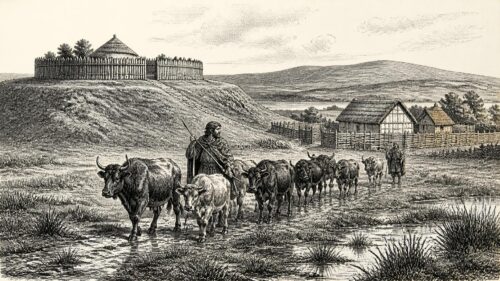
The annal, however, gives no biography and no set-piece battle. It simply says that Ua Canannáin made a foray into Fir Lí, plundered it, and killed Flaithbertach ua Néill. Fir Lí lay in the northern midlands, associated with territory around modern south County Londonderry and north County Antrim. It was a significant frontier zone between the spheres of Cenél nEógain, Cenél Conaill, Ulaid and smaller local peoples. A raid there could therefore be more than a search for movable wealth: it could test allegiance, punish an opponent, seize cattle and captives, or demonstrate who could move armed men through contested country.
Ua Canannáin was Ruaidrí Ua Canannáin of Cenél Conaill, the rival northern Uí Néill dynasty based west of the Foyle in what is now Donegal. Ruaidrí was then one of the strongest contenders for wider Irish kingship. The killing of Flaithbertach thus represented a sharp success for Cenél Conaill against the family of Ailech. It also exposed the vulnerability of Muirchertach’s sons only a few years after their father’s death. Dynastic succession did not pass automatically from father to son. It had to be defended through kinship, military following, church connections and the capacity to collect submissions.
Nothing in the entry permits the claim that Flaithbertach was king of Ailech, nor that he died heroically in a pitched battle. The language supports a more restrained picture: he was killed in the course of Ruaidrí’s raiding expedition. Yet even that bare statement has weight. A man of royal descent had fallen while Cenél Conaill was ranging into a borderland; the rivalry of the northern Uí Néill was not an abstract contest of pedigrees but a threat felt in farms, settlements and churches along the route of an army.
Raiding and Local Power
The same Ulster annal records another expedition in the north-east. Matudán son of Áed, king of Ulaid, joined Niall, grandson of Erulb, in plundering Conaille, Druim Inasclainn and Inis Cáin Dega. The sequence of places points towards the area of Conaille Muirthemne, around Dundalk and the Cooley peninsula, with Druim Inasclainn identified with Monasterboice. This was an assault on a densely connected landscape of secular lordship, ecclesiastical sites, roads and coastal access rather than a raid into an empty periphery.
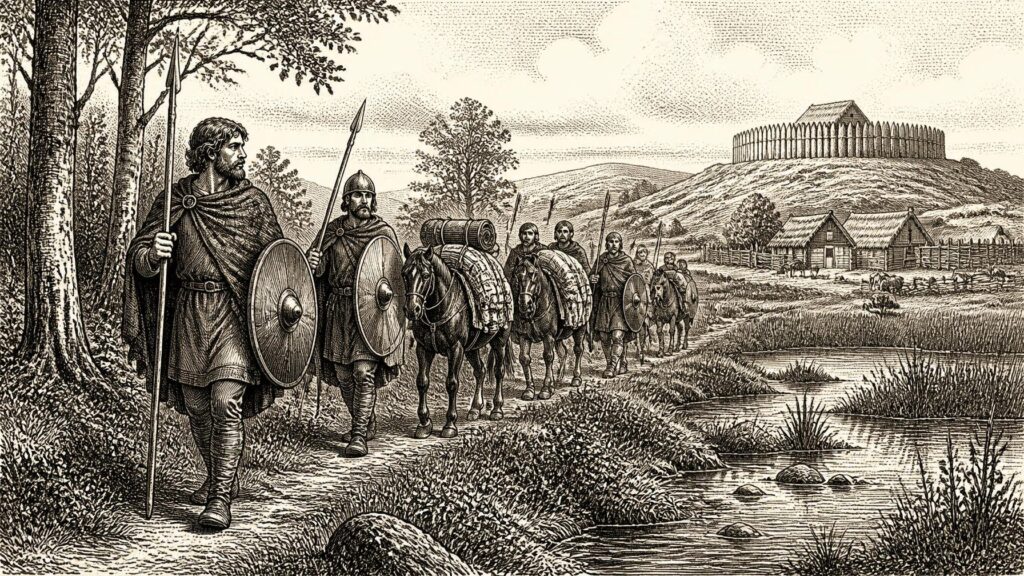
The notice also corrects a simplistic division between “Irish” kingdoms and Scandinavian attackers. Matudán’s force was an Ulaid-led expedition against neighbouring Irish territories. Warfare in tenth-century Ireland was often local and inter-dynastic. Kings could raid fellow Irish rulers, ally with Scandinavian rulers or oppose them, according to changing interests. The principal burdens of campaigning were borne locally: food had to be gathered, boats and horses maintained, men summoned, and the people in the raiders’ path stripped of cattle, provisions and portable valuables.
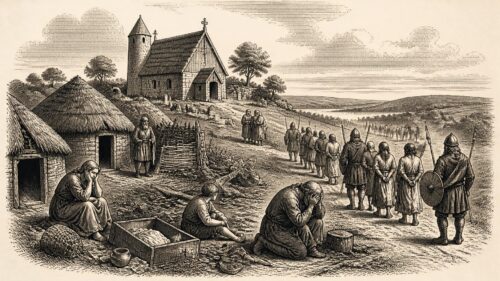
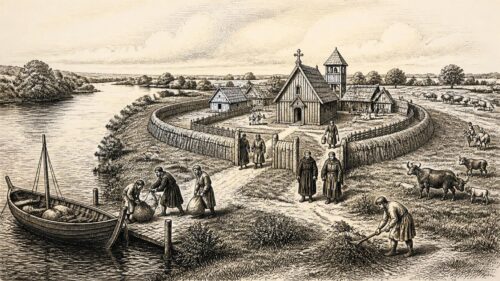
For ordinary households, an annal’s word “plundered” compresses serious disruption. Cattle were a source of food, labour, status and compensation; their seizure affected a household’s ability to cultivate, feed dependants and meet obligations. Captives could also be taken in early medieval warfare, though this particular entry does not specify them. Churches and monasteries were especially exposed because they concentrated food renders, metalwork, books, skilled personnel and political patronage. Monasterboice’s appearance in the itinerary does not prove that its church was attacked, but it shows that a major ecclesiastical settlement lay within the zone traversed by the expedition.
Congalach’s Southern Reach
A third military notice places Congalach son of Máel Mithig on campaign in Uí Méith and Fernmag, territories spanning parts of present-day south Armagh, Monaghan and adjoining borderlands. Congalach, king of Brega and claimant to the kingship of Tara, had risen after the deaths of powerful Uí Néill rulers in the early 940s. His authority was substantial but contested, particularly by Ruaidrí Ua Canannáin. His expedition northwards in the annalistic year associated with 949 should be read alongside the violence at Fir Lí: leading rulers were actively making, or denying, claims to dominance across the north and midlands.
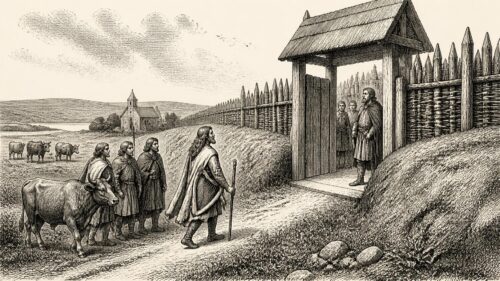
“Ravaged” is purposeful language. It indicates an expedition intended to impose political cost, not merely a diplomatic visit. In a society without a single state administration, royal power was made visible through hostings, tribute, hostages, protection and punitive raids. A king who could enter Uí Méith and Fernmag with an army could demand recognition; a local ruler who endured or resisted such an incursion defended his own standing. The annals do not tell us the outcome beyond the devastation, and it would be wrong to infer a permanent conquest. The evidence shows a campaign, not a settled new frontier.
These northern operations unfolded against a wider contest for the kingship of Ireland. Congalach’s position rested on Brega and the southern Uí Néill; Ruaidrí’s on Cenél Conaill; the descendants of Muirchertach remained a force in Cenél nEógain. Dublin, meanwhile, was a Hiberno-Scandinavian political and commercial centre whose rulers could become allies, enemies or decisive military partners. That wider setting belongs to the late 940s, but should not be mistaken for an additional event specifically dated to 949. The year’s notices instead offer a close view of its consequences: mobile warbands, exposed borderlands and royal families under acute pressure.
Churches, Learning and Penitence
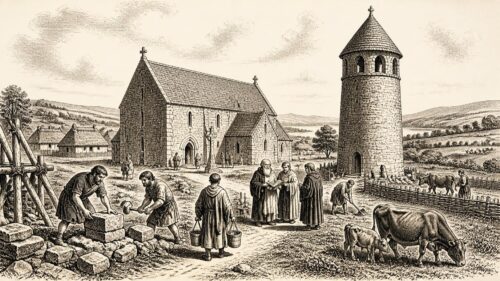
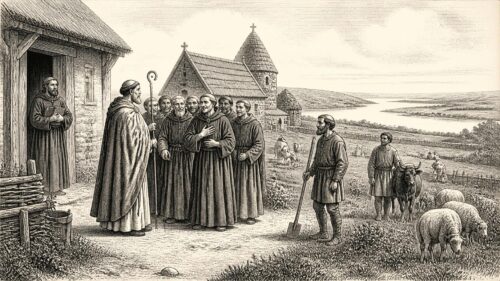
The year’s record is not solely martial. The Annals of Ulster note the death of Aedán of Tuaim Dá Ghualann, apparently a churchman associated with a monastery in the wider Louth region. Such terse obits are reminders that ecclesiastical communities were central institutions of settlement and learning. A monastery was not simply a secluded religious house. It could be a landholder, a centre of worship, a place of burial and commemoration, a focus for scribal activity, and a node in networks linking local patrons to saints of national standing.
The annal also records that Fogartach son of Donnocán, king of Airgialla, died “in penitence”. The phrase is formulaic but significant. It presents a ruler’s end within a Christian moral framework, measuring political life against repentance and salvation. Penitential retirement, almsgiving, pilgrimage and attachment to a religious community offered rulers ways to shape their memory. The annalist did not separate secular authority from religion: the death of a king and the death of a churchman both deserved recording because both affected the ordered Christian society the annals sought to preserve.
That perspective helps explain why the record is selective. It names kings, dynasts, clerics and raids, but gives little direct voice to cultivators, craftspeople, women, enslaved people or traders. Their absence from these few notices is not evidence of absence from history. Agricultural work, livestock management, local exchange and the maintenance of roads, boats and buildings continued beneath the annals’ political surface. But in a year marked by expeditions through Fir Lí, Conaille and the Airgialla borderlands, these everyday activities were vulnerable to the demands and damage of warfare.
A Year of Narrow Evidence
949 should therefore not be inflated into a turning point for all Ireland. No surviving source securely assigns a national battle, a new law or a major ecclesiastical foundation to this calendar year. Its importance lies elsewhere. The notices reveal three overlapping realities: Cenél Conaill struck a damaging blow against the descendants of Muirchertach; Ulaid forces raided south into Conaille; and Congalach demonstrated force in the politically fractured north. The death of Flaithbertach at Fir Lí is the sharpest event, but it gains meaning from the surrounding pattern of movement, plunder and rivalry.
The year also demonstrates why medieval Irish chronology must be handled with care. Annals were copied, continued and reorganised across centuries, and their year-numbering can diverge even where their underlying event tradition overlaps. Responsible history does not hide that difficulty. In this case, the sources permit a clear conclusion: by 949, or at the latest within the adjacent annalistic years, the contest between Cenél Conaill and Cenél nEógain had taken the life of Flaithbertach, a grandson of Niall Glúndub. They do not permit a fuller story than that. The restraint is part of the history: a sparse annal leaves us seeing not a complete kingdom, but the flash of a raid across a contested Irish landscape.
Primary Sources
- The Annals of Ulster
- The Annals of Ulster, Year U949
- The Annals of Ulster, Year U950
- Annals of Inisfallen, Annals AI940–AI949
- Annals of Inisfallen, Annals AI950–AI954
- Annals of the Four Masters, Annals M943–M952
- CELT Project: Annals of the Four Masters
- The Annals of Tigernach
- Chronicon Scotorum
- Exploring the Irish Annals
- Chronological Synchronisation of the Irish Annals
- Home Page for Dr. Daniel P. McCarthy
- Congalach Cnogba | Dictionary of Irish Biography
- Muirchertach na Cochall Craicinin | Dictionary of Irish Biography
- The Vikings in Ninth-Century Ireland: Sources and Settlements
- Viking Ireland: Archaeology and History
- Hoards: Viking Age Gold and Silver from Ireland
- Viking Age Gold and Silver from Irish Crannogs and Other Watery Places
- Technological Change in the Agrarian Economy of Early Medieval Ireland
- The Vikings in Ulaid
- Cogad Gaedel re Gallaib in the Book of Leinster
- Irish Annals