

A Kingdom Under Strain1085 CE
In 1085, Ireland remained divided among provincial rulers, lordships, churches and Hiberno-Norse towns, despite Tairdelbach Ua Briain’s extensive but personal supremacy. His severe illness weakened a political system based on alliances, hostages and force, foreshadowing his death in 1086. Deaths among rulers and churchmen, including Murchad Ua Maeldoraid, altered regional leadership, while a Ua Ruairc prince was treacherously killed. Donngus Ua hAingliu was consecrated bishop of Dublin at Canterbury, demonstrating distinctive Irish Sea ecclesiastical links. Most of Cell Chainnigh burned, cause unknown. Rural production, monastic learning and maritime trade continued amid a precarious political balance during this apparently quiet year.
Dateline
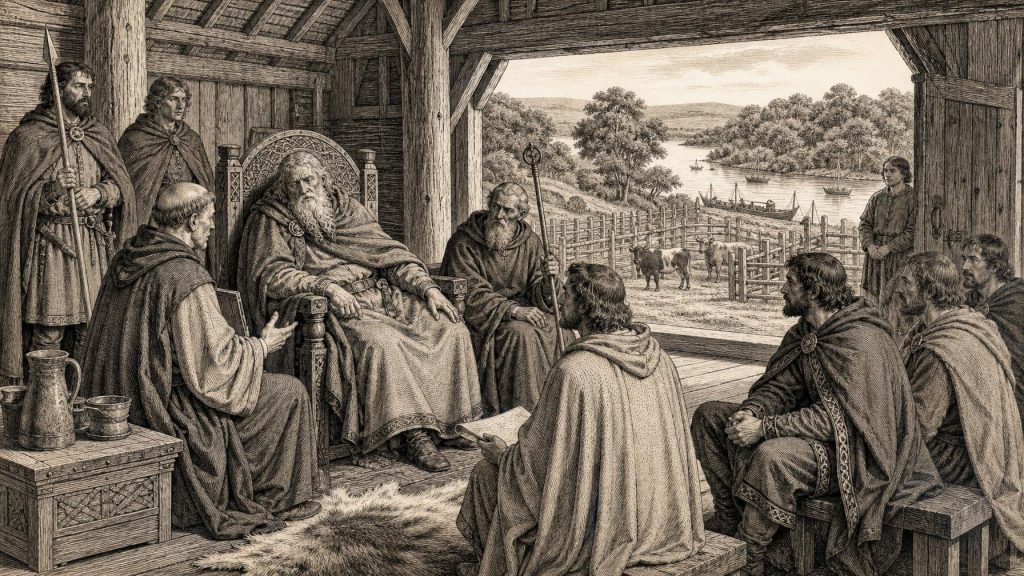
The surviving chronicles make 1085 appear quieter than the years immediately around it, but their silence should not be mistaken for peace. Ireland remained a mosaic of provincial kingdoms, smaller lordships, ecclesiastical territories and Hiberno-Norse towns. Tairdelbach Ua Briain still claimed an authority extending far beyond Munster, while rival dynasties retained their own armed followings and ambitions. The year’s securely recorded events consist chiefly of illness, deaths, a treacherous killing, an important episcopal consecration and the burning of Cell Chainnigh. Together, they reveal a political order held together by personal power, kinship, hostages and negotiation rather than permanent central government.
The Illness of Tairdelbach
The most consequential development was a severe illness suffered by Tairdelbach Ua Briain. The Annals of Tigernach place this affliction firmly in 1085 and describe it as so grave that his hair fell out. No diagnosis is possible, and the chronicler’s vivid detail should not be turned into one. What matters politically is that the dominant king in Ireland was visibly weakened. He recovered sufficiently to live into the following year, dying at Cenn Corad, or Kincora, in July 1086, but 1085 marked the beginning of the end of his long supremacy.
Tairdelbach was king of Munster and the strongest claimant to the kingship of Ireland, though he did not rule a unified state. Since 1072 he had compelled submissions, collected hostages and manipulated rival dynasties in Leinster, Mide and Connacht. Dublin also lay within his political orbit. His son Muirchertach had been placed in authority there in 1075 and remained a principal agent of Ua Briain power. The arrangement linked the resources of Munster to Ireland’s largest port and gave the dynasty access to ships, merchants and the wider Irish Sea.
The previous year had shown the strength of that system. In 1084 Muirchertach and the southern forces defeated Donnchad Ua Ruairc at Móin Cruinneóige, killing both Ua Ruairc and Tairdelbach’s kinsman and enemy Cennétig Ua Briain. No comparable campaign can be dated securely to 1085. The absence is significant but not conclusive: Tairdelbach’s illness may have limited major operations, while the effects of the 1084 victory continued to shape relations between Munster, Bréifne, Connacht and Mide.
Change in the North and Midlands
In northern Ireland, Domnall Ua Lochlainn had recently emerged as king of Cenél nÉogain and ruler of Ailech. He would later become the principal northern rival of the Uí Briain, but the chronicles record no direct confrontation between him and Tairdelbach during 1085. The year instead brought the death of Murchad Ua Maeldoraid, king of Cenél Conaill. The Annals of Loch Cé praise Murchad as a pillar of dignity, nobility and hospitality, language expressing the qualities expected of a successful ruler: courage, generosity, maintenance of followers and public honour. His death removed an established leader from the north-west at a time when Ua Lochlainn’s power was growing.
Other regional deaths underline how frequently political stability depended upon individual men. Ualgarc Ua Ruairc, described as a royal heir of Connacht, died during the year. The Four Masters also record the deaths of Aengus Ua Caindelbáin, lord of Loegaire in Mide, and the Blind Ua Faoláin, lord of the Déisi. These notices do not explain the circumstances or immediate consequences, so it would be unsafe to manufacture succession struggles. Nevertheless, every such death opened questions of inheritance, seniority and alliance within ruling kindreds.
A separate and darker notice appears in the Annals of Tigernach and Chronicon Scotorum: a son of Domnall Ua Ruairc, king of the Uí Briúin of Bréifne, was killed treacherously. The victim is not named in these accounts. He should not automatically be identified with Ualgarc, whose death is described differently elsewhere. The discrepancy is a useful warning that medieval annals were compiled from distinct regional traditions and do not always preserve identical details.
Dublin and Canterbury
The most clearly international Irish event of 1085 was the consecration of Donngus Ua hAingliu as bishop of Dublin by Lanfranc, archbishop of Canterbury. Donngus succeeded Gilla Pátraic, who had drowned in October 1084 while crossing the Irish Sea. His selection involved Tairdelbach, Irish churchmen and the clergy and people of Dublin. Having trained as a Benedictine at Canterbury, Donngus represented the particularly close relationship developing between the Hiberno-Norse church of Dublin and the English archbishopric.
Donngus made a profession of canonical obedience to Lanfranc and returned with books, vestments and church ornaments. This should not be portrayed as a wholesale English reorganisation of the Irish church. Most Irish ecclesiastical centres still operated through native networks of monasteries, hereditary church families, bishops, abbots and coarbs, or successors of founding saints. Dublin’s Canterbury connection was distinctive. Even so, the consecration shows that reform, education and political influence were travelling along the same maritime routes as merchants and warriors.
Churchmen and Learning
The year’s obituary lists are especially rich in ecclesiastics. Among those recorded were Ua Laidcnén, superior of Ferns; Mac Soilligh, superior of Inis Cáin Dega; Cléirech Ua Selbaig, head of the church of Cork; and Gormgal Loigsech, coarb of Brigit’s oratory at Armagh, praised for wisdom and piety. The Four Masters add Áed Ua hOisín, successor of Iarlaithe and archbishop of Tuam; Finn, bishop of Kildare; Nechtan son of Nechtan, bishop of Ros Ailithre; and Gilla Críst son of Cú na mBocht, an outstanding clerical student associated with Clonmacnoise.
These titles reflect a church not yet arranged into the later medieval diocesan structure. Major religious settlements were centres of worship, landholding, hospitality, teaching, manuscript work and political influence. The praise given to wisdom and learning was not ornamental. Literacy in Latin and Irish supported liturgy, law, genealogy, poetry and the writing of chronicles. Students and clerics could move between institutions, and church offices could be embedded in powerful local families.
The Four Masters also place in 1085 the death of Gilla na Náem Laigen, a distinguished bishop of Glendalough who had entered religious life in Germany and became head of monks at Würzburg. The notice, preserved in a much later compilation, must be handled cautiously, but it is supported by the enduring tradition of Irish clerical travel on the Continent. His career connects the Wicklow monastery of Glendalough with the long-established Irish religious presence in central Europe.
Fire at Cell Chainnigh
The Four Masters report that most of Cell Chainnigh, modern Kilkenny, was burned. No cause is given, and the entry does not say whether the destruction resulted from warfare, accident or some other circumstance. Timber buildings, thatched roofs and closely grouped structures made settlements highly vulnerable to fire. Cell Chainnigh was an important ecclesiastical centre associated with St Canice, and a large burning would have damaged homes, stores, workshops and church property as well as sacred buildings. The record is one of the few securely placed notices of physical destruction in Ireland during the year.
Work, Wealth and Trade
For most people, life continued beyond the annalists’ attention. Rural households cultivated grain, tended cattle, sheep and pigs, cut turf and timber, produced textiles and maintained enclosures. Cattle were food, movable wealth and a standard measure of tribute, compensation and status. The prominence of cattle-raiding in surrounding years reflects this economic reality. Elite residences included ringforts, stone cashels and crannogs, while ordinary farmsteads have often left less visible traces. These are broad conditions of the period, not events uniquely documented for 1085.
Dublin offered a markedly urban environment of timber houses, workshops, lanes, property boundaries and waterfront activity. Craftspeople worked wood, bone, antler, leather and metals; merchants handled silver, coins, cloth, pottery and imported luxuries. Ships connected Dublin with Britain, the Isle of Man and continental markets. Waterford, Limerick, Cork and Wexford likewise joined regional produce to maritime exchange, although their precise fortunes in 1085 are poorly recorded. Irish and Scandinavian traditions had by then blended into a Hiberno-Norse culture visible in personal ornaments, ship technology and ecclesiastical metalwork.
A Precarious Balance
By the close of 1085, Tairdelbach Ua Briain remained Ireland’s foremost ruler, but illness had exposed how much his political system depended on his own authority. Death had altered leadership in Cenél Conaill, Bréifne, Mide and the Déisi, while Domnall Ua Lochlainn’s northern power remained intact. In Dublin, Donngus Ua hAingliu’s consecration strengthened a channel between Ireland and Canterbury; elsewhere, established monastic communities continued to sustain worship, learning and local government. The year was therefore not a dramatic turning point by itself. It was a year of weakening foundations, immediately preceding Tairdelbach’s death and the renewed competition that followed.
Primary Sources
- The Annals of Ulster
- The Annals of Tigernach
- Annals of Loch Cé
- Annals of the Four Masters, Volume 2: 1085 Entries
- Chronicon Scotorum: 1085–1087
- Annals of Inisfallen: 1085–1087
- Ua Briain, Tairdelbach
- Ua Lochlainn (Mac Lochlainn), Domnall
- Ua Briain, Muirchertach
- Ua hÉnna, Domnall
- Christ Church Cathedral Dublin: Conservation Management Plan
- Canterbury’s Claim to Primacy over Ireland
- Glendalough
- Viking
- Early Medieval
- Nine Unmissable Objects from Clontarf 1014
- Wooden Plank with Viking Ship and Weathervane Graffiti
- Ardagh Ringfort
- Hill of Tara: Highlights
- The Dublin Region in the Middle Ages: Settlement, Land-use and Economy
- The Archaeology of Medieval Rural Settlement in Ireland
- Western Stone Forts Project