Muirgius’s Southern Hosting811 CE
In 811, annalistic evidence records Scandinavian raiding and Irish political religious activity across Ireland. Men of Umall killed raiders, while Scandinavians defeated the Conmaicne; Cobthach of Loch Léin likewise slew raiders in Munster. These mobile incursions brought no proven permanent settlement. Muirgius son of Tomaltach, king of Connacht, led a southern hosting, though its destination and outcome remain unknown. Daire’s law was promulgated in Connacht, demonstrating ecclesiastical and secular cooperation. Deaths of prominent abbots, bishops and regional kings highlighted interconnected religious institutions and fragmented political authority. The year reveals local resistance, royal ambition, church privilege, and pressures on coastal communities.
Dateline
The surviving evidence for 811 is unusually revealing, but it requires careful handling. In the Annals of Ulster, the entries placed under the annal-heading U812 are explicitly assigned to AD 811; their numbering reflects the chronicle’s internal system rather than a different calendar year. A much later compilation, the Annals of the Four Masters, places another cluster of events under 811 but itself labels that dating “recte 816”. Those later entries therefore cannot responsibly be transferred into 811. What can securely be placed in this year is a set of encounters with Scandinavian raiders, the movement of a Connacht king’s army, the promulgation of an ecclesiastical law, and deaths that show how densely political and religious authority was distributed across Ireland.
Fighting on the Western Seaways
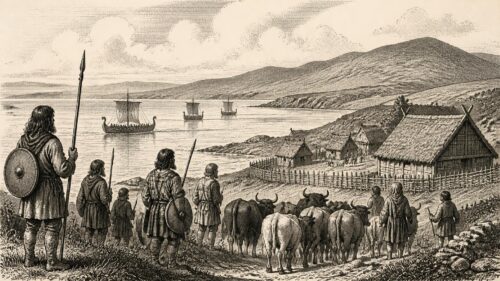
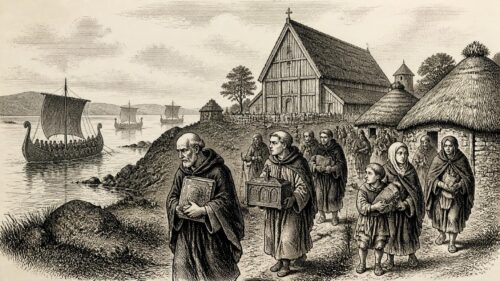
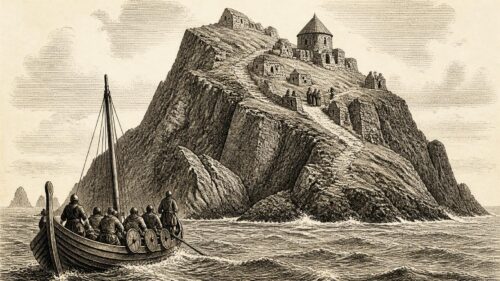
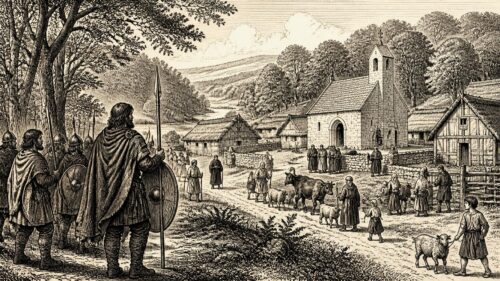
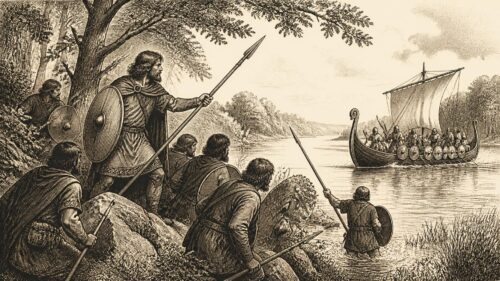
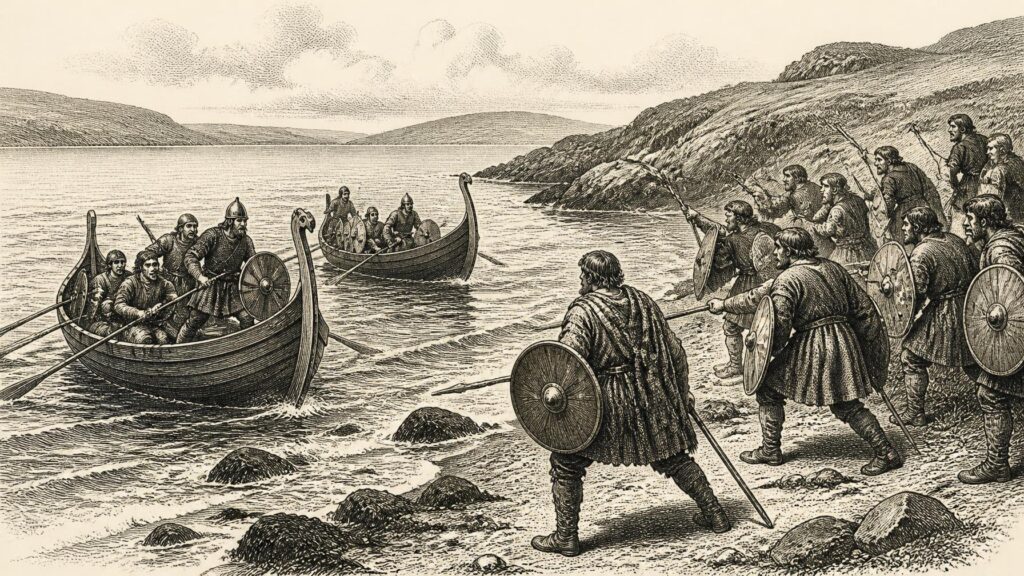
The sharpest events of the year occurred on and near the western coast. The annalist records “a slaughter of the heathens by the men of Umall”, followed immediately by “a slaughter of the Conmaicne by the heathens”. In this period heathens was the Irish annalists’ usual description for Scandinavian sea-raiders. The entries do not supply dates, commanders, ship numbers, or the exact order in which the two encounters unfolded; nor do they permit the confident identification of a single raid. They do, however, establish that 811 saw armed conflict between local Irish communities and raiders in the western region.
Umall lay around Clew Bay in modern County Mayo, a landscape of inlets, islands and coastal approaches where small seaborne forces could appear quickly and where local people knew the waters and landing places. The Conmaicne named in the next notice occupied territories further south and east in Connacht, including areas connected with modern Galway and Mayo. Read together, the notices suggest a raid, or linked raids, moving through the western coastal world: one local force successfully inflicted losses on the newcomers, while another community suffered a serious reverse. That contrast is important. Irish resistance was real from the first phase of raiding, but it was neither uniform nor guaranteed.
The annals do not call the conflict a conquest, and nothing in the evidence indicates a permanent Scandinavian settlement in Umall or Conmaicne in 811. These were early, mobile incursions, not yet the fortified longphuirt and town-based Scandinavian power familiar from later ninth-century Irish history. Modern scholarship similarly places the years around 807–813 in an initial phase of coastal reconnaissance and hit-and-run raiding. The men who came by sea had already demonstrated that western monasteries and settlements could be reached; the people of Umall demonstrated in 811 that those visitors could also be fought and beaten.
Munster’s Recorded Victory
The annalist also records a separate “slaughter of the heathens in Mumu”, Munster, achieved by Cobthach son of Máel Dúin, king of Loch Léin. Loch Léin was the kingdom centred on the Killarney lakes and their hinterland in south-west Munster. Again, the source is terse. It does not say where the fighting took place, whether Cobthach met raiders ashore or afloat, or how large either side was. Yet the entry matters because it places successful local resistance at the opposite end of the island from Umall.
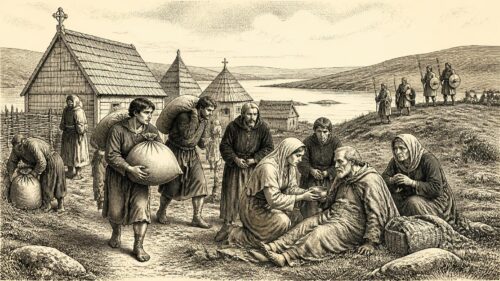
For communities living near sea-loughs, river mouths and island routes, raiding was not an abstract danger reported from afar. Boats were essential for fishing, travel, pastoral movement and communications, but they also made exposed coasts vulnerable. A raiding party could seize food, livestock, valuables and captives, then withdraw before a larger force assembled. The notices for 811 cannot tell us what was taken or lost in any individual encounter. They can show that local kings and their followers were expected to organise defence, and that success in doing so was sufficiently notable to enter the historical record.
Muirgius Moves South
Conflict within Irish society continued alongside the new maritime threat. The Annals of Ulster state that “the south was invaded by Muirgius son of Tomaltach, king of Connacht”. Muirgius was the leading figure of the Uí Briúin Síl Muiredaig, based in Mag Aí, the great plain around north Roscommon and north-east Galway. He had emerged as overking of Connacht after hard-fought struggles among rival dynasties and subordinate peoples. His hosting in 811 was therefore not an isolated adventure but part of a wider effort to impose and display authority beyond his own heartland.
Yet “the south” should not be expanded beyond what the annal says. It does not identify a destination, opponent, battle or tribute, and it does not demonstrate that Muirgius marched through all southern Ireland. The phrase may denote a southern zone of Connacht or a more distant southern expedition; the surviving notice cannot resolve that question. What is firm is that a king of Connacht led an invasion southward in 811. In early medieval Ireland, such a hosting was an exercise in politics as well as war: it could demand submission, collect cattle or other renders, punish resistance, secure routes, and proclaim the reach of a ruler’s protection.
Muirgius’s position also illuminates the limits of the idea of a single Irish kingdom. Áed Oirdnide of Cenél nÉogain was then king of Tara and the most powerful Uí Néill overking, but he did not command every regional king at will. Muirgius had previously opposed him in the politics of the midlands. In 811 the Connacht ruler could still lead his own southern campaign, while independent local rulers defended their own shores in Umall and Loch Léin. Authority was layered: provincial overkings, lesser kings, aristocratic kindreds, monasteries and churches all held land, clients, rights and influence.
Daire’s Law in Connacht
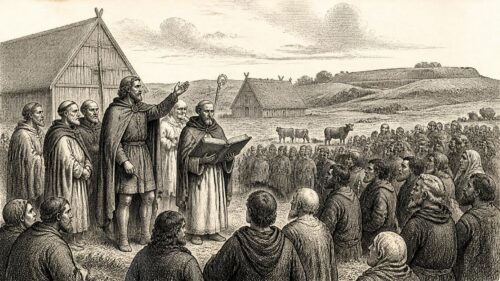
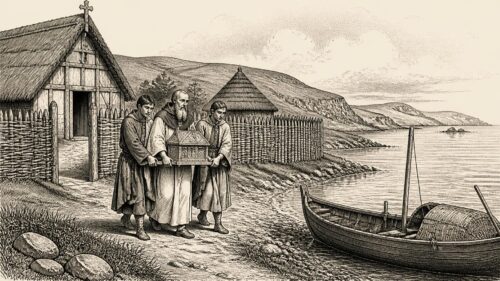
The year closes, in the annalistic sequence, with the statement that Daire’s law was promulgated in Connacht. This was no modern statute printed and circulated by a state. A saint’s law was a public ecclesiastical claim, advanced through ritual, proclamation and the support of secular rulers. It could establish or renew the privileges, protections, dues and sanctuary associated with a church and its saint. The record does not explain Daire’s law clause by clause, name its clergy, or identify the places through which it travelled. It would be unsafe to invent such details.
Nevertheless, the entry shows church and kingship acting in the same public sphere. The promulgation of a saint’s law required recognition by communities with competing interests, and it strengthened the institutional presence of the church across a region. Muirgius had already made use of ecclesiastical patronage in consolidating Connacht. The law of Daire, recorded in the year of his southern hosting, belongs to that political landscape: spiritual authority, legal privilege and royal power could reinforce one another, even though they were not identical.
Churchmen and Local Rulers
Several deaths recorded in 811 reveal the human infrastructure behind this world. Flann son of Cellach, abbot of Finglas, is described as a scribe, anchorite and bishop, and is said to have died suddenly. Echaid, bishop and superior of Tallaght, also died. These are unusually full descriptions, reminding us that senior churchmen could combine pastoral, scholarly, ascetic and administrative roles. Finglas and Tallaght were not isolated retreats: they belonged to networks of learning, landholding, worship and patronage that connected local communities to wider ecclesiastical politics.
Nuadu of Loch Uama, bishop, anchorite and abbot of Armagh, also died in 811. His accumulation of titles indicates the prestige of Armagh and the flexibility of Irish ecclesiastical office. An abbot was not simply the head of a cloister in the later medieval sense; leadership of a major church could entail responsibility for people, estates, relics, legal claims and relations with kings. The deaths of Flann, Echaid and Nuadu would have required succession in institutions whose authority reached well beyond their religious households.
The annals additionally record the deaths of Coscrach, king of Garbros; Cernach, king of Mugdorn in Brega; Flann son of Congalach, king of the Ciannachta; Aengus son of Dúnlang, king of Cenél Artgail; and Áed Rón, king of Corcu Baiscinn. Their titles map a political order made up of many small and medium-sized kingdoms rather than a simple hierarchy descending from Tara. A death could open a contested succession, alter alliances, or weaken a people’s capacity to resist neighbours. The sources do not describe those consequences in 811, so they should not be presumed; but the number of obituaries captures the island’s fragmented and intensely local politics.
A Year of Connected Pressures
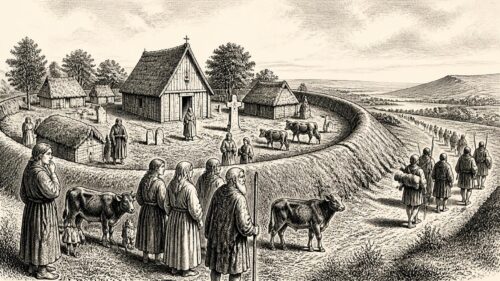
For ordinary households, the year’s consequences would have been felt through obligations more tangible than annalistic titles. Farming and cattle-rearing structured most livelihoods; rivers, lakes and sea routes carried people and goods; monastic settlements offered worship, education, craft production and market opportunities, but also imposed claims on surrounding land. A royal hosting could bring requisitions and danger. A saint’s law could redefine protection or dues. A raid could threaten coastal travel, livestock and kin. These are broader conditions of early ninth-century life, not separately dated events for 811, but they explain why the year’s short notices mattered.
811 was therefore neither a year wholly defined by Vikings nor one in which Irish rulers merely reacted to outsiders. Western and south-western communities fought Scandinavian raiders with mixed results; Muirgius of Connacht projected force southward; and Daire’s law was proclaimed within Connacht. At the same time, deaths in Armagh, Tallaght, Finglas and several regional kingdoms marked transitions in religious and secular leadership. The annals preserve only the leading contours. Even so, they show an Ireland of vigorous local societies, linked by church institutions and waterways, negotiating both internal competition and an increasingly disruptive seaborne world.
Primary Sources
- The Annals of Ulster: U812
- The Annals of Ulster: U811
- The Annals of Ulster
- The Annals of Ulster: U816
- Annals of the Four Masters, Part 64
- Annals of the Four Masters: Editions and Translations
- Annals of Inisfallen: Bibliographical Information
- The Annals of Tigernach
- Chronicon Scotorum
- Irish Texts at CELT
- Muirgius
- Áed Oirdnide
- Vikings in Ireland and Scotland
- Vikings in Early Medieval Ireland: Church-Raiding, Politics and Kingship
- Etchingham, Colmán, Vikings in Early Medieval Ireland: Church-Raiding, Politics and Kingship
- The Vikings in Ninth-Century Ireland: Sources and Settlements
- Clonmacnoise, County Offaly
- Clonmacnoise Monastic Site
- Irish School of Illumination, c. 650–1100
- The History and Provenance of Two Early Medieval Crosiers Ascribed to Clonmacnoise