Flann of Iona’s Passing891 CE
In 891, Irish annals record three modest yet revealing events: the death of Gormán son of Mugrón, king of Glennamain; the death of Flann mac Máel Dúin, abbot of Iona; and Máel Petair son of Cúán’s acquisition of Clonfert. Variant annalistic naming of Iona’s abbot illustrates the uncertainties of transmitted chronology, though scholars generally identify Faelán and Flann as one man. Iona remained an active Columban centre despite earlier Scandinavian raids, while authority was gradually shifting towards Irish houses such as Kells. Clonfert’s succession reflected ecclesiastical control of land, revenues and patronage. Gormán’s death demonstrates Ireland’s fragmented local kingship clearly.
Dateline
The surviving record for 891 is brief, but it catches Ireland at a meaningful religious and political threshold. The Annals of Inisfallen place three notices in this year: the death of Gormán son of Mugrón, king of Glennamain; the peaceful death of the abbot of Iona; and Máel Petair son of Cúán taking control of Cluain Ferta Brénainn, modern Clonfert in east Galway. These were not events on the scale of a great battle or a kingdom-wide assembly. Yet they illuminate how authority worked in late ninth-century Ireland: through local kingships, ecclesiastical successions, kinship networks and institutions whose influence travelled far beyond their immediate settlements.
The year must also be handled with care. Irish annals were compiled and recopied over centuries, and their chronological systems do not always align perfectly. The Annals of Inisfallen call the dead abbot of Iona Faelán son of Máel Dúin, while the Annals of Ulster and Chronicon Scotorum, under an entry calibrated to 891, call him Flann son of Máel Dúin. Modern discussion normally treats these notices as referring to the same man, Flann mac Máel Dúin. The discrepancy matters: it is a reminder that the sources preserve transmitted memories, not modern civil records. What can responsibly be said is that the death of Iona’s abbot belongs to the historical horizon of 891.
An Abbot of Iona
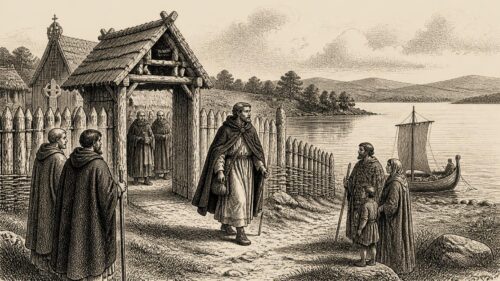
Flann’s death was important to Ireland even though Iona lies off the west coast of what is now Scotland. The island monastery had been founded by Colum Cille, or Columba, an Irish saint from the north-west, and remained central to a religious federation that crossed the North Channel and the Irish Sea. Its churches, dependent houses, relics, scholars and patrons linked communities in Ireland, Dál Riata and northern Britain. To be abbot of Í, as the annals call Iona, was therefore to hold an office embedded in Irish ecclesiastical life.
The title did not mean that one man ruled a neat monastic order from a single permanent headquarters. Early medieval Irish churches were organised through familiae: extended communities of churches associated with a saint, sustained by lands, tenants, clerics, lay dependants and aristocratic patrons. The successor of Colum Cille possessed spiritual prestige, but also responsibilities involving property, protection, hospitality, tribute and the arbitration of claims. An abbot’s death could consequently affect churches and families over a very wide area.
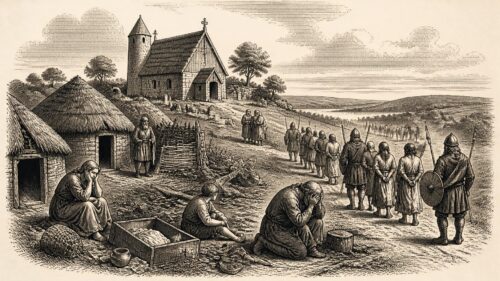
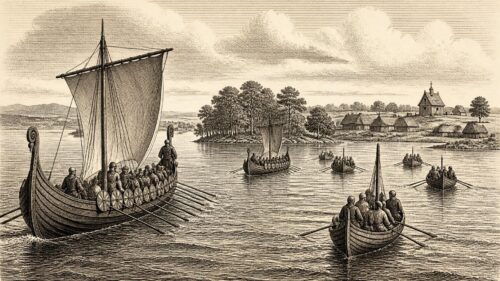
Iona had suffered repeated Scandinavian attacks earlier in the ninth century. Those raids were traumatic, but it would be wrong to picture the island as a deserted ruin by 891. The very record of an abbot’s death shows continuing institutional life, while archaeology and later evidence support the conclusion that Iona remained occupied and significant. Its community still inhabited a seaborne world in which travel was easier by boat than across many inland routes. Pilgrims, clerics, messengers and traders could move between the Hebrides, Ulster and the western Irish coast, carrying news, books, valuables and religious connections.
Flann’s passing has sometimes been treated as marking the end of the old pattern in which an abbot of Iona stood at the head of Columba’s wider federation. That is too simple if taken as an event completed in a single year. The redistribution of Columban authority towards Irish centres, especially Kells, was gradual and remains debated. Nevertheless, 891 is a useful point at which to see the transition beginning to sharpen. The death of an abbot named specifically for Iona came as the leading Columban inheritance was increasingly administered through Irish networks, even while Iona itself retained sacred standing and a living community.
Succession at Clonfert
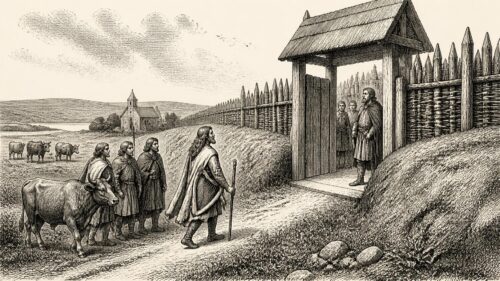
The third Inisfallen notice is more forward-looking: Máel Petair son of Cúán “took” Cluain Ferta Brénainn. The language is terse, but clearly signals an acquisition of ecclesiastical office at Clonfert, the church associated with St Brendan. This was not merely a vacancy filled in a secluded religious house. Clonfert was an established centre in Connacht, heir to the reputation of one of Ireland’s most celebrated monastic founders and voyaging saints.
Brendan’s cult connected western Ireland with a broader maritime Christian imagination. His Latin voyage tale, the Navigatio Sancti Brendani, had probably been composed by the late eighth century and would become famous far beyond Ireland. In 891, however, the relevant reality was less literary than institutional. Possession of Brendan’s church carried authority over a community, its lands and revenues, and its relationships with surrounding rulers. The selection or recognition of Máel Petair must have involved people whose names the annals do not record: senior clerics, local ecclesiastical households and secular patrons.
A later Inisfallen entry calls Máel Petair abbot both of Clonfert and of Tír dá Glas, or Terryglass, in north Tipperary. That later evidence should not be projected too confidently back onto the day he took Clonfert in 891; it does, however, show that he belonged to the mobile and interconnected ecclesiastical elite of the period. Major churches were not isolated spiritual islands. They shared personnel, learning, landed interests and routes of travel. A churchman’s authority could be recognised at more than one centre, especially where saintly foundations and political alliances overlapped.
A Small Kingship Ends
The death of Gormán son of Mugrón, king of Glennamain, provides the year’s explicitly secular notice. The entry offers neither a cause of death nor a successor. Such silence is typical of the annals and should restrain modern reconstruction. Gormán was not presented as a king of all Ireland, nor even of one of its major over-kingships. He ruled a smaller people or territory, probably associated with the Muirthemne region of the north-east, although the precise historical geography of Glennamain is not entirely secure.
His notice nevertheless reveals the density of Irish political life. Ireland was not a unitary state. It comprised numerous local kingdoms, each sustained by leading kin-groups, client relationships and control of productive land. Kingship was personal and competitive. A ruler’s death could prompt a negotiated succession, a contested claim, or violence, but the annals do not tell us which followed Gormán. We should not invent a crisis simply because one is conceivable. What the entry demonstrates is that local rulers mattered enough to be entered into an annalistic record otherwise concerned with saints, abbots and larger political affairs.
Above such kings stood more powerful rulers, including Flann Sinna of the southern Uí Néill, who was recognised in many sources as king of Tara from 879 until 916. His authority depended on military strength, alliances, hostages and ceremonial recognition rather than on a permanent national administration. In 891, then, the death of a minor king and the succession of an abbot belonged to the same political environment: a landscape in which control of people, churches, cattle, estates and routes mattered as much as formal titles.
Work, Worship and Communication
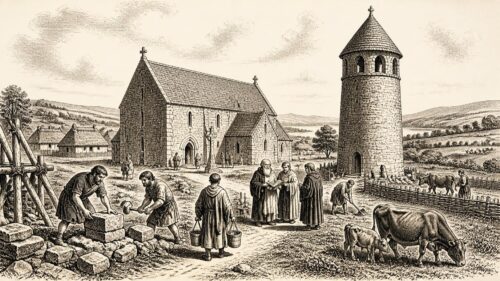
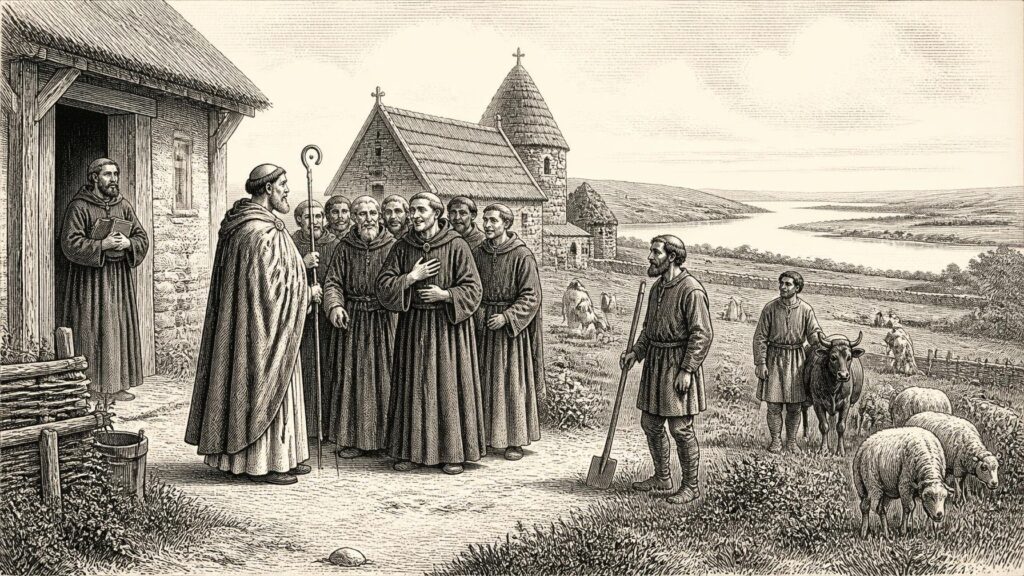
No annal describes an ordinary household in 891, but the year’s church notices allow a responsible glimpse of the labour underlying elite institutions. Monasteries such as Iona and Clonfert required food, fuel, livestock, building timber and skilled work. Their communities included priests and scribes, but also agricultural workers, craftsmen, servants and dependants. Fields and grazing sustained hospitality; boats enabled exchange; scribes produced or repaired books, charters and liturgical material; metalworkers and woodworkers made the objects needed for worship and display.
Religious houses also gave structure to memory. The annals’ formulae of “repose” and “rested in peace” did more than announce death. They placed abbots within a Christian community extending across generations. A successor was expected to maintain the saint’s inheritance: prayers, ritual observance, hospitality, education and the defence of rights. The record of Máel Petair taking Clonfert is thus a record of continuity as well as change.
Learning was part of that continuity. Iona was renowned for artistic and intellectual production, and its eighth- and ninth-century crosses testify to a culture in which stone carving, theology and patronage met. Clonfert’s claim on Brendan likewise connected local religious life with texts, liturgy and a saint’s far-reaching reputation. Nothing allows us to assign a particular manuscript, poem or work of art to 891 itself. Yet the institutions named that year had helped sustain the learned culture from which Irish annals, saints’ lives and religious literature emerged.
A Year of Successions
There is no securely dated Viking raid, major battle or national settlement recorded for Ireland in 891. That absence is itself worth observing. The late ninth century was certainly shaped by Scandinavian settlement, raiding and involvement in Irish politics, but not every year can honestly be made into a dramatic episode of conflict. In this year, the clearest evidence concerns death and succession.
Gormán’s death removed a local king from the political map. The death of Flann mac Máel Dúin, despite disagreement over the name preserved in one annal, affected the Columban world that linked Ireland and Iona. Máel Petair’s assumption of Clonfert placed a new custodian over one of Brendan’s principal churches. Together, these small notices show an Ireland held together not by a single centre, but by overlapping local lordships and religious communities. In 891, continuity depended on who could inherit a king’s following, an abbot’s office and a saint’s enduring authority.
Primary Sources
- Annals of Inisfallen, Part 45
- The Annals of Ulster
- Annals of the Four Masters, Part 72
- Chronicon Scotorum
- Vikings in Irish Chronicles, 794–902: Data
- Annals of Inisfallen: diplomatic edition
- The Annals of Tigernach, Part 12
- Iona and the Shrine of Columba, c. 800–1200
- Iona v. Kells: Succession, Jurisdiction and Politics in the Columban Familia in the Later Tenth Century
- A New Jerusalem ‘At the Ends of the Earth’: Interpreting Charles Thomas’s Excavations at Iona Abbey 1956–63
- Iona Abbey and Nunnery: History and Stories
- St Mary’s Abbey, Iona, Monastic Settlement (SM12968)
- The Alliance between Church and State in Early Medieval Alba
- The Vikings in Ninth-Century Ireland: Sources and Settlements
- Vikings in Ireland and Scotland
- Catalogue of Viking Raids on Irish Churches in the Annals, 795–1015
- The Earliest Wave of Viking Activity? The Norwegian Evidence Revisited
- Clonmacnoise, County Offaly
- Brendan (Brénainn)
- Irish Sagas: Táin Bó Cúalnge Names
- A Great Assembly of the Men of Ireland in Cluain Ferta Brénainn