Ímar’s Son Returns894 CE
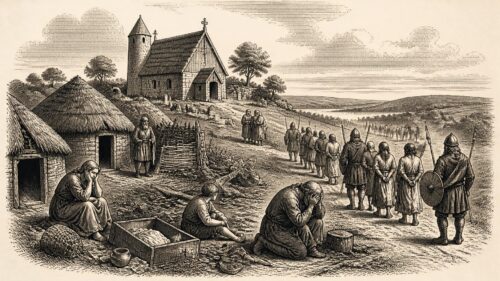
In 894, Irish annals record significant political and ecclesiastical developments. An unnamed son of Ímar returned to Ireland after dissension among Scandinavians at Dublin, although neither his aims nor success is known. Diarmait son of Cerball assumed kingship of Osraige, restoring dynastic rule in a strategic region between Munster and Leinster. Deaths of ecclesiastical stewards and abbots, including officers of Patrick’s community, Clonmacnoise and Lismore, underline monastic institutions’ temporal authority. Later annals preserve traditions concerning fairs, warfare and church profanation, but their chronology is uncertain. The evidence depicts fragmented Ireland shaped by regional rivalries, church power and Irish Sea mobility.
Dateline
A Year Recorded in Fragments
Ireland in 894 does not yield a single, panoramic narrative. The surviving annals offer instead a small number of terse notices: an overseas war-leader returned, a new king took Osraige, and prominent ecclesiastical officers died. That sparseness is itself important. Early Irish annals were selective records, not annual surveys of every kingdom or household; silence cannot be read as peace, prosperity or inactivity. Their chronological systems also require care. The Annals of Ulster place the relevant notices beneath a heading rendered “AD 893 alias 894”, while modern synchronised treatments conventionally retain the Viking entry under 894. For a year-by-year account, 894 is therefore the best practical placement, but claims should not be made more precise than the evidence allows.
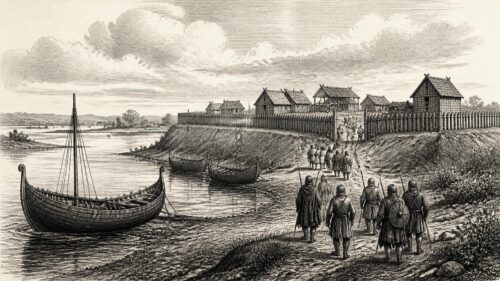
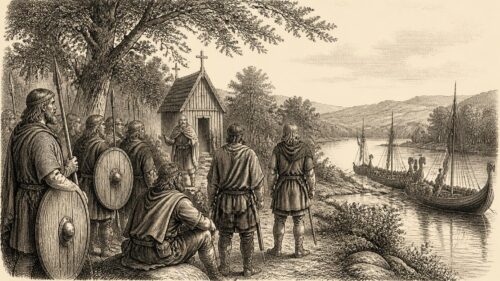
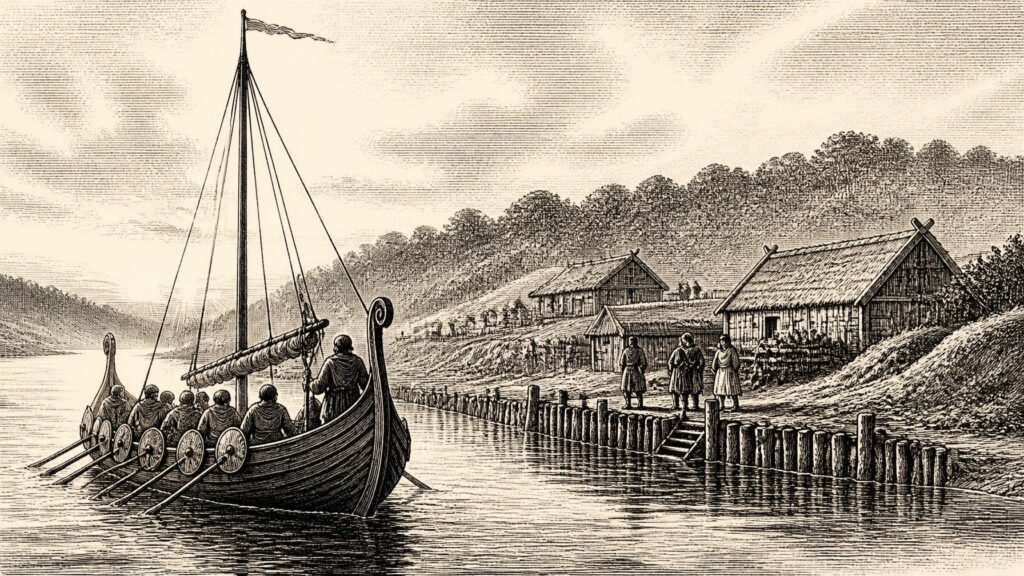
The clearest political development was the arrival “again” in Ireland of a son of Ímar. The annal gives neither his personal name nor his landing-place, destination or immediate purpose. It does, however, make plain that he was not a stranger arriving for the first time. The word “again” points to a figure already involved in the Irish Sea world, and it follows closely upon the recorded crisis among the Scandinavians of Áth Cliath, or Dublin. The previous annalistic year reports a great dissension there: one section followed Ímar’s son, another Sigfrith the jarl. A related notice in the Annals of Inisfallen says that the heathens had departed from Ireland. The return recorded in 894 should be understood against that background of division, movement and attempted re-entry, rather than as proof that one leader at once recovered Dublin or commanded all Scandinavian groups in Ireland.
The Irish Sea and Dublin’s Dispute
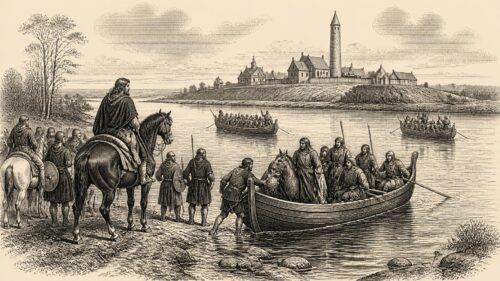
Ímar’s descendants, conventionally called Uí Ímair, were central to politics around the Irish Sea in the later ninth and tenth centuries. Their power was mobile: ships, armed followings, kinship and access to ports could matter as much as possession of a fixed territory. The 894 entry captures that reality in its most compressed form. A claimant or leader who had left amid factional strife could return with followers, allies or ambitions drawn from the wider sea-lanes linking Ireland, western Scotland, the Isles and northern Britain. Yet the annal does not describe a battle, a raid, tribute-taking or a royal proclamation. Those details must remain unknown.
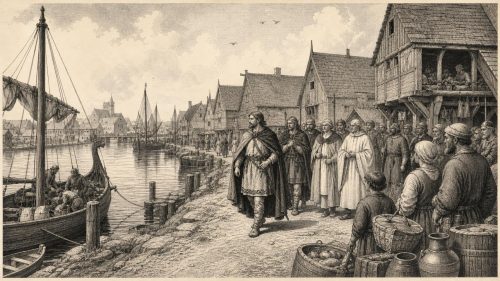
Dublin nevertheless mattered greatly to the conditions of the year. By this stage it was more than a temporary raiding camp. Research on ninth-century Viking activity stresses that the apparent reduction in some annalistic reports of raids coincided with increasing evidence for settlement, exchange and the use of strategic bases. Such a settlement did not replace Irish political structures; it became entangled with them. Irish kings could fight Scandinavian forces, bargain with them or use them in their own rivalries. The split reported before 894 reveals that Dublin’s foreign population was not a united bloc, while the return of Ímar’s son shows how quickly Irish affairs could be shaped by conflicts extending beyond the island.
For ordinary inhabitants of the Dublin region, the consequences were likely practical as well as political. A divided military community could disrupt security on roads and waterways, alter demands for food and livestock, and affect the traffic in people and goods on which the settlement depended. But no source permits a detailed reconstruction of the town’s streets or markets in 894. It is more responsible to say that the annals preserve the high-level outcome of instability—departure, then return—rather than the experience of each household.
Diarmait Takes Osraige
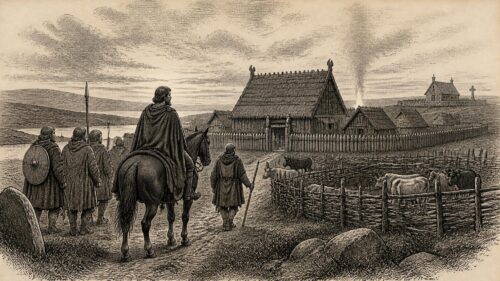
A second firmly relevant notice comes from the Annals of Inisfallen: Diarmait son of Cerball “took the kingship of Osraige”. This was a consequential succession in the south-east Midlands. Osraige lay between Munster and Leinster, across lands now associated principally with Kilkenny and neighbouring districts, and its rulers had long used that position to exert influence beyond their own core territory. Diarmait’s father, Cerball son of Dúngal, had been one of the most formidable Irish rulers of the Viking age. Cerball’s death in 888 had left a difficult inheritance; the accession of his son in 894 marked the renewal of that dynasty’s direct rule after the intervening reign of Cerball’s brother Riacán.
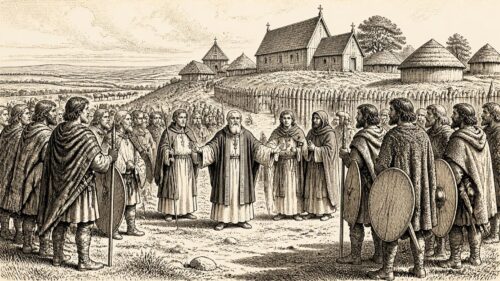
“Took the kingship” should not be mistaken for evidence of a modern-style, uncontested coronation. In early medieval Ireland, kingship depended on dynastic entitlement, military capacity, client relationships, ecclesiastical backing and the ability to distribute resources. The annal provides no account of Diarmait’s inauguration, no named opponent and no description of violence. Still, the choice to record his accession shows that it was recognised as a political change worth preserving. His rule would later face internal and external challenges, but those later developments should not be projected backwards into 894 as if they had already happened.
Diarmait’s accession also illuminates the fragmented character of Irish politics. There was no unitary Irish state whose business was settled in a capital. Flann Sinna of Clann Cholmáin was king of Tara and the leading Uí Néill ruler, with wide claims to supremacy, but provincial and regional dynasties retained substantial agency. Osraige’s location made its allegiance and strength a matter of concern to Leinster, Munster and the midlands alike. Thus a short annalistic sentence about a king in Osraige belongs to a larger story of negotiation and rivalry between overlapping centres of power.
Church Communities and Local Authority
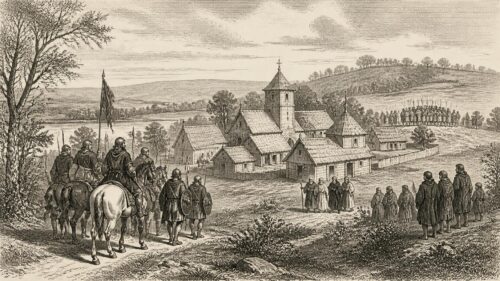
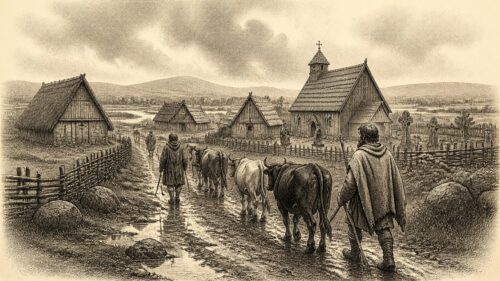
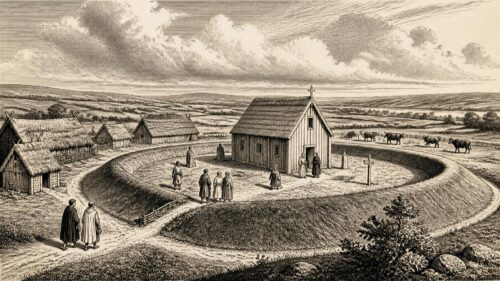
The deaths recorded under 894 show another dimension of power. The Annals of Ulster note Maelodar son of Forbasach, steward of Patrick’s community south of “the Mountain”; Lachtnán son of Máel Ciaráin, king of Tethba; and Fergus son of Máel Michil, steward of Clonmacnoise. The Annals of Inisfallen add the death of Flann son of Forbasach, abbot of Lismore, and the succession of Máel Brigte to its abbacy. These entries place royal, monastic and administrative authority side by side. A steward was not a decorative religious title: he managed the temporal interests of an ecclesiastical community, whose estates, tenants, dependants and valuable ritual possessions made it a significant social and economic institution.
Clonmacnoise is especially revealing. Situated beside the Shannon near a major route across the island, it was both a religious centre and a settlement with a large lay population. Its influence rested on learning, burial, patronage, craft production, agricultural resources and control of connections through the midlands. Fergus’s death in 894 does not tell us that the community was in crisis; it does show that its internal offices were important enough to enter the historical record. Likewise, the change of abbot at Lismore points to continuity as well as loss: monasteries were enduring corporate communities, capable of replacing a deceased leader and maintaining their claims.
Religious institutions also helped to preserve political memory. Annals were compiled and transmitted in ecclesiastical milieus, so their concentration on kings, abbots, stewards and major disruptions reflects the concerns of literate communities. This does not make them unreliable; rather, it tells us what kinds of events were judged memorable. The absence of entries on harvests, weather or disease in the surviving notices for 894 means that no island-wide environmental conclusion can responsibly be drawn for this year.
What Later Annals Add — and Cannot Settle
A much later compilation, the Annals of the Four Masters, places several dramatic episodes beneath its heading for 894: the renewal of a Connacht fair by Tadhg son of Conchobar; the renewal of the fair of Tailtiu by Diarmait son of Cerball; a Connacht expedition into Westmeath; the profanation of Inis Aingin, associated with the cult of Ciarán; and a defeat of the Connachtmen at Athlone. These are valuable traditions, particularly because they show how fairs, church sanctity, warfare and the Shannon corridor were remembered together. But they cannot automatically be treated as securely dated events of the calendar year 894. The Four Masters was compiled in the seventeenth century from earlier material, and Irish annalistic year-headings diverge across texts. In a strict annual account, these notices must remain later, chronologically uncertain testimony rather than the backbone of the year’s narrative.
What can be said with confidence is narrower but still meaningful. In 894, an unnamed son of Ímar returned to Ireland after Scandinavian dissension centred on Dublin; Diarmait son of Cerball assumed the kingship of Osraige; and the deaths of officers and abbots marked transitions within the intertwined worlds of lordship and church. Ireland was not quiet or isolated. It was a landscape of regional kingships, powerful ecclesiastical communities and sea-borne connections, where a single return across the water or succession in a neighbouring kingdom could alter the balance of influence far beyond the place named in the annal.
Primary Sources
- The Annals of Ulster: Year U894
- The Annals of Ulster
- Annals of Inisfallen: Annals AI890–AI899
- Annals of the Four Masters: Annal M894
- Annals of the Four Masters
- Chronicon Scotorum
- The Annals of Tigernach
- Fragmentary Annals of Ireland: Part 23
- Vikings in Irish Chronicles, 794–902: Data
- The Vikings in Ninth-Century Ireland: Sources and Settlements
- Vikings in Ireland and Scotland
- Flann Sinna
- Cerball
- Cerball
- Chronological Synchronisation of the Irish Annals
- Home Page for Dr Daniel P. McCarthy
- Exploring the Irish Annals
- Clonmacnoise Monastic Site
- Clonmacnoise Visitor Guide
- High Crosses