Fertas Battle668 CE
In 668, annalistic sources record the battle of Fertas, where the Dál Fiatach Ulaid defeated their Dál nAraide rivals and Cathassach son of Luirgéne was killed, probably near the lower River Lagan. Bishop Colmán, commonly identified with the former bishop of Lindisfarne, founded a church on Inishbofin after travelling from the Irish Sea world of Iona and Northumbria. The arrival of Gartnaid’s sons from Skye further indicates maritime connections. Notices of plague and elite deaths reflect continuing epidemic uncertainty. Though chronologically imperfect, the sources portray a politically divided, rural Ireland linked by warfare, monastic networks and sea travel.
Dateline
In 668 CE, the surviving Irish record brings together a northern battle, a western monastic foundation and evidence of continuing movement across the Irish Sea. These are not events with securely known days or seasons. They are annalistic notices, preserved in texts copied long after the seventh century and subject to differing chronological systems. The year is nevertheless conventionally associated with the battle of Fertas between the Ulaid and the Cruithin, and with Bishop Colmán’s journey to Inis Bó Finne, where he founded a church. The Annals of Ulster place both under their entry U668, although that manuscript’s calendrical heading equates the entry with AD 667; parallel chronicles and modern scholarship commonly connect the material with 668. This article therefore treats 668 as a carefully defined chronological setting, not as a claim that every notice happened on one precisely recoverable date.
A Ford Contested
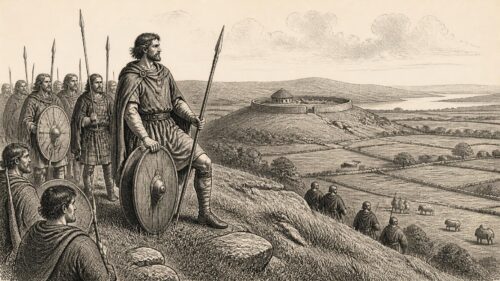
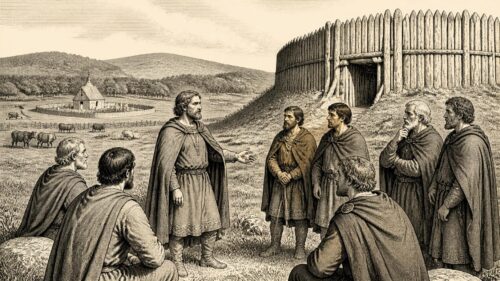
The most overtly political event attached to 668 was the battle of Fertas. The Annals of Ulster state tersely that it was fought “between the Ulaid and the Cruithin” and that Cathusach, or Cathassach, son of Luirgéne fell. Such compressed notices conceal as much as they reveal: no motive, troop numbers, battlefield narrative or formal settlement survives. Yet the names used by the annalist are significant. Here “Ulaid” denotes the Dál Fiatach, the dynasty then holding the overkingship of Ulaid, while “Cruithin” identifies their powerful rival, the Dál nAraide. These were Irish-speaking neighbouring peoples and dynasties, not simple ethnic blocs or modern national communities.
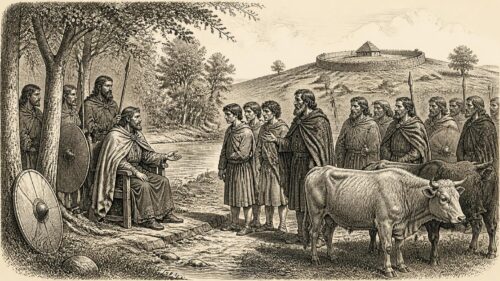
Cathassach was apparently a Dál nAraide ruler. His death was thus a serious reverse for a dynasty that repeatedly competed with Dál Fiatach for dominance in the north-east. Blathmac son of Máel Cobo, Dál Fiatach overking of Ulaid since 647, was probably the beneficiary of the victory, though the annal does not name him as commander. His reign had reportedly been largely peaceful before this late clash. The battle did not end the wider contest for Ulaid: its kingship remained vulnerable to rivalry within and between dynasties. It does, however, show that regional power could be decided violently at a crossing-place rather than only through the claims of more distant kings.
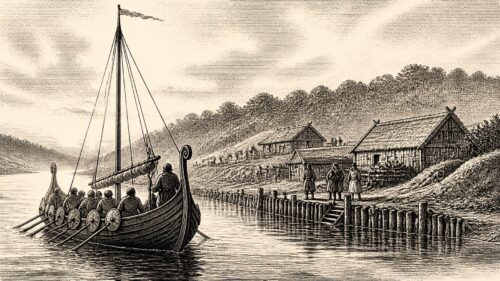
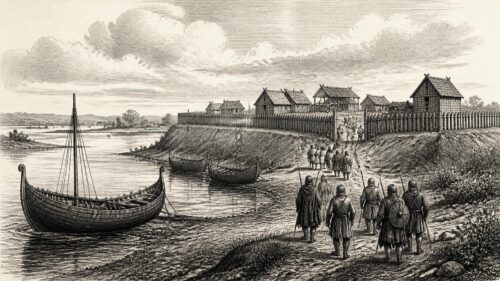
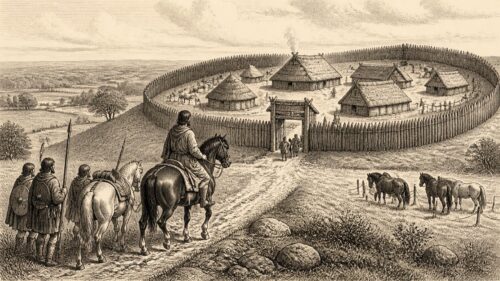
Fertas is generally, but not beyond doubt, associated with the strategic ford or sandbank crossing at the lower River Lagan, in the area of present-day Belfast. That identification gives the encounter an intelligible geographical setting. A tidal and riverine crossing linked routes along the shores of Belfast Lough and between territories later associated with Antrim and Down; it could also mark a political frontier. The location should not be imagined as a town in the modern sense. Seventh-century Ireland was overwhelmingly rural, but a ford could concentrate travel, cattle movement, raiding parties and armed followings. In that setting, control of a passage mattered economically as well as militarily.
Authority Beyond the High Kingship
Elsewhere on the island, Sechnassach son of Blathmac of Síl nÁedo Sláine was counted by later annalistic tradition among the kings of Ireland. His position did not make Ireland a united kingdom administered from a single centre. It was a hierarchy of overlordship, alliance, tribute and kinship, constantly negotiated among provincial and local rulers. The battle at Fertas is a useful corrective to any image of a high king directing every Irish affair: northern rivals fought over their own political landscape, and the sources do not suggest Sechnassach decided the result.
Chronicon Scotorum also records, under 668, the deaths of Fergus son of Muiccid and Muirchertach Nár, whom it styles king of Connacht and identifies as a son of Guaire. These notices hint at change among regional elites, but must be handled cautiously. Muirchertach’s royal title occurs in this chronicle rather than across a full set of concordant contemporary records, and the annals do not describe a succession or conflict arising from his death. Likewise, some deaths assigned to 668 by later compilations appear one year later in other annalistic sequences. The evidence permits recognition of political fragility, not an invented island-wide crisis.
Colmán’s Western Foundation
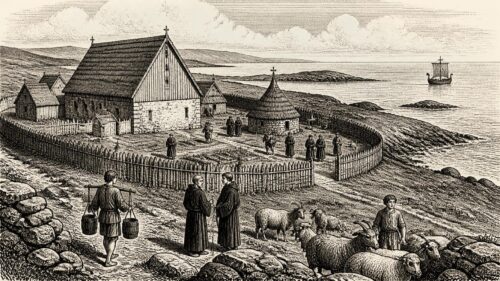
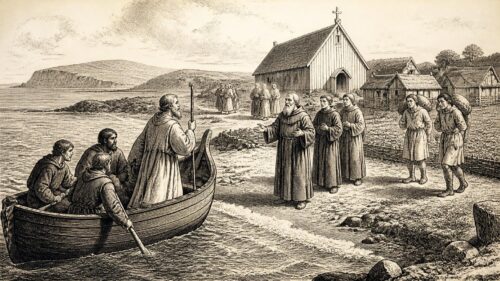
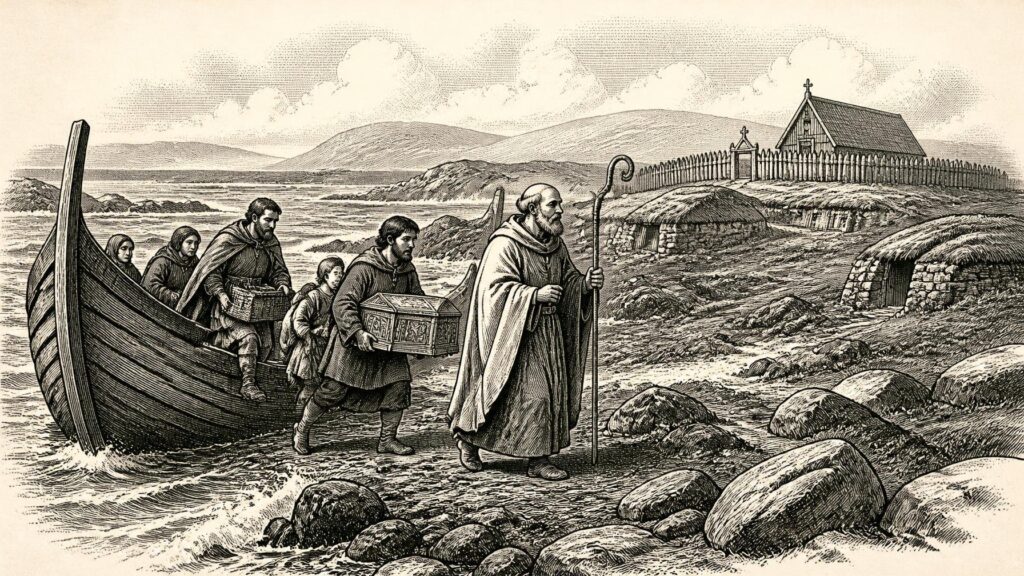
The year’s most consequential religious notice concerns Bishop Colmán. The Annals of Ulster describe his sea-voyage “with the relics of the saints” to Inis Bó Finne, the Island of the White Heifer, where he founded a church. Inis Bó Finne is normally identified with Inishbofin off the coast of modern County Galway. The statement is strikingly practical as well as devotional: a bishop, portable relics, a voyage, a named island and a foundation all appear in one sentence. Relics made a new church a place of sacred presence and institutional memory, while an island site could offer both seclusion and command of maritime routes.
This Colmán is usually identified with Colmán of Lindisfarne, the Irish bishop who had defended the Columban calculation of Easter at the Synod of Whitby in 664. Bede, writing in Northumbria within the following century, says that Colmán left Britain with the Irish clergy he had assembled at Lindisfarne and about thirty English monks trained in monastic life. He first went to Iona and then established a monastery on Inishbofin. Bede dates this sequence to 667, while the Irish annals connect the voyage and foundation with 668. The difference is a reminder that early medieval chronology is not always exact to a single modern calendar year; the convergence of Irish and Northumbrian testimony, however, makes the foundation itself secure.
Colmán’s arrival was not a simple retreat after defeat at Whitby. It carried people, learning, religious practice and prestigious objects across the sea. The foundation bound the western Irish coast into a network that included Lindisfarne and Iona. Bede’s later account says that tensions developed when Irish and English monks followed different seasonal patterns, and that Colmán eventually provided a separate mainland house for the English at Mayo. That later development should not be projected back into 668 as an accomplished fact. What can responsibly be said is that the Inishbofin settlement began as a mixed community whose composition made such negotiations possible.
Irish Sea Connections
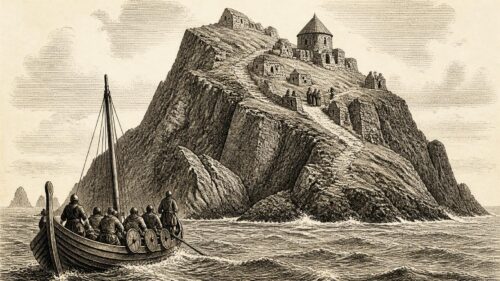
The same annal entry records another voyage: the sons of Gartnaid came to Ireland with the people of Scí, usually understood as Skye. The annalist does not explain whether they travelled with Colmán, why they came, or where they settled; the notices may simply have been copied together. Even so, their juxtaposition reveals an Irish Sea world in which the sea was a route rather than an outer boundary. Iona, Skye, western Ireland and Northumbria were linked by small vessels, monastic friendships, dynastic connections and the movement of communities. The word “voyage” is important: such travel required skilled crews, seaworthy boats, landing places, provisions and knowledge of coasts and currents.
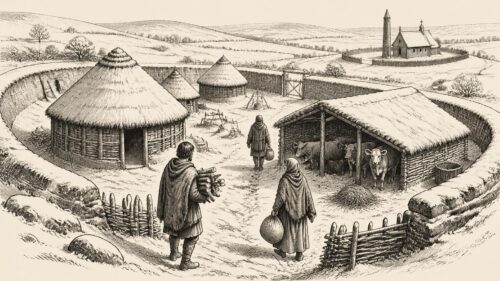
There is no reason to suppose that every traveller belonged to an ecclesiastical elite. A monastery needed food, timber, fuel, vessels, animal products and labour. Its foundation therefore touched nearby households as well as clergy. Yet the surviving notice gives no licence to describe a particular church building, harbour or island population in 668. Archaeology provides the broader setting instead. Ireland between 600 and 800 was densely rural by early medieval standards, with farmsteads, enclosed settlements, routeways and managed farmland. Cattle were central to wealth and status, alongside sheep, pigs and crops including barley and oats. Such work sustained both secular rulers and churches, whose communities depended upon local production and patronage.
Disease and the Limits of the Record
The Annals of Ulster also put “the great plague, that is the buide Chonaill” under U668. This must not be treated as proof that the epidemic began in 668, or that the named deaths in the following notice occurred then. Chronicon Scotorum dates the arrival of pestilence in Ireland to 664 and records the deaths of Diarmait and Blathmac, kings of Ireland, and many leading churchmen in the ensuing outbreak. The Ulster entry itself says that its list of victims comes “according to another book”, strongly suggesting that material has been repeated or displaced during transmission. Modern researchers commonly regard 664–668 as the span of a major epidemic, but its precise medical identity remains uncertain.
That uncertainty still conveys an important reality for 668. Illness remained part of the lived environment in a society where political households, monasteries and farms depended on people able to travel, herd, sow, harvest and provide military service. Mortality among kings and abbots appears most clearly because annalists named elite men; the effect on dependants, families and unrecorded communities is largely invisible. It would be irresponsible to calculate losses or claim a universal collapse. But the overlap of plague notices with warfare and institutional change shows a society managing danger without ceasing to contest territory, cross the sea or found churches.
A Year of Connections
For Ireland, 668 is therefore best understood through connections rather than an imagined single national narrative. At Fertas, Dál Fiatach and Dál nAraide rivalry turned a northern crossing into a battlefield and cost Cathassach his life. Off the western coast, Colmán’s foundation at Inis Bó Finne joined an island community to the religious and maritime worlds of Iona and Lindisfarne. Reports of travellers from Scí reinforce the same seaborne horizon. Behind these events lay cattle-based farming, crop cultivation, local labour and the continuing shadow of epidemic disease. The sources are brief, chronologically imperfect and elite-focused, but they preserve a vivid outline of an Ireland that was locally divided, internationally connected and still capable of creating durable religious institutions.
Primary Sources
- The Annals of Ulster: Year U668
- The Annals of Tigernach: Annal T668
- Chronicon Scotorum: Annals CS664–CS671
- Fragmentary Annals of Ireland: Annals FA 41–60
- Annals of the Four Masters: Annals M656–M680
- Chronological Synchronisation of the Irish Annals
- Ecclesiastical History of the English People, Book IV
- Colmán
- Colmán of Inis Bó Finne
- Blathmac
- The Vikings in Ulaid
- The Evolution of Belfast: A Historical GIS Approach
- From blefed to scamach: Pestilence in early medieval Ireland
- The Identification of Some Pestilences Recorded in the Irish Annals
- When Plagues and Pandemics Were Common in Ancient Ireland
- Agriculture, Settlement and Society in Early Medieval Ireland
- The Economy of Early Medieval Ireland
- Early Medieval Ireland: Archaeological Excavations, 1930–2009
- Early Medieval Farming and Food Production: A Review of the Archaeobotanical Evidence from Archaeological Excavations in Ireland
- Legal Position and Living Conditions of Peasants and Commoners in Early Medieval Ireland, c.680–c.1170
- The Economy of Early Medieval Ireland: EMAP Report 7.1
- Early Medieval Archaeology Project: Research Report 2.1