Riaccán’s River Victory892 CE
In 892, Riaccán son of Dúngal, of Osraige’s ruling dynasty, defeated Scandinavian forces associated with Waterford, Wexford and St Mullins, demonstrating local resistance along vital river routes. The annals’ reported two hundred heads signal a major victory but not a precise casualty total. Ireland remained politically fragmented under Flann Sinna’s loose overkingship; Tigernán of Bréifne also died. Obituaries for Máel Brigte of Clonmacnoise and Máel Corgais of Lorrha underline churches’ religious, economic and political importance. On 11 November, the Martinmas storm destroyed trees, houses and oratories. These notices portray a society dependent on vulnerable waterways, lordships, monasteries and rural resources.
Dateline
In 892, an Irish victory over Scandinavian forces operating from the south-east coast stands out amid a year otherwise marked by deaths in monasteries and kingdoms, and by a destructive November storm. The evidence is unusually revealing precisely because it is so compact. It places conflict along the river routes linking Waterford, Wexford and St Mullins; records the passing of the abbot of Clonmacnoise, a major religious and political centre; and preserves a fixed calendar date for an environmental disaster. Together, these notices show an Ireland in which authority depended on the safety of rivers, churches and local lordships as much as on the claims of kings.
Dating requires a little care. The Annals of Ulster place the deaths of Máel Brigte of Clonmacnoise, Máel Corgais of Lorrha and Tigernán of Bréifne, together with the Martinmas windstorm, under a heading equivalent to 892 in modern usage. The Annals of the Four Masters preserve the same cluster under their nominal year 888, because their early-medieval chronology is offset from the modern calendar. Modern specialist studies accordingly connect its additional notice of Riaccán’s victory with 892. The battle’s precise day and battlefield are not recorded; neither should be invented.
A Defeat on the River Routes
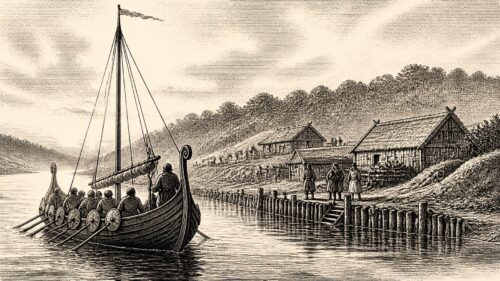
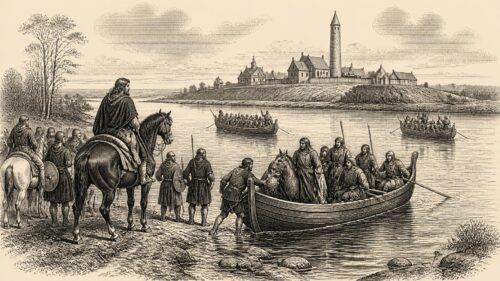
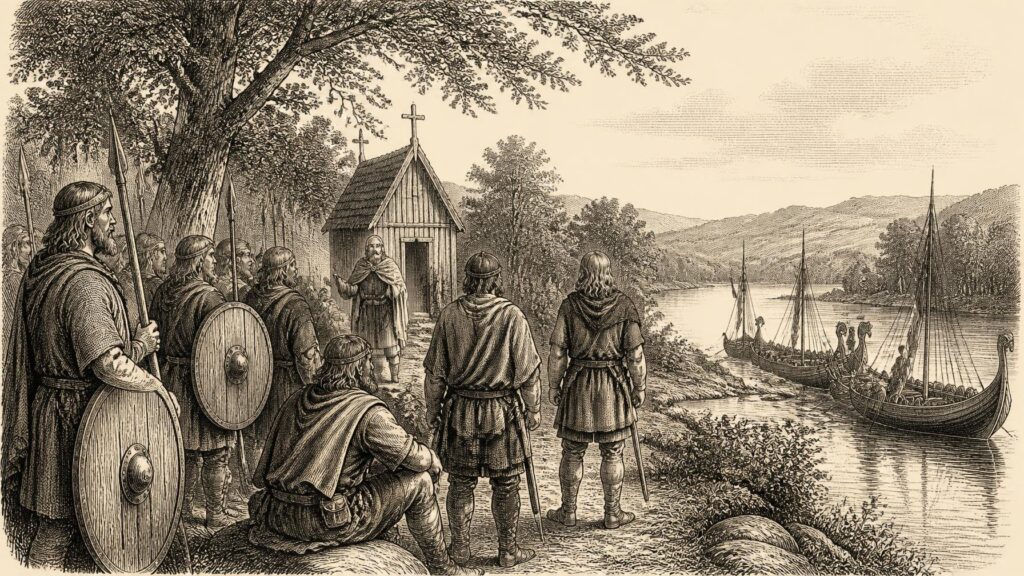
The most dramatic entry names Riaccán, son of Dúngal, as victor over “the foreigners of Port Láirge, Loch Carman and Tech Moling”. In modern geographical terms, these places correspond broadly to Waterford, Wexford and St Mullins on the Barrow in County Carlow. The annalist says that two hundred heads were left behind. Such figures must be treated cautiously: annals often use rounded or rhetorical totals, and this is not an archaeological body count. Yet the wording leaves no doubt that the encounter was remembered as a serious defeat, not a minor skirmish.
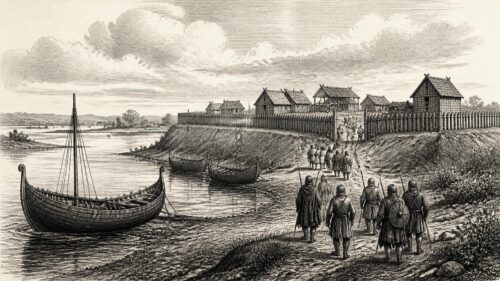
The phrase “foreigners of” three places is important. It indicates Scandinavian groups connected with more than one point along the south-eastern seaways and river corridors. It does not prove that Waterford or Wexford was already a continuously occupied town in the later medieval sense, nor does it permit a precise reconstruction of any camp. It does, however, strongly suggest bases, anchorages or recurrent operating points from which crews could move between the coast and inland waters. St Mullins, on the Barrow, was especially significant: a religious settlement beside a navigable route that led towards the fertile and politically contested lands of Leinster and Osraige.
Riaccán belonged to the ruling family of Osraige, the kingdom centred on the modern Kilkenny region. He was a brother of Cerball son of Dúngal, the formidable king of Osraige who had died in 888. Riaccán’s appearance in 892 therefore shows the dynasty still capable of leading armed resistance after Cerball’s death. The victory need not mean that Riaccán had become sole ruler of Osraige, and the annal does not give him a royal title. What it securely demonstrates is that he commanded enough local support to defeat seaborne enemies whose reach extended across three connected districts.
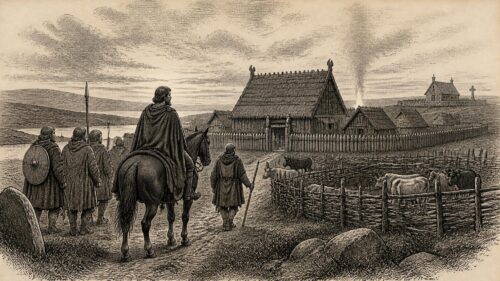
For communities near the Barrow and its tributaries, the stakes were immediate. River traffic carried people, livestock, food, tribute and prestige goods; the same waterways made monasteries, royal residences and farms accessible to raiders. A defeat inflicted on mobile Scandinavian forces could temporarily make a corridor safer, but it did not remove the wider danger. Norse and Norse-Gaelic groups were not a single army acting from one capital. Their alliances, leadership and locations shifted. Dublin remained the largest Scandinavian power centre in Ireland, but the south-east could sustain smaller and more fluid concentrations of ships and warriors.
Power Without a Single Kingdom
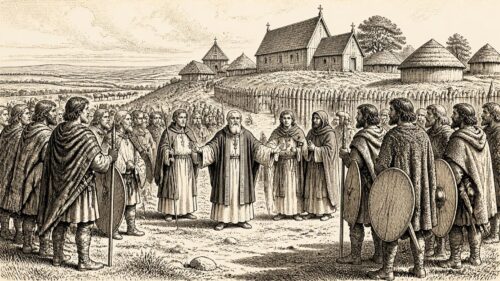
Ireland in 892 was not governed as a unitary realm. Flann Sinna of Clann Cholmáin, king of Tara, was the leading claimant to overkingship among the Southern Uí Néill and had held that position since 879. His authority rested on kinship, military capacity, hostages, alliances and influence over major churches rather than on a permanent national administration. Provincial and local rulers retained their own interests. Riaccán’s victory is therefore best understood as an Osraige achievement within a wider political order, not as a campaign directed by a modern-style Irish state.
The death of Tigernán son of Sellachán, king of Bréifne, was another reminder of this fragmented landscape. Bréifne lay across the Connacht–Ulster borderlands, a region whose rulers could affect communications between northern and midland powers. The annal merely records Tigernán’s death, not the circumstances, burial or succession. Still, the removal of a king was never a private matter. Kingship was embedded in competing kindreds, landholding, cattle wealth and the command of fighting men; a vacancy could create opportunities for rivals even where no immediate conflict was recorded.
The year’s evidence also cautions against presenting “Irish” and “Viking” as two unchanging blocs. The annals identify the defeated force as foreigners, and Riaccán’s side as an Irish dynastic force. But Scandinavian raiders and settlers were already participants in Irish political life, commerce and warfare, sometimes as enemies and sometimes as allies. The south-eastern battle belongs to that continuing process of negotiation and violence around ports, rivers and lordships.
Clonmacnoise and Lorrha
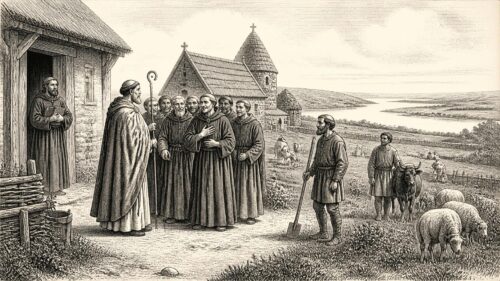
Máel Brigte, abbot of Clonmacnoise, died in 892. His obituary is spare, calling his death a peaceful “falling asleep”, but the office mattered greatly. Clonmacnoise occupied a strategic position on the Shannon, close to routes crossing the island and to the interests of the kings of Mide. It was a religious community, a centre of learning and manuscript culture, a place of burial and commemoration, and an estate with labourers, dependants and material resources. Its abbot was accordingly not simply a secluded spiritual superior. He stood at the meeting point of prayer, property, patronage and politics.
The death does not tell us what Máel Brigte achieved, who succeeded him, or whether the community altered its policies that year. Those details are lost. But the notice itself is evidence of Clonmacnoise’s standing: its abbot was deemed worthy of entry in annals that could be notably selective. Under Flann Sinna, Clonmacnoise was also increasingly tied to royal patronage. The famous Cross of the Scriptures belongs to the following century, but it expresses a relationship between king and monastery already visible in the political world of 892: major churches could strengthen a ruler’s legitimacy, while royal backing could protect and enrich an ecclesiastical community.
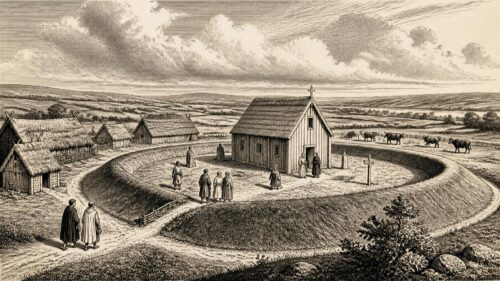
The annals also record the death of Máel Corgais, superior of Lothra, now Lorrha in north Tipperary. Lorrha had an early monastery associated with St Ruadhán and lay not far from the Shannon frontier. The term “superior” signals an ecclesiastical office without allowing us to impose later monastic structures upon it. His passing nevertheless points to the dense network of churches and religious communities that organised local life. Such establishments preserved worship and learning, but also depended upon fields, food renders, craftsmen and connections with lay patrons.
The Wind of Martinmas
One event can be dated exactly. On the feast of St Martin, 11 November, a great windstorm struck. The Annals of Ulster reports that it destroyed many trees in the woods and tore oratories and houses from their foundations. The Annals of the Four Masters, despite its chronological displacement, preserves much the same description. This agreement makes the storm one of the firmer events of the year.
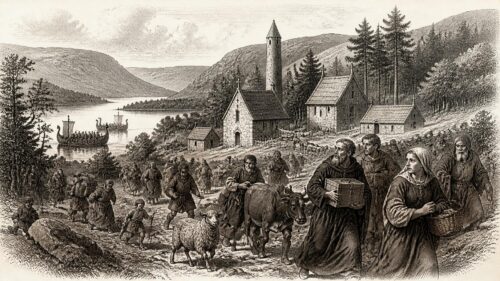
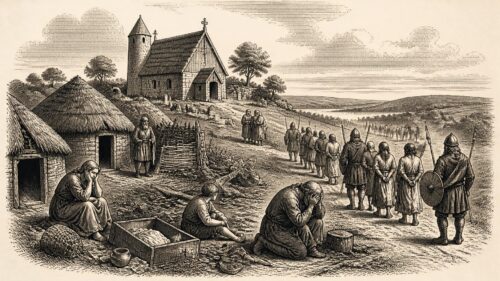
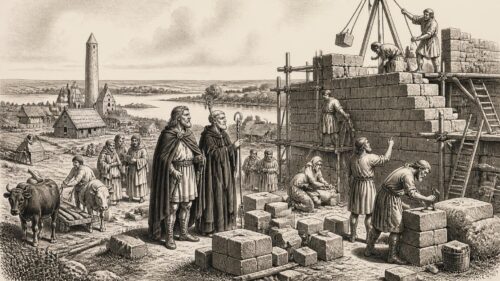
The language conveys damage on a national scale, but it should not be read as a modern meteorological survey. No track, wind speed or complete map of destruction survives. Even so, the named consequences are concrete. Woodland supplied fuel, timber, pannage and building materials. Houses and small church structures were vulnerable to severe weather, especially where timber, wattle, thatch and light roofing were used. Repairing roofs, replacing walls, clearing fallen trees and restoring an oratory demanded labour at the onset of winter, when daylight shortened and stored food mattered most.
For ordinary people, 892 was not experienced chiefly through annalistic entries. Most lived in a managed rural landscape of farmsteads, fields, pasture and woodland. Cattle remained central to wealth, food production and lordship, while grain cultivation, dairying, pigs, sheep, milling, weaving and craft work sustained households. Monasteries were part of this same economy rather than separate from it. A great storm could interrupt travel and damage buildings, but its effects would have been absorbed differently by a powerful church with patrons, a lordly settlement able to demand labour, and a poorer household reliant on its own kin and neighbours.
A Year of Vulnerable Connections
The surviving record for 892 is not a full national narrative. It gives no reliable basis for claiming a general famine, a countrywide political settlement or a single coordinated war. What it does reveal is a society joined by vulnerable connections. Scandinavian crews used the sea and rivers; Osraige leaders could mobilise against them; kingship changed hands in Bréifne; abbots died at Clonmacnoise and Lorrha; and one storm damaged woods, homes and sacred buildings on 11 November. Riaccán’s victory may have checked a south-eastern threat, but the year’s deeper lesson is how closely power, livelihood and religious life depended on routes and structures that could be contested, damaged or swept away.
Primary Sources
- Annals of Ulster, U892–U893
- Annals of Inisfallen, Part 45
- Annals of the Four Masters
- Annals of the Four Masters: Project Description and Chronology Note
- Chronicon Scotorum
- Vikings in Irish Chronicles, 794–902: Data
- Exploring the Irish Annals
- The Vikings in Ninth-Century Ireland: Sources and Settlements
- Viking Activity in Ireland by County in the Annals
- Vikings’ Settlements in Ireland Before 1014
- Flann Sinna
- Cerball
- Early Medieval Archaeology Project: Early Medieval Agriculture and Economy
- The Archaeology of Livestock and Cereal Production in Early Medieval Ireland, AD 400–1100
- The Economy of Early Medieval Ireland
- Early Medieval Ireland: Archaeological Excavations, 1930–2009
- Clonmacnoise Monastic Site
- High Crosses
- Lorrha Dominican Priory
- Irish School of Illumination, c. 650–1100
- The Vikings
- St. Mullins Tourism and Heritage Masterplan 2022–2032