Kells’s Violated Sanctuary904 CE
In 904, Flann Sinna, king of Tara, violently confronted his adult son Donnchad at Kells, where the Annals of Ulster record the profanation of the sacred site and the beheading of many men near its oratory. The episode, imperfectly dated, reveals dynastic conflict overriding sanctuary. Deaths of the leaders of Clonmacnoise, Glendalough and Emly marked transitions within influential ecclesiastical centres. Beyond Ireland, Ímar, grandson of Ímar, was killed by men of Foirtriu, reflecting instability after Dublin’s 902 expulsion of Scandinavian rulers. Later attribution of Clonmacnoise’s stone church to 904 is unreliable; evidence dates it to 909 rather than that year.
Dateline
Dating a Difficult Year
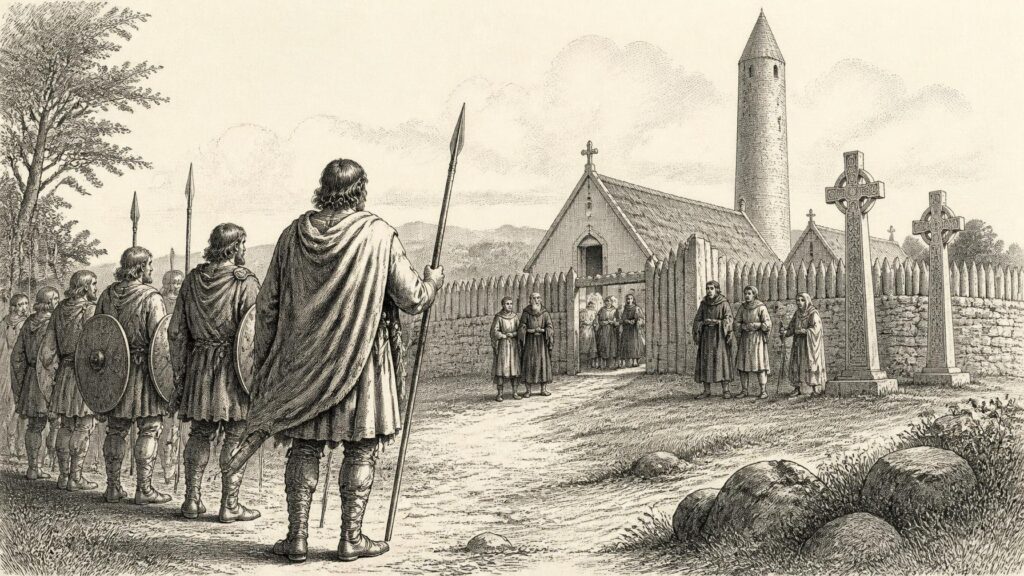
The surviving Irish annals make 904 CE a year of unusual clarity in one respect and frustrating silence in others. Their most vivid record concerns a violent royal intervention at Kells, in modern County Meath: Flann Sinna, king of Tara and leading ruler of the Southern Uí Néill, acted against his own son Donnchad. The Annals of Ulster state that Kells was “profaned” by Flann against Donnchad and that many men were beheaded around the oratory. This is not a story that can safely be expanded into a detailed battle narrative. We do not know why Donnchad was at Kells, whether he had sought sanctuary there, how long the confrontation lasted, or precisely who died. But the wording is strong enough to show that royal family conflict had entered a holy enclosure and left a memorable stain upon it.
There is a chronological caution at the threshold. The annal is headed 904 in the modern edition of the Annals of Ulster, but its manuscript dating formula allows an alternative year-numbering. Such slippage is normal in early medieval Irish chronology, where different annals sometimes place the same occurrence a year apart. The episode belongs securely to the period conventionally treated as 904, even if no day or month can be recovered. It should therefore be understood as a year of dynastic repression at Kells, not as a neatly dated event in a modern calendar.
Flann and Donnchad at Kells
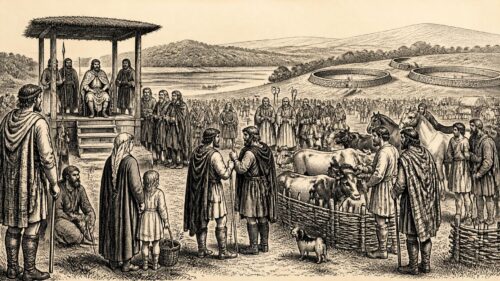
Flann Sinna had ruled from Tara since 879. He was a Clann Cholmáin king of Mide whose power rested on lordship within the Southern Uí Néill, military force, political alliances and influence over great churches. The title often translated as “high king” is useful only with care: Ireland was not a centrally governed kingdom. Flann did not command an all-Ireland bureaucracy or permanent national army. His authority depended on personal dominance, tribute, hostages, marriage ties, campaigning and the willingness of provincial rulers and ecclesiastical communities to recognise his standing.
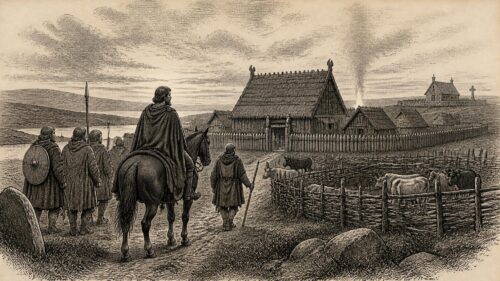
Donnchad, the son challenged in 904, was no child. He was an adult dynast with his own future claim to the kingship of Tara. The annal’s identification of him as Flann’s “own son” gives the incident much of its force. This was not simply an expedition against a distant rival but a public rupture within the ruling house. The source does not explicitly say that Donnchad had rebelled, although later historical interpretation reasonably treats Flann’s action as the suppression of a revolt or challenge. It is safer to say that Donnchad stood in opposition to his father and that Flann answered with lethal force.
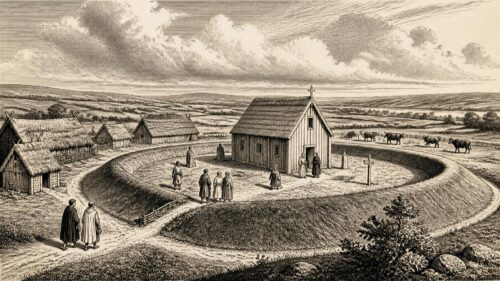
Kells mattered greatly as the setting. It was a Columban monastery of long standing, associated with the community that had received relics of Columba from Iona in 878. It was a place of worship, learning, landed resources and political importance, not an isolated retreat beyond worldly affairs. An oratory was the immediate sacred heart of such a community. To kill men around it was an affront recognised by the annalist as sárugud, a violation or profanation. That judgement does not mean that kings normally stood outside religious law; rather, it shows how extraordinary and morally charged this assertion of royal power appeared.
Sanctuary, Violence and Authority
The Kells episode exposes a central tension in early medieval Ireland. Churches offered spiritual authority, ritual protection and sometimes a practical refuge for people caught in conflict. Kings also needed them. Monasteries preserved genealogies, trained clerics and scribes, received gifts, controlled estates and linked rulers to revered saints. A king who entered a sacred precinct violently could gain his immediate objective while risking the reputational damage that the annal’s language preserves. Flann’s willingness to do so suggests that the danger posed by Donnchad, or the need to demonstrate mastery over him, outweighed restraint.
The victims are anonymous. “Many” were beheaded, but the annal does not identify them as warriors, retainers, tenants, churchmen or members of Donnchad’s household. Their anonymity is itself revealing. Annalists were often concerned with kings, bishops and abbots, yet the practical burden of dynastic politics fell most harshly on less prominent people: armed followers, household dependants and local communities obliged to supply food, transport, intelligence or shelter. In 904 the chronicler’s brief notice permits no reconstruction of individual lives, but it does preserve the human cost of a contest for succession.
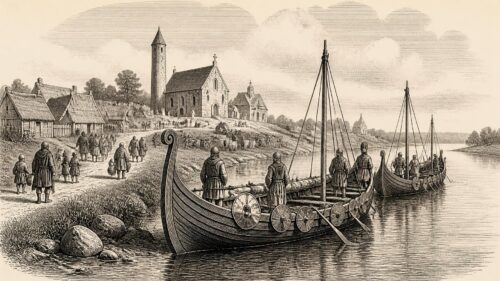
Nor should Kells be imagined as a stone-built modern town. Its ecclesiastical settlement included churches, burial ground, workshops, dwellings and agricultural spaces, much of it likely constructed in timber. Roads and routeways connected it to the political heartland of Mide and to the wider network of Columban churches. The splendour now associated with Kells’s crosses and the Book of Kells should not obscure the vulnerability of such a place: prestige, portable treasure, food stores and royal connections could make a monastery attractive both as refuge and as target.
Church Leadership in Transition
Three deaths recorded for the year underline the importance of ecclesiastical office to Ireland’s public life. Ioseph, abbot of Clonmacnoise, “rested in peace”. Clonmacnoise stood beside the Shannon at a major crossing of routes through the island. It was a religious community, but also a populous settlement whose influence rested on pilgrimage, learning, craftsmanship, estates and strategic geography. The death of its abbot was therefore not merely an internal monastic matter. It involved the succession to a powerful institution whose leadership could be connected to the interests of kings and regional families.
Bishop Dúngal, described as superior of Glendalough, also died “as an old man in Christ”. Glendalough, in the Wicklow mountains, had grown far beyond the memory of its sixth-century founder Kevin. Its community drew authority from its saintly past, its valley setting and its religious reputation. Dúngal’s double description as bishop and superior shows that episcopal and monastic leadership could overlap. Irish church organisation was not arranged simply as later territorial dioceses would be; major churches and their hereditary or politically connected office-holders could hold influence across broad networks of people and land.
The Annals of Ulster also note the death of Flann son of Conall, abbot of Imlech Ibuir, generally identified with Emly in Munster. The notices from Clonmacnoise, Glendalough and Emly range from the Shannon basin through Leinster to Munster. They do not prove coordinated national policy in 904, but together they show an island in which major ecclesiastical centres remained essential centres of authority. For clerics, lay tenants, craftspeople and visitors, a change of abbot or bishop could affect patronage, estate management, education, hospitality and the protection offered by powerful allies.
After Dublin’s Expulsion
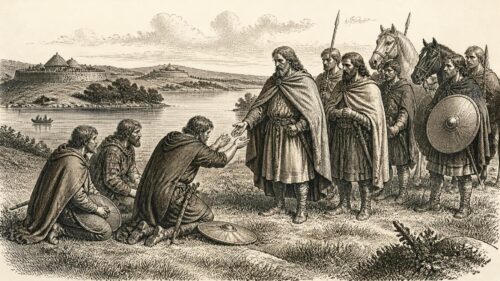
The year also has an Irish dimension beyond the island. The annals record that Ímar, grandson of Ímar, was killed by the men of Foirtriu, with “great slaughter” around him. Foirtriu lay in northern Scotland, yet the death is directly relevant to Ireland because Ímar belonged to the Scandinavian-Gaelic political world that had centred on Dublin. Only two years earlier, in 902, Irish forces led by Cerball of Leinster and Máel Finnia of Brega had expelled the foreigners from their fortified base at Áth Cliath.
Ímar’s death should not be presented as an Irish victory: the annal names the men of Foirtriu, not an Irish army. Nor does it demonstrate the permanent destruction of Scandinavian power. It does, however, illuminate the mobility of the displaced Dublin leadership. The Irish Sea connected rather than separated Ireland, western Britain and Scotland. The fall of Dublin in 902 forced members of the Uí Ímair kindred to seek opportunities elsewhere; the killing of Ímar in 904 is a sharp indication that their fortunes remained precarious. Dublin would return to Scandinavian control in 917, but that later reversal must not be read back as inevitable in 904.
What Cannot Be Assigned to This Year
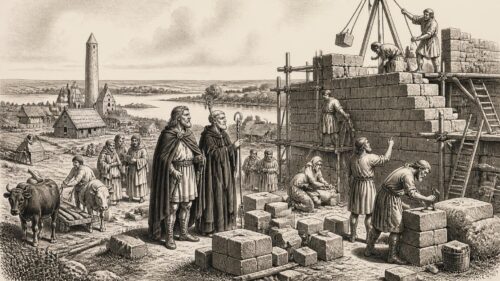
Later annalistic tradition requires special care. The Annals of the Four Masters, compiled in the seventeenth century from earlier materials, place the erection of a great stone church at Clonmacnoise by Flann Sinna and Abbot Colmán under 904. Other evidence and modern historical dating place that building in 909. It is therefore not responsible to describe the church’s construction as an event of 904 merely because one later chronicle uses that year-number. The connection is still useful: it shows that Flann’s kingship was closely tied to patronage of Clonmacnoise, but the famous stone church belongs to the later phase of his reign.
Thus 904 is best remembered not for a general war or a sweeping political settlement, but for the collision of kinship, kingship and sanctuary at Kells. Flann’s violence against Donnchad revealed the fragility behind royal authority; the deaths of leading churchmen marked transitions at important religious centres; and Ímar’s fall in Foirtriu showed that the upheaval following Dublin’s expulsion was playing out across the Irish Sea. The surviving notices are short, but together they present an Ireland in which sacred places, family rivalry and overseas movement were tightly entangled.
Primary Sources
- The Annals of Ulster: Year U904
- CELT Project: The Annals of Ulster
- Chronicon Scotorum: Annal CS904
- CELT Project: Chronicon Scotorum
- Annals of the Four Masters: Annal M904
- CELT Project: Annals of the Four Masters
- Flann Sinna
- Donnchad Donn
- Clonmacnoise, County Offaly
- Clonmacnoise Monastic Site
- Clonmacnoise Visitor Guide
- Kells Monastic Site
- Glendalough Monastic Site and Visitor Centre
- High Crosses
- CELT Project: Annals of Inisfallen
- CELT Project: Annals of Tigernach
- CELT Project: Fragmentary Annals of Ireland
- Vikings in Irish Chronicles, 794–902: Data
- The Dating of the Irish Annals
- The Practice of Irish Kingship
- The Multivocality of the Cross of the Scriptures
- Vikings in Scotland and Ireland in the Ninth Century