Flann’s Osraige March905 CE
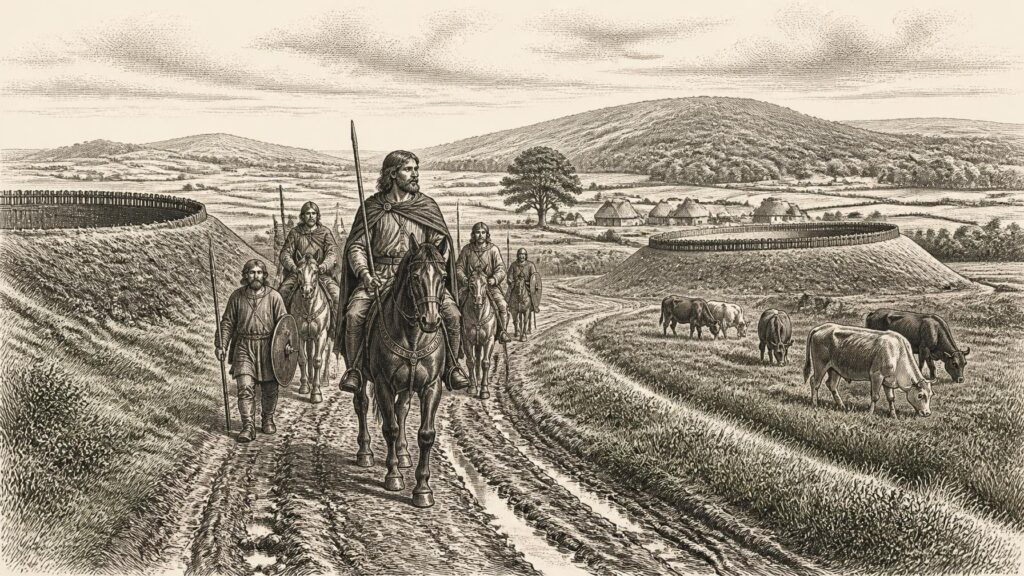
In 905, the Annals of Ulster record Flann Sinna, king of Tara, leading an expedition into strategically important Osraige, amid rivalry with Munster and instability within its ruling dynasty. The source does not specify fighting or outcomes, but the march demonstrated royal pressure in a region linking Leinster and Munster. Máel Ciaráin, bishop of Lann Léire, and Lachtnán, abbot of Ferna, died, highlighting ecclesiastical succession and local power. In the north, Cenél nÉogain prevented battle between Domnall and Niall, sons of Áed Findliath. These sparse notices reveal interconnected kingship, church institutions, rural resources, diplomacy, and tensions preceding wider conflict soon.
Dateline
A Spare but Revealing Record
The surviving annalistic record for 905 is brief, but it catches Ireland at a politically consequential moment. The Annals of Ulster, under the entry conventionally assigned to this year, note an expedition by Flann son of Máel Sechnaill to Osraige; the death of Máel Ciaráin son of Fortchern, bishop of Lann Léire; the death of Lachtnán, abbot of Ferna; and a threatened battle between Domnall and Niall, sons of Áed, which the Cenél nÉogain prevented. None is supplied with a day, season or detailed narrative. They should therefore be treated as securely associated with the annal-year, not as events whose exact dates or sequence can be recovered.
This restraint matters. Later annals place dramatic battles, fleets, burnings and portents under a year numbered 905, but their chronological systems do not always align with those of the Annals of Ulster. Some such notices belong, in a synchronised chronology, to later years. For 905 itself, the firm evidence is smaller in scale: a royal progress or campaign into the south-east; the passing of two church leaders; and successful intervention to avert a dynastic conflict in the north. Yet these entries illuminate the connected worlds of kingship, monasteries and local communities on the eve of a major struggle for influence across Ireland.
Flann Sinna Moves South
Flann Sinna, king of Tara and head of the southern Uí Néill, led the expedition to Osraige. He had ruled since 879 and was among the strongest Irish overkings of his generation, but his authority was neither a modern national monarchy nor a command automatically obeyed everywhere. Ireland was divided among many kingdoms and lordships. A king of Tara could claim pre-eminence, draw allies into hostings and receive tribute or hostages, but he needed to make that supremacy real through personal relationships, military pressure and conspicuous movement across the landscape.
The annal merely says that Flann made an expedition to Osraige. It does not state whether there was a pitched battle, a siege, plundering, tribute, hostages, negotiations or a change of ruler. None should be invented. Even so, the choice of destination was highly significant. Osraige, broadly corresponding to much of later County Kilkenny and adjoining areas, sat between Leinster and Munster, with routes linking the midlands to the south-east. Its rulers could affect the balance between the king of Tara, the kings of Leinster and the increasingly forceful kings of Cashel.
Flann also had a personal connection with the region. His mother, Land daughter of Dúngal, belonged to the Dál mBirn ruling kindred of Osraige. Kinship, however, did not guarantee obedience. Royal families were large, competitive and accustomed to faction. The death of the formidable Cerball son of Dúngal in 888 had left Osraige politically unsettled. By the opening years of the tenth century, Diarmait son of Cerball had been displaced and his brother Cellach held the kingship. Flann’s march in 905 was thus directed into a kingdom whose internal division and strategic location made it an obvious arena for an overking’s intervention.
Pressure at the Munster Frontier
The expedition also belongs to the growing contest between Flann and Cormac son of Cuilennán, king of Cashel. Cormac was not only a ruler of Munster but a bishop and a learned churchman, an unusual combination that gave his public authority particular weight. He and his ally Flaithbertach son of Inmainén were extending Munster’s influence north and east, especially towards Leinster and Osraige. For Flann, an assertive Munster threatened the political arrangements on which his own standing rested.
Osraige was therefore more than a neighbour needing correction. It was a hinge territory. A friendly or compliant ruler there could obstruct Munster’s advance and reinforce connections between Tara and Leinster; an Osraige aligned with Cashel could expose Leinster and weaken Flann’s southern position. The expedition of 905 was likely intended as a demonstration of superior force and a demand for political recognition. It may have involved a sizeable retinue of warriors, clients, churchmen and supply personnel, but the annal does not allow a reconstruction of its route or numbers.
Its importance is clearer in retrospect. Flann undertook another southern expedition in the following annal-year, and the rivalry with Cormac soon became open warfare. The battle of Belach Mugna in 908, where Cormac and Cellach of Osraige were killed by a coalition led by Flann and Cerball of Leinster, was still in the future. In 905, the outcome remained undecided. Flann’s advance into Osraige shows that the political crisis was already developing through targeted campaigns rather than arising suddenly on a battlefield.
The Cost of a Hosting
A royal expedition was an event felt far beyond the men named in the annals. Armies travelled with food requirements, horses and baggage; local rulers faced demands for provisions, submission or security. In an economy where cattle were a principal measure of movable wealth, control of herds, grazing and the labour needed to sustain households had direct political value. A campaign could disrupt planting, harvesting and seasonal movement even when no battle was recorded. Raiding and the threat of raiding were instruments of government as well as of warfare.
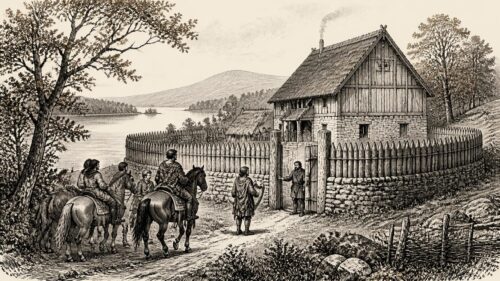
Most people in and around Osraige lived in dispersed rural settlements: farmsteads enclosed by earthen banks or, where stone was plentiful, cashels. Their mixed economy depended on cattle, dairying and cereals, with milling, craftwork and woodland resources contributing to household survival. Such communities were not passive scenery for royal politics. Their produce sustained kings and ecclesiastical establishments; their local elites supplied followers; and their vulnerability gave a hosting leverage. The silence of the sources about ordinary people should not be mistaken for an absence of consequences.
Nor was political power exercised only through destruction. Hostages, gifts, food-renders and formal acknowledgements were all means by which an expedition might produce an outcome without an annalist recording combat. The surviving notice is best read as evidence of assertion, not proof of a particular victory. Flann had entered Osraige with sufficient purpose for the action to be entered in a chronicle, but the terms secured there remain unknown.
Two Ecclesiastical Deaths
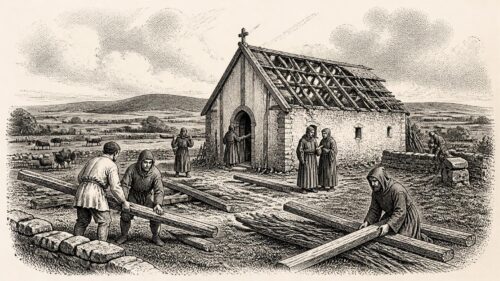
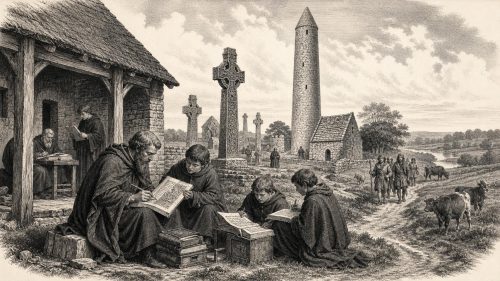
The deaths recorded in 905 bring the church into the same political landscape. Máel Ciaráin son of Fortchern is called bishop of Lann Léire, the important ecclesiastical settlement generally identified with Dunleer in modern County Louth. Lachtnán was abbot of Ferna, now Ferns in County Wexford. Their titles do not imply two neatly separate institutions resembling modern dioceses and monasteries. Early medieval Irish churches were organised around powerful local communities, their churches, lands, tenants, clergy and hereditary associations. Bishops performed sacramental functions, while abbots and other ecclesiastical superiors often controlled the community’s property and public leadership.
Lann Léire stood in the north-eastern lowlands, on routes connecting the Boyne region, southern Ulster and the Irish Sea. Its repeated appearance in the annals indicates a long-established church of regional consequence. The death of its bishop was not simply a private bereavement: it created a vacancy in a position bound up with local status, learning, pastoral duties and the management of resources. The annal’s formula that he ‘rested’ expresses a Christian ideal of death, while preserving the fact that an institutional office had changed hands.
Ferna occupied a different but equally strategic setting in Leinster. Its monastery, associated with Máedóc, had become an important religious centre in a kingdom where dynastic rivalry and church patronage were closely entwined. By 905, Ferns had already endured Viking attack in earlier generations, yet it had endured as a centre of worship, landholding and memory. Lachtnán’s death therefore reminds us that ecclesiastical continuity depended on succession as much as royal government did. An abbot’s replacement could shape alliances, protection, learning and the distribution of local wealth.
Peace Among the Cenél nÉogain
The final notice is especially revealing because it records a conflict that did not happen. Domnall and Niall, sons of Áed Findliath, prepared to fight one another, but the Cenél nÉogain intervened through entreaty and prevented the battle. Their father had been king of Tara before Flann, and the brothers belonged to the dominant northern Uí Néill people of Cenél nÉogain. Competition between such close kin was structurally common: royal succession did not normally pass by strict primogeniture, and several adult members of a ruling lineage might have credible claims to leadership.
The wording gives no detail about the settlement. It does not say which brother had the stronger claim, whether hostages were exchanged, or whether churchmen participated in mediation. But it demonstrates that collective pressure could restrain a princely feud. The ‘Cenél nÉogain’ were not a single obedient bloc; they included leading kindreds and followers with much to lose from internal warfare. Avoiding battle preserved men, livestock, honour and the group’s capacity to act against rivals beyond its territory.
The episode also suggests that diplomacy was not an interruption of politics but one of its essential forms. Persuasion, arbitration and the weight of kinship could be as decisive as weapons. In a year remembered for Flann’s outward projection of force, the northern entry records a different exercise of power: a community preventing its own rulers from turning a succession dispute into a destructive war.
A Year Before Escalation
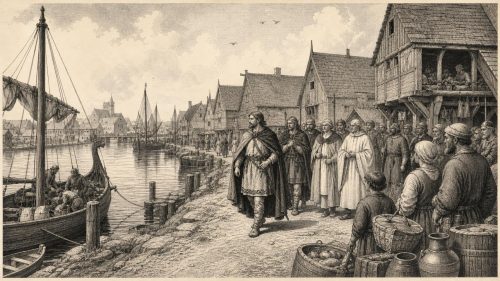
There is no Viking raid recorded for Ireland in the principal Ulster annal entry for 905, and no securely dated catastrophe to dominate the year. That relative quiet should not be mistaken for stability. Dublin’s Scandinavian rulers had recently suffered reverses, while Hiberno-Norse maritime networks and Irish Sea connections continued to matter to Irish politics and trade. The more immediate pressures visible in 905, however, were Irish dynastic ones: Flann’s attempt to hold the south-east within his political orbit, Osraige’s contested kingship, Munster’s rising ambition and the delicate cohesion of the northern Uí Néill.
Thus 905 was not a year of one famous battle or transformative decree. It was a year in which authority was tested in motion. Flann marched to a strategically vital kingdom; bishops and abbots died at established centres; and a northern people stopped a fraternal dispute from becoming war. The annals leave much unsaid, but their spare notices preserve the outlines of an Ireland in which kingship, ecclesiastical institutions and rural resources were inseparable—and in which the choices made in one seemingly quiet year helped prepare the conflicts soon to follow.
Primary Sources
- The Annals of Ulster
- CELT project: The Annals of Ulster
- Flann Sinna
- Chronicon Scotorum
- CELT project: Chronicon Scotorum
- Annals of the Four Masters, Part 1
- CELT project: Annals of the Four Masters
- Annals of the Four Masters, Part 73
- Annals of Inisfallen, Part 5
- Fragmentary Annals of Ireland
- CELT project: Fragmentary Annals of Ireland
- The chronology and sources of the early Irish annals
- The Dating of the Irish Annals
- The Irish Annals: Their genesis, evolution and history
- Kingship, Society, and Sacrality: Rank, Power, and Ideology in Early Medieval Ireland
- Religion and society in Ireland
- Early Christian Monasteries
- Rathbeagh Ringfort, Co Kilkenny
- Farming and Archaeology
- Brú na Bóinne Research Framework
- Dunleer: County Louth Urban Archaeology Survey
- The Origin and History of Irish Names of Places
- Ferns Archaeological Excavation Report 2022
- The Cult of Relics in Medieval Ferns