
A Shattered Kingship1024 CE
In 1024, Ireland remained fragmented after Máel Sechnaill’s death, with authority contested among provincial dynasties, Norse-Gaelic towns and church interests. Leinster suffered upheaval when Úgaire, king of Leinster, and Máel Mórda of Uí Cheinnselaig were killed during Donn Sléibe’s seizure and burning of a house; Donn Sléibe was later slain. Fighting marked Corann, Ulster and the midlands, while Irish forces raided Foreigners for hostages and wealth. Ecclesiastical deaths, pilgrimages and attacks on Slane and Kildare demonstrated churches’ scholarly, economic and political importance. Cúán ua Lothcháin, Ireland’s chief poet-historian, was murdered, emphasising the learned class’s prestige amid endemic violence and instability.
Dateline
The Ireland visible in the annals for 1024 was not a quiet island recovering neatly from the age of Brian Bórama. It was a landscape of competing provincial dynasties, church estates, learned households, Norse-Gaelic towns and cattle-rich lordships, all trying to adjust after the death of Máel Sechnaill mac Domnaill in 1022. The entries for this year are brief, but they are unusually revealing. They show a Leinster kingship violently broken, warfare on the Connacht-Ulster frontier, pressure around the Hiberno-Norse world, the killing of Ireland’s most eminent poet-historian, and a steady stream of ecclesiastical notices from the learned churches of Munster and the midlands.
The year itself is firmly anchored by the chronicle tradition. The Annals of Ulster, Annals of Tigernach, Annals of Inisfallen and Annals of Loch Cé all mark 1024 with kalendrical notes: the Kalends of January fell on the fourth feria, and the year was a bissextile, or leap year. Such entries are more than scribal tidiness. They remind us that Irish monastic chroniclers placed local killings, burnings and successions within a Christian chronology shared across Europe. Yet the events they chose to record were intensely local, often concerned with the survival of dynasties and the honour or violation of churches.
After the High-Kings
By 1024 no ruler could claim the island-wide standing that Brian Bórama had sought and that Máel Sechnaill had briefly recovered after Clontarf. Modern historians often describe the decades after 1022 as a period in which no single king was acknowledged throughout Ireland. That is context rather than a single event of 1024, but it is essential to understanding the year. Donnchad son of Brian was consolidating in Munster and would soon seek wider hostages; the Uí Néill still mattered in the north and midlands; Dublin and other Norse-Gaelic powers retained hostages, wealth and military reach; Leinster was divided among rival branches of its ruling kindreds.
The annals of 1024 do not record a national assembly, a coronation or a settled succession. Instead, they record fractured authority. Men styled king, lord, royal heir or chief poet appear not as secure office-holders but as targets. The political order was one in which kingship had to be continually demonstrated through raids, hostage-taking, protection of churches, distribution of wealth and victory over rivals. Failure could be immediate and fatal.
Leinster In Flames
The most dramatic event of the year was the death of Úgaire son of Dúnlaing, king of Leinster. Several annals agree on the core facts. At Dubloch, Donn Sléibe son of Máel Mórda, king of Uí Fáeláin, captured the house in which Úgaire was present with Máel Mórda son of Lorcán, king of Uí Cheinnselaig. The house was taken, and in some versions burned, and Úgaire, Máel Mórda and others were killed there. The Annals of Inisfallen summarise the matter starkly: Úgaire was killed with his princes by Donn Sléibe in one house.
This was not simply an assassination. It exposed a dangerous struggle within Leinster’s ruling world. Úgaire belonged to the Uí Dúnlainge milieu that had long supplied kings of Leinster, while Uí Cheinnselaig, based in the south-east, were rising in importance. Donn Sléibe’s own Uí Fáeláin connections placed him within another powerful Leinster branch. The attack at Dubloch therefore looks like an act in a wider contest over Leinster’s future, not an isolated feud.
Donn Sléibe did not long enjoy the result. The annals record that he was afterwards killed by the Uí Muiredaig. The Four Masters and Tigernach add that he had gone raiding into Uí Failge and was overtaken and slain at or near the place where plunder from Kildare was divided. The detail is important because it links elite politics to the economic violence of raiding. Spoil, especially livestock and movable church wealth, was not incidental to war; it was the material proof of power. It also shows the danger of attacking sacred or prestigious places such as Kildare. Chroniclers frequently presented the fall of plunderers as moral retribution, and 1024 offered them a ready example.
Raids, Hostages And Frontiers
Conflict was not confined to Leinster. In the north-west, the battle of Áth na Croise in Corann was fought between Ua Maíl Doraid of Cenél Conaill and Ua Ruairc of Bréifne. The annals agree that Ua Ruairc was defeated and that a slaughter was inflicted on his side. Corann lay in the wider Sligo-Roscommon frontier zone, between the ambitions of northern and Connacht powers. The entry’s preserved verse in the Annals of Ulster, celebrating Cenél Conaill glory and a field filled with bodies, suggests that memory of the battle circulated in poetic form as well as annalistic prose.
In Ulster and the midlands, the records are terse but cumulatively telling. Domnall son of Aed, heir designate of Ailech, was killed by Gilla Mura son of Ócán. Mael Dúin ua Con Chaille, king of Uí Nialláin, was killed by the Uí Dorthainn. Mael Ruanaid ua Ciarda, king of Cairpre, was killed by his own people. A son of Ua Néill made a foray and plundered Uí Méith and Uí Dorthainn. These entries name small kingdoms and border peoples whose politics rarely receive narrative explanation, but the pattern is clear: succession disputes, revenge killings and predatory expeditions shaped everyday political life.
The Norse-Gaelic or Hiberno-Scandinavian presence also remains visible. Tigernach records a rout called the Rout of the Staves inflicted by Gerr Gaela on the Foreigners. Another entry says that the son of Eochaid made a hosting against the Foreigners and brought away the hostages of the Gaels with other spoil. The Four Masters preserve a similar notice, adding the burning of their territory, and also record an expedition by the Osraige and Leinstermen to Tulcainne where jewels and hostages were obtained from the Foreigners. These notices cannot all be expanded into a detailed campaign, but they show that the Norse-Gaelic towns were still central to Irish power politics. They held hostages, accumulated portable wealth, and could be attacked by Irish kings seeking both prestige and leverage.
Churches And Learned Men
The church notices for 1024 are strongest in the Annals of Inisfallen, whose Munster interests are evident. Ua Maíl Shluaig, coarb of Mo-Chutu, died. Mael Mórda Ua hArrochtáin, lector of Emly, was remembered as the most notable man in Munster for almsgiving and largesse. Niall Ua Cellaig, lector of Tuaim Gréine, died. Senchán son of Flaithbertach went on pilgrimage to Inis Cathaig, the island monastery associated with St Senán. Dúngal Ua Donnchada, later remembered as king of Cashel, was also noted as being on pilgrimage.
Such entries tell us much about Irish society in this year. A coarb was the successor or representative of a founding saint, often controlling church lands and rights. A lector was a senior scholar and teacher, a reminder that monasteries were centres of Latin learning, vernacular scholarship, legal memory and political record-keeping. Pilgrimage, whether to an Irish holy island or eventually overseas, was both an act of devotion and a recognised late-life choice for kings and clerics. The annals do not describe ordinary worshippers, but these notices imply communities of tenants, students, craftsmen, servants and dependants clustered around important churches.
At the same time, churches were not outside politics. Slane was, according to Tigernach, plundered, robbed and burned by Domnall the Stammerer. Kildare appears in connection with the division of plunder. In nearby years the annals record burnings of Armagh, Kildare and Glendalough, so the 1024 notices belong to a broader pattern in which churches were both sacred institutions and wealthy targets. Their relics, cattle, books, bells and rights mattered because they embodied spiritual authority and economic power.
The Death Of Cúán
The most culturally significant death of 1024 was that of Cúán ua Lothcháin, described as chief poet of Ireland and, in some versions, a learned historian or chief sage. He was killed in Tethba, in the midlands, by the men of Tethba themselves. The annals add a striking moral tale: those responsible were said to have become putrid within the hour, or to have died an evil death. The accounts call this a poet’s miracle.
The miracle language should not be read simply as reportage. It reflects the prestige and feared power of the learned class. A poet of Cúán’s standing was not merely an entertainer. Poets preserved genealogies, praised and shamed kings, maintained place-lore, and helped shape the public memory on which dynastic legitimacy depended. Modern scholarship attributes to Cúán a substantial body of learned poetry, though not every attribution can be treated with equal certainty. His killing in 1024 therefore marks more than the death of an individual. It shows that learned men could be drawn into local violence, and that chroniclers considered an attack on such a figure a violation demanding supernatural explanation.
Life Beneath The Annals
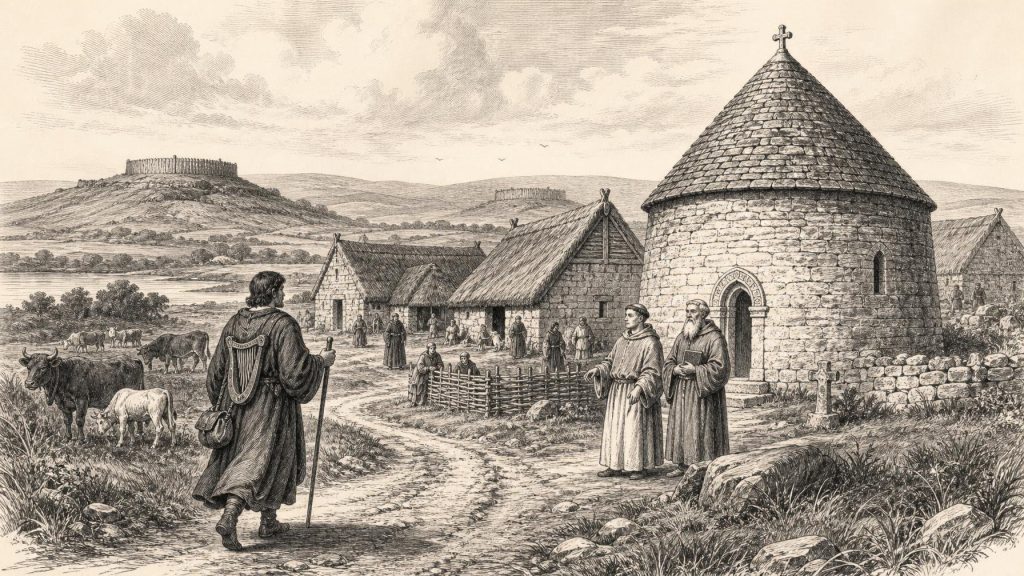
For most people in Ireland, 1024 was not experienced as a sequence of named royal deaths. It was lived in farmsteads, ringforts, crannogs, church settlements and coastal towns. Archaeology and law texts from the wider early medieval period show a society heavily dependent on cattle, dairying, cereals, pigs, sheep, craft production and seasonal labour. The annals’ repeated emphasis on forays and plunder should be read against that background. A raid was not only a political message; it could strip a district of cows, horses, captives, tools and stored wealth.
Trade continued through Dublin, Waterford, Limerick, Cork and Wexford, though the 1024 entries do not give a market description. Dublin in this era was a major Irish Sea port, a place of coinage, craftwork, imported goods and human trafficking. The references to hostages and jewels held by the Foreigners fit that wider picture of towns as treasuries and diplomatic hubs. Yet rural Ireland remained dominant. Kings made their authority visible by taking hostages, protecting or exploiting churches, and redistributing cattle and valuables to followers.
Seen as a whole, 1024 was a year of unsettled succession rather than decisive transformation. Leinster’s leadership was violently shaken; northern and western rulers fought across frontier zones; churchmen died, travelled and taught; and Cúán ua Lothcháin’s murder reminded contemporaries that words, pedigree and memory were forms of power. The annals offer no grand conclusion, but their fragments reveal an Ireland in which political authority was local, mobile and dangerous, and in which sacred learning stood close to the violence it sought to judge.
Primary Sources
- The Annals of Ulster: Year U1024
- TEI Header for Annals of Ulster otherwise Annala Senait
- The Annals of Tigernach, Part 16
- CELT Project: Annals of Tigernach
- CELT Project: Annals of Inisfallen, English Translation
- CELT Project: Annals of Inisfallen, Irish Text
- CELT Project: Annals of Loch Cé
- Annals of the Four Masters, Part 13
- CELT Project: Chronicon Scotorum
- Chronological Synchronisation of the Irish Annals
- The Life and Work of Cúán Ua Lothcháin
- Ua Lothcháin, Cúán | Dictionary of Irish Biography
- Donnchad | Dictionary of Irish Biography
- Sitriuc Silkbeard | Dictionary of Irish Biography
- Brian Bórama (Bóruma, Boru) | Dictionary of Irish Biography
- Ua Néill, Áed | Dictionary of Irish Biography
- Life after Brian: the High-Kingship
- Early Medieval Ireland: Archaeological Excavations, 1930–2009
- The Archaeology of Livestock and Cereal Production in Early Medieval Ireland, AD 400–1100
- Early Medieval Dwellings and Settlements in Ireland, AD 400–1100
- Dublin City Urban Archaeology Survey
- The City of Dublin | The Viking Ship Museum
- Irish Script on Screen: MS D ii 3, The Stowe Missal and Bookshrine
- History | Christ Church Cathedral Dublin