Sanctuary and Strife1043 CE
In 1043 Ireland remained politically fragmented, with Donnchad mac Briain’s prestige contested and Diarmait mac Máel na mBó consolidating Leinster. Annals record local warfare, killings and cattle raids, including violence at Glendalough, where sanctuary was breached, and fighting around the Suir. Northern conflicts involved Uí Méith, Ua Ruairc, and competing Uí Néill dynasties. Churches were both targets and political actors: Ciarán’s community ritually denounced Aed Ua Con Fhiacla, whose subsequent death was viewed as saintly vengeance. Cathal of Connacht died while pilgrim at Armagh. Despite insecurity, ecclesiastical centres sustained learning, wealth, pilgrimage and networks alongside rural farming and maritime trade.
Dateline
Ireland in 1043 was not governed as a single, centralised kingdom. It was a landscape of provincial rulers, regional kings, local dynasties and ecclesiastical communities, bound together by shifting relationships of tribute, kinship, alliance and hostility. Since the death of Máel Sechnaill mac Domnaill in 1022, no claimant had secured undisputed island-wide supremacy. Donnchad mac Briain remained king of Munster and possessed considerable prestige as a son of Brian Bóruma, but his wider authority was contested. In Leinster, meanwhile, Diarmait mac Máel na mBó had recently emerged as provincial king, beginning the rise that would make him one of the dominant Irish rulers of the mid-eleventh century.
A Fragmented Political Order
The surviving annals do not record a great national assembly or island-wide campaign in 1043. Instead, they present a series of local confrontations extending from Ulster to Munster. This pattern is itself significant. A king’s authority depended upon his ability to defend territory, obtain hostages, reward followers and punish challenges, while subordinate rulers constantly tested the strength of neighbours and overlords. Raiding was not merely uncontrolled violence: it was a recognised instrument of politics, capable of transferring livestock, damaging an opponent’s standing and compelling submission without requiring permanent occupation.
The broader political context was one of changing regional fortunes. Diarmait’s acquisition of the Leinster kingship in 1042 followed years of warfare involving the Uí Chennselaig, the Uí Dúnlainge and the rulers of Osraige. Donnchad mac Gilla Pátraic of Osraige had briefly held the Leinster overkingship before his death in 1039, while Murchad mac Dúnlainge, king of Leinster, was killed in 1042. Although Diarmait is not assigned a specific campaign in the annals for 1043, the violence recorded within Leinster belongs to the unsettled environment in which his new supremacy was being consolidated.
Violence in Leinster
Domnall Ua Fergaile, king of the Fortuatha Laigen, was killed during the year. The Annals of Ulster and Annals of Loch Cé say that he was slain by his own people, while the Annals of Tigernach and the later Four Masters identify the killer as a son of Tuathal son of Fiachra and place the act in the sanctuary of Cóemgen, meaning Glendalough. These accounts need not be wholly incompatible: the named assailant may have belonged to Domnall’s political community. His death nevertheless illustrates the vulnerability of lesser kings, who could be overthrown by internal rivals as readily as by foreign enemies.
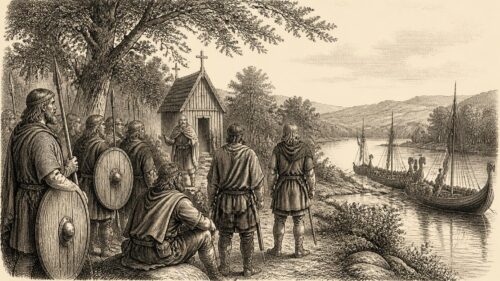
Glendalough was also violated by a raid led by Cellach mac Briain. The Annals of Tigernach report that he entered Cóemgen’s termonn, carried away many cattle and killed sixty members of the settlement’s community. A termonn was protected ecclesiastical land, theoretically enjoying the peace of its founding saint. Attacking it therefore combined material plunder with deliberate intimidation. Glendalough was not an isolated retreat occupied only by contemplative monks: it was a substantial religious and economic settlement with dependants, livestock, workshops, cultivated land and connections to powerful Leinster families.
War on the Suir
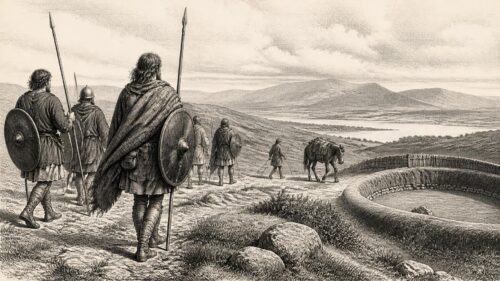
Another important encounter occurred near the River Suir. Forces from Osraige and eastern Munster, led by Mac Raith Ua Donnchada and Ua Donnocáin, king of Ára, raided Dún na Sciath, burned the stronghold and seized spoils. Carthach son of Saerbrethach then intercepted or pursued them and inflicted a defeat near the river. Ua Donnocáin was killed; the Annals of Inisfallen name him as Echthigern Ua Donnocáin. The fighting reflects competition along a strategic frontier where Osraige, Ára and Munster interests met. Rivers such as the Suir were communication routes, economic arteries and political boundaries, making their crossings and neighbouring strongholds natural points of conflict.
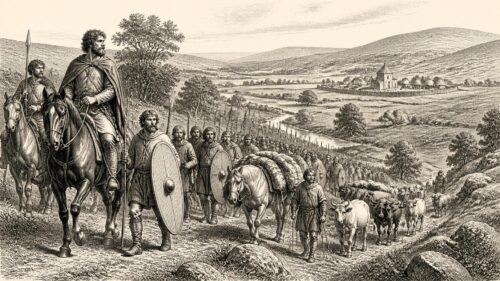
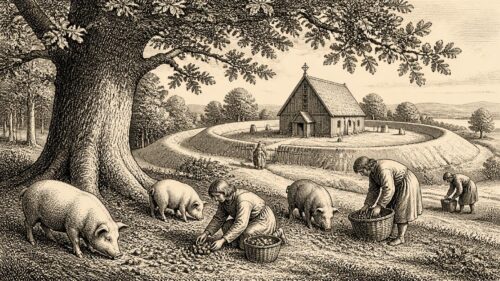
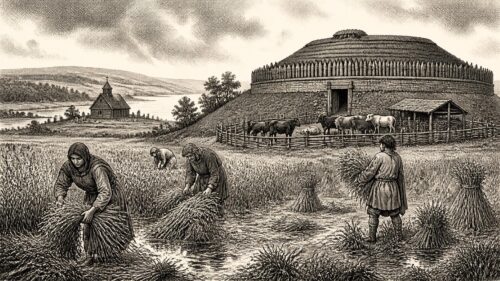
The episode also reveals the central place of cattle in warfare. The raiders at Glendalough took cattle, and the forces at Dún na Sciath sought movable booty. Livestock supplied meat, milk, hides and traction, but cattle were also measures of wealth, tribute and compensation. Removing a herd damaged both the immediate food supply and the social standing of its owner. Archaeological evidence for early medieval Ireland confirms an economy dominated by mixed farming, especially cattle husbandry, although sheep, pigs, grain cultivation, fishing and craft production were also important.
Conflicts in the North
In southern Ulster, Flann Ua hAinbíth, king of Uí Méith, was killed by the Ua Cerbaill ruler of Fernmag. The same year, Annud Ua Ruairc led a plundering expedition across Louth, Dromiskin and the territory of Conaille Muirthemne. These districts contained prosperous farmland, routeways and important churches. According to the Annals of Tigernach and the Four Masters, Annud was subsequently killed by a son of Art Beag. The chroniclers interpreted this as the swift vengeance of Mochta and Rónán, the saints whose territories had been violated. Their explanation expresses the ecclesiastical conviction that saints remained active protectors of their churches and dependants.
Farther west, the Cenél Eógain and Cenél Conaill fought at Termonn Dá Beócc. The Annals of Ulster and Annals of Tigernach agree that Cenél Eógain defeated Cenél Conaill, whereas the seventeenth-century Four Masters reverses the result. The agreement of the earlier annalistic traditions makes the Cenél Eógain victory more probable, but the contradiction should be acknowledged. Both dynasties belonged to the northern Uí Néill and competed for influence across the north-west. Once again, the battlefield was associated with a saint’s protected territory, demonstrating how frequently ecclesiastical lands became entangled in secular rivalries.
The Power of Saints
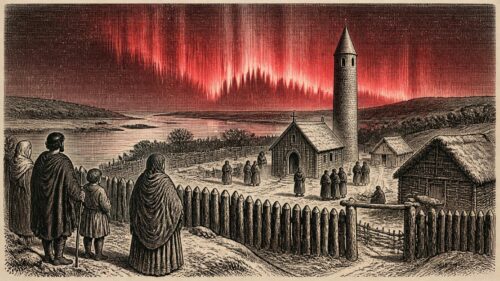
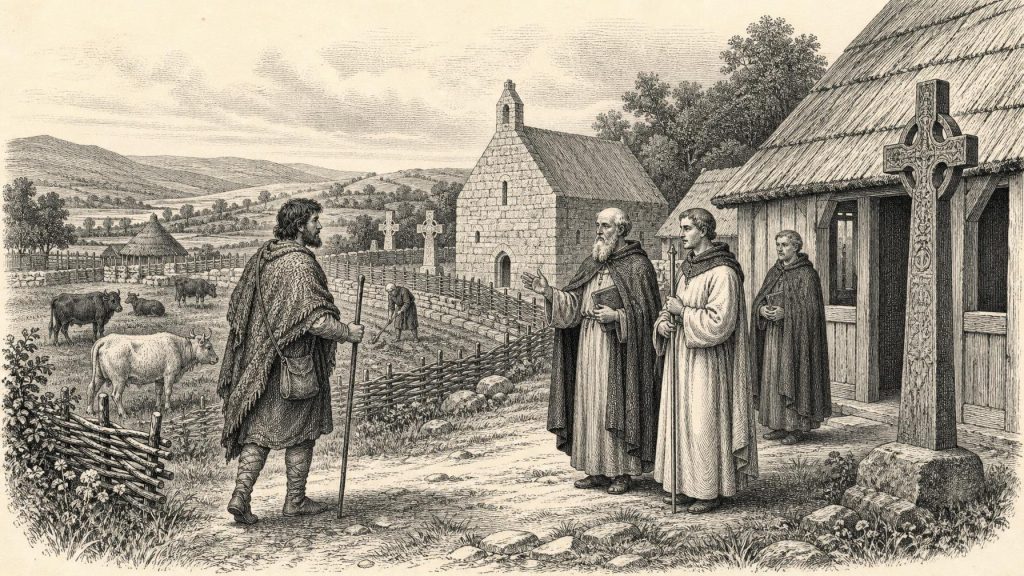
The most vivid ecclesiastical episode concerned Aed Ua Con Fhiacla, king or sub-king of Tethba. The community of Ciarán fasted against him at Tulach Garba. They rang Ciarán’s bell, the Bernán Ciaráin, and employed the Bachall Ísu, the ‘Staff of Jesus’, in a solemn ritual of denunciation. When Aed turned his back upon the clerics, the annals say, he was beheaded in that same place within a month, either by Muirchertach Ua Máel Sechnaill or by the men of Mide under his authority.
Such fasting was a public and socially forceful appeal for justice, not simply private devotion. A community might fast against a ruler who had violated its rights, refused restitution or ignored ecclesiastical judgement. Bells, staffs and other relics embodied the authority of founding saints and could be carried into negotiations, oath-taking or confrontations. The annalists’ presentation of Aed’s death as supernatural punishment also served a practical warning: rulers who challenged a major church risked political isolation as well as divine anger.
Pilgrimage and Learning
Cathal son of Ruaidrí, king of western Connacht, died at Armagh while on pilgrimage. His journey from the west to Patrick’s principal Irish church demonstrates Armagh’s island-wide attraction and the mobility of the political elite. Pilgrimage could express penitence, devotion or preparation for death, while also strengthening relations with an influential ecclesiastical centre. Cathal’s death is one of the few events repeated across the Annals of Ulster, Tigernach, Inisfallen, Loch Cé and the Four Masters, giving it unusually strong chronological support.
Several senior churchmen also died. Flaithbertach, bishop of Dún Lethglaise, or Downpatrick, is recorded by multiple chronicles. Cellach Ua Cléircíne, successor of Finnian and Mo-Cholmóc, and the superior associated with Ferns and Tech Moling also died. The Four Masters additionally name Aedán Connachtach, an anchorite and lector of Roscommon. The title lector indicates organised teaching and scriptural scholarship. Even the annals’ notation that 1 January fell on a Saturday, with the moon in its sixteenth day, reflects the learning required for calendars, liturgy and Easter calculation.
Religious settlements were nevertheless exposed to attack. The Annals of Inisfallen uniquely record that Clonfert of Brendan was plundered by the Calraige in 1043. Churches accumulated livestock, stored produce, precious metalwork and the offerings of patrons and pilgrims, making them attractive targets. Their populations included clerics, students, craftspeople, tenants, servants and visitors. The conventional distinction between ‘monastic’ and ‘secular’ settlement can therefore be misleading: major churches were centres of landholding, production, learning and political influence.
Life Beyond the Annals
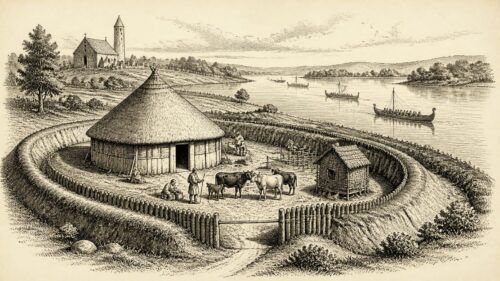
The chronicles say little about ordinary households, women, children or seasonal labour unless disaster brought them into an elite narrative. Archaeology supplies a broader picture. Most people lived in dispersed farmsteads, ringforts, open settlements or crannógs, raising animals and cultivating cereals. Timber, wattle, thatch, leather, bone and iron shaped everyday material life. Local churches formed focal points for worship, burial, exchange and identity, while roads, rivers and customary hosting places connected otherwise scattered communities.
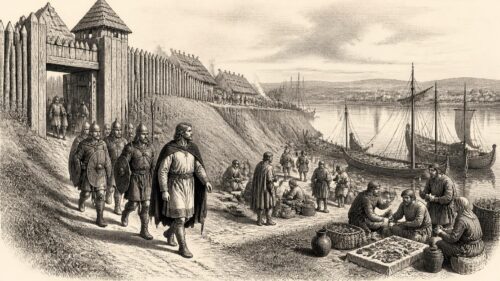
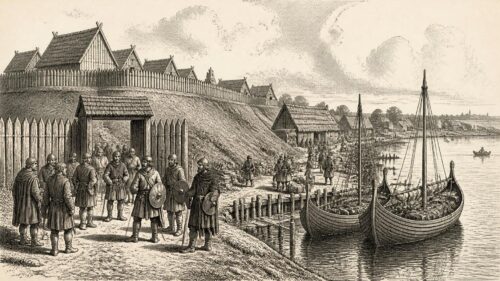
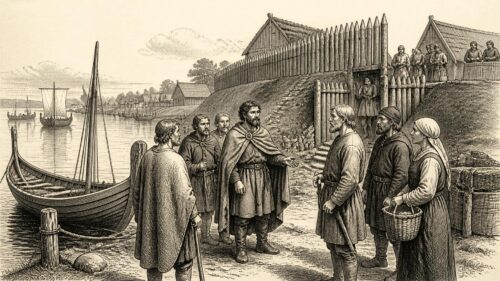
Ireland’s coastal towns also formed part of this world, although Dublin, Waterford, Wexford, Cork and Limerick are not prominent in the surviving entries for 1043. Hiberno-Norse merchants and craftspeople linked Ireland to Britain and continental Europe. Silver bullion and coins circulated alongside the cattle-based economy, and Dublin had produced silver pennies since the late tenth century. Urban workshops manufactured metalwork, combs, textiles and wooden objects, while imported pottery, stone vessels, amber and other goods reveal extensive maritime contacts.
No major building, manuscript or urban foundation can be securely assigned to 1043 itself. What the evidence does show is a year shaped by regional competition, cattle-raiding, contested sanctuaries and the formidable moral authority of churches. The annals preserve the deeds of kings, but they also reveal communities defending their lands through relics, ritual and historical memory. In that combination of warfare and devotion, 1043 offers a characteristic glimpse of an Ireland whose political fragmentation did not prevent far-reaching networks of pilgrimage, learning, trade and ecclesiastical power.
Primary Sources
- The Annals of Ulster: Year U1043
- Annals of Tigernach
- Annals of Inisfallen: AI1043
- Chronicon Scotorum
- Annals of the Four Masters: M1043
- Annals of Loch Cé
- Chronological Synchronisation of the Irish Annals
- Diarmait (Diarmait mac Maíl na mBó)
- Donnchad, Son of Brian
- Donnchad, Son of Gilla-Pátraic
- The Origins of the Lordship of Leinster and the Role of William Marshal: Perceptions and Reality
- Kingship, Lordship, and Resistance: A Study of Power in Eleventh- and Twelfth-Century Ireland
- Early Medieval Ireland, AD 400–1100: The Evidence from Archaeological Excavations
- Theme and Variations: Christianity and Regional Landscapes in Early Medieval Ireland
- Local Churches and Social Power in Early Medieval Ireland: A Case Study of Fir Maige
- Reflections on Kingship, the Church and Viking-Age Silver in Ireland
- Viking Collections
- 950–1450: Vikings, Normans and Medieval Mints
- Early Medieval Collections
- Glendalough Monastic Site and Visitor Centre
- High Crosses
- Medieval Ireland: Territorial, Political and Economic Divisions
- Animals and the Economy of Medieval Ireland: A Zooarchaeological Analysis of the Faunal Remains from Caherconnell Cashel, Co. Clare