Snám Aignech’s Three Nights852 CE
In 852, rival Viking fleets fought for three days at Snám Aignech, probably Carlingford Lough. Annals disagree over leaders, numbers and victors, but confirm a major struggle between competing overseas groups. Raiders from Linn Duachaill devastated Armagh, Ireland’s foremost Patrician church, while later tradition describes some local collaboration. That year also saw deaths of Armagh’s rival coarbs, Forannán and Diarmait, complicating recovery. Elsewhere, Cianachta defeated foreigners in eastern Brega. The evidence depicts contested coastal waters, vulnerable yet resilient ecclesiastical centres, local resistance, and fragmented Irish politics under Máel Sechnaill across a predominantly rural society, rather than outright conquest or collapse.
Dateline
A Year of Contested Waters
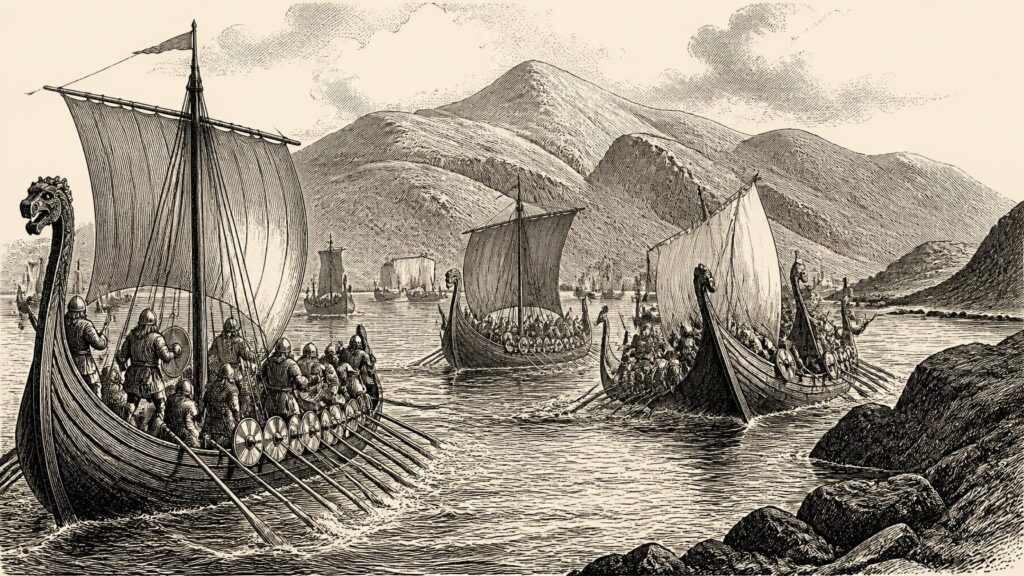
The clearest Irish record for 852 is not a battle between an Irish king and a Scandinavian raider, but a struggle among rival Viking forces. At Snám Aignech, generally identified with Carlingford Lough on Ireland’s north-eastern coast, a large fleet of Finngenti, or ‘fair foreigners’, arrived to fight the Duibgenti, the ‘dark foreigners’. The Annals of Ulster gives the striking figure of eight score ships—160—and says that the fighting lasted for three days and three nights. The dark foreigners prevailed; their opponents abandoned their ships, while Stain escaped and Iercne was beheaded.
The vocabulary should not be treated as a simple ethnic map. Later writers and modern readers have often rendered the two labels as Norwegians and Danes, but the annalists’ colour terms were political descriptions applied to competing groups, not reliable proof of every fighter’s homeland. The scale of the confrontation is more secure than its exact composition. In 852, Irish coastal waters and estuaries were not merely routes used by raiders from outside: they were contested military spaces in which rival overseas forces sought bases, ships, followers and access to Ireland’s wealth.
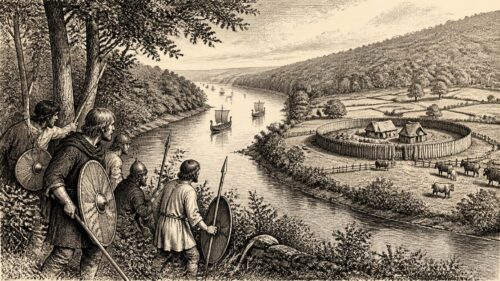
Snám Aignech was an especially important setting for such a contest. Carlingford Lough opens between the Cooley Peninsula and the Mourne coast, with access towards the Irish Sea and routes inland through the north-east. The annals had already associated this waterscape with Viking activity, and the later evidence suggests that it remained strategically useful. Yet no excavated fortification can be confidently assigned to the combatants of 852. It is safest to describe the lough as a place where fleets could assemble, anchor and threaten neighbouring districts, rather than to picture a known permanent camp at a precisely located point.
Conflicting Accounts, Shared Violence
Another near-contemporary annalistic tradition, preserved in the Fragmentary Annals of Ireland, also places a clash at Snám Aignech in 852, but tells it differently. It names Zain and Iargna as leaders of a Norwegian fleet and gives their force as seventy ships. More importantly, it says that the Danes were defeated. That reverses the outcome reported in the Annals of Ulster and Chronicon Scotorum, which state that the dark foreigners won.
This disagreement matters. It is not a licence to select the more dramatic version, nor does it make the battle imaginary. Several Irish chronicles independently preserve a major encounter at the same place and in the same year. What remains uncertain is the fleet’s precise size, the identities behind the colour labels, and which side left the field in possession of the ships. The Fragmentary Annals is a valuable but later and more literary compilation, with a particular interest in narrative and royal politics. For the basic outline, the briefer Ulster and Clonmacnoise-related notices deserve greater weight; for names and the fuller story, caution is essential.
Even so, the event reveals the disruption caused by rival maritime powers. Ships were expensive concentrations of labour, timber, iron fittings, sailcloth, weapons and trained crews. To lose them meant more than losing a battle: it meant losing mobility, carrying capacity and the ability to extract food, livestock, valuables or captives from vulnerable coastal communities. The abandoned vessels at Snám Aignech therefore represent a significant transfer of resources, though the annals do not say how many ships were captured intact or what became of them afterwards.
Armagh Under Attack
While fleets fought on the coast, Ard Macha—Armagh—was laid waste by the ‘foreigners of Linn Duachaill’, according to the Annals of Ulster. The annalist dates the attack to the day after Summer-Lent, preserving an unusually close seasonal marker even though it does not describe the destruction in detail. Linn Duachaill, near Annagassan on the Co. Louth coast, had been a Viking base since the early ninth century. From there, raiders could move along the coast and into the river systems of the north-east.
Armagh was no isolated church. It was the principal church associated with Patrick, a centre of ecclesiastical authority, learning, writing and political negotiation. Its religious standing gave its leaders influence far beyond its immediate lands; its accumulated movable wealth and stores made it attractive to attackers. To ‘lay waste’ the settlement need not mean that every building was destroyed or that institutional life ceased. Medieval annalists could use such language for severe plunder and devastation. But the notice makes plain that a leading ecclesiastical community had been successfully struck in 852.
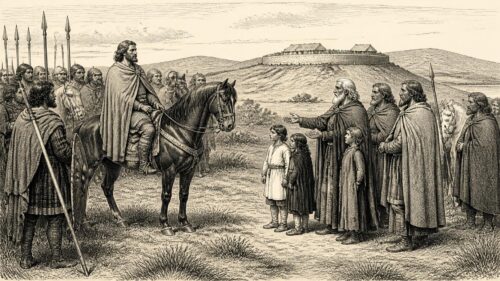
The Fragmentary Annals adds a morally charged detail: it says that many people abandoned Christian baptism, joined the Norwegians and helped plunder Armagh, though some later did penance and made restitution. This cannot be accepted uncritically as a literal count or a transparent account of motive. Its language reflects a Christian writer’s concern with apostasy and repentance. Yet it usefully warns against an overly simple picture of Irish Christians and foreign pagans standing in fixed opposing camps. Local people could be coerced, recruited, allied with seaborne groups, or profit from disorder; political allegiance, religious identity and material interest did not always coincide.
The Passing of Patrick’s Successors
The attack on Armagh came in a year of exceptional transition for its leadership. The annals record the deaths of Forannán and Diarmait, both described as successors of Patrick and bishops of Armagh. Forannán was also a scribe and anchorite; Diarmait was praised in the Latin of the annals as the wisest of all the teachers of Europe. Such superlative language is conventional, but it still indicates Diarmait’s standing as a learned churchman within an Irish scholarly world connected by Latin literacy and travel to Britain and the Continent.
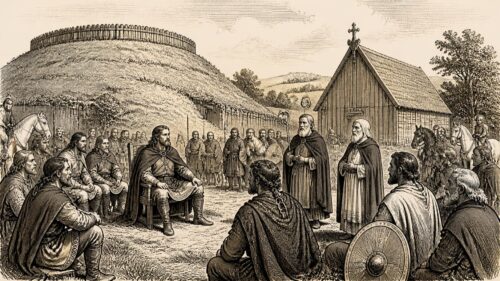
The pair’s simultaneous commemoration reflects the complicated ecclesiastical politics of Armagh. They had been rivals for control of the community before reaching an accommodation, and both had participated in wider political and religious affairs. Only the previous year, 851, a royal meeting had been held at Armagh involving Máel Sechnaill, king of Tara, Matudán of Ulaid, leading clerics of Patrick’s congregation and representatives of Mide. That gathering is not an event of 852, but it is indispensable context: Armagh’s authority was a resource sought by kings as well as churchmen.
Forannán and Diarmait died in the same year that Armagh was raided. The sources do not say that either death resulted from the attack, and no such connection should be invented. Their loss nevertheless compounded a difficult moment. The community had to maintain worship, preserve books and relics, administer estates and sustain its claims to Patrician pre-eminence while recovering from plunder and adjusting to a new leadership.
Power Beyond the Lough
Other notices show that violence was not confined to the northern coast. The Annals of Ulster records that the people of Cianachta inflicted two defeats on foreigners in eastern Brega, at islands in the region and at Ráith Alláin, within the same month. The places are in the wider zone north of the lower Boyne, close to the eastern midlands and their routes to the sea. The entries are brief, but their paired form suggests concerted local resistance rather than a single accidental encounter.
This was territory in the orbit of Máel Sechnaill mac Máele Ruanaid, the powerful Clann Cholmáin ruler whose position as king of Tara rested on alliances, submissions and military reach rather than on a modern central state. His authority did not eliminate local kingship. Airgialla, for example, lost its king Fogartach son of Máel Bresail in 852, while Cathal son of Dubán, king of Uí Duach in Argat Ros, also died. The annals do not attribute either death to battle, but their notices remind us that the political landscape remained densely divided among regional dynasties, churches and lesser lordships.
A later compilation, the Annals of the Four Masters, places a Munster expedition by Máel Sechnaill in 852 and links resistance there to foreign influence. As that work was compiled centuries after the events and its chronology diverges from the earlier annals around these years, the campaign should not be treated as securely dated evidence for this calendar year. The safer conclusion is narrower: in 852 Máel Sechnaill remained a dominant figure in Irish politics, but the surviving contemporary notices concentrate on the northern and eastern disturbances rather than on a documented all-island campaign.
Life in a Disturbed Landscape
For most people, 852 was lived not in annalistic sentences but in farmsteads, small settlements and ecclesiastical estates. Ireland remained overwhelmingly rural. Cattle, grain, dairying, fishing and local craft underpinned life, while churches and monasteries acted as places of worship, landholding, production and learning. Armagh’s raid demonstrates why such communities were targets: they concentrated portable valuables, food stores, skilled personnel and political influence. But their economic and social role also made recovery necessary. A church centre could not simply be abandoned if surrounding households depended upon it for ritual, protection, exchange and authority.
The year’s evidence therefore gives no basis for declaring either an Irish collapse or a Viking conquest. It shows a more unsettled reality. Rival fleets could fight for control of a lough; raiders from an established base could strike Ireland’s leading church; local groups in Brega could kill foreigners; and ecclesiastical institutions could endure political rivalry and leadership change. In 852, the sea connected Ireland to a violent Scandinavian world, but Irish rulers, communities and churchmen were active participants in shaping what that connection meant.
Primary Sources
- Part 422 of The Annals of Ulster
- Part 84 of Chronicon Scotorum
- Fragmentary Annals of Ireland
- Vikings in Irish Chronicles, 794–902 – Data
- Part 68 of Annals of the Four Masters
- Forannán
- Máel-Sechnaill
- The Vikings in ninth-century Ireland: Sources and settlements
- The Vikings in Ulaid
- Vikings in Early Medieval Ireland: Church-Raiding, Politics and Kingship
- Early Medieval Ireland
- Viking
- Early Medieval
- Annals of Inisfallen
- Annals of Inisfallen: Bibliography and Annal Index
- Exploring the Irish Annals
- Early Christian Monasteries
- Early Irish Monasticism
- Churches and Ecclesiastical Enclosures / Shéipéil agus Ráthanna
- List of Published Texts at CELT