Patrick’s Law and Murchad767 CE
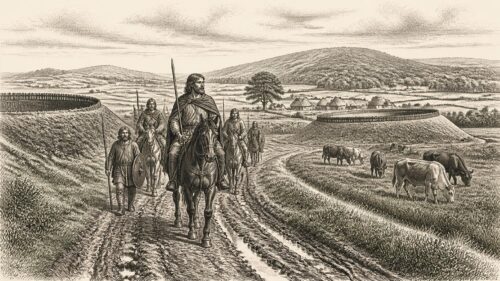
In 767, reconstructed from chronologically problematic annalistic entries, Ireland’s surviving record highlights political violence, ecclesiastical succession and sacred law. Murchad son of Flaithbertach, king of Cenél Conaill, was killed, weakening a northern Uí Néill lineage already eclipsed by Cenél nÉogain under Tara’s king, Niall Frossach. Cellach son of Cairpre died at a robber’s hands, while Flathgus son of Fiachra was treacherously slain. The annals also record abbots’ deaths, demonstrating churches’ religious, economic and political importance. Patrick’s law, probably a proclamation of Cáin Phátraic linked to Armagh and royal authority, asserted a moral order, though its provisions and enforcement remain unknown.
Dateline
For Ireland, 767 is a year best approached through a short but revealing annalistic record. The surviving notices do not offer a continuous narrative, nor do they describe battles, assemblies or journeys in detail. Instead, they register a northern king’s killing, several violent deaths, the passing of important churchmen and the enforcement of Patrick’s law. Taken together, those entries expose the foundations of power in eighth-century Ireland: dynastic rank, control of territories and client groups, ecclesiastical authority, and the capacity of saints’ cults to give political agreements a sacred force.
A Year Recovered From the Annals
The dating needs care. In the manuscript sequence of the Annals of Ulster, the entries concerned appear under U767 but are supplied with an annus Domini figure equivalent to 766. This is part of a known chronological problem in the Ulster annals before the eleventh century. Modern synchronisation of their kalends and related annalistic evidence places this cluster in 767 CE. The result is a responsibly dated year, but not one in which the month or day of any Irish event can be recovered. The annals tell us that certain things happened in 767, not precisely when within the calendar they occurred.
That distinction matters because later compilations sometimes assign dramatic material to neighbouring years or reshape older records. The most secure account for 767 therefore remains deliberately narrow. It centres on the killing of Murchad son of Flaithbertach, king of Cenél Conaill; the killings of Cellach son of Cairpre son of Fogartach and Flathgus son of Fiachra son of Cathal; the deaths of a number of abbots and ecclesiastics; and the terse statement, Lex Patricii, “Patrick’s law”. These notices are small in scale, but they belong to a world in which the affairs of ruling families and churches were closely interwoven.
Murchad of Cenél Conaill
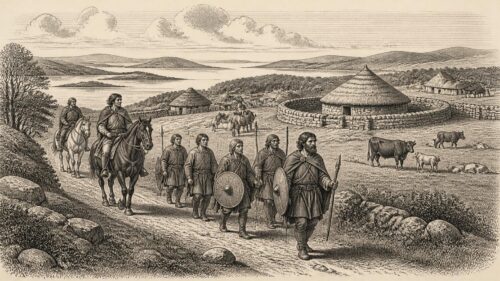
The year’s foremost secular death was Murchad’s. He was king of Cenél Conaill, the powerful northern branch of the Uí Néill whose heartland lay in what is now County Donegal. Murchad’s father, Flaithbertach son of Loingsech, had once held the paramount Uí Néill kingship associated with Tara before withdrawing from active rule; he died in religious life in 765. Murchad therefore represented a family with an imposing political inheritance, even if he was recorded only as king of Cenél Conaill rather than as king of Tara or king of all Ireland.
The annal merely says that Murchad was killed. It gives neither place, attacker nor motive, and no responsible reconstruction can supply them. Yet his death had clear political significance. Cenél Conaill had been losing ground within the northern Uí Néill to its rival Cenél nÉogain. In 767, Niall Frossach of Cenél nÉogain was recognised as king of Tara, while Murchad ruled a more restricted north-western kingship. Murchad’s killing removed a mature representative of the older Cenél Conaill royal line at a time when Niall’s dynasty held the more prestigious position. It did not end Cenél Conaill, but it made succession and local authority more precarious in a region where royal kinship was itself a resource for power.
Ireland was not a unitary kingdom governed from one capital. Kingship worked through overlapping claims: a ruler commanded his own people, sought tribute or submission from neighbours, made alliances through marriage and fosterage, and depended on armed followers. A death within a royal kindred could alter those relationships at once. The killing of Murchad is thus not evidence for an island-wide civil war in 767; it is evidence of the persistent vulnerability of even high-ranking rulers within a competitive political order.
Violence Beyond the Kings
Two further killings reveal that insecurity was not confined to recognised kings. Cellach, son of Cairpre and grandson of Fogartach, was killed by a latro, translated by the annals’ editors as a robber. The word establishes the manner of his death more securely than the social identity or intention of the attacker. Flathgus, son of Fiachra and grandson of Cathal, was “treacherously killed”. Here again the annalist gives no location or explanation. “Treacherously” signals condemnation, perhaps an ambush, betrayal or killing outside accepted expectations, but it cannot safely be expanded into a named feud.
These concise notices show the annals’ priorities as much as they show the events themselves. They normally preserved deaths and killings of people whose descent, office or connections made them worth recording. They do not provide a count of ordinary crime or violence. Nevertheless, the different wording is important: Murchad was a king killed; Cellach died at a robber’s hands; Flathgus was slain treacherously. Early Irish political culture was not lawless, but public order depended on kin groups, compensation, lordship, sanctuary and recognised legal procedure rather than on a central police force. An unlawful death could have consequences far beyond its immediate victim.
Patrick’s Law
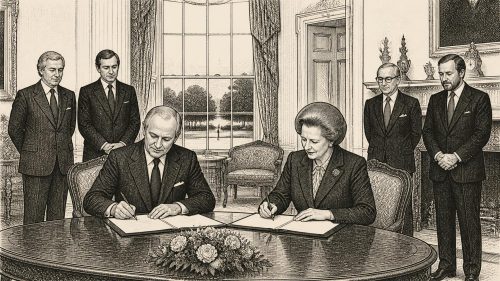
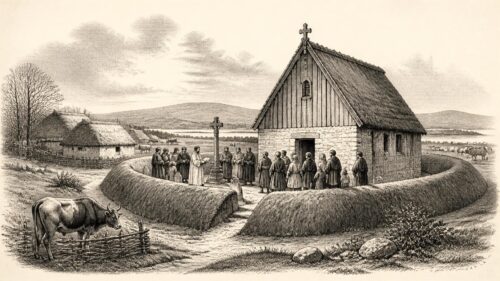
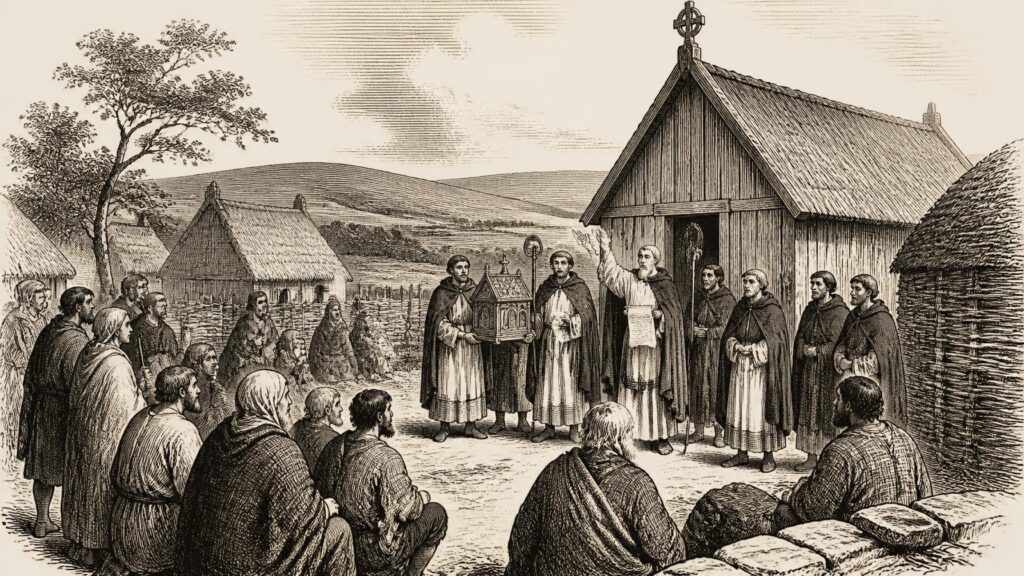
The most enigmatic entry of 767 is also among the most consequential: “Patrick’s law.” The phrase almost certainly refers to Cáin Phátraic, a sacred legal settlement associated with St Patrick and, by extension, with Armagh’s claims to special ecclesiastical authority. It should not be imagined as a surviving statute book enacted by a parliament. No text of the particular 767 proclamation survives, and the annal gives neither venue nor provisions. What can be said firmly is that the law was proclaimed or put into effect in a manner important enough to be entered beside royal killings and the deaths of abbots.
Earlier and later annals record comparable renewals of saintly laws. Such cána could combine rules of conduct, religious protection, penalties and the collection of dues or tribute. Their authority rested not simply on force, but on the prestige of a saint, the relics and churches attached to that saint, and the participation of kings. Scholarly discussion of the 767 notice reasonably connects it with Niall Frossach, king of Tara, and Fer dá Crích, the contemporary head of Armagh; this is a strong inference rather than information explicitly supplied by the annal. If so, the proclamation joined royal and Patrician authority at a moment when northern Uí Néill politics were in flux.
The juxtaposition is striking. Murchad’s killing demonstrated the fragility of dynastic power; Patrick’s law asserted that there was a sanctioned order extending beyond one kingdom or lineage. That did not mean every part of Ireland was directly administered from Armagh or Tara. The practical reach of such a law depended on local rulers and churches accepting it. But the very ideal of a Patrick-associated law offered a language through which powerful men could represent protection, peace and obligation as binding across political boundaries.
Churches and Their Networks
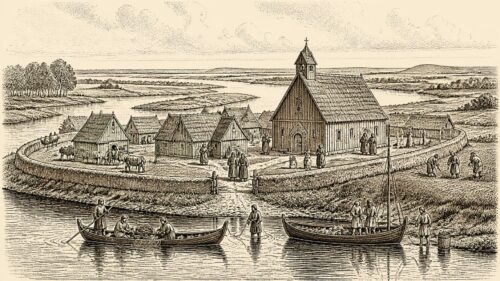
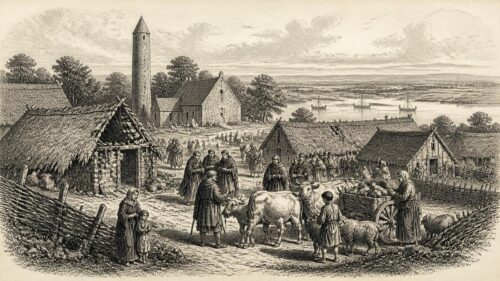
Ecclesiastical deaths make up much of the year’s surviving record. Conbrann, abbot of Cell Achaid, died; Fidbadach, abbot of Bennchor, rested; Dub dá Inber son of Cormac, abbot of Mainister Buiti, died; Sléibéne of Í, or Iona, died; Mac int Shair, abbot of Enach Dub, died; and Glaindibuir, abbot of Lathrach Briúin, died. The formulae vary, but the overall impression is of a densely connected Christian landscape in which senior offices mattered enough to be remembered.
Some sites can be located with confidence. Bennchor is Bangor in present-day County Down, while Mainister Buiti is Monasterboice in County Louth, a foundation associated with St Buite. Iona lay off the west coast of Scotland, not in Ireland, but it was central to the Gaelic ecclesiastical world and maintained deep connections with Irish churches and dynasties. The inclusion of Sléibéne among Irish annalistic notices is therefore unsurprising. Other named establishments are less securely identifiable, a useful warning against attaching modern map references where the evidence does not permit it.
An abbot’s role reached well beyond worship. Monasteries and churches managed land, livestock, food renders, tenants and guests; maintained religious observance; educated clerics; and in some cases supported writing and book production. Individual communities differed greatly in wealth and influence, and the annals do not tell us the scale of any one house in 767. Still, the concentration of obits shows that ecclesiastical succession was a matter of public concern. Leadership of a monastery could bring spiritual prestige, economic resources and political connections, especially where a church stood within the territory of a powerful dynasty.
What the Record Cannot Tell Us
For all its value, the record does not justify a richly detailed picture of daily weather, harvests or village life in 767. No securely dated Irish annal for this year reports famine, epidemic, unusual cold, flood or crop failure. Nor does it describe a market, a ship voyage, a building project or a battle involving the wider population. Most people continued to live in rural settlements, working mixed agricultural landscapes and owing obligations through family and lordship, but that is broader eighth-century context rather than a development documented specifically in 767.
The same caution applies to learning and art. Irish monasteries were important centres of literacy, Latin learning and the copying of religious books in this period. Yet the deaths of abbots in 767 do not prove that a particular manuscript was made, school opened or church built that year. The year is historically meaningful precisely because it demonstrates the limits as well as the strengths of medieval evidence. A few carefully preserved lines illuminate a society of kings, monasteries and sacred law; silence surrounds much else.
Authority Tested and Asserted
Thus 767 was not a year of one grand national event. It was a year in which authority was tested in several forms. Murchad’s death exposed the risks facing a royal house whose wider dominance had ebbed. Other killings reminded contemporaries that rank and lineage did not guarantee safety. The deaths of church leaders marked transitions in communities that were both religious institutions and holders of land, learning and influence. Above all, the enforcement of Patrick’s law articulated an alternative to fragmentation: a sacred framework through which kings and churchmen could seek to regulate conduct and proclaim a wider moral order. The annals leave the details obscure, but they preserve that central contrast with unusual clarity.
Primary Sources
- The Annals of Ulster, Year U767
- The Annals of Ulster
- Chronological Synchronisation of the Irish Annals
- The Annals of the Four Masters, Annal M767
- Flaithbertach
- Niall Frossach
- Donnchad Midi
- Domnall Midi
- Cellach
- Áed Oirdnide
- Eithne
- Cáin Adomnáin and Canones Adomnani
- The Early Mediaeval Gaelic Lawyer
- The Law of Patrick in the Annals of Ulster, Year U737
- Annals of Inisfallen, Annal AI842
- Annala Uladh: Annals of Ulster Otherwise Annala Senait, Annals of Senat
- CELT Project: The Annals of Ulster
- Monasterboice Monastic Site
- Irish School of Illumination, c. 650–1100
- High Crosses
- Exploring the Irish Annals
- Annales Hiberniae