Inis Eter Dá Dabul745 CE
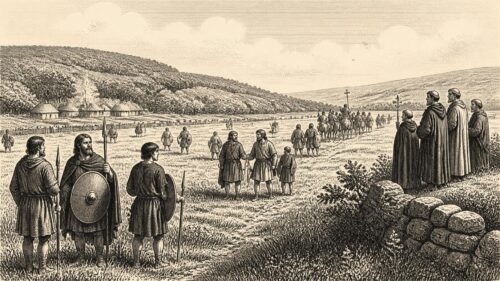
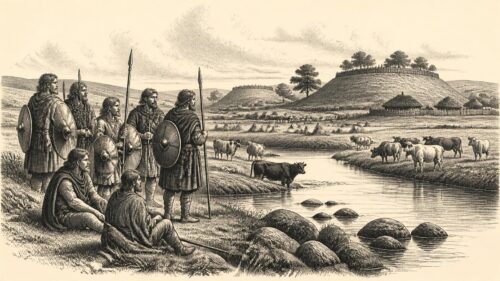
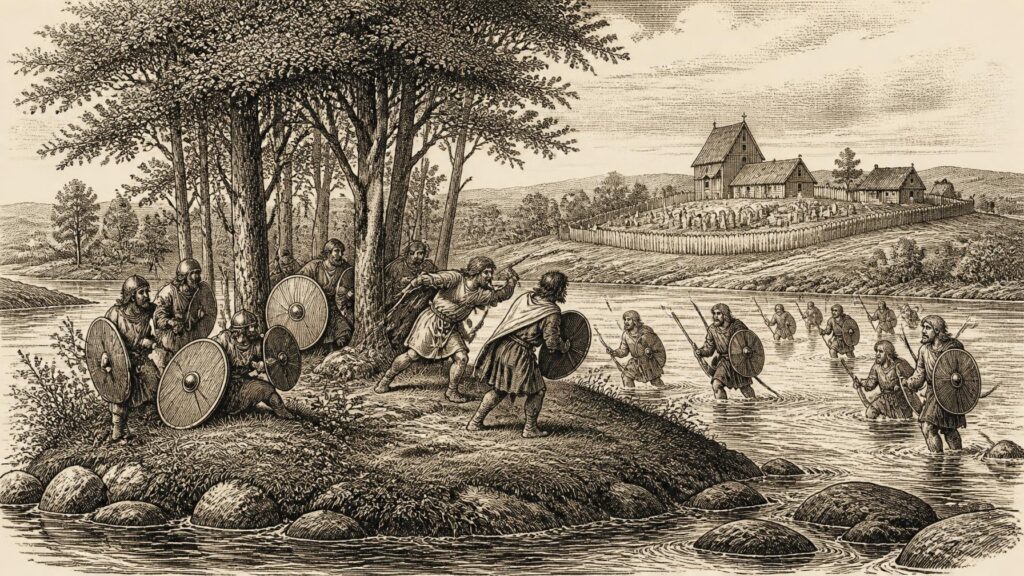
In 745, Irish annals recorded a battle at Inis eter dá Dabul between the Uí Thuirtri and Airthir. Congal son of Éicnech led the Airthir to victory; notable opponents were killed or fled. The conflict reflected shifting local power within Airgíalla, despite Domnall Midi’s wider kingship of Tara. The same annalistic year saw the deaths of abbots at Clonard, Lann Léire and Tech Taille, an anchorite, a church superior and the scribe Conall Foltchain. A remarkable night-time celestial sign was also reported. Together, these concise notices illuminate interconnected warfare, ecclesiastical leadership, learning, rural resources and belief in early medieval Ireland.
Dateline
In 745 CE, the Irish annals place a sharp but tightly bounded cluster of events before us: a night-time sign among the stars; a battle between neighbouring northern peoples; and the deaths of abbots, an anchorite, a scribe and a church superior. The fullest contemporary-style record does not offer a grand national narrative. Rather, it preserves what mattered to the communities that kept and transmitted such notices: the outcome of a local conflict, the passing of religious leaders and learned men, and an unusual phenomenon in the sky. These entries, assigned to 745 in both the Annals of Ulster and the Annals of Tigernach, make the year unusually revealing precisely because they connect politics, religion and learning at several points across Ireland.
A Year in the Annals
The evidence must be handled with care. The surviving manuscripts of these annals are later copies and compilations, not a bundle of dated reports written on the day of each occurrence. Their chronology can also present technical difficulties. Yet the agreement of the Annals of Ulster and the Annals of Tigernach is important: both record the same sequence under 745, including the battle, the celestial sign and the principal deaths. What they do not supply is equally important. There is no month, day or season for the fighting, no stated cause, no number of combatants, and no account of a royal settlement afterwards. The events can responsibly be placed in the annalistic year 745, but not more narrowly within its calendar.
The most substantial political notice is a battle between the Uí Thuirtri and the Airthir, or “Easterners”. Both were among the peoples associated with Airgíalla, the politically varied region centred broadly on what is now south Ulster and north midlands. Airgíalla was not a unified modern-style state. It comprised several kindreds and lordships, whose relationships with one another, with the Uí Néill and with the powerful churches of the north could shift with military success, kinship and patronage. A conflict between two such groups was therefore not a minor private quarrel: it could affect control of land, clients, tribute, church connections and access through contested country.
The Battle on the Island
The annals name the battlefield as Inis eter dá Dabul, “the island between two Dabul”. The place-name is evocative, suggesting a defended or geographically constricted landscape shaped by watercourses, but it should not be overinterpreted. The sources do not identify the two streams or rivers, describe an island fortification, or permit a confident reconstruction of the field of battle. A modern heritage inventory associates the annal’s name with a site in Mid Ulster; that association is valuable, but it does not turn the annal’s brief phrase into an excavated battlefield narrative.
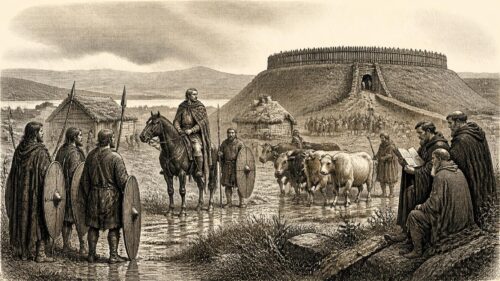
What is firm is the result. Congal son of Éicnech won for the Airthir. Cú Chongalt, described as the grandson of Cathusach, escaped in flight, while Bóchaill son of Conchobor and Ailill, also a grandson of Cathusach, were killed. The formula is typical of early Irish battle reporting: victory is attached to a named leader, survival or flight to a defeated notable, and death to men whose genealogy mattered. The casualty list should not be read as complete. It marks those whom the annalist or the annalist’s source regarded as politically memorable.
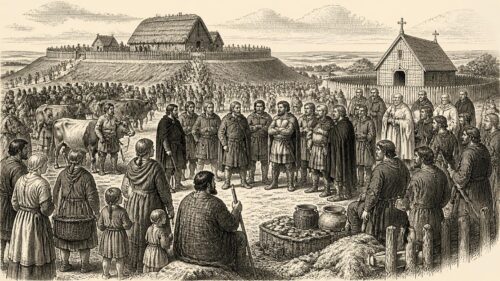
The conflict also shows the personal scale of authority. The annal does not say that an abstract territory conquered another territory; it names competing men and their kin. In a society divided into many small kingdoms and lordships, political power rested on households, client networks, cattle wealth, armed followings and claims of descent. Defeat could bring deaths, loss of status and altered obligations even where no permanent boundary changed. A later annal records Congal son of Éicnech himself slain in 748, a reminder that the winner of 745 did not thereby secure lasting safety. That later death does not explain the battle, but it places its victor’s success in the unstable world from which it emerged.
Power Beyond the Battlefield
At island-wide level, Domnall Midi of Clann Cholmáin was king of Tara in 745. He had defeated Áed Allán in 743 and held the pre-eminent kingship associated with Tara until 763. That did not mean that he governed Ireland through a central administration or that every battle required his intervention. The 745 notice contains no reference to Domnall, and it would be wrong to assign him responsibility for it. Instead, the clash between the Uí Thuirtri and Airthir demonstrates the limits as well as the reach of high kingship: substantial local rivalries continued within the wider political order while an overking in the midlands maintained his own alliances and ecclesiastical connections.
Deaths in the Churches
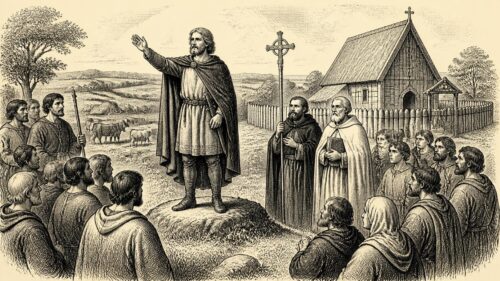
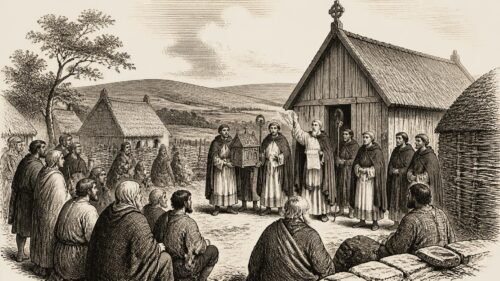
The annals record the death of Forannán, abbot of Cluain Iraird, the great monastery of Clonard on the Boyne; Congus, anchorite of Cluain Tibrinne; and Cuiméne descendant of Máenach, abbot of Lann Léire, later Dunleer in County Louth. These are not interchangeable titles. An abbot headed a major ecclesiastical community and its lands, dependants and religious obligations. An anchorite represented a more withdrawn devotional vocation, although an anchorite’s reputation could still matter greatly to a surrounding church. The same year also saw the deaths of Cenn Fáelad, “superior” of Druim Cuilinn, and Mac ind Fherthaigse, abbot of Tech Taille. The notices offer no causes of death and no named successors; they nevertheless indicate a moment of turnover among several established religious houses.
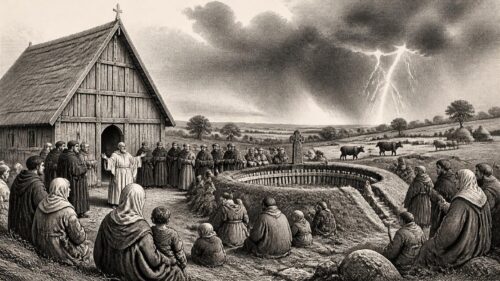
Clonard’s prominence gave Forannán’s death particular resonance. Founded in the sixth century and remembered as a centre of teaching, it stood in the Boyne region of the southern Uí Néill heartland. Lann Léire likewise had a long-lived ecclesiastical presence in the north-east; its name survives in Dunleer. Such centres were not secluded institutions apart from society. Early medieval monasteries and churches held livestock and crops, attracted tenants and visitors, offered worship and burial, maintained learned traditions and stood within networks of aristocratic patronage. Their leaders were thus figures of both spiritual and practical consequence. The concentration of deaths in 745 need not indicate a shared crisis—no source says that it does—but it did create occasions for succession, negotiation and the renewal of local alliances.
Writing, Work and Resources
One of the year’s shortest notices is among its most suggestive: the death of Conall Foltchain, “Conall of the beautiful hair”, identified simply as a scribe. The designation is significant. A scribe copied and preserved texts, but writing also underpinned the intellectual life in which saints’ cults, genealogies, legal learning, Latin scholarship and annalistic memory circulated. Nothing permits us to identify Conall’s home institution or surviving work. Still, his inclusion beside abbots and political casualties shows that scribal status itself merited commemoration. In 745, literacy was concentrated in ecclesiastical and learned settings, yet its effects reached far beyond them by recording pedigrees, transactions, religious authority and the remembered past.
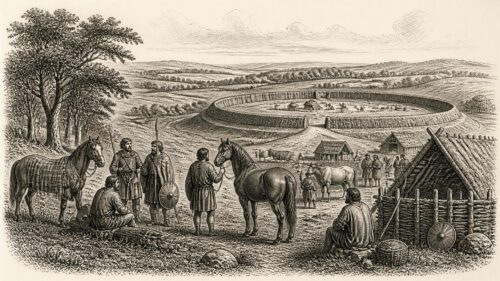
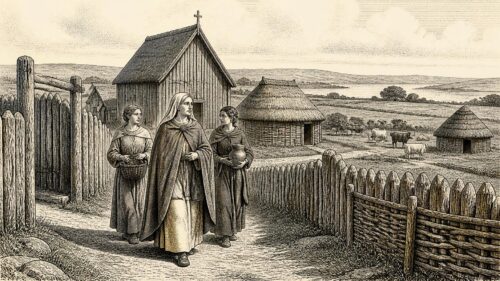
The wider material setting was overwhelmingly rural. Most people lived in dispersed farmsteads, often within ringforts or stone cashels, working mixed pastoral and arable economies. Cattle remained fundamental to wealth, status and exchange, while crops, milling and grain drying mattered increasingly. Monastic establishments participated in that economy rather than standing outside it: their enclosures could include worship spaces, dwellings, workshops, storage, fields and cattle. The battle of 745 and the deaths of church leaders therefore belonged to the same social landscape. Political followings required food and livestock; churches depended on landed resources and labour; learned communities needed patrons and material support in order to maintain books and schooling.
The Sign in the Stars
Before its notices of death and battle, the annal records that “a horrible and wonderful sign was seen in the stars at night”. This is securely an observation reported under 745, but its physical identity is not. The wording does not establish a comet, aurora, meteor shower or any other particular event, and no modern astronomical label should be imposed upon it. Its importance lies in how it was received: the observer or source considered it alarming and marvellous enough to enter the historical record. For Christian annalists, striking phenomena in the heavens could be signs demanding attention, prayer and interpretation, even when no explicit meaning was written down.
Thus 745 is best understood not as a year dominated by a single island-wide upheaval, but as a documented moment of transition and contest. At Inis eter dá Dabul, an Airthir leader gained a hard-won victory over the Uí Thuirtri. At Clonard, Lann Léire and other religious communities, respected office-holders died. The death of a scribe records the continuing value of learning, while an unexplained light or sign in the night sky entered collective memory. The annals leave many questions unanswered, but their restraint is itself instructive: early medieval Ireland was made up of interlocking local worlds, where warfare, land, churches and writing all helped determine whose names would endure.
Primary Sources
- The Annals of Ulster, Year U745
- The Annals of Ulster, Year U745 (diplomatic text)
- CELT Project: The Annals of Ulster
- The Annals of Tigernach
- CELT Project: The Annals of Tigernach
- Annals of the Four Masters, Part 57
- CELT Project: Annals of the Four Masters
- Domnall Midi
- Early Medieval Ireland, AD 400-1100: The evidence from archaeological excavations
- Agriculture, settlement and society in Early Medieval Ireland
- Farming and Archaeology: The Irish Historic Landscape
- Clonmacnoise, County Offaly
- County Louth Urban Archaeology Survey: Dunleer
- MUDC211: Position Paper – Environmental Assets
- Caherlehillan
- Early Christian Monasteries
- Patrician and Early Christian Architecture
- Christian Ireland, 5th–8th Centuries
- Archaeological Survey
- Annals of Tigernach, NLW MS 4655E
- The Annals Attributed to Tigernach